Inspiration
Professionals and small teams lose a surprising amount of time deciding which opportunities are actually worth their attention: grants, competitions, accelerator programs, funding calls, and professional programs.
The difficult part is not finding a link. It is reading the official rules, checking eligibility, understanding deadlines and restrictions, estimating the work required, and deciding whether to act.
QUALOR was built to make that process faster, evidence-based, and safer.
What it does
QUALOR is an autonomous opportunity intelligence agent.
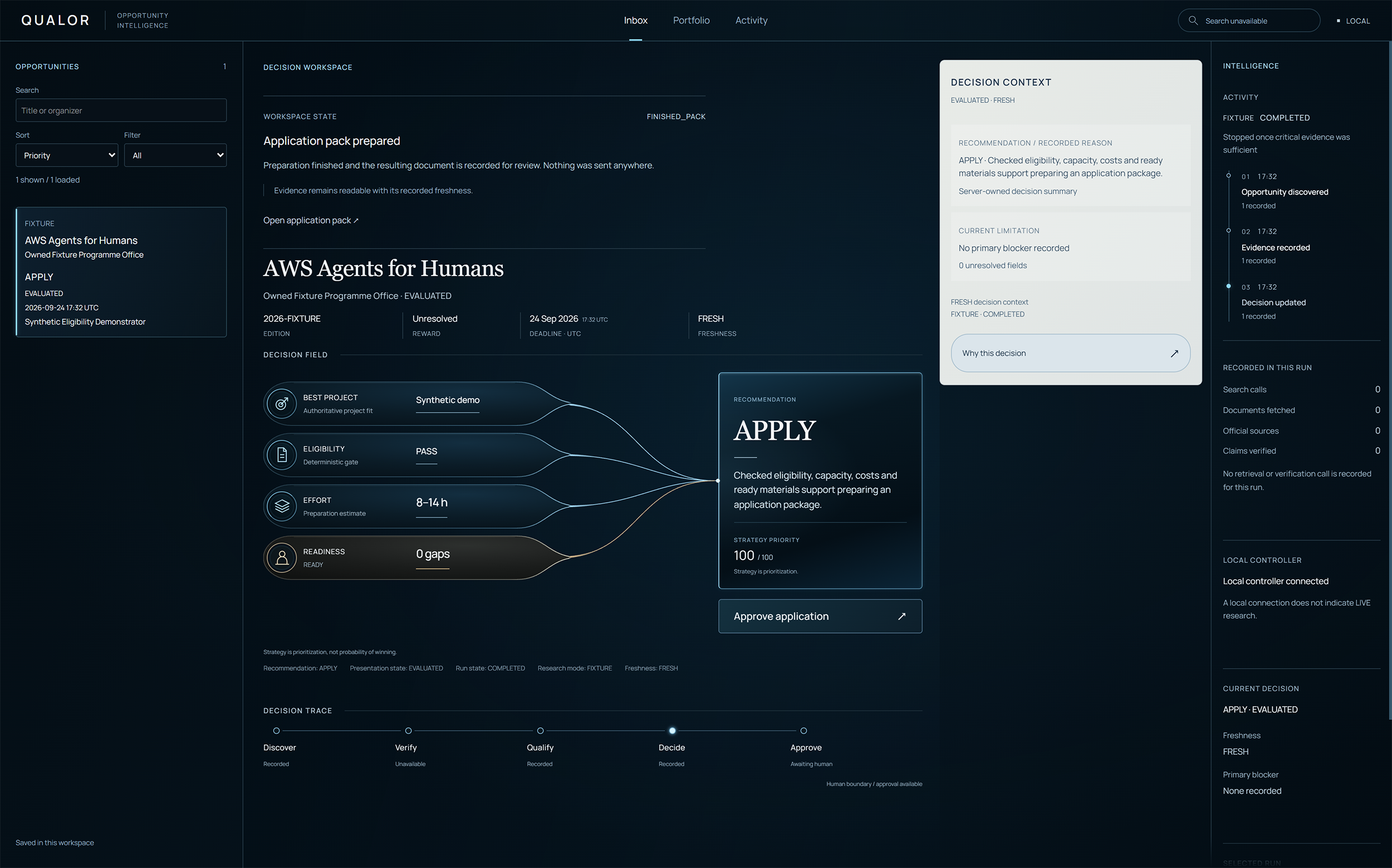
It researches official sources, extracts relevant rules and evidence, and turns them into a structured decision:
- eligibility
- readiness gaps
- estimated effort
- strategic priority
- a clear recommendation such as PREPARE or APPLY
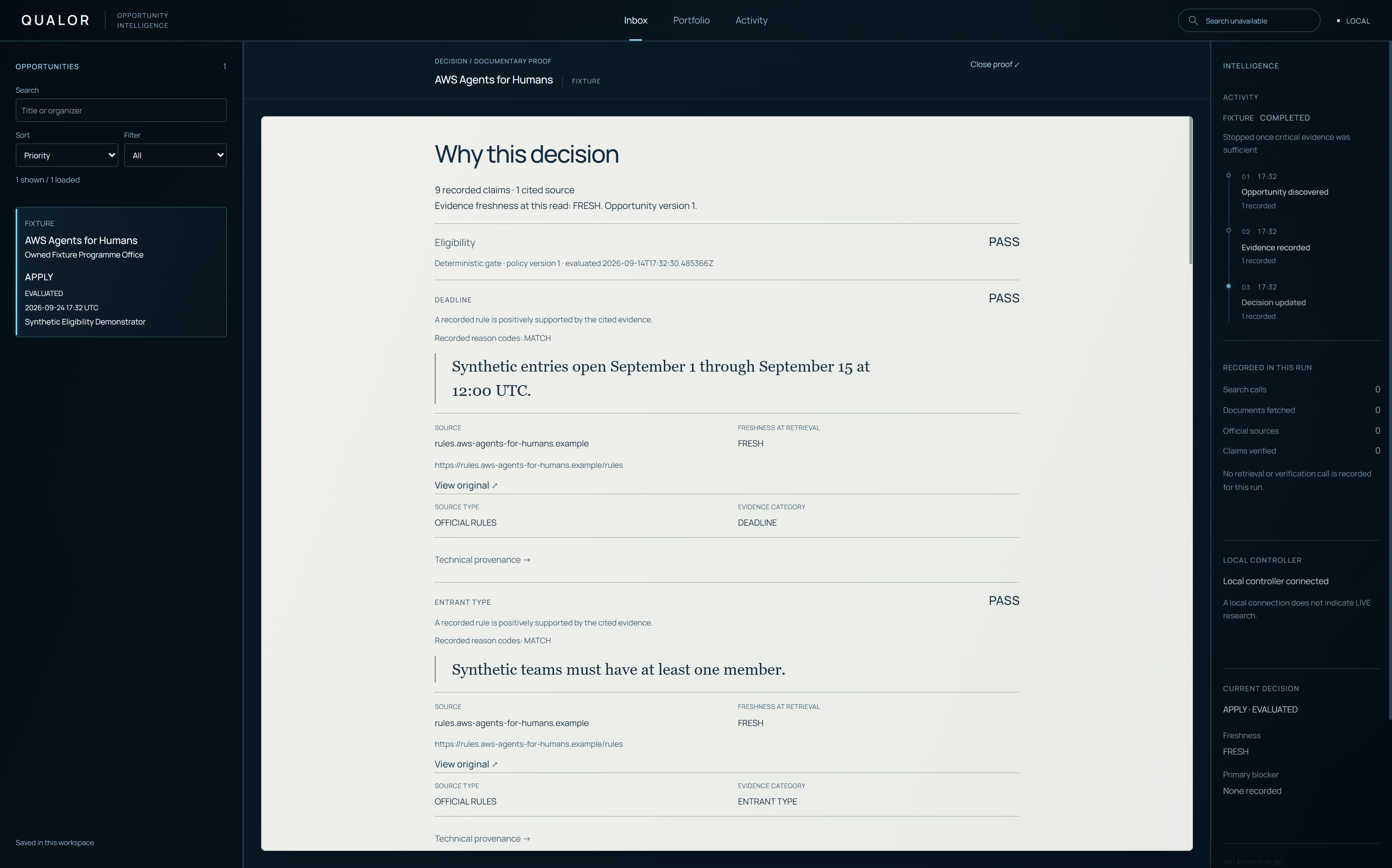
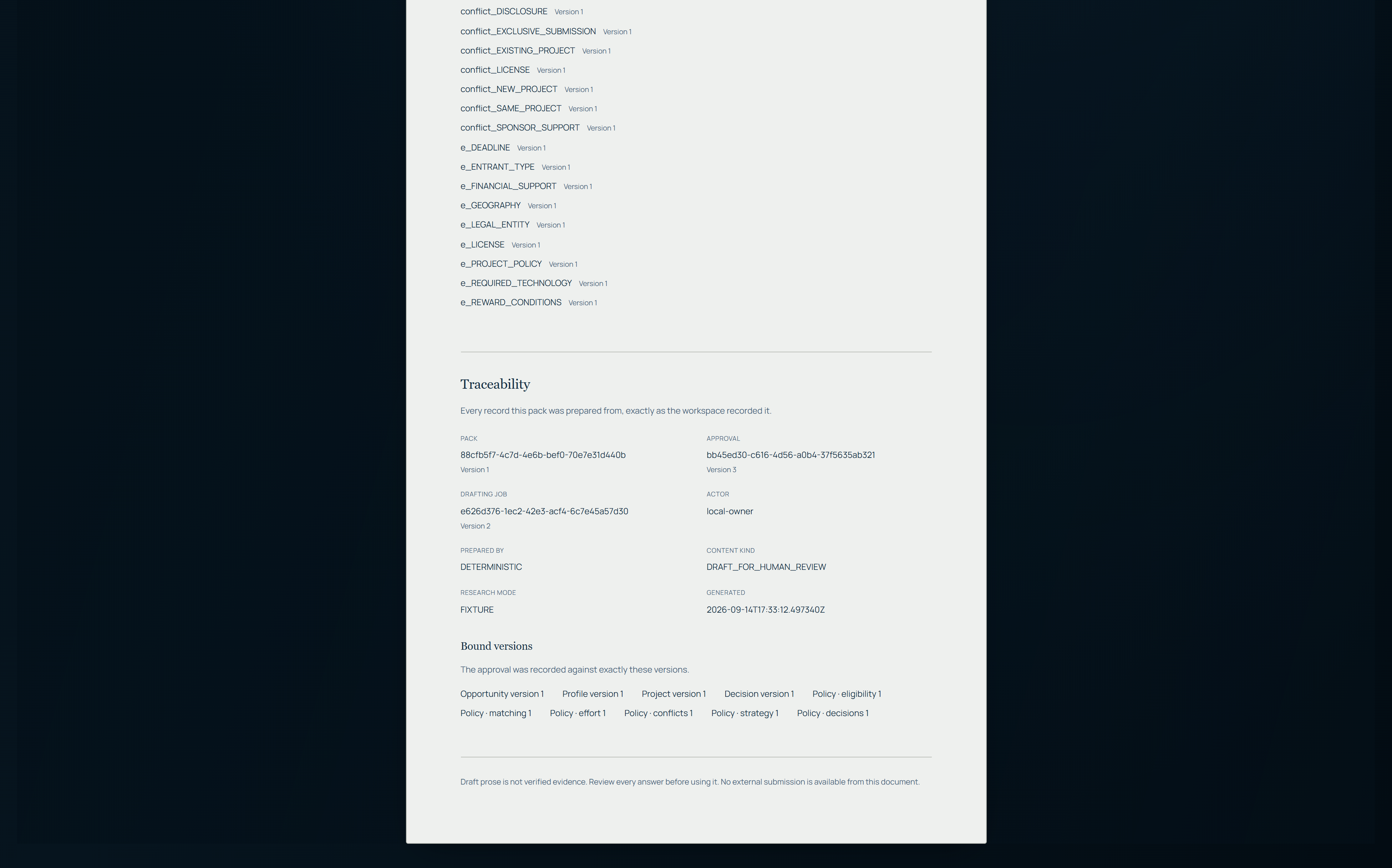
Every important source-derived fact remains connected to the evidence that supports it.
QUALOR also treats uncertainty as uncertainty. UNKNOWN, AMBIGUOUS, or unsupported information never becomes a false PASS.
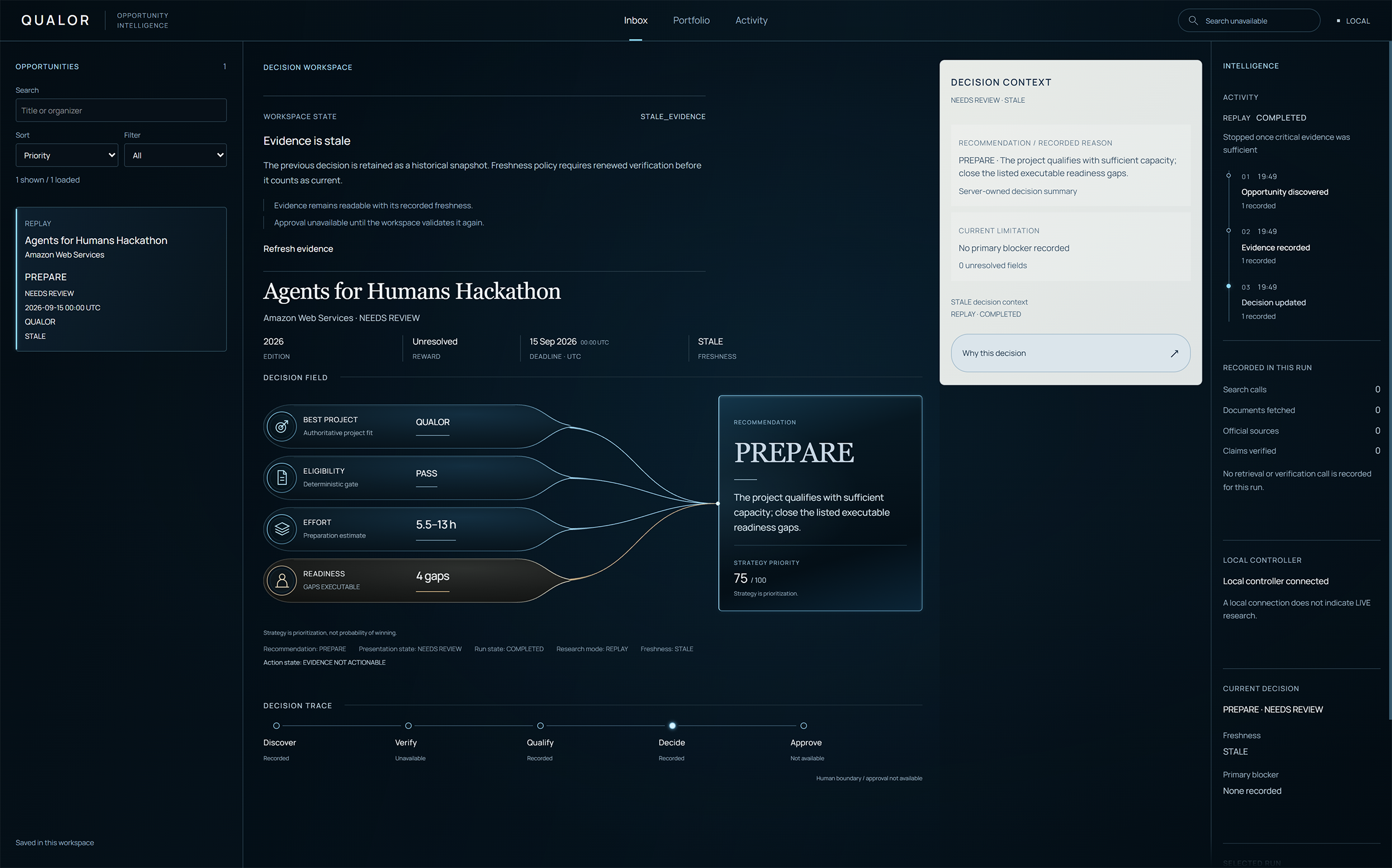
When evidence becomes stale, QUALOR keeps the historical decision visible but blocks approval until the information is verified again.
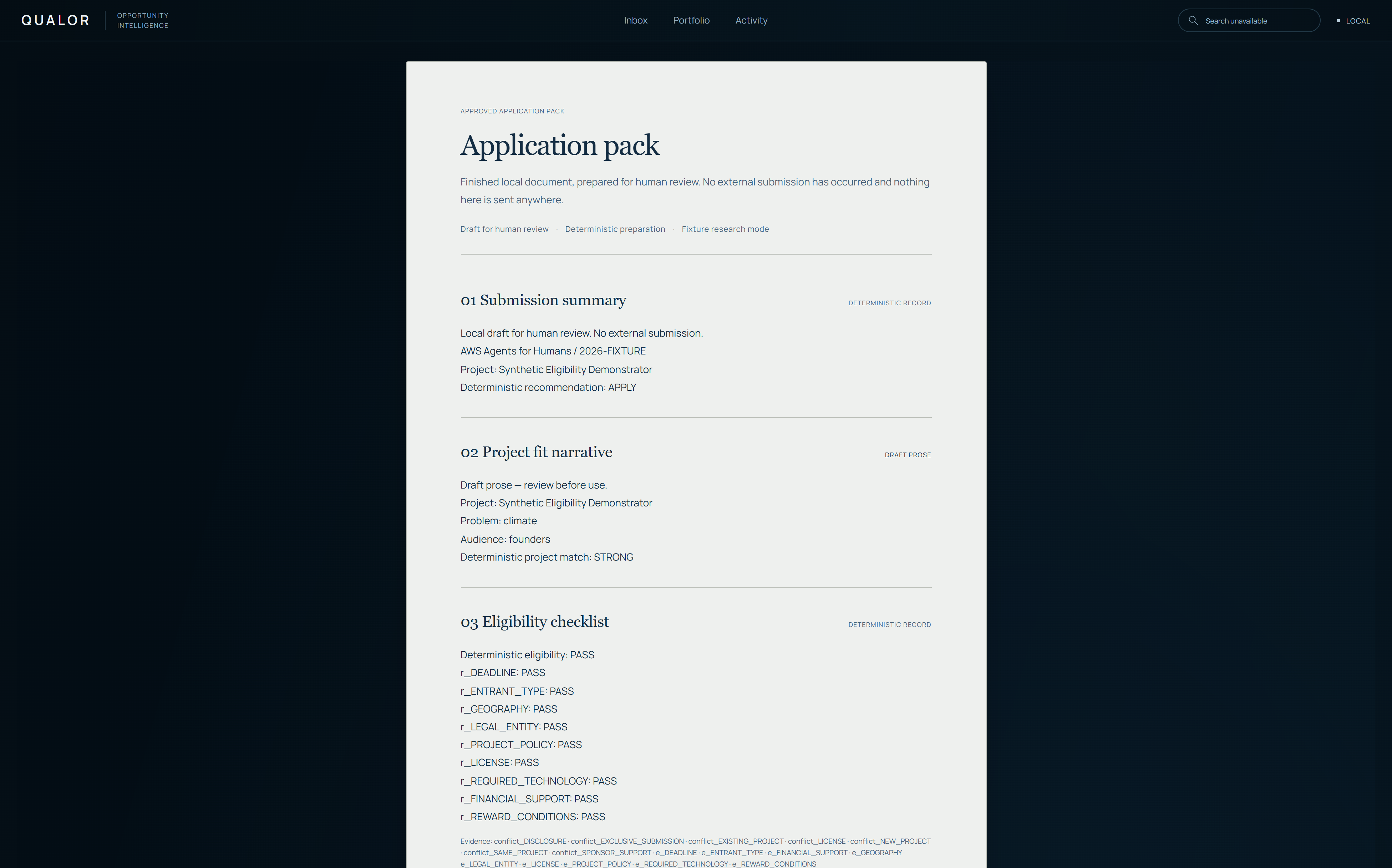
For consequential actions, QUALOR stops at a human approval boundary. After explicit approval, it can prepare a reviewable application pack, but it does not submit anything externally.
How we built it
QUALOR uses the Strands Agents SDK with Amazon Bedrock for autonomous research and bounded tool use.
The agent decides what information to inspect next, while deterministic Python logic owns the final eligibility, readiness, effort, strategy, and recommendation rules.
The system separates:
- autonomous research
- official-source evidence
- deterministic decision logic
- traceability
- human approval
- application-pack preparation
The interface makes the full decision path visible, including the evidence behind a result, freshness state, activity history, approval status, and the exact versions connected to a generated pack.
The application includes a Python backend and a React/TypeScript web interface.
Challenges
One of the hardest problems was preventing an AI research system from turning incomplete information into confident answers.
We designed QUALOR so that missing or unclear evidence cannot silently become a positive eligibility result.
Another challenge was keeping the autonomous research process bounded and predictable. Research uses explicit budgets, acquisition planning, evidence coverage tracking, and controlled termination states.
We also had to preserve the exact decision through persistence and approval so that generating an application pack cannot silently recompute or replace the decision that the user reviewed.
Accomplishments
We are especially proud that QUALOR combines useful agent autonomy with a strict human-control boundary.
The system can autonomously research an opportunity and explain what it found, while deterministic logic remains responsible for the final decision.
The demo also shows a historical replay of QUALOR evaluating the Agents for Humans Hackathon itself. Eligibility passed, but readiness gaps remained, so the recorded recommendation was PREPARE rather than APPLY.
When that historical evidence later became stale, QUALOR correctly blocked approval instead of pretending the old evidence was still current.
What we learned
Building a useful professional agent is not only about giving a model more autonomy.
The harder problem is deciding where autonomy should stop.
For QUALOR, the model is useful for research and information gathering, but important decisions need deterministic rules, evidence traceability, freshness controls, and explicit human approval.
What's next
The next step is expanding QUALOR from a competition-ready prototype into a broader opportunity intelligence platform for grants, funding programs, accelerators, competitions, and professional opportunities.
Future work includes more opportunity sources, richer organization profiles, portfolio-level prioritization, collaboration workflows, and additional integrations while preserving the same evidence and human-control principles.
Built With
- agents
- amazon
- amazon-web-services
- bedrock
- fastapi
- pydantic
- python
- react
- sdk
- sqlite
- strands
- typescript
- vite

Log in or sign up for Devpost to join the conversation.