-
-
-
-
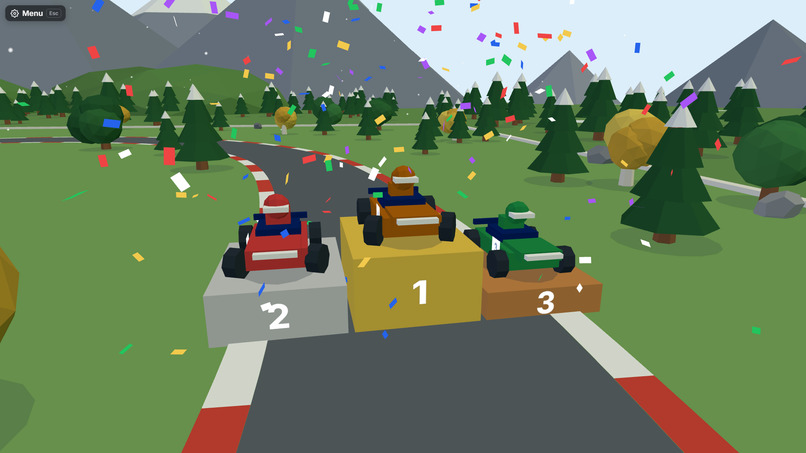
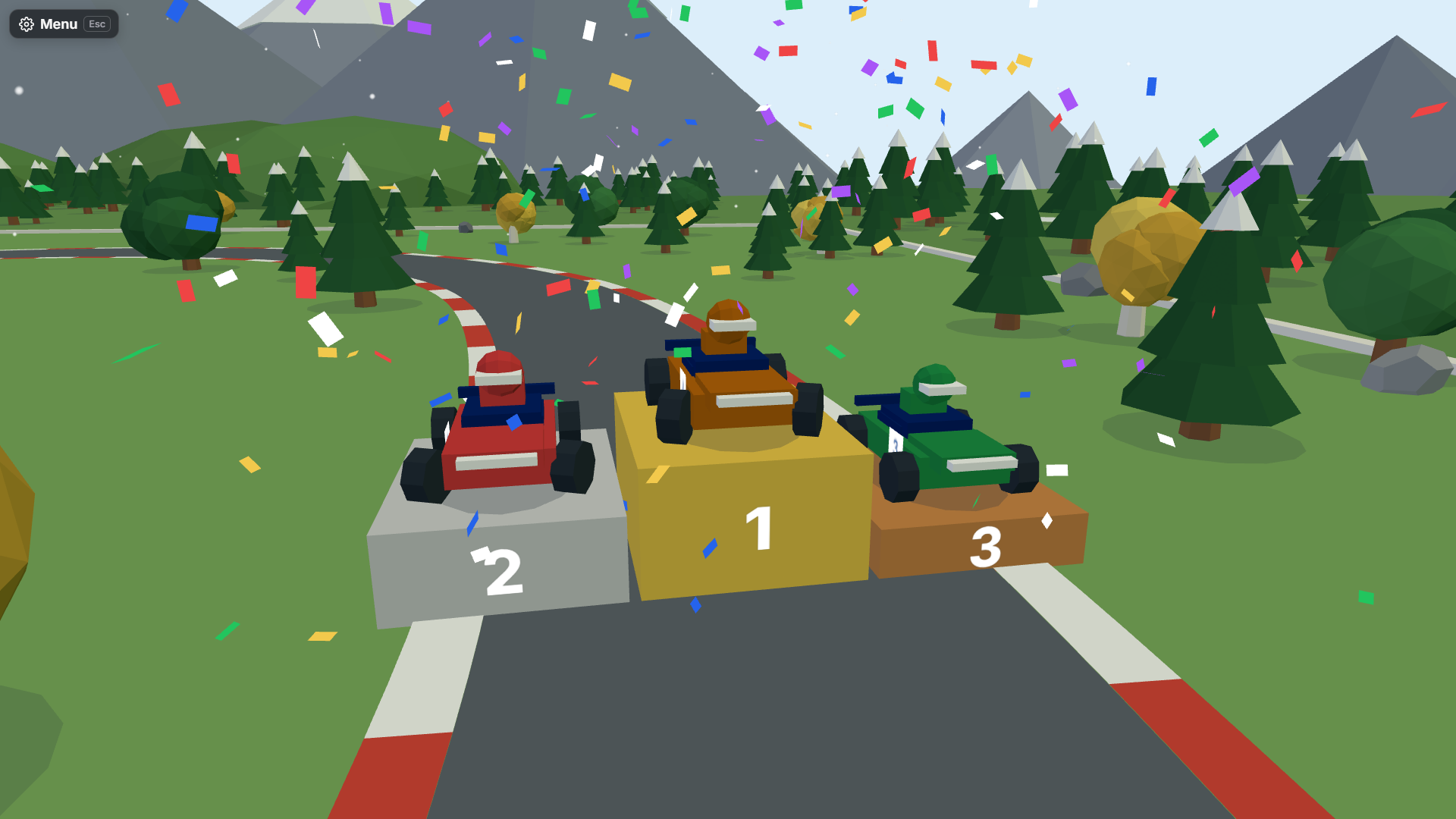
Top three drivers take the podium right on the track, with champagne and confetti, on Pikes Pass, Colorado.
-
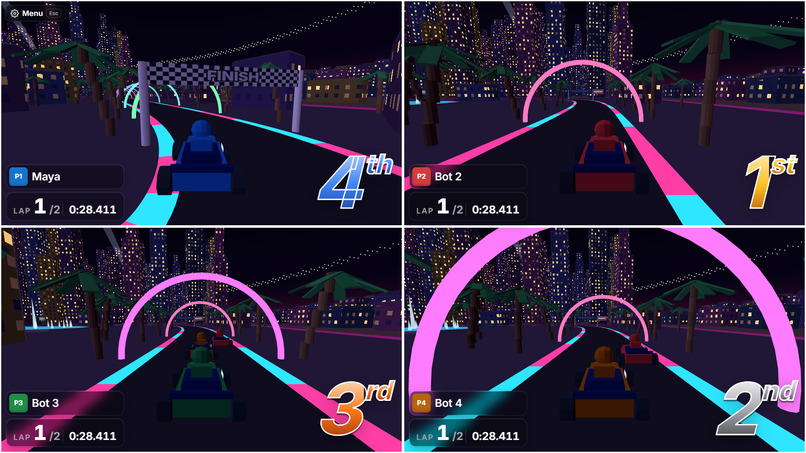
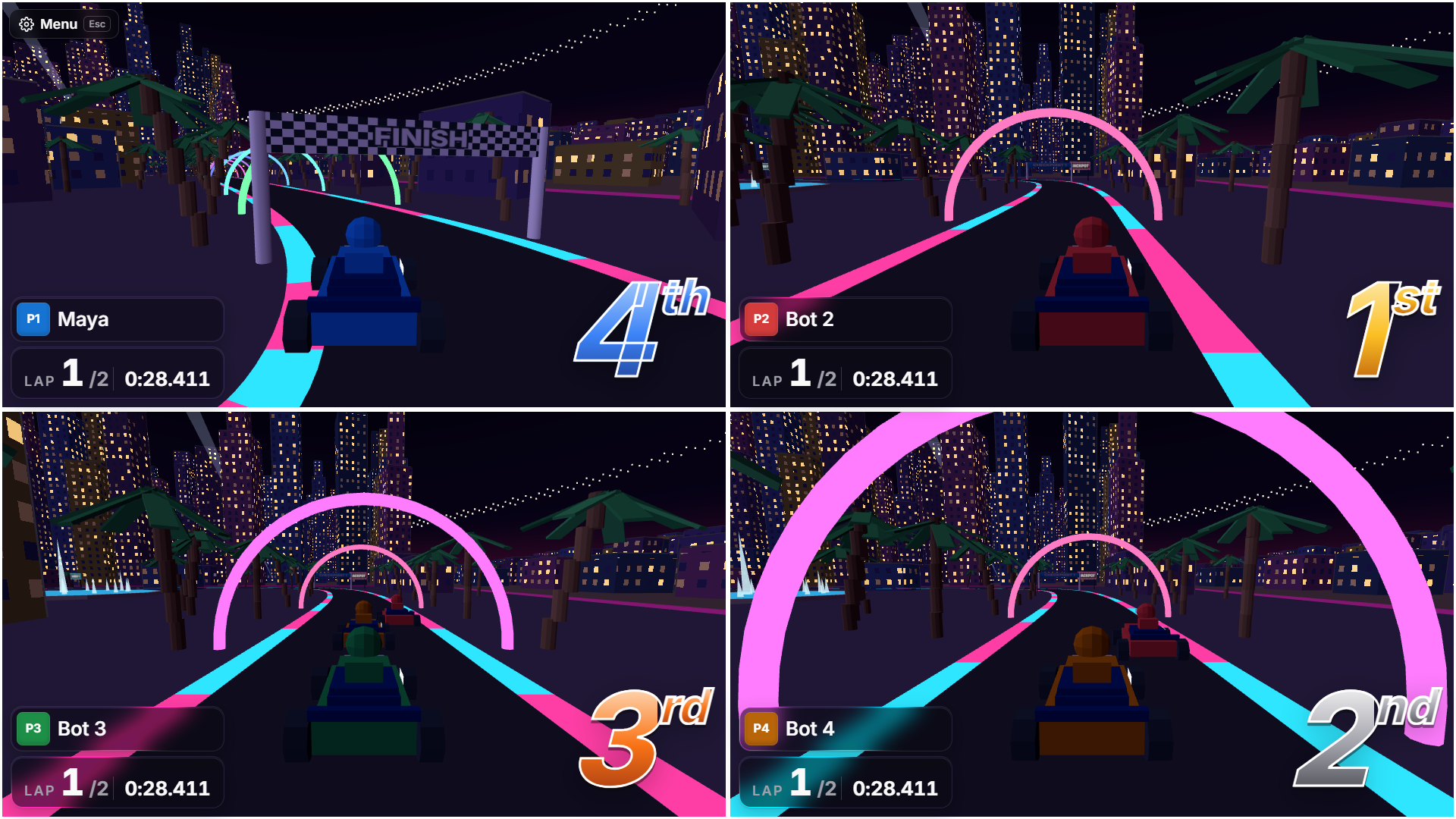
Four players race the Neon Strip at night, each with their own split-screen view. The AI host calls the action live.
-
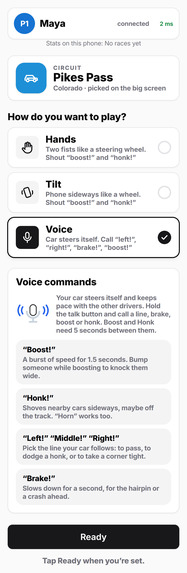
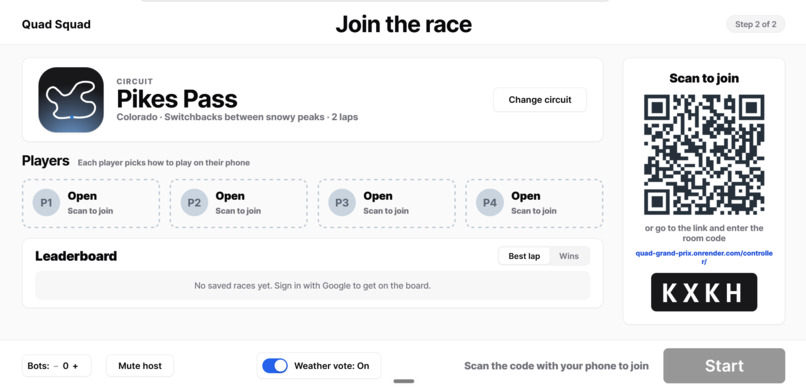
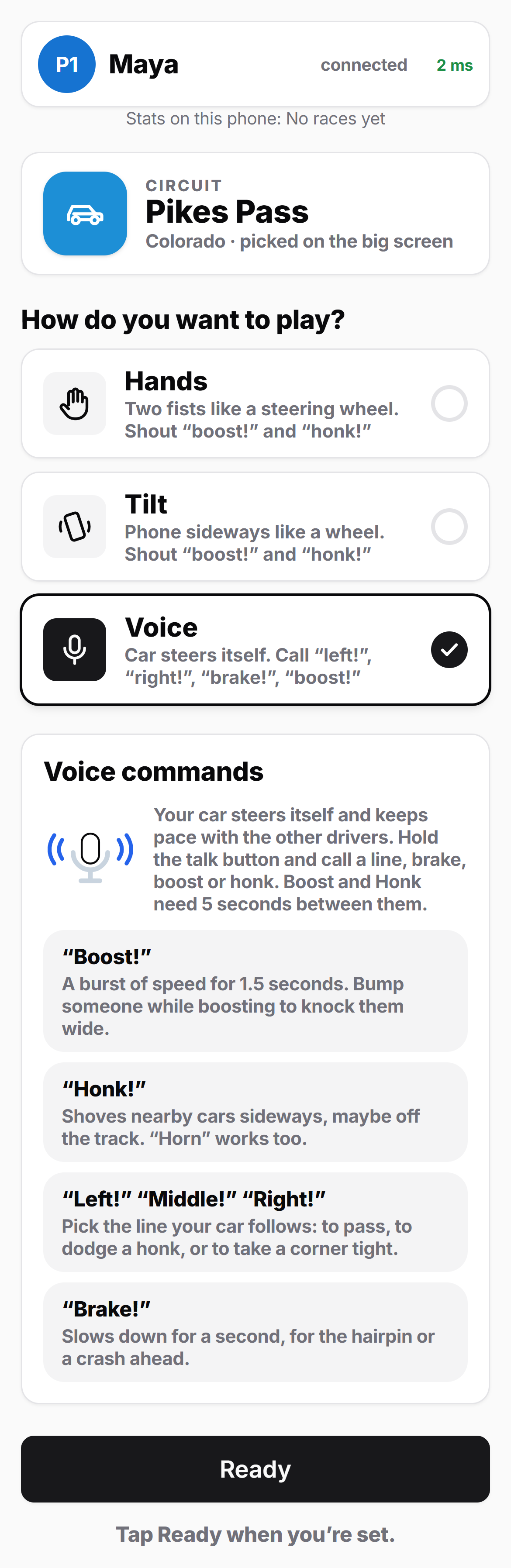
Each player picks Hands, Tilt or Voice on their own phone. No app: just scan the QR code.
-
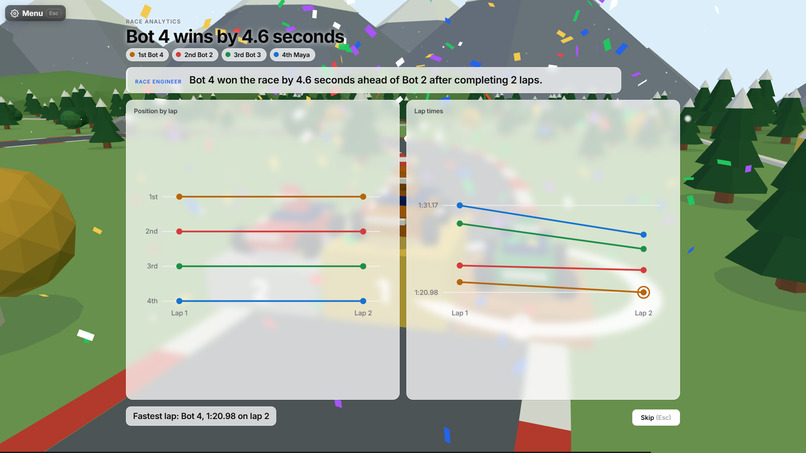
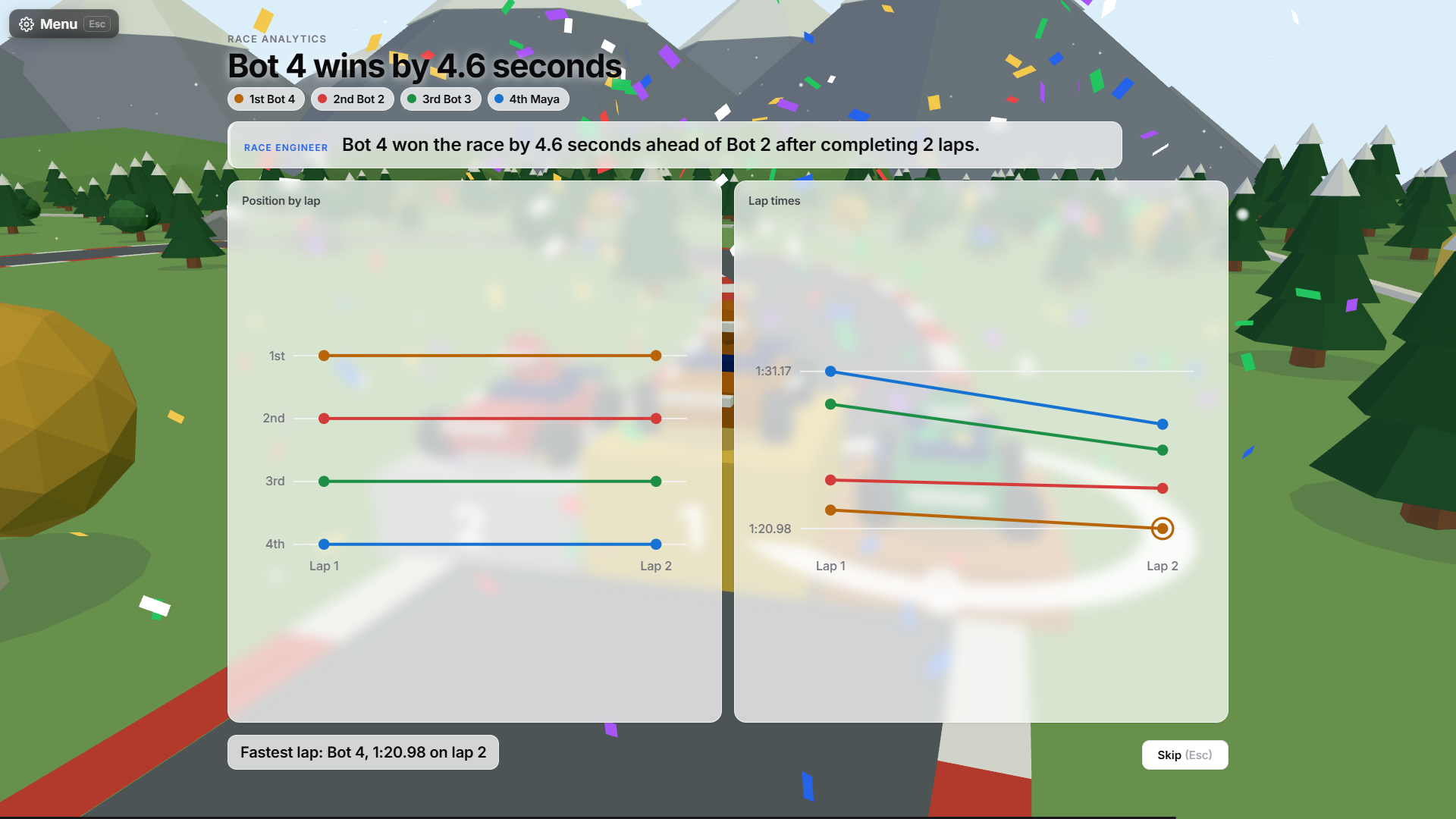
After every race, the big screen charts each lap's positions and times, and a race engineer sums up how it was won.
Inspiration
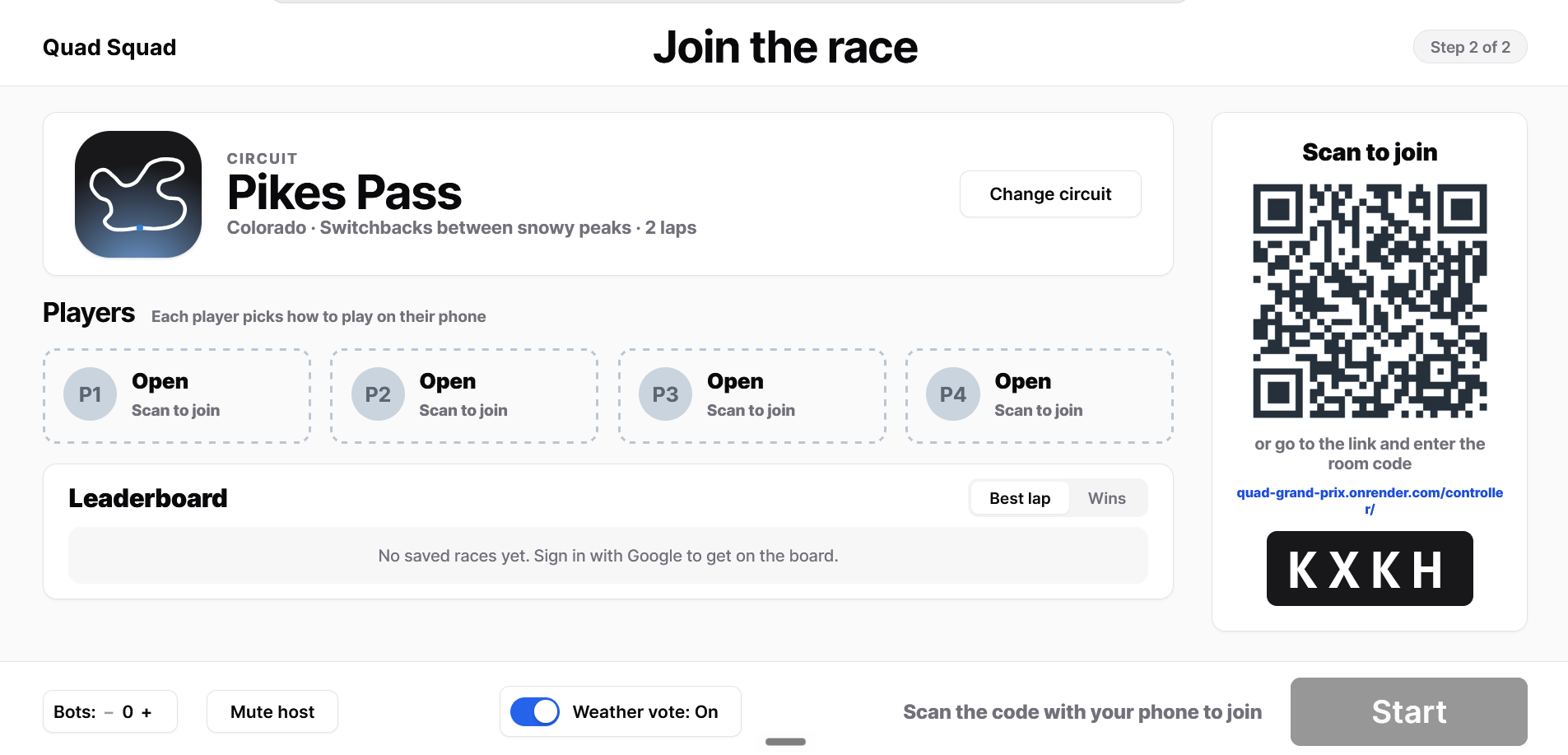
At most party games, a few people hold the controllers and everyone else watches. We wanted a game for a campus quad, where anyone walking by can join in seconds: no app, no account, no controller. Everyone already has a phone with a camera, so we made your hands the controller and your friends the crowd.
What it does
Quad Squad is a party racer for one big screen. A laptop on a TV shows a QR code. Players scan it, prop up their phone, and steer with two fists held like a steering wheel. Close your fists to drive at full speed and open them to coast. Players who'd rather not use the camera can tilt the phone, or pick voice mode and shout "Boost!" or "Honk!" to knock rivals wide.
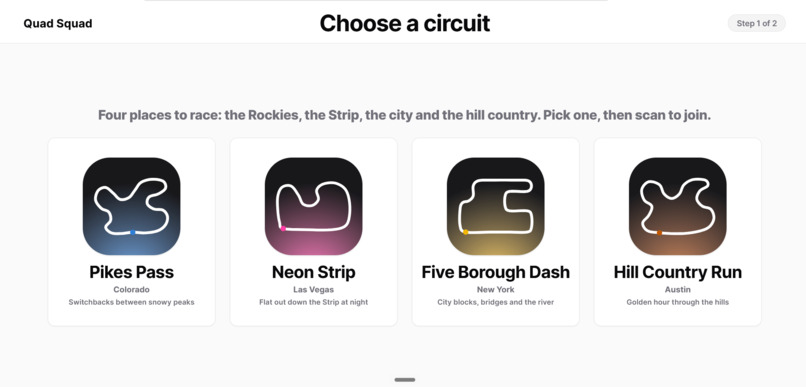
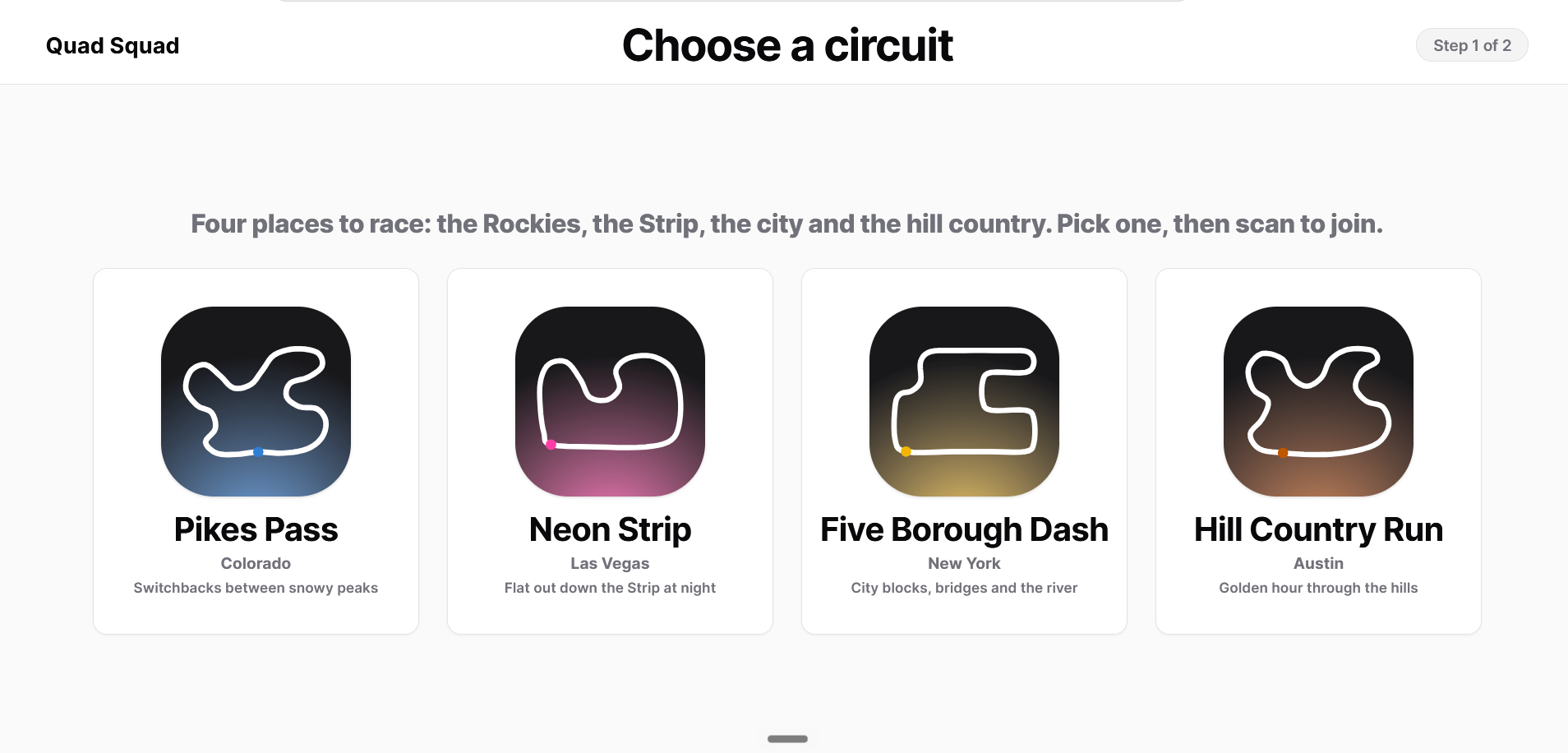
- Four themed low-poly circuits: Colorado switchbacks, the Las Vegas Strip at night, New York bridges and Austin at golden hour
- An AI race host calls the action out loud, plus a podium with a champagne pop
- After each race: analytics (overtakes, fastest laps, which control mode won) and an all-time leaderboard
- A queue with a ready check and rotation, so a crowd of 20 can share 4 cars. Bots fill any empty seats
- Spectators send reactions and vote on the weather for the next race
Privacy: video and audio never leave the phone. Hand tracking runs in the browser, and the phone sends only a steering number and a throttle number, 30 times per second.
How we built it
- Phone controller: TypeScript with MediaPipe Hand Landmarker in the browser. The steering angle comes from the line between the two wrists. A One Euro filter smooths it, and then it goes through a dead zone and a response curve:
$$ s = \operatorname{sign}(\theta)\left(\frac{|\theta| - 4^\circ}{60^\circ - 4^\circ}\right)^{1.6}, \qquad s \in [-1, 1] $$
With a $4^\circ$ dead zone (plus $2^\circ$ of hysteresis), the car drives straight while your hands jitter, and the exponent $1.6$ keeps small corrections gentle but still gives full lock at $60^\circ$. Tilt mode uses the same tuning, so both modes feel the same.
- Server: Node with WebSockets. The server owns the game state and runs it at 30 Hz, so a phone can't cheat or drift out of sync.
- Big screen: a Three.js scene with cel-shaded buildings, instanced trees and an animated sky for each theme.
- AI host: Gemini writes the commentary and ElevenLabs speaks it.
- Data: Supabase stores races, lap times and the leaderboard. Each race is saved in one transaction. Google sign-in is optional.
- Hosted on Render over HTTPS, which phones need before they allow camera and mic access.
Challenges we ran into
- Making three control modes fair. Hands, tilt and voice drove very differently at first. Voice players couldn't steer, so their cars drive themselves now, and players steer by calling a line. Pace adapts so voice players stay competitive. Tilt was retuned to match hands exactly, and we made a comfortably closed fist count as full throttle so nobody needs a white-knuckle grip.
- Hand tracking in the real world. Phone front cameras differ a lot. Some reject size hints, and some open the back camera. Slow phones dropped frames, so we added a low-quality mode. Dark or backlit rooms broke tracking, so the app now warns about them. When your hands leave the frame, the steering holds for a moment and the car then coasts, instead of swerving.
- Noisy speech. At a loud party, speech recognition hears "boost" in everything. We added a confidence threshold and a 5-second cooldown that the server enforces, and the phone shows what it heard.
- Venue networks. Phones drop off Wi-Fi. We added reconnect-to-your-slot, screen wake locks, a latency readout, and a soak-test checklist for venue Wi-Fi, hotspots and cellular.
- Scope and merges. We built three games: Racing, a sword duel and volleyball. Late in the hackathon we cut Duel and Volley to make Racing excellent. Along the way we hit merge-conflict markers that broke the Render build, duplicated handlers, and design-polish PRs we had to revert and redo.
- Polish vs. noise. We added music, removed it, and then brought back only engine, honk and crowd sounds. WASD keyboard driving got the same treatment: it was easy for testing but took away from the hook.
Accomplishments that we're proud of
Players need nothing to install, the hand steering really works, and the camera feed never leaves the phone. A stranger can scan a QR code and be racing in under a minute.
What we learned
- Feel matters more than accuracy. A dead zone, hysteresis and a response curve did more for the steering than better tracking did.
- Fairness across input methods is a design problem, not just a tuning problem.
- Letting the server own the state keeps a room full of unreliable phones consistent.
- Cutting features is part of shipping.
What's next
More circuits, tournaments for campus events, and bot drivers that learn from real laps.
Built With
- css3
- deviceorientation
- elevenlabs
- express.js
- gemini
- github
- google-oauth
- html5
- javascript
- mediapipe
- node.js
- postgresql
- qrcode
- render
- socket.io
- supabase
- three.js
- typescript
- vite
- web-speech-api
- webgl
- webrtc
