-
-
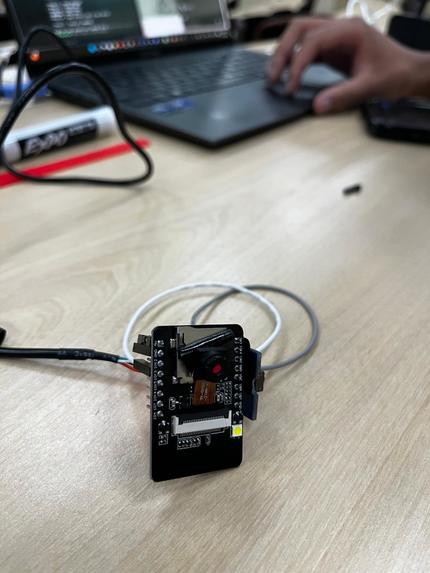
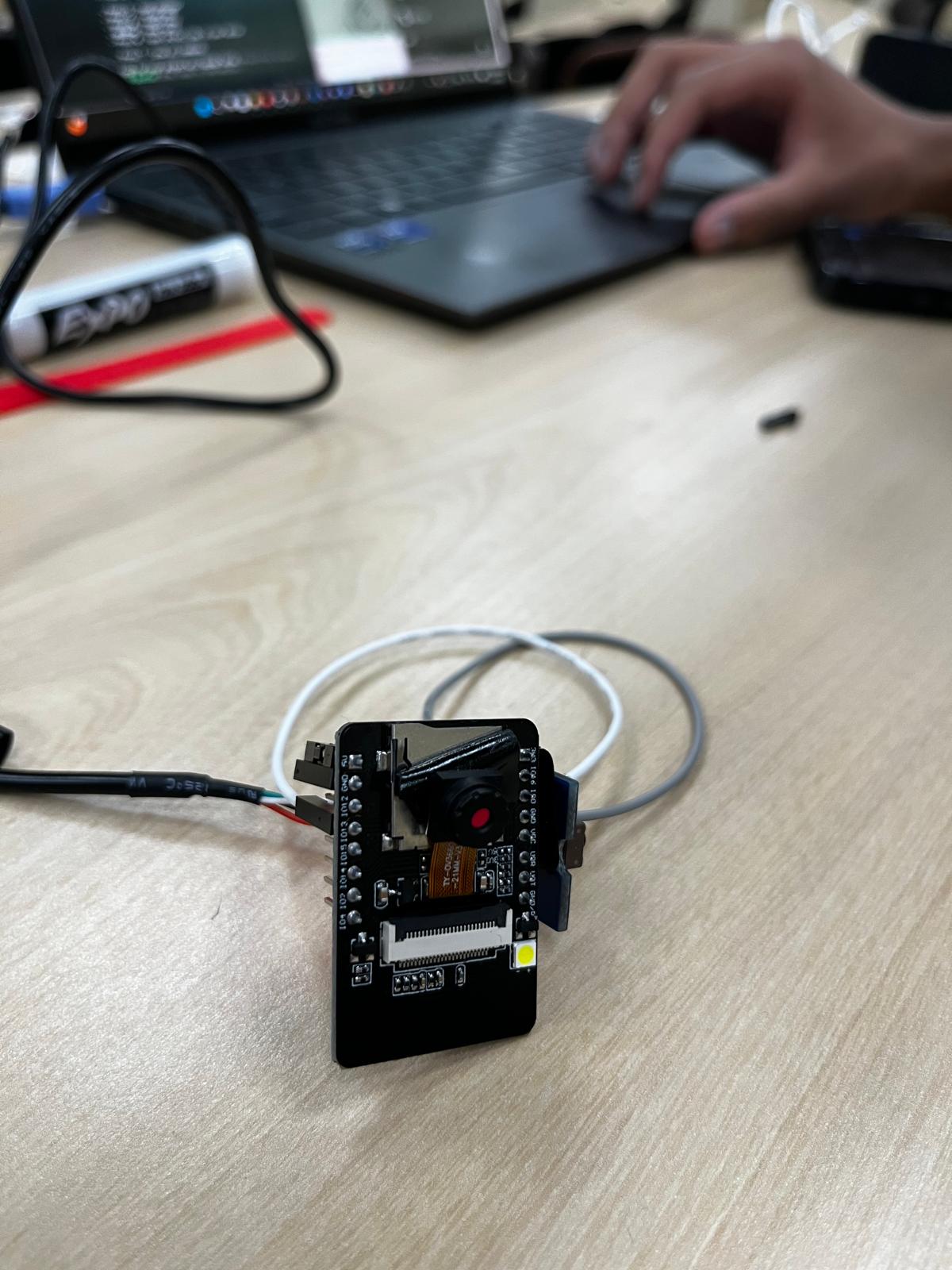
Qu Ring Point One Hardware Piece
-
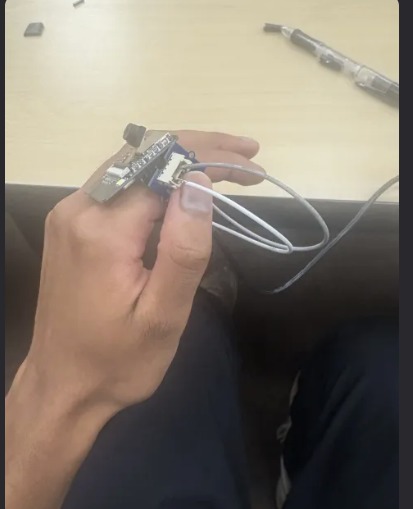
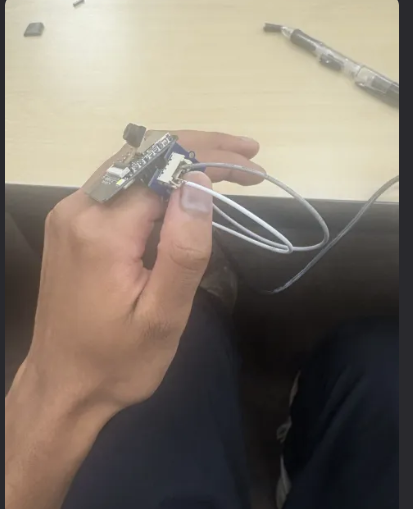
Qu on finger
-
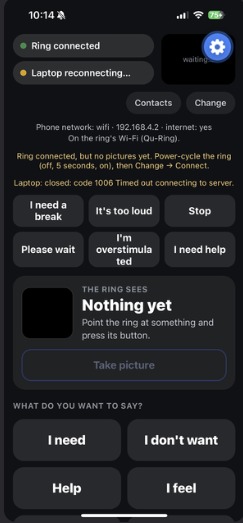
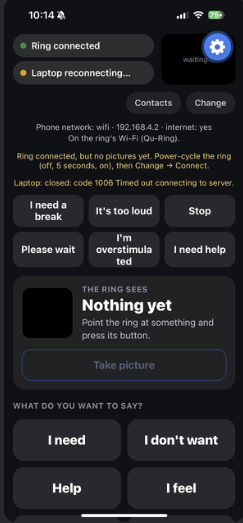
Mobile implementation
-
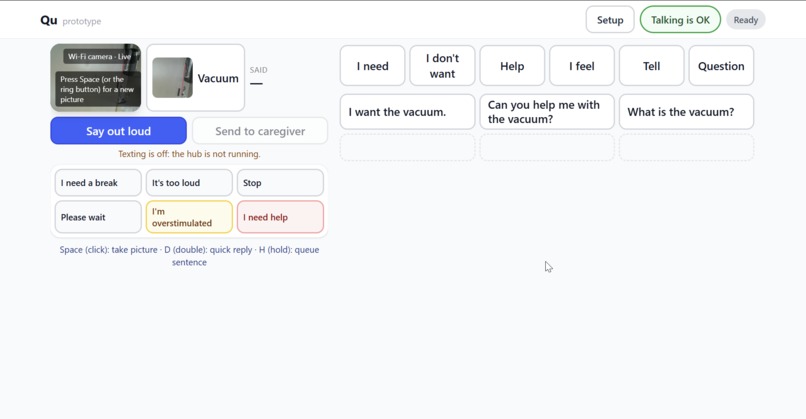
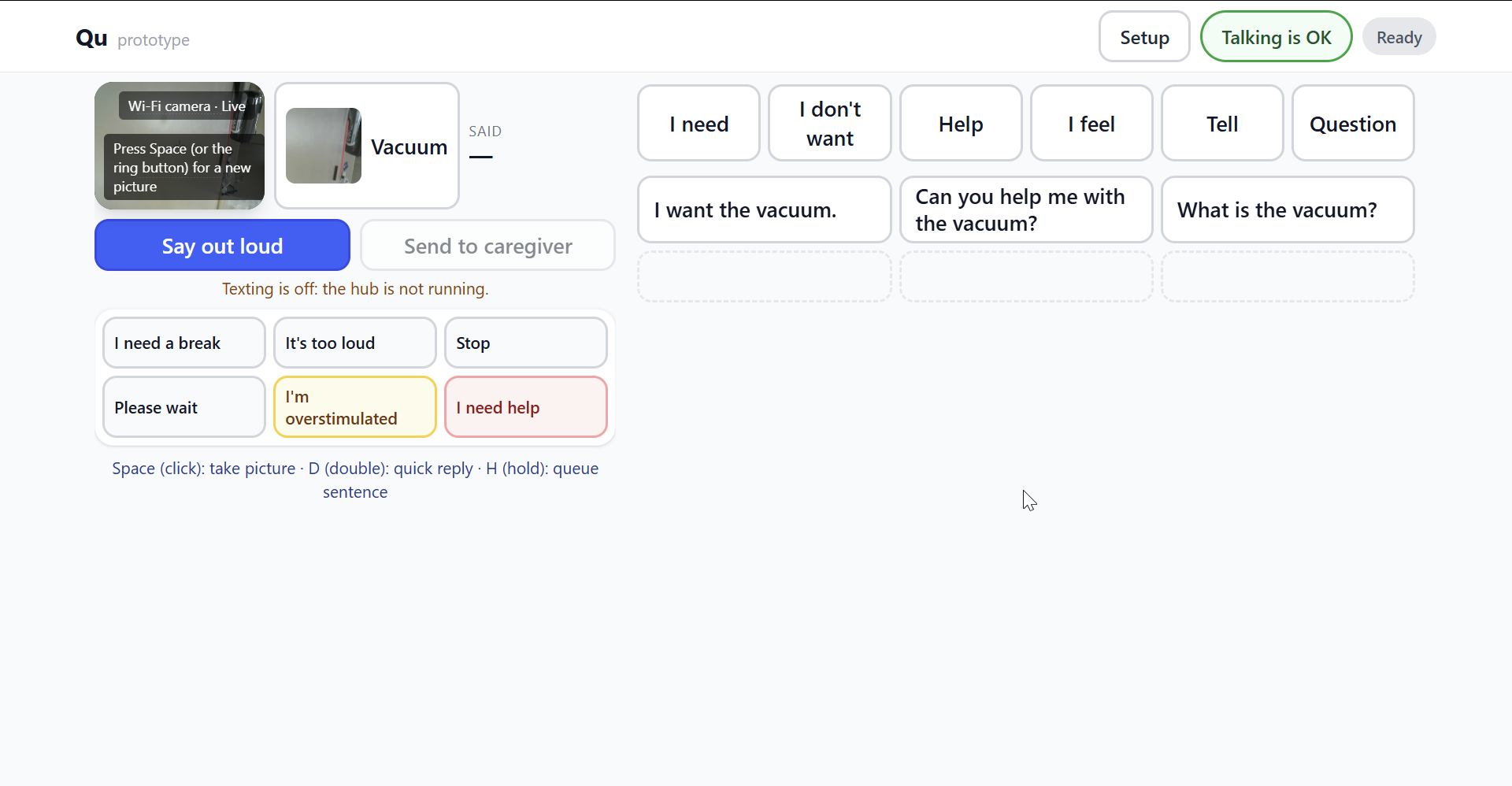
Web implementation
Inspiration
After a stroke, many people lose the ability to speak (aphasia), even though they still know exactly what they want to say. Most AAC (augmentative and alternative communication) tools are tablet apps with big grids of symbols. Finding the right word means digging through menus, and that's tiring when you're already struggling to communicate. We wanted communication to start from what's right in front of you: point at it, and it becomes a word.
What it does
Qu turns the world into words. Slip on the ring-sized camera, point at anything, and tap to snap a photo or hold to record a short video. Computer vision picks out the objects in view and instantly turns them into word cards: water, pills, blanket. Cards you use most rise to the top, so your vocabulary adapts to you. Arrange them into a sentence and Qu speaks it aloud or sends it privately to a caregiver as a text. You don't need menus or symbol grids. You point, and Qu speaks for you.
How we built it
Hardware: an ESP32-CAM for image capture and a Grove button as the trigger, wired to an Arduino. Capture: each button press sends a single JPEG. We don't stream continuously, which keeps the WiFi load small. Backend: [Python/Node] receives the frame, runs object detection with [OpenCV], and maps the labels to word cards. Frontend: [React] app where the user arranges cards into sentences. Messaging: [Photon] sends the finished sentence to the caregiver as a private text.
Challenges we ran into
Networking: the ESP32 only supports 2.4GHz, and the venue WiFi didn't cooperate. We had to work out how the backend reaches a device that only has a private IP. We ended up with [AP mode with the laptop pulling images / a phone hotspot]. Detection: [Detected labels like "bottle" or "cup" aren't always the word the user means. We built a mapping layer from labels to useful vocabulary.] Hardware reliability: [ESP32-CAM flashing, camera init errors, etc.]
Accomplishments that we're proud of
A working ring-sized wearable, not just a desk prototype. Text-to-speech, so users can speak in the room, not just text. Adaptive card ranking that learns which words each user reaches for.
What we learned
Networking: how embedded devices connect: local vs. public IPs, NAT, and when a device should push data instead of having a server pull it. Edge cases: CV labels don't map neatly onto human vocabulary. Users: designing for people with aphasia means fewer steps, larger targets, and no menus.
What's next for Qu Ring
Custom cards: names, places, and phrases the camera can't see, like "Mom," "home," or "I'm tired." Care loop: pill-bottle checks to confirm medication, and one-tap pain reporting to caregivers. On-device detection: offline detection for privacy and reliability without WiFi. Smaller and longer-lasting: a slimmer ring with all-day battery life. Clinical feedback: testing with speech-language pathologists and stroke rehab patients.
Built With
- anthropic
- arduino
- c++
- claude
- elevenlabs
- expo.io
- hugging-face
- imessage
- javascript
- mediapipe
- node.js
- onnx
- photon
- react
- react-native
- tailwind
- transformers.js
- typescript
- vite
- vitest
- web-bluetooth
- web-speech-api
- webassembly
- webgpu
- websockets

Log in or sign up for Devpost to join the conversation.