Inspiration
Modern vehicles and robots make safety decisions from sensors that can silently fail: a frozen wheel-speed sensor, a drifting gyro, a loose connector that spikes. Per-signal thresholds miss slow drifts or raise false alarms. We wanted something small and deterministic enough to sit next to real-time control code on QNX, but smart enough to tell which sensor is wrong and how.
What it does
qsentry watches four coupled vehicle signals (wheel speed, longitudinal acceleration, steering angle, yaw rate) at 100 Hz. For each sensor it computes eight features over a 1-second window, including physics residuals between coupled sensors, and a 293-parameter neural network classifies it as ok, stuck, drifting, spiking or noisy. A small, auditable supervisor turns those verdicts into NOMINAL / DEGRADED (limp-home) / SAFE_STOP, and a timer-pulse watchdog trips SAFE_STOP if the sensor stream goes silent for more than 50 ms.
How we built it
qsensord(simulated sensor ECU) sends each sample withMsgSend();qsentrydreplies, which unblocks the sender and can carry a fault-injection command — QNX synchronous messaging used as the data path and the control path.- A POSIX timer delivers a 100 Hz
SIGEV_PULSEto the same channel, so oneMsgReceive()loop serves both data and the deadline watchdog. - A resource manager publishes
/dev/qsentry:catfor status,echofor commands. ClockCycles()histograms measure detector time and timer jitter;qsloadsaturates the CPU at a lower priority to show the detector keeps its deadline.- The model is trained in plain numpy on data produced by the same C simulator and feature code that runs on the target, then exported as a C header (no runtime, no allocation).
Challenges
- Drift on one sensor shifts the shared physics residual of its partner. We removed those ambiguous windows from training and added pair-level reasoning plus fault isolation in the supervisor (a condemned speed sensor does not also condemn the steering pair).
- An early model flipped back to "ok" when a drift grew beyond the training range; the supervisor now needs confident health (p ≥ 0.9 for 1 s) to clear a verdict.
Accomplishments
On held-out simulator seeds: 800/800 injected faults detected with the right sensor and fault type, 0 false alarms in 200 clean drives (3.3 hours), 0 false SAFE_STOPs, ~3.5 µs per tick on x86-64.
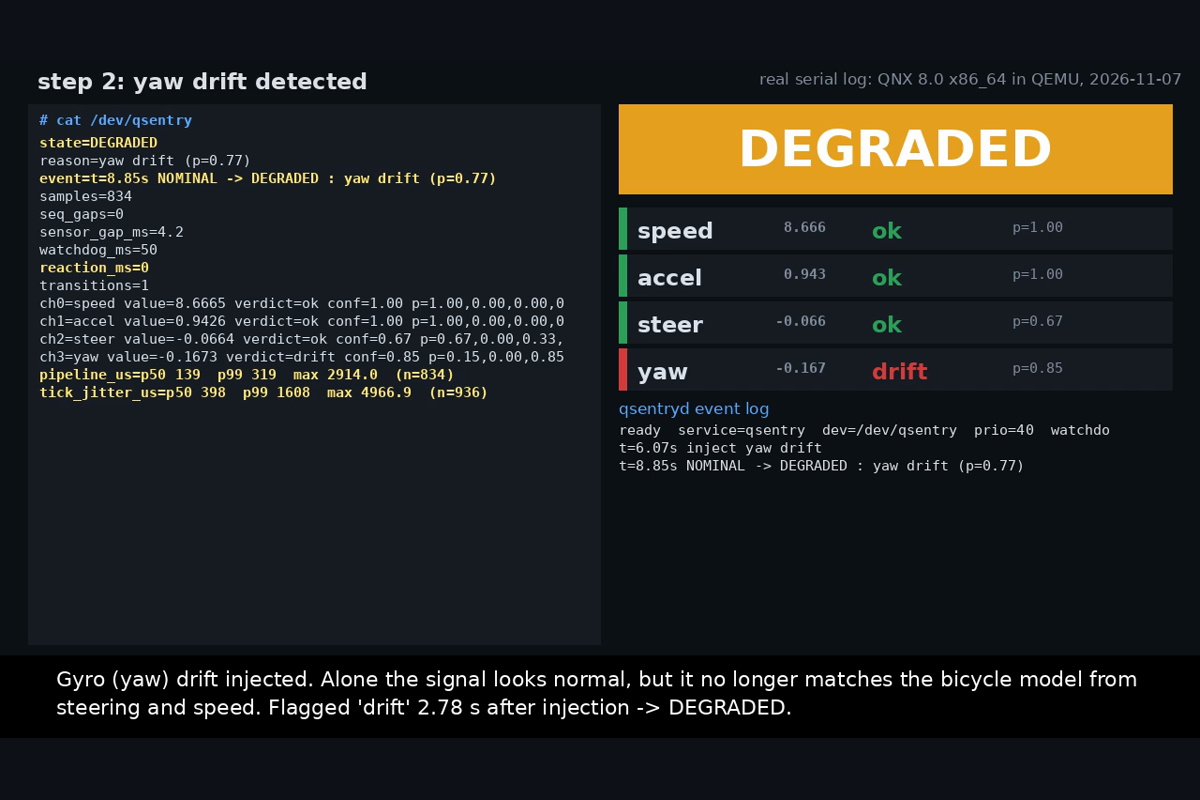
On QNX 8.0 in QEMU (x86_64, software-emulated CPU, log docs/qnx_run_2026-11-07/serial_run4.log,
the run shown in the video): gyro drift caught in 2.78 s, frozen wheel speed in 0.43 s, accelerometer
noise in 0.18 s, two-pair SAFE_STOP 4.06 s after the second fault, operator reset back to NOMINAL, and the
deadline watchdog tripped 60 ms after the sensor process was killed (50 ms deadline, 10 ms tick). Under two
priority-9 CPU hogs the detector's per-sample time stayed at p50 179 µs / p99 378 µs (emulated).
What we learned
QNX message passing makes a clean real-time pipeline: priorities travel with messages, pulses unify timers and data, and a resource manager gives a zero-dependency operator interface.
What's next
Train on recorded CAN/IMU logs, add a third redundant source (GNSS heading) to remove pair ambiguity, run on Raspberry Pi 5 with real IMU hardware, and export verdicts over SOME/IP.
Build instructions
See README. Linux/WSL host: make qnx, scripts/run_qemu.sh, scripts/deploy_qemu.sh, then
sh /tmp/demo_on_target.sh on the target. Windows host: scripts\build_qnx.cmd, then the scripts in
scripts/qemu_win/ build a mkqnximage QEMU image that boots straight into the scripted demo.
