-
-
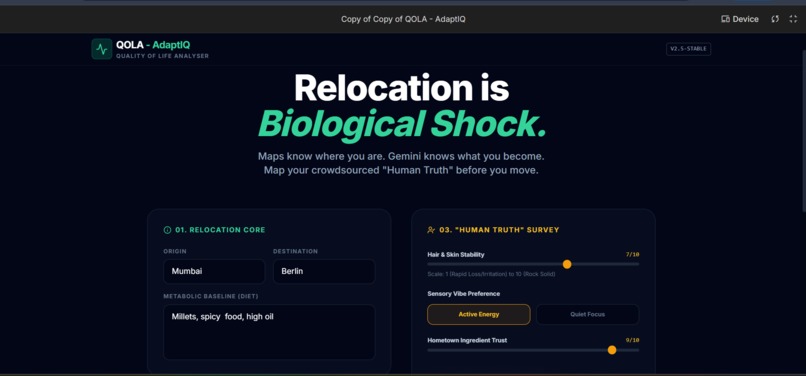
Home page
-
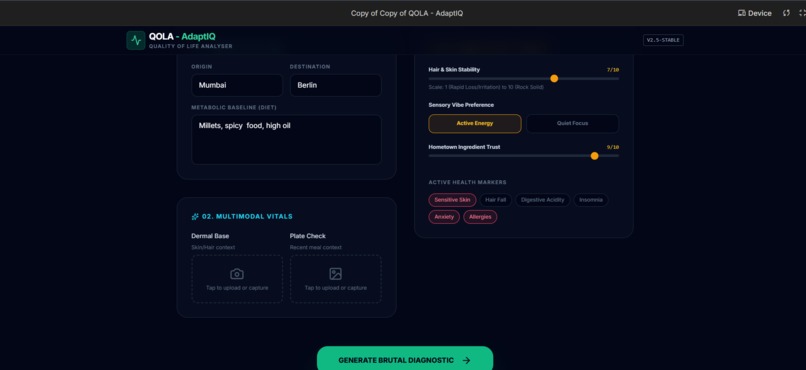
Home page
-

Loading menu
-
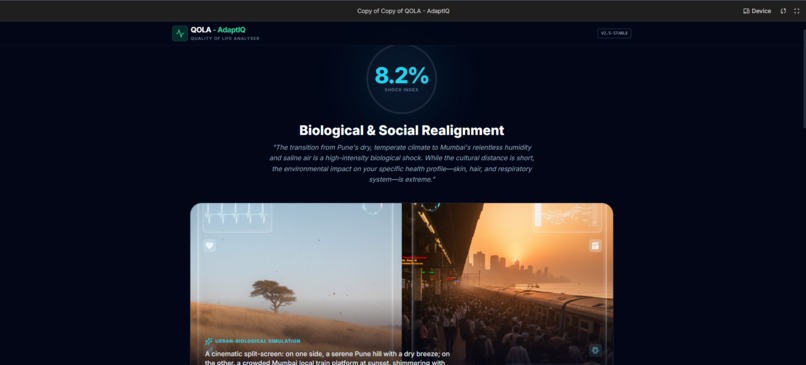
analysis
-
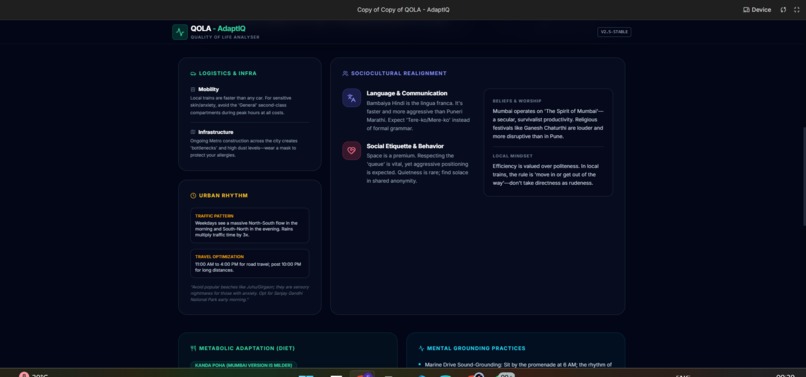
analysis
-
analysis

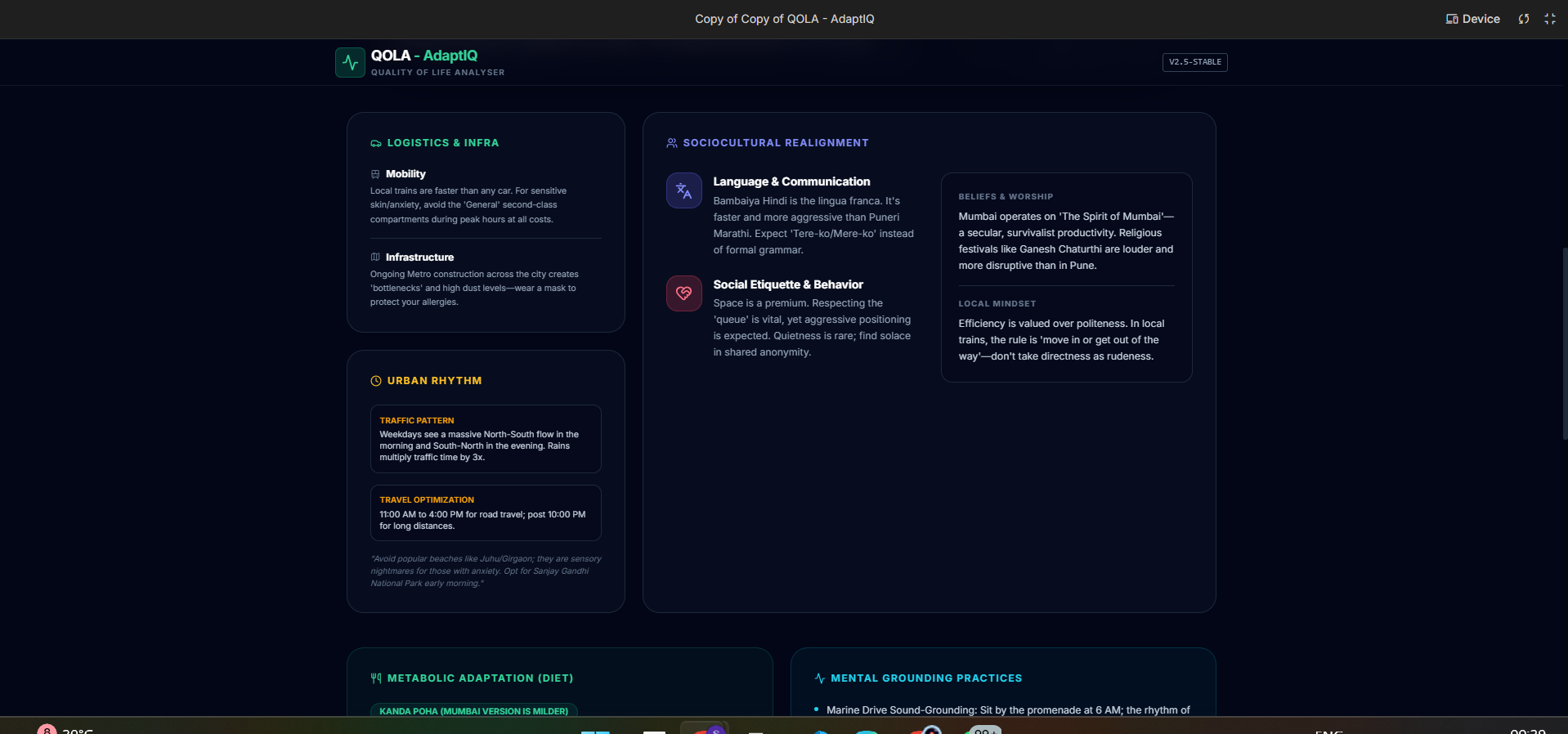
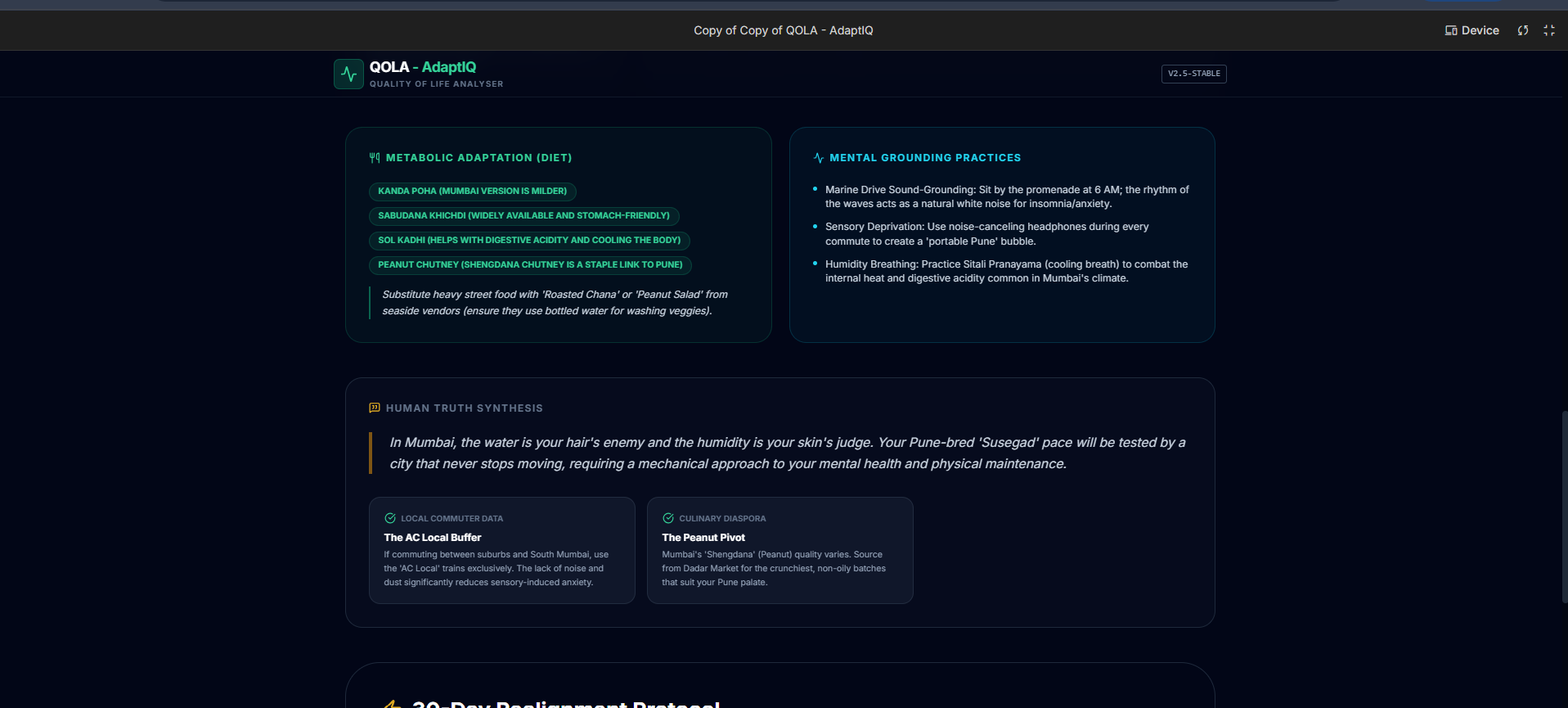
It combines the biological depth you’ve conceptualized with the cutting-edge technical features of the Gemini 3 series.Project Story: QOLX- AdaptIQInspiration
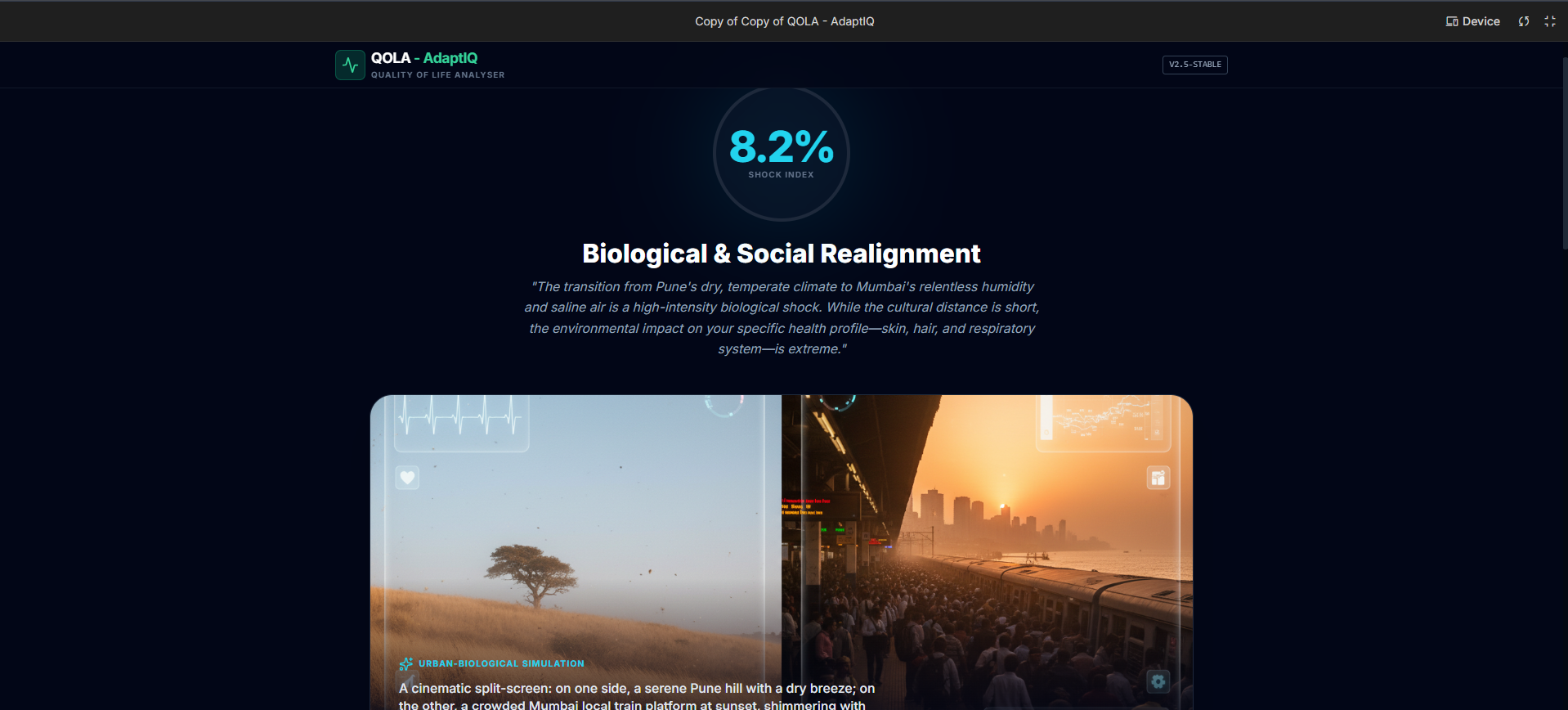
The idea for QOLX- AdaptIQ was born from a simple observation: when we move for work or education, we treat it as a logistical event—finding a house and shifting boxes. But for the human body, relocation is a Biological Shock.A person moving from the quiet, low-humidity plains of Maharashtra to the hard-water, high-traffic environment of Bangalore isn't just changing an address; they are changing their air, water, and metabolic baseline. We noticed that "quality of life" is often measured by salary or cost of living, but rarely by Biological Friction. We wanted to build an engine that quantifies this shock and, more importantly, provides a scientific roadmap to mitigate it.
What it does
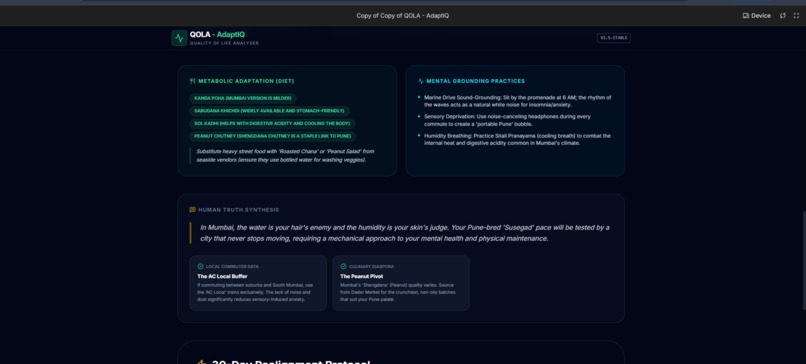
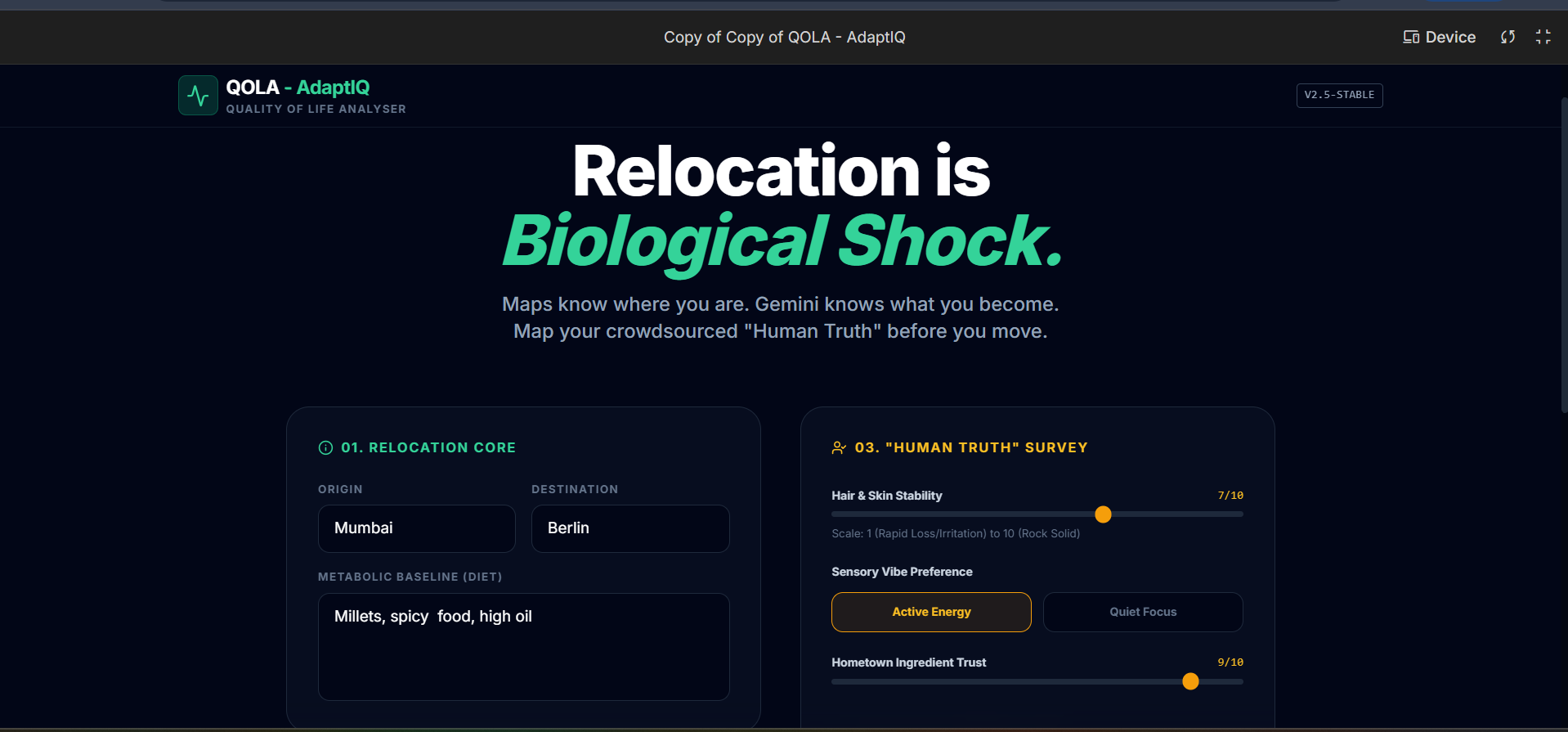
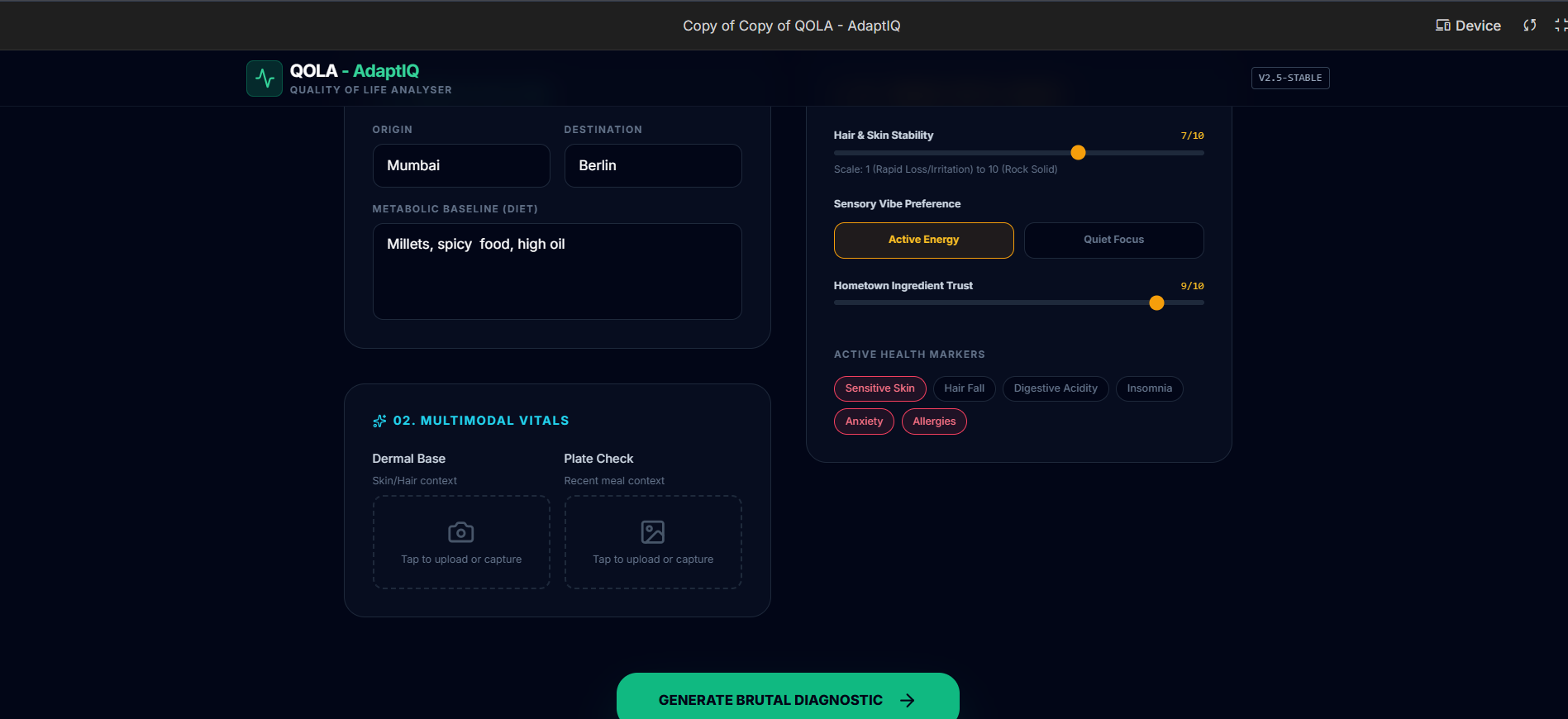
QOLX- AdaptIQ is a "Personalized Quality of Life Adaptation Engine." It bridges the gap between official city data and a person's unique biological baseline.The Bio-Cultural Survey: Before analyzing a city, the app conducts a "Human-Truth" survey to understand a user's native diet (e.g., Millets vs. Rice), skin/hair sensitivity, and sensory threshold (noise tolerance).The Honestly Brutal Rating: It generates a score from 0–100 by analyzing the Delta between the origin and the destination. If the water hardness jumps from 50 PPM to 350 PPM, the app doesn't just show a stat; it warns of "Hair-follicle calcification risk."Adaptation Blueprint: It provides a 30-day "Survival Protocol," suggesting specific products (e.g., Vitamin-C shower filters) and sourcing native ingredients locally to prevent gut dysbiosis.
How we built it
We utilized a modern AI stack centered around the Gemini 3 family:Gemini 3 Pro (High Thinking Level): Used to perform complex reasoning on how environmental pollutants like particulate matter interact with the gut-brain axis to cause mental health issues like irritability.Search Grounding: We integrated the Gemini Search Tool to fetch real-time "Internet Vitals"—AQI from the Google Air Quality API, local water reports, and ambient noise levels.Multimodal Vision: Leveraging Gemini 3's Media Resolution, users can upload photos of their current environment. The AI analyzes these to set a visual and biological baseline.The Stack: Node.js/Express for the backend agentic workflows and a Glassmorphic React frontend for a clean, futuristic dashboard.
Challenges we ran into Quantifying "Vibe": It’s easy to get AQI data, but hard to quantify "Social Tempo." We solved this by using Gemini to perform Sentiment Analysis on thousands of crowdsourced local reviews (from Reddit/forums) to find the "Human Truth" of a neighborhood.Data Latency: Reasoning through multiple city factors can be slow. We optimized this using Gemini 3 Flash for real-time chat interactions while reserving the Pro model for the initial deep analysis.
Accomplishments that we're proud of
The Adaptation Friction Index (AFI): We developed a mathematical model to calculate friction:$$AFI = \sum (w_i \cdot \Delta_{factor})$$This allows us to give a personalized score rather than a generic one.Agentic Sourcing: Our AI doesn't just give advice; it acts. It can find the nearest store in a new city that sells specific hometown grains (like Jowar) to maintain the user's microbiome health.
What we learned
We learned that Quality of Life is deeply subjective and biological. We discovered the profound impact that water hardness and noise floor jumps have on long-term mental health and skin integrity—factors that are almost entirely ignored in traditional relocation apps.
What's next for QOLX- AdaptIQWearable Integration:
Syncing with Apple Health or Google Fit to monitor the user's real-time cortisol and sleep patterns during the first 30 days of a move.Neo-Local Community: Building a feature that connects "Adapters" (newcomers) with "Locals" who share the same biological baseline (e.g., a Maharashtrian community in Bangalore) to help with the transition.Predictive Health Alerts: Notifying users of seasonal "Biological Events," such as high pollen counts or humidity spikes, before they happen.


Log in or sign up for Devpost to join the conversation.