-
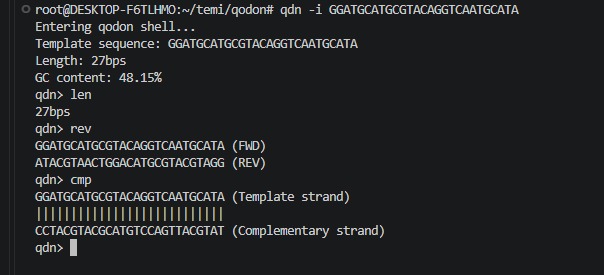
qodon shell
-
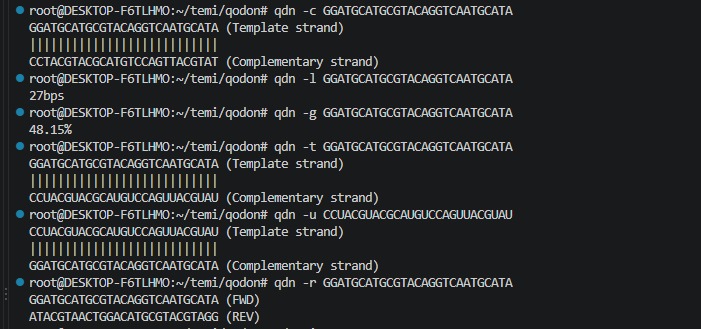
qodon quick terminal usage with flags
Inspiration
In molecular biology and bioinformatics education, working with sequence data often comes with unnecessary friction. Students and developers trying to run basic exploratory checks - like calculating GC content, reversing a strand, or generating a complement - are usually forced to spin up heavy Python/R environments or navigate bloated graphical software.
The core question driving qodon was simple: Why should a simple string manipulation require a heavy runtime? Inspired by the need for lightweight, resource-efficient developer tools that can run seamlessly on any machine (even modest student laptops or remote servers), I set out to build an ultra-fast sequence utility written entirely in pure C.
What it does
qodon (qdn) is an ultra-fast, lightweight command-line utility and interactive shell built for quick genomic sequence manipulations. It operates in two primary modes:
- Quick Terminal Flags: Enables one-off evaluations directly in shell scripts or terminal pipelines.
- Stateful Interactive Context Shell: Triggered via the
-iflag, it loads a target sequence into workspace memory, allowing researchers and developers to perform rapid, back-to-back operations (cmp,tr,rt,rev,len,gc) without retyping or reloading data.
How I built it
qdn was architected with a focus on zero overhead and bare-metal performance:
- Language & Core Engine: Written in standard C (
gcc/clang), utilizing direct memory pointers and high-performance byte manipulation for zero-lag sequence transformations. - Dual-Mode Architecture: Built with a modular CLI argument parser alongside a custom REPL-like interactive session loop.
- Mathematical Calculations: Core metrics like GC content are calculated dynamically using precise fractional evaluation:
$$GC\text{-}Content = \frac{G + C}{A + T + G + C} \times 100$$
Challenges I ran into
- Memory Safety & String Handling: Writing in C required manual buffer management without the safety nets of garbage-collected languages. Handling dynamic nucleotide string inputs cleanly while preventing buffer overflows required meticulous pointer arithmetic and string termination handling.
- Designing a Fluid REPL Loop: Creating a responsive interactive context shell (
qdn>) that maintains state across multiple commands required designing a clean command-dispatcher loop that readsstdincleanly and evaluates tokens without dropping session memory.
Accomplishments that we're proud of
- Achieving zero runtime dependencies and single-binary portability, making it instantly executable on virtually any machine or resource-constrained environment.
- Successfully bridging low-level systems programming (C) with practical, day-to-day bioinformatics workflows.
- Creating a tool that effectively lowers the barrier to entry for students learning computational biology by removing heavy setup friction.
What I learned
- The Power of Low-Level Design: Stripping away framework bloat and working close to the metal reminds us how fast software can be when optimized correctly.
- Developer Experience (DX) in CLI Tools: I learnt that even command-line utilities benefit immensely from dual-mode flexibility, reducing repetitive typing during active script testing or biological data exploration.
What's next for qodon
- FASTA/FASTQ Support: Expanding sequence input handling beyond raw strings to parse standard biological file formats directly.
- Pipeline Integrations: Building out additional stream filters to make
qdna drop-in component for larger genomic bioinformatics workflows. - Community Workshops: Launching peer-led introductory tutorials for students and researchers in academic medical environments to make terminal-based bioinformatics more accessible.

Log in or sign up for Devpost to join the conversation.