Inspiration
We were inspired by popularity of quantum TiqTaqToe (https://qplaylearn.com/game-tiqtaqtoe) which has become a staple of the Quantum Computing Club at UNC club meetings. We wanted to create something original and that makes you think deeply about strategy and uniquely leverages quantum principles. Although there was previous work on Quantum Go (e.g. https://arxiv.org/abs/1603.04751), we uniquely started by introducing measurement in capture and quantum tunneling as an alternative reality, giving possible life in the face of death, evading capture, depending on the existent structure of the stones.
Our goal was to bridge two worlds: the deep strategic complexity of Go and the non-intuitive mechanics of quantum computation. We wanted players to experience ideas like superposition, entanglement, and measurement directly through strategy of the game.
What it does
Qo is a reimagined version of Go where moves are no longer strictly deterministic. Instead, the game introduces core quantum-inspired mechanics that fundamentally change how players think about strategy and board state.
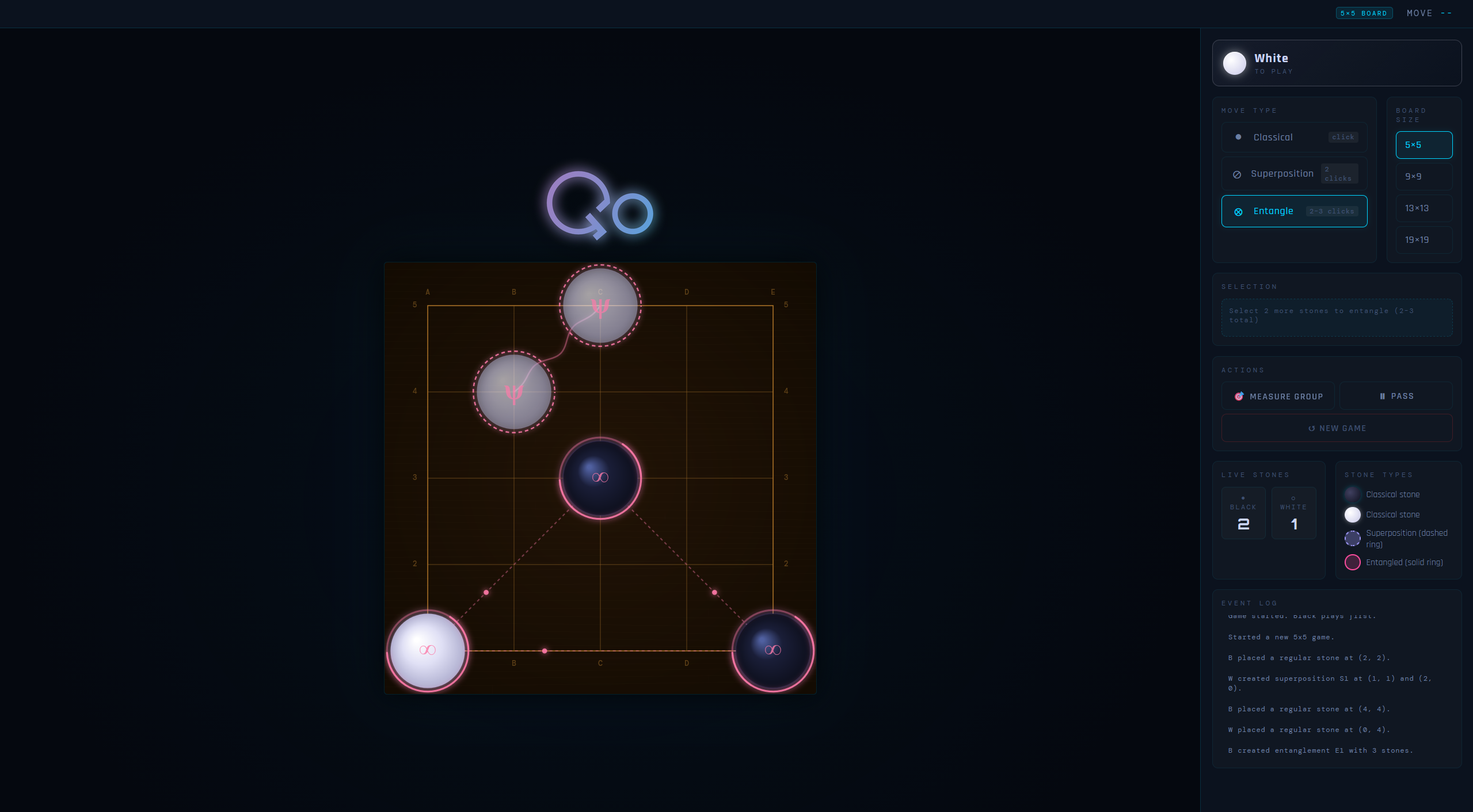
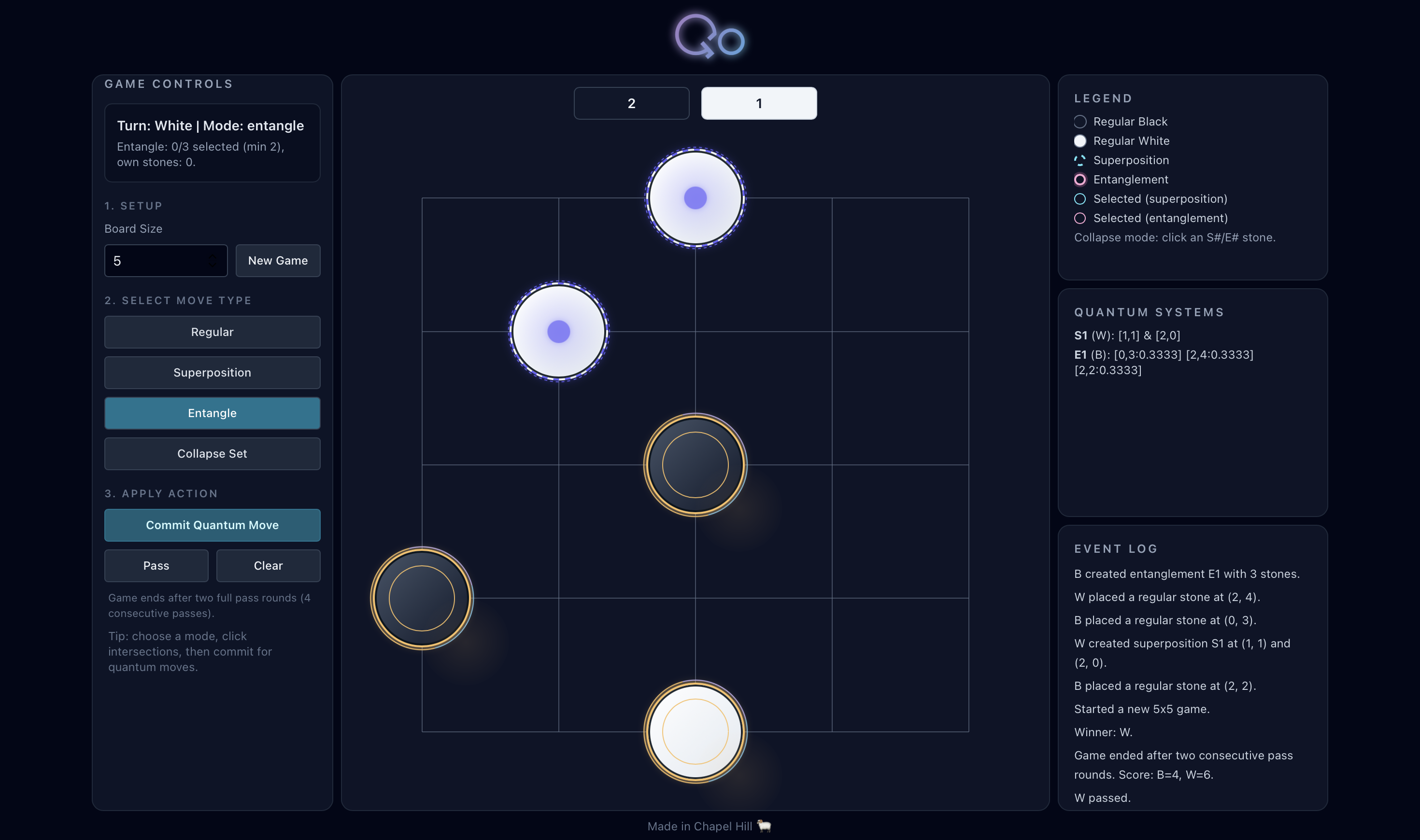
Stones can exist in superposition, meaning a single move may correspond to multiple possible positions at once. Rather than committing immediately to one outcome, the game tracks several potential board configurations simultaneously. Over time, these possibilities evolve based on player actions.
Qo also introduces entanglement between stones. Certain moves create dependencies between positions on the board, so that resolving one part of the game can directly affect another. This creates non-local strategic effects that do not exist in classical Go.
At key moments, the game performs a measurement during capture moves through quantum tunneling, collapsing the superposition into a single classical board state. The outcome is not purely random, it is influenced by the structure of the game and prior decisions, rewarding players who manage uncertainty effectively.
By combining these mechanics, Qo transforms Go into a hybrid of strategic planning and uncertainty management, where players must reason not just about the current board, but about the space of all possible boards.
How we built it
We structured Qo around three core layers:
Game Engine (Classical + Quantum State Layer) We represent the board as a collection of possible states rather than a single configuration. Inspired by quantum simulators (which track amplitudes across basis states) , we implemented:
State branching for superposition moves Probability tracking for each configuration Collapse rules triggered by measurement events
Quantum Mechanics Abstraction We mapped game mechanics to quantum analogues:
Placement → state initialization Linking stones → entanglement constraints Conflict resolution → measurement
We intentionally avoided full Hilbert space simulation (which scales exponentially) and instead used structured probabilistic representations to keep gameplay tractable.
UI / Player Feedback Layer A major focus was making invisible quantum behavior visible through
- Visual indicators for superposition (multi-state stones)
- Entanglement links between board positions
- Collapse animations showing measurement outcomes
This ensures players can reason about quantum effects without needing formal training.
Challenges we ran into
One of the biggest challenges was avoiding the trap of “just randomness.” A naive implementation turns superposition into coin flips, which loses the essence of quantum mechanics.
We had to carefully design:
Correlated outcomes (entanglement vs independent randomness) Consistent collapse rules so gameplay remains fair and predictable State explosion control, since the number of possible boards can grow exponentially
Another major challenge was UX: quantum mechanics is abstract, so we needed intuitive visual metaphors that didn’t mislead players.
Accomplishments that we're proud of
We’re particularly proud that Qo moves beyond probabilistic mechanics into structured quantum-inspired game play, successfully integrates entanglement as a strategic resource, maintains the strategic depth of Go while introducing new dimensions of play, and makes complex quantum ideas accessible through interaction rather than explanation.
What we learned
We learned that translating physics into game play requires abstraction, not simulation. Faithfully simulating quantum systems is computationally expensive, but capturing their principles is achievable with clever design.
We also learned game design is as much about communication as mechanics. Quantum concepts like entanglement only become meaningful when they affect decisions. Simplicity in rules leads to deeper emergent complexity.
What's next for Qo
There are several exciting directions going forward:
- Incorporate quantum error correction mechanics Introducing redundancy and recovery rules inspired by stabilizer codes
- Hardware-inspired modes Different rule sets based on real quantum systems (ion traps, superconducting qubits, etc.)
- Multiplayer + competitive balancing Ensuring fairness despite probabilistic elements
- True circuit-based gameplay Allowing players to construct “quantum circuits” that influence the board evolution
- Simulation backend upgrades Potential integration with more formal quantum frameworks for richer state evolution
- Incorporate leading research to make quantum advantage in gameplay possible When FTQC (fault-tolerant quantum computers) backends become available, we want to integrate strategies in quantum learning (e.g. https://github.com/haimengzhao/quantum-oracle-sketching) to show quantum advantage within strategy of the game itself
Ultimately, we want Qo to evolve into both a game and an educational tool. To graduate to a research-level project, we will need to implement our game with new research that hasn't been demonstrated yet in game play!
Built With
- css
- html
- javascript
- python
- qiskit

Log in or sign up for Devpost to join the conversation.