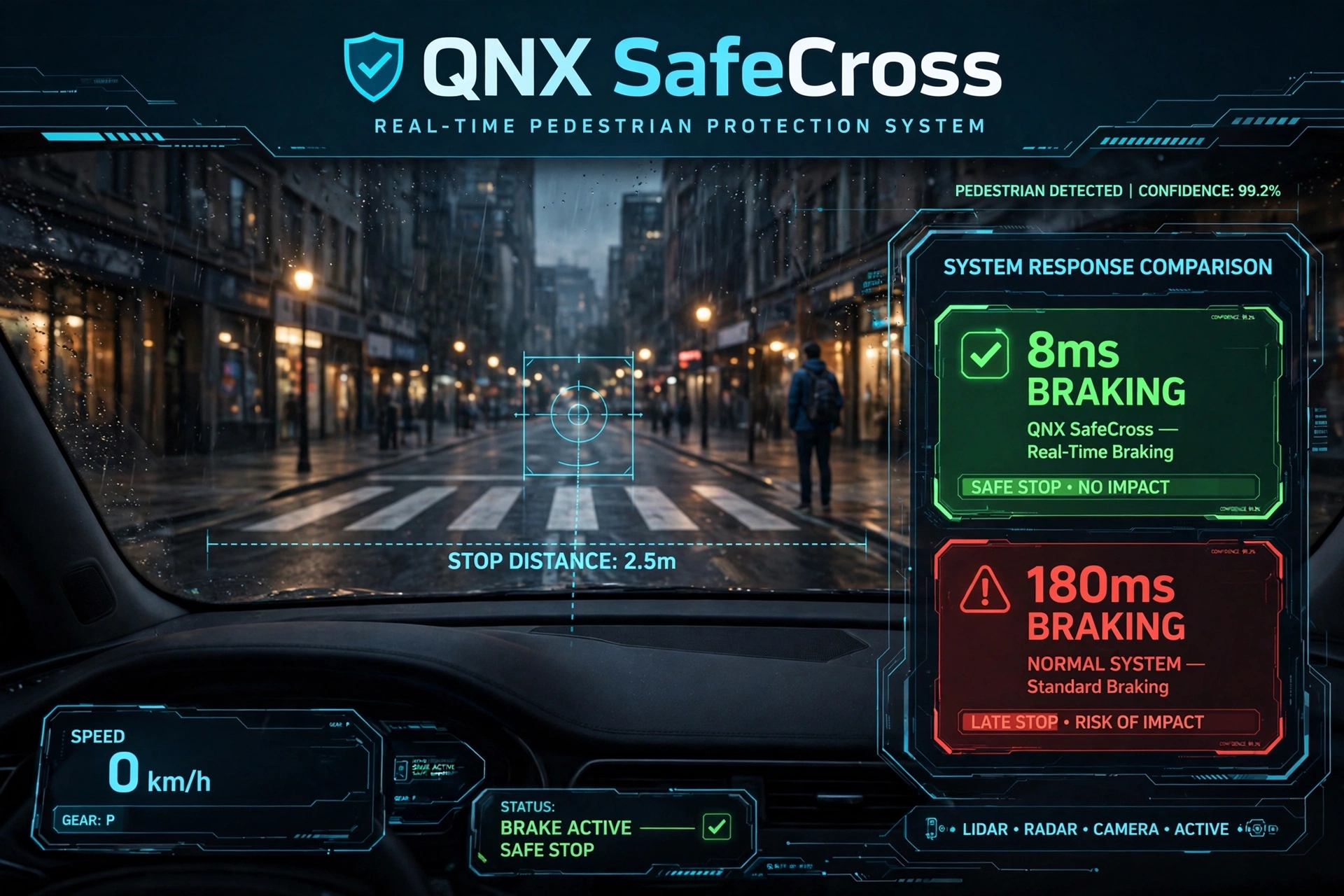
Inspiration Every year, thousands of pedestrians are killed because cars react too late. A human needs 1.5 seconds to react. A normal system needs 200ms+. In a city street, that delay is the difference between life and death.
What it does QNX SafeCross is a real-time pedestrian protection system built on QNX principles. A camera sensor detects a pedestrian entering the road, and a high-priority QNX process triggers emergency braking in under 10ms - deterministically, every time.
The live demo shows a side-by-side comparison:
- Normal System: 180ms delay, car hits pedestrian
- QNX SafeCross: 8ms delay, car stops safely 2.5m before
How we built it We simulated the QNX microkernel architecture: sensor input, perception, decision, and braking run as separate isolated processes with priority-based scheduling. The critical braking task always preempts non-critical tasks like infotainment, just like real QNX in cars.
Frontend: Interactive simulation with real-time latency graph Logic: Priority scheduler + deterministic braking model
Challenges we ran into Making latency truly deterministic and proving that infotainment can never block braking.
What we learned Why QNX is trusted in 255M+ cars: safety is not about being fast on average, it's about being fast every single time.
What's next V2X integration so cars warn each other, and night-time / rain detection.
