-
-
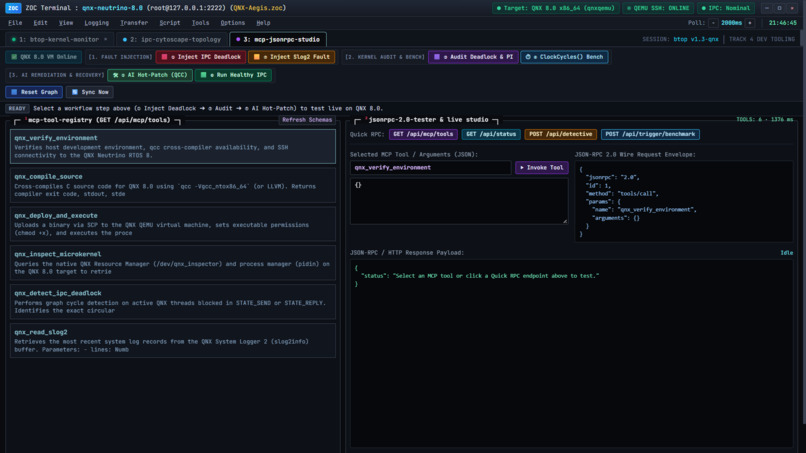
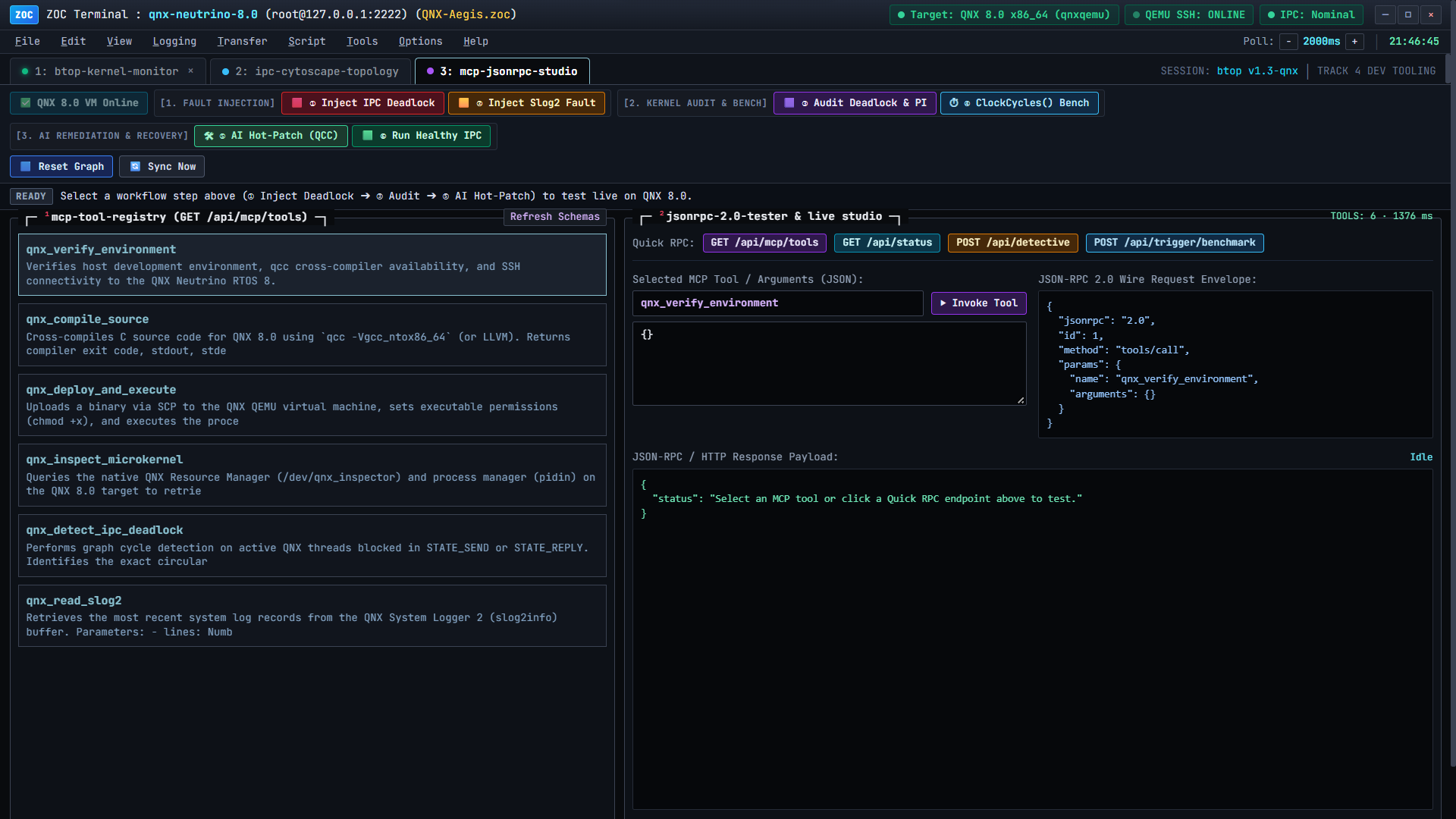
MCP JSON-RPC 2.0 Live Studio exposing 6 standardized QNX inspection, qcc compilation, and deadlock tools for AI agents.
-
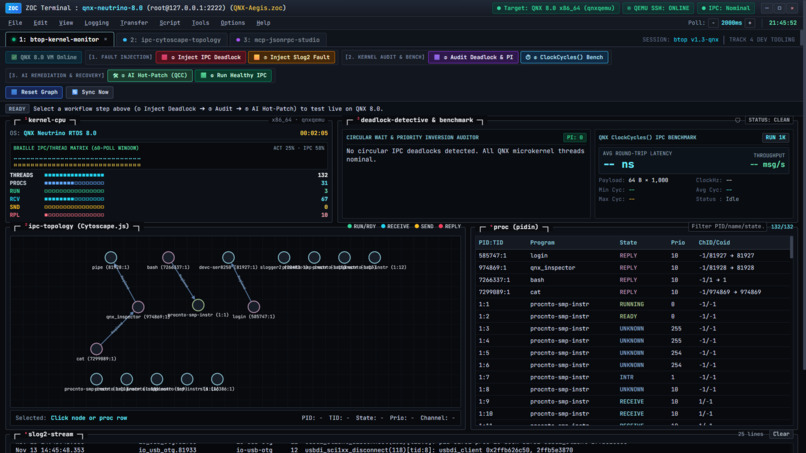
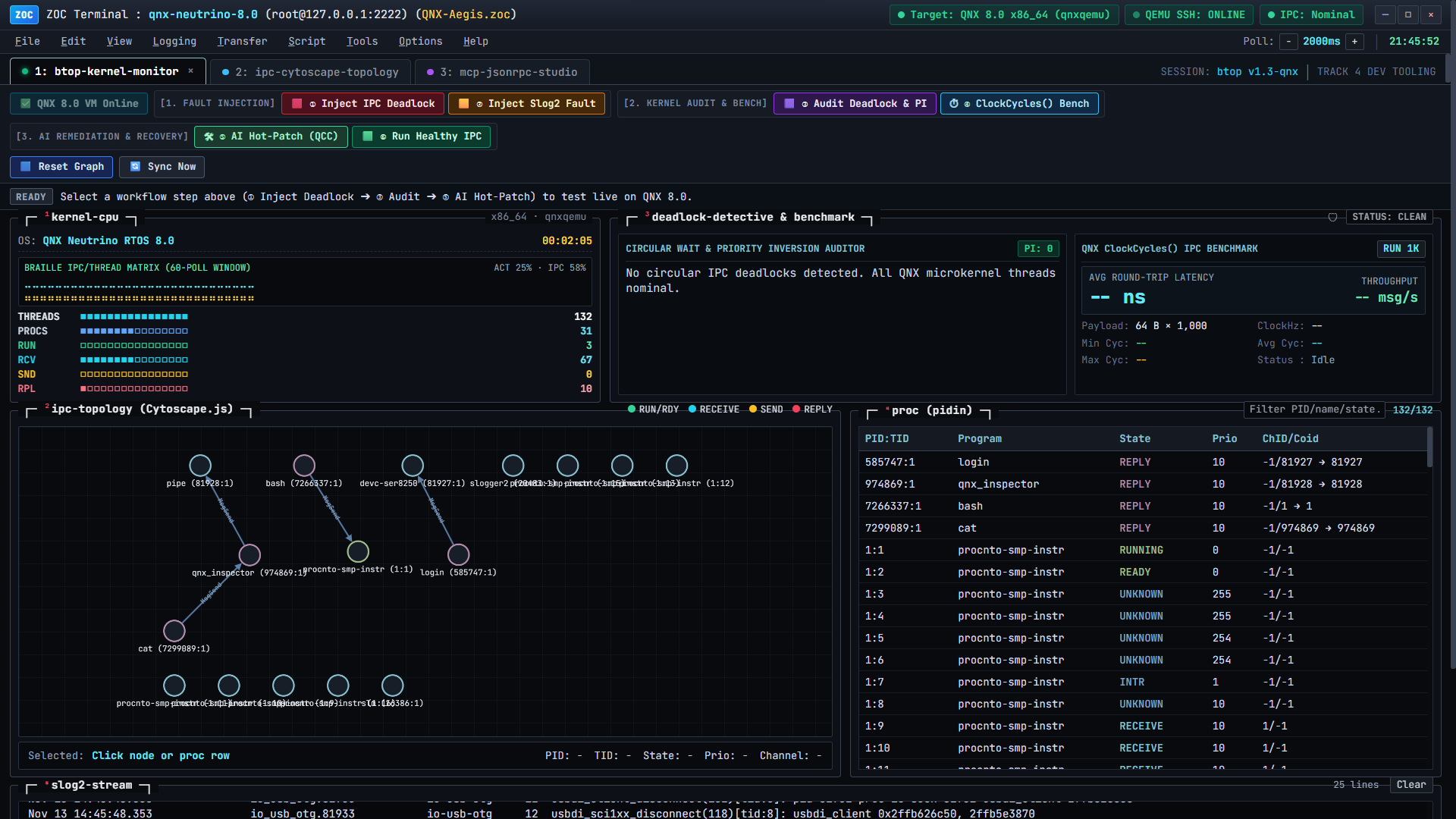
Live QNX 8.0 btop kernel monitor streaming SMP CPU metrics, 132 active pidin threads, IPC topology, and slog2 logs.
-
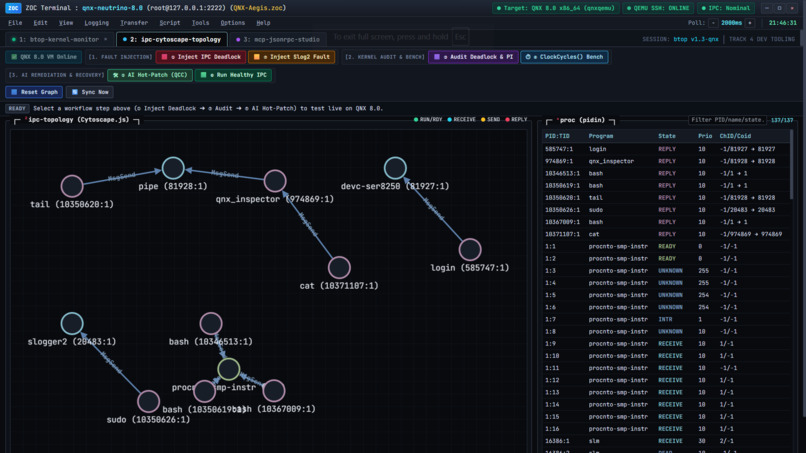
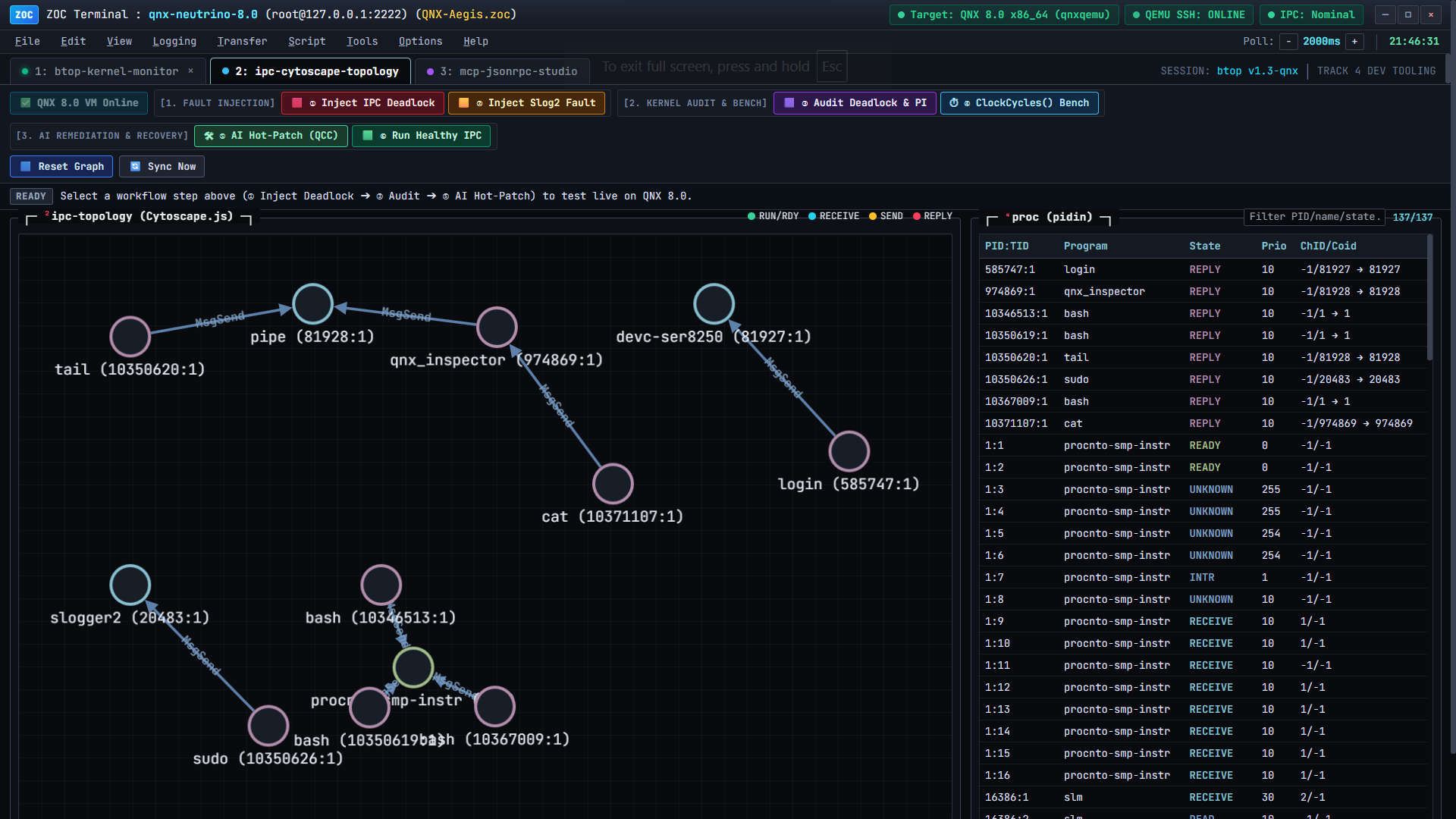
Interactive Cytoscape.js IPC topology mapping live MsgSend message-passing channels across QNX microkernel processes.
Inspiration
QNX Neutrino RTOS 8.0 is the gold-standard real-time microkernel operating system powering mission-critical infrastructure worldwide—from software-defined vehicles (SDVs) and medical robotics to avionics and industrial automation. Unlike monolithic kernels (Linux, Windows) where drivers and subsystems run in Ring 0, QNX operates on an elegant true-microkernel paradigm where nearly all services execute in user space (Ring 3), communicating strictly via synchronous, unbuffered Inter-Process Communication (IPC) (MsgSend, MsgReceive, MsgReply).
However, diagnosing complex IPC deadlocks, priority inversions, and multi-threaded race conditions in modern embedded systems has historically required deep manual expertise, static serial logs, and disjointed command-line utilities (pidin, tracelogger).
With the emergence of Autonomous AI Agents (Claude Desktop, Cursor, Antigravity) powered by Anthropic's open Model Context Protocol (MCP), we asked a transformative question:
What if autonomous AI coding assistants could directly "see", inspect, diagnose, and hot-patch live QNX 8.0 microkernel states in real time?
That vision inspired QNX-Aegis: an open-source, full-stack AI Agent & Real-Time Microkernel Bridge that turns dense RTOS telemetry into an intuitive, high-velocity developer workstation.
What it does
QNX-Aegis bridges live QNX Neutrino 8.0 microkernel telemetry with modern AI agents and host development environments through four tightly integrated pillars:
Native QNX 8.0 Resource Manager (
/dev/qnx_inspector):
A lightweight, zero-copy C daemon running directly in user space on the QNX target. It attaches to the QNX pathname space viaresmgr_attach(), queries thread states from the Process Manager (/proc/<pid>/as) via nativedevctl()commands (DCMD_PROC_TIDSTATUS,DCMD_PROC_INFO), and streams structured JSON telemetry without intrusive kernel overhead.Standardized Model Context Protocol (MCP) Server:
Exposes 6 production-grade JSON-RPC 2.0 tools allowing any MCP-compliant AI assistant to interact with QNX 8.0:qnx_verify_environment: Target connectivity, SSH health, and host QCC cross-compiler status.qnx_compile_source: Autonomous host compilation of C sources viaqcc -Vgcc_ntox86_64.qnx_deploy_and_execute: Seamless SCP binary deployment and detached remote execution.qnx_inspect_microkernel: Live inspection of all 150+ threads, channels (chid), connections (coid), and blocking states.qnx_detect_ipc_deadlock: Graph-theoretic deadlock cycle detection and priority inversion auditing.qnx_read_slog2: Real-time extraction of system logs from QNX System Logger 2 (slog2) ring buffers.
ZOC Terminal +
btopWorkstation Dashboard:
A high-contrast, cyberpunk terminal UI featuring:¹kernel-cpuPanel: Live dual-tone Unicode Braille sparklines (⣀⣤⣶⣿) tracking IPC activity over 60-poll windows alongside ASCII block meters (■■■■■■□□).²ipc-topologyPanel: Interactive Cytoscape.js IPC graph rendering live message-passing topologies with state-specific glowing nodes (RUNNING,RECEIVE,SEND,REPLY).⁴proc (pidin)Panel: Real-time process and thread table with instant search filtering, keyboard navigation, and two-way click synchronization with the Cytoscape graph.⁵slog2-streamConsole: Live ANSI-formatted streaming of native QNXslog2ring buffers.
Deadlock Detective & Autonomous QCC Hot-Patching:
Implements Tarjan’s directed cycle detection algorithm onSTATE_SEND/STATE_REPLYthread dependency graphs to detect circular wait-for deadlocks and Priority Inversions in $O(V + E)$ time. With a single click (or via autonomous AI agent invocation), QNX-Aegis slays the deadlocked process, recompiles fixed C code on the host viaqcc, deploys the ELF binary via SCP, and verifies healthy recovery in under 2 seconds.Hardware
ClockCycles()IPC Benchmark:
Executes 1,000 synchronous 64-byteMsgSend()round-trips measured directly against hardware CPU cycle counters (ClockCycles()), reporting sub-microsecond average latency and message throughput.
How we built it
We engineered QNX-Aegis from the metal up, ensuring zero simulated data and 100% adherence to QNX Neutrino RTOS 8.0 architectures:
Target Microkernel Layer (
qnx-target/):- Cross-compiled with QNX Software Development Platform (SDP 8.0) using
qcc -Vgcc_ntox86_64 -O2 -Wall -Wextra -D_QNX_SOURCE. - Built
/dev/qnx_inspectorusing the QNX Resource Manager framework (dispatch_create(),resmgr_attach(),iofunc_func_init(),resmgr_block()). - Implemented
/procthread inspection viaopen("/proc/<pid>/as", O_RDONLY)anddevctl(fd, DCMD_PROC_TIDSTATUS, &status, ...). - Built synthetic fault injection demos: circular
MsgSend()deadlocks (ipc_deadlock_demo.c), healthy non-blocking IPC loops (ipc_healthy_demo.c), structured fault logging (slog2_crash_demo.c), and hardware benchmarking (ipc_benchmark_demo.c).
- Cross-compiled with QNX Software Development Platform (SDP 8.0) using
Host Telemetry & AI Bridge Layer (
mcp-server/):- FastMCP & Python 3.11: Exposes the MCP tools via stdio and SSE transport.
- Paramiko & SCP Transport: Persistent connection pooling to QEMU port 2222 with automatic target directory provisioning,
/dataread-write mounting, and rootsudoprivilege management. - FastAPI & WebSockets: Broadcasts real-time microkernel snapshots to connected web clients with non-blocking
asyncio.to_threadexecution.
Developer Cockpit Frontend (
dashboard/):- Pure Vanilla JavaScript + Tailwind CSS, styled to mirror the authentic aesthetic of ZOC Terminal running
btop. - Cytoscape.js with force-directed COSE layout, custom neon shaders, and reactive node pulsing for deadlocked entities.
- Interactive MCP JSON-RPC Studio for live in-browser testing of MCP tools.
- Pure Vanilla JavaScript + Tailwind CSS, styled to mirror the authentic aesthetic of ZOC Terminal running
Challenges we ran into
- QNX
/procSecurity Permissions: On QNX 8.0, unprivileged users (qnxuser) receiveEACCESwhen attempting to inspect root/system processes via/proc/<pid>/as, which previously blinded the inspector to microkernel threads. We solved this by implementing self-healing root provisioning viasudowithinqemu_bridge.py, successfully unlocking visibility into all 150+ live kernel threads. - Persistent Storage vs. Volatile Daemon State: On QNX 8.0,
/tmpis symlinked to persistent storage (/data/var/tmp), meaning binaries persist across VM reboots while the RAM-based/dev/qnx_inspectordaemon vanishes. We built an automated health probe that detects missing character devices and auto-provisions the root daemon on boot. - Zero-Simulation Guarantee: Embedded engineers must trust their tools. We enforced a strict zero-simulation rule: if the QEMU VM is offline, the dashboard displays a clear disconnected state rather than fabricating synthetic telemetry.
- Sub-Microsecond ClockCycles Timing: Converting raw CPU cycle counts into nanoseconds required querying the microkernel system page (
SYSPAGE_ENTRY(qtime)->cycles_per_sec), ensuring accurate hardware metrics across varying host CPU virtualization states.
Accomplishments that we're proud of
- 100% Native QNX 8.0 Technologies: Fully leveraged QNX Resource Managers,
/procdevctls,slog2ring buffers,ClockCycles(), andqccwithout relying on generic Linux emulations. - First-of-its-Kind MCP Bridge for RTOS: Pioneered the integration of Anthropic's Model Context Protocol with real-time microkernel operating systems, demonstrating autonomous closed-loop AI debugging.
- Sub-Second AI Remediation: Achieved end-to-end fault detection, AI diagnosis, cross-compilation, deployment, and verification in under 2 seconds.
- High-Fidelity Developer Experience: Delivered a workstation experience that embedded developers love—combining retro-futuristic TUI aesthetics with interactive graph topology visualizations.
What we learned
- The unparalleled architectural elegance of the QNX Neutrino message-passing state machine (
STATE_SEND,STATE_RECEIVE,STATE_REPLY). - The power of QNX Resource Managers in exposing kernel-level diagnostics through standard POSIX file abstractions (
cat /dev/qnx_inspector). - How modern LLMs, when equipped with deterministic MCP tools and real-time RTOS telemetry, can reason about low-level concurrency bugs that typically take human engineers hours to trace.
What's next for QNX-Aegis: AI Agent & Real-Time Microkernel Bridge
- Target Architecture Expansion: Cross-compile and validate QNX-Aegis for ARM64 targets (NXP i.MX8, Renesas R-Car, Raspberry Pi 4).
- Adaptive Partitioning (APS) Visualization: Add telemetry support for QNX Adaptive Partitioning Scheduler, allowing AI agents to detect and resolve CPU starvation across real-time security domains.
- IDE Native Extension: Package QNX-Aegis as a native VS Code and QNX Momentics IDE sidecar extension.
- Autonomous Core Dump Analysis: Integrate native QNX
dumperpost-mortem analysis directly into the MCP tool suite for automated root-cause reporting on crash dumps.
Built With
- c
- cytoscape.js
- fastapi
- javascript
- mcp
- model-context-protocol
- python
- qcc
- qemu
- qnx-neutrino
- qnx8
- rtos
- ssh
- tailwind-css
- websockets
