-
-
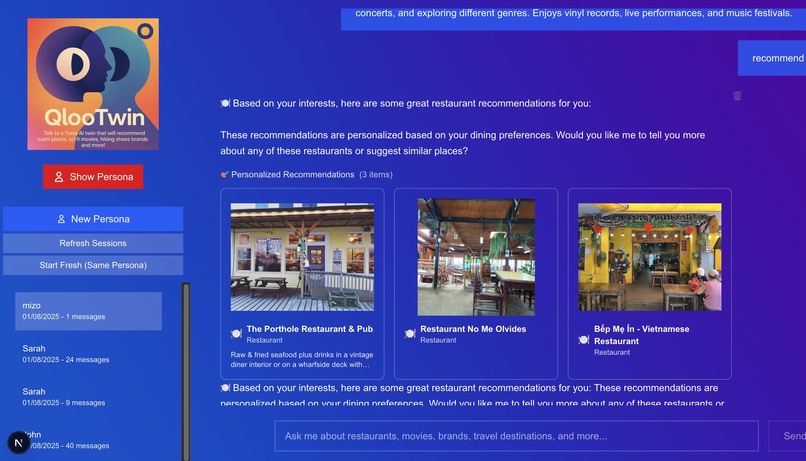
Screenshot from the app
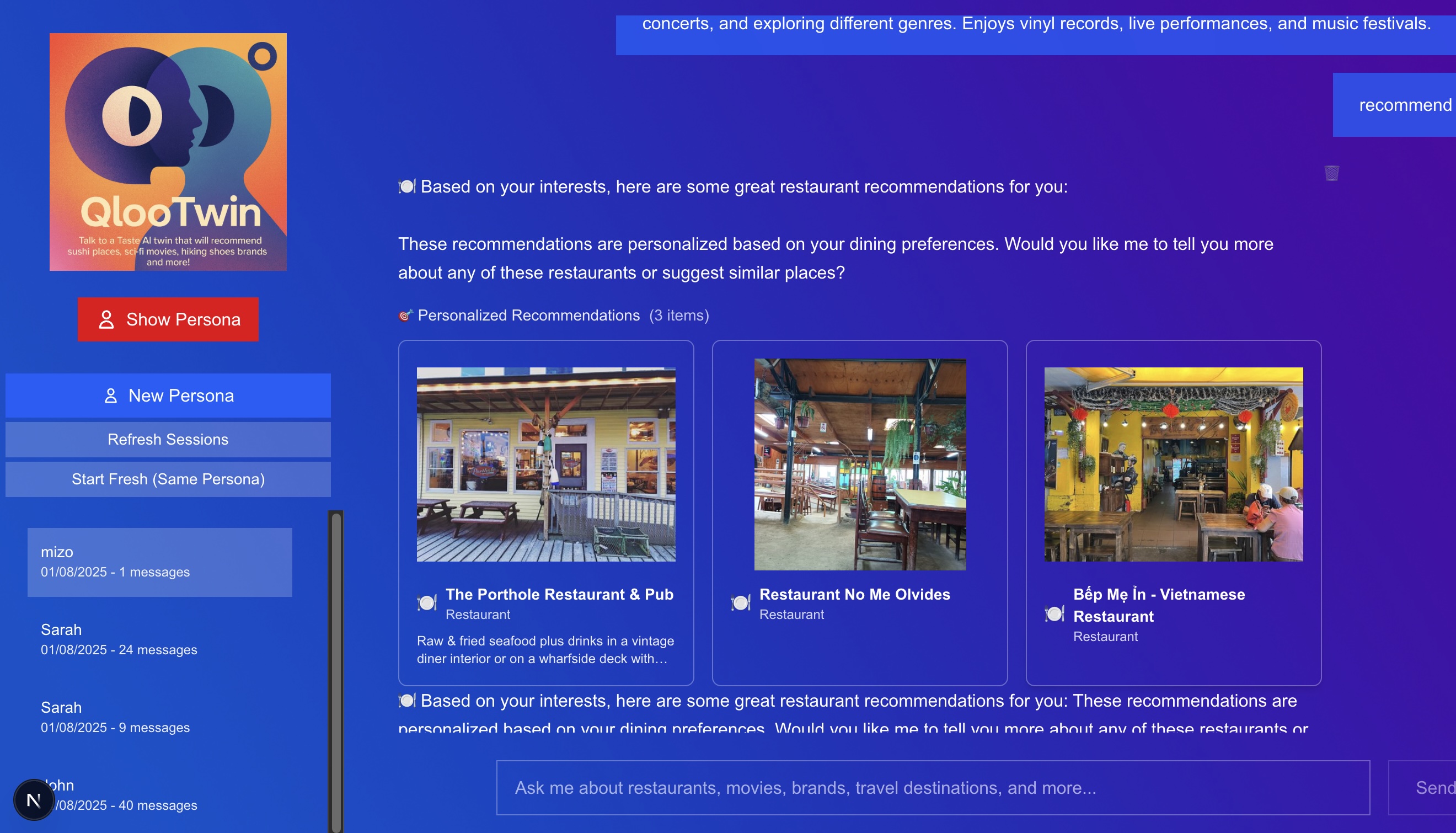
TLDR; In a 10-day coding sprint, I built QLooTwin, an AI cultural intelligence companion. It uses a custom AI agent system with the Qloo API to provide hyper-personalized recommendations for dining, movies, brands, and more, learning directly from user conversations. The app features a dynamic persona system and a polished "glass-morphism" UI, all built on Next.js, Google AI, and Prisma.
Inspiration
I wanted to build an AI that was less of a generic search engine and more of a "cultural twin"—a companion that truly understands your unique taste. The goal was to create an AI concierge that could translate a simple conversation into a world of perfectly tailored discoveries, moving beyond mainstream recommendations.
What it does
QLooTwin is an AI-powered companion that provides hyper-personalized recommendations across dining, entertainment, brands, travel, and more. It allows users to create dynamic personas, and its AI agent system analyzes conversations to automatically extract interests and refine its understanding of the user's preferences.
How we built it
This app was built in an intense 10-day sprint. The foundation is Next.js 14, TypeScript, and Tailwind CSS. The app's "brain" is a custom-built, modular agent system that uses Google AI for language analysis and the Qloo API for cultural intelligence data. We used Prisma and a SQLite database for memory, persisting chat sessions and user profiles. The polished "glass-morphism" UI was created to provide a visually rich and intuitive experience.
Challenges we ran into
- Vague Entity Types: The Qloo API sometimes returned generic entity types, which we solved by implementing our own intelligent type inference based on entity properties.
- Location Context Loss: Fallback API calls were losing location data, so we added explicit location preservation in all fallback scenarios to maintain relevance.
- Poor Text Contrast: Our initial black text was invisible against the background, so we switched all text to white with varying opacity for a clear visual hierarchy.
Accomplishments that we're proud of
- Modular Agent System: Building a multi-agent system from scratch to manage intent, memory, and API calls in an organized way.
- Polished UI/UX: Creating a visually striking and intuitive glass-morphism interface with rich recommendation cards.
- Dynamic Persona Intelligence: The AI's ability to automatically extract interests from conversations and add them to a user's profile, making the experience feel truly personal.
What we learned
Signal / Filter / Entitiy etc. Qloo is great engine, like a comb of wool with one side signals and other filters. I was thinking about the metaphor of what Qloo really does when I started understanding. As we say it's good to know how it goes.
Besides that, this project was a masterclass in the power of specialized APIs like Qloo's for building intelligent applications. I learned that a well-planned architecture (like our agent system) is crucial for managing complexity, and that user experience often comes down to small but critical details, like text color.
What's next for QlooTwin
Who knows how long Qloo Api Key will last :) Though I want to show it to a friends from marketing industry and then talk about next steps.
- Multi-language support for global users.
- Native iOS and Android mobile applications.
- Social features to share recommendations.
- Technical improvements like WebSocket integration for real-time updates and advanced caching.
Built With
- cursor
- gemini
- nextjs
- qloo
- vercel
- vercelaisdk

Log in or sign up for Devpost to join the conversation.