-
-
QlooSport Sync
Inspiration
The inspiration for QlooSport Sync came from the desire to make live sports commentary more engaging and tailored to individual fans. Traditional broadcasts offer a one-size-fits-all experience, but every fan has unique preferences—some love deep tactical analysis, others crave emotional highs, and some just want a good laugh. I wanted to harness the power of AI and user taste profiles to deliver commentary that feels like it was made just for you.
What I Learned
- Integrating LLMs for Real-Time Tasks: I learned how to use large language models (LLMs) to generate natural, context-aware sports commentary on the fly, adapting to different user styles.
- Streaming Data with Flask & SSE: Implementing Server-Sent Events (SSE) in Flask taught us about real-time data streaming and the challenges of keeping the UI in sync with backend events.
- Prompt Engineering: Crafting prompts that reliably produce specific, non-generic outputs from LLMs is both an art and a science. I iterated on our prompts to ensure the AI used real player and team names, not placeholders.
- User Experience: I explored how to make the UI intuitive, visually appealing, and responsive to live updates.
How I Built It
- Backend:
- Built with Python and Flask, simulating a live football match with a sequence of events.
- Commentary is generated for each event using an LLM (e.g., OpenAI, Gemini), with prompts tailored to the user's selected style (analytical, emotional, humorous, or balanced).
- Commentary is streamed to the frontend in real time using SSE.
- Text-to-speech (TTS) integration (EdgeTTS, gTTS, or ElevenLabs) can convert commentary to audio.
- Frontend:
- A modern, responsive web UI built with HTML, CSS, and vanilla JavaScript.
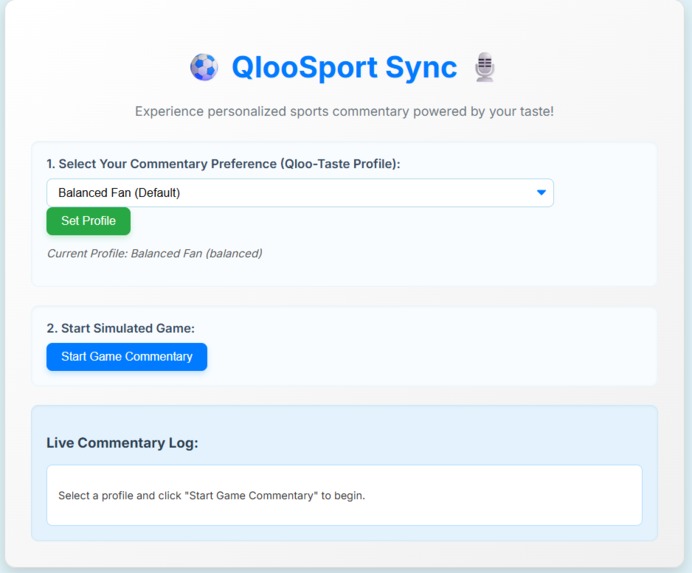
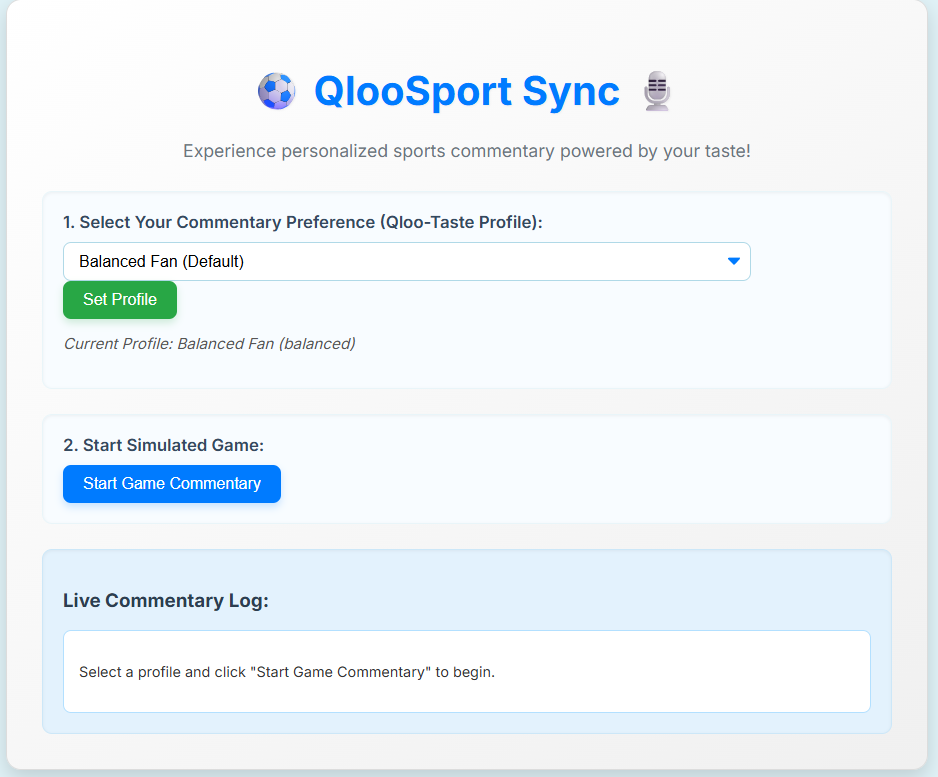
- Users select their preferred commentary style and start the game simulation.
- Commentary appears live in the UI as soon as it is generated.
- Personalization:
- User taste profiles are simulated via a mock Qloo API, influencing the style and focus of the commentary.
Challenges I Faced
- Real-Time Streaming in Flask: Flask's built-in server isn't optimized for SSE, so I had to carefully manage streaming responses and UI updates.
- Prompt Specificity: Early LLM outputs were generic and filled with placeholders. I refined our prompts to force the use of actual event data, which greatly improved realism.
- Synchronizing Audio and Text: Ensuring that audio playback matched the live commentary stream required careful timing and error handling.
- Simulating Realistic Events: Creating a believable sequence of football events with enough metadata for rich commentary was a challenge.
- User Experience: Making the UI both beautiful and functional, with instant feedback and no lag, took several iterations.
What's next for QlooSport Sync
- Live Data Integration: Connect to real sports APIs (e.g., football-data.org, ESPN, or official league feeds) to provide commentary for actual live matches, not just simulations.
- User Accounts & Persistent Profiles: Allow users to create accounts, save their taste profiles, and track their favorite teams and players.
- Advanced Personalization: Use machine learning to learn from user feedback and further refine commentary style and focus over time.
- Audio Streaming: Stream live audio commentary in sync with the text, and support multiple languages and voices.
- Mobile App: Build a mobile version for on-the-go personalized commentary.
- Social & Community Features: Let users share memorable commentary moments, vote on the best lines, or interact with other fans in real time.
- Stochastic Event Simulation: Replace the fixed event list with probabilistic models (e.g., Markov chains) for more dynamic and unpredictable match simulations.
- Cloud Deployment: Deploy both frontend and backend to scalable cloud platforms for global access.
- Accessibility: Add features for visually impaired users, such as screen reader support and high-contrast modes.
Conclusion
QlooSport Sync demonstrates how AI and personalization can transform the sports viewing experience. By combining real-time event simulation, LLM-powered commentary, and user taste profiles, I created a prototype that brings fans closer to the action—on their own terms.

Log in or sign up for Devpost to join the conversation.