-
-
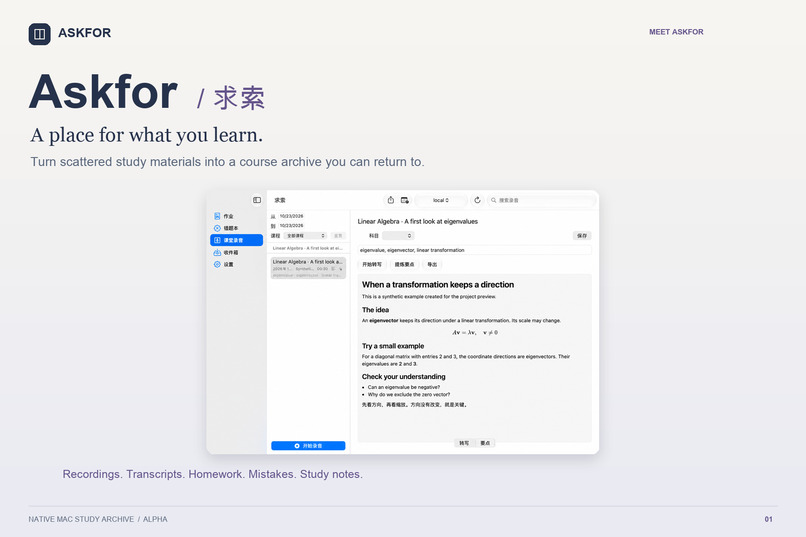
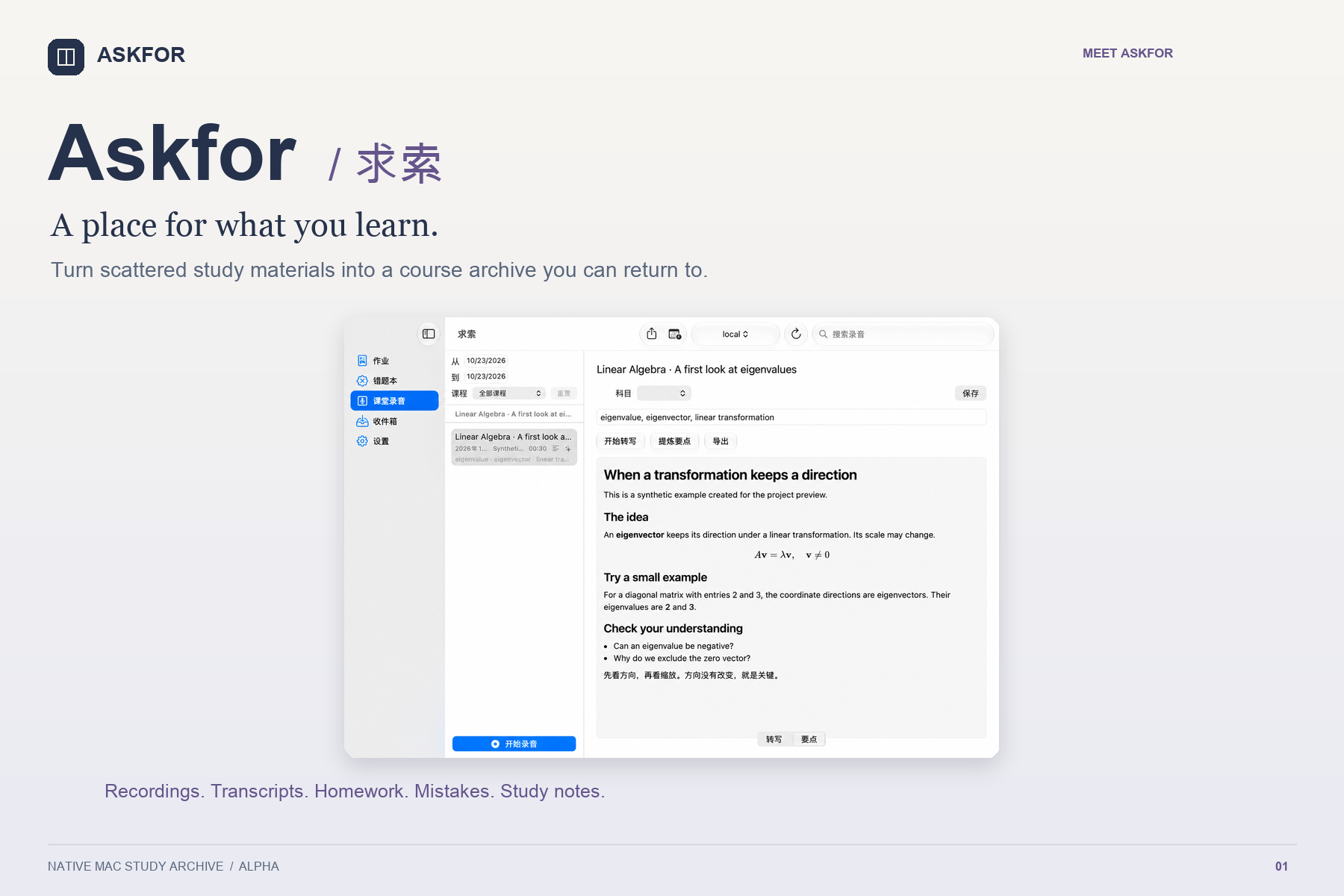
A place for what you learn: recordings, transcripts, homework and mistakes. App preview with synthetic study content.
-
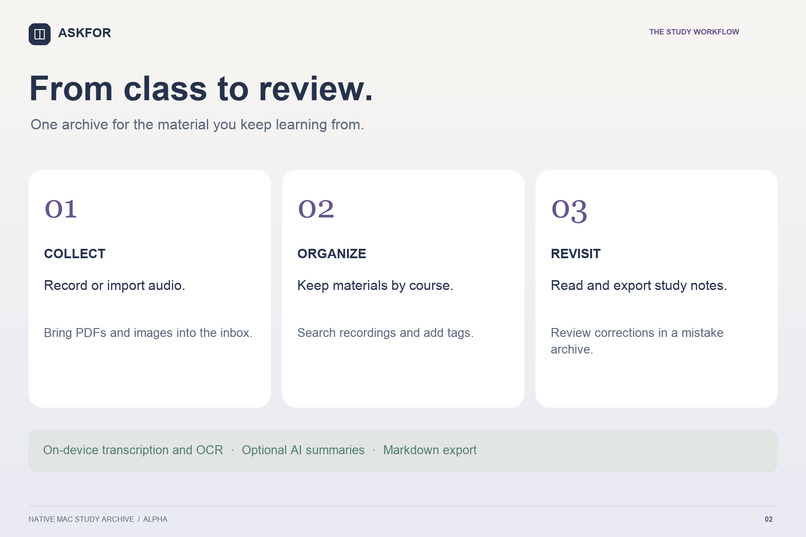
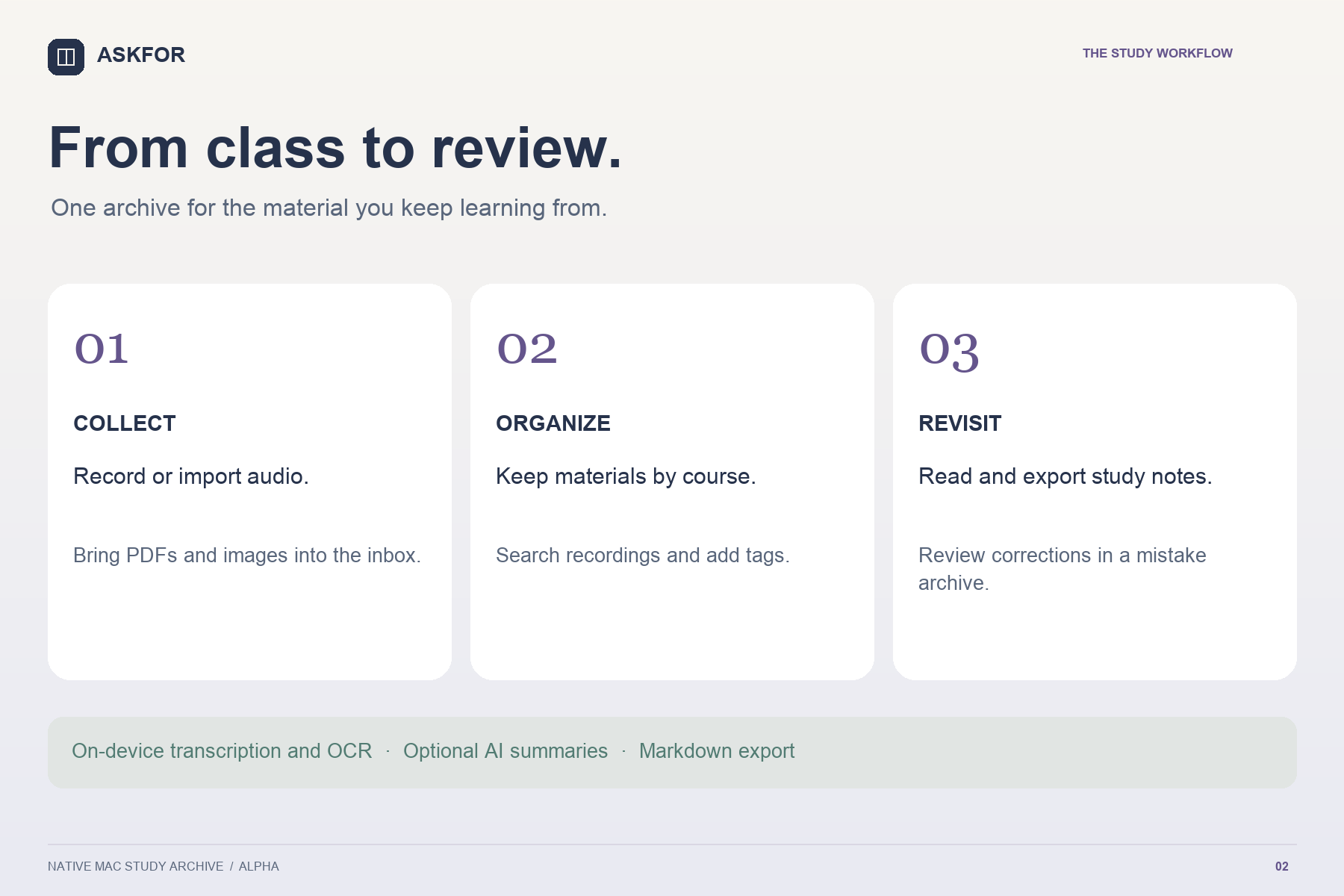
From class to review: collect materials, organize by course and tags, and return to notes and corrections.
-
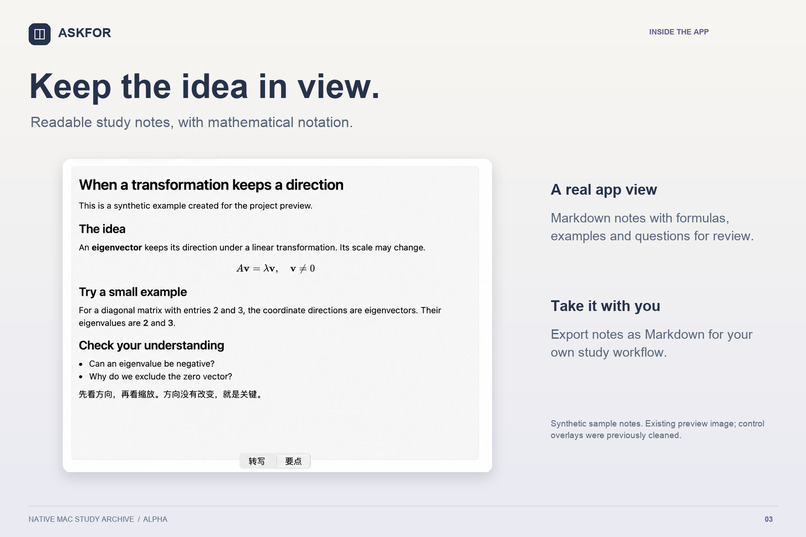
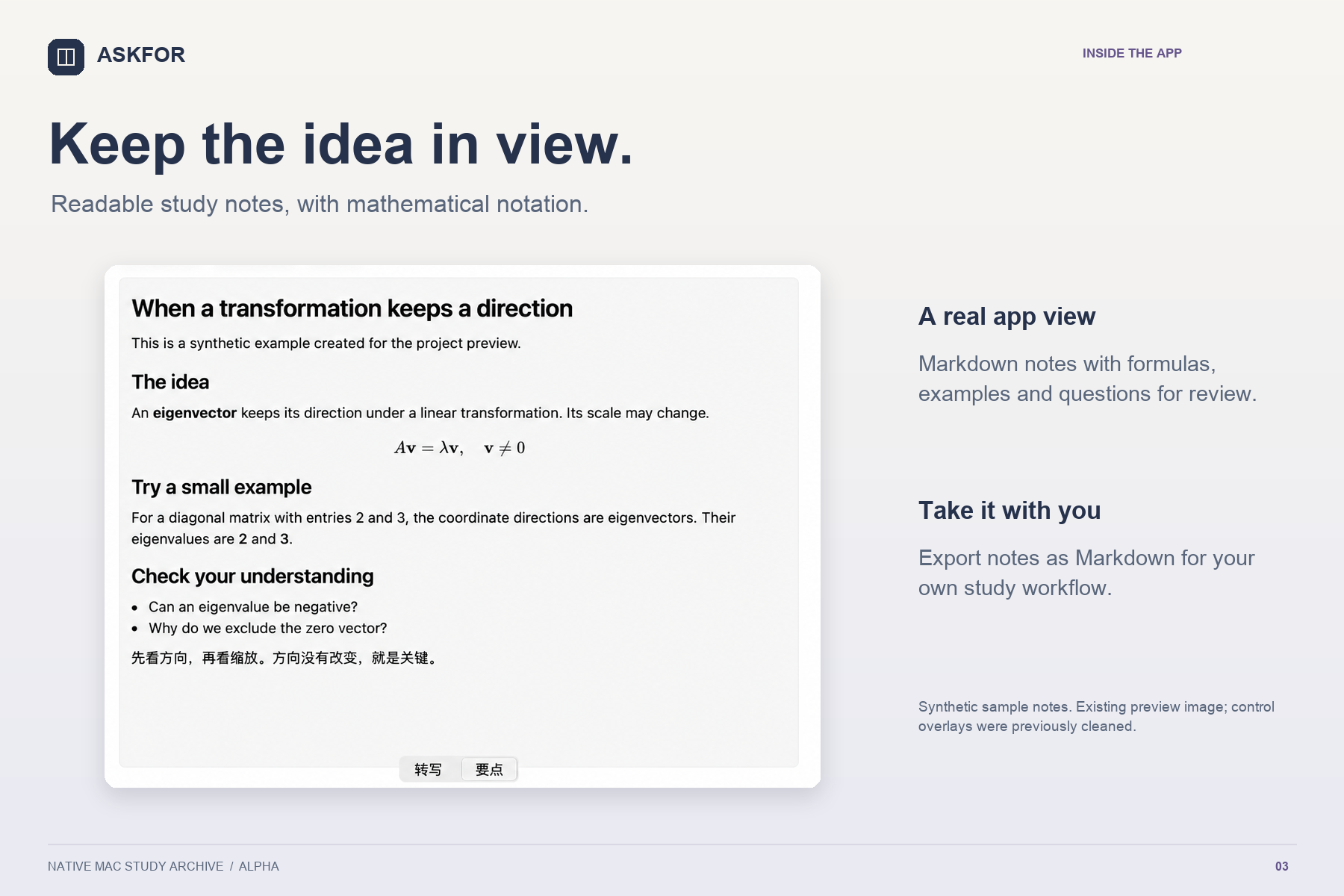
Synthetic study notes in the app, with mathematical notation. Existing preview cleaned of control overlays and pointer.
-
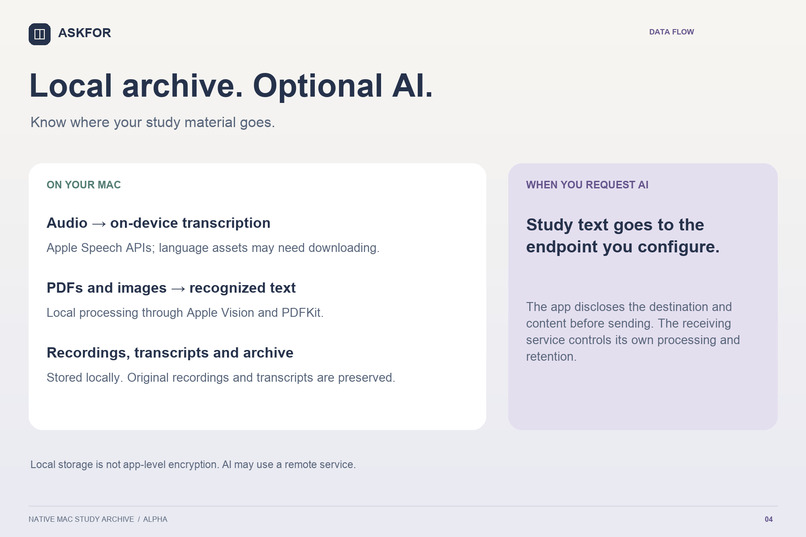
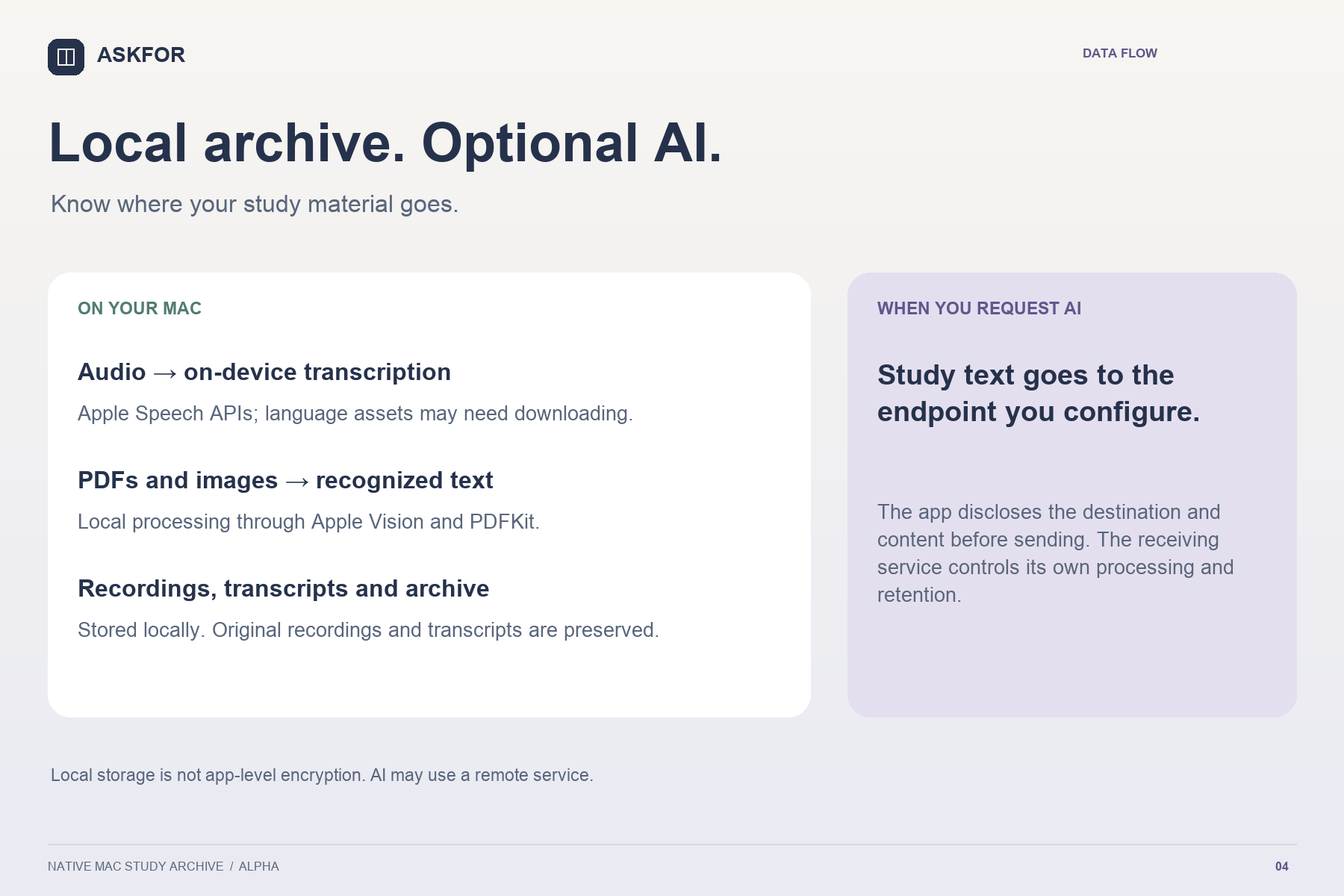
Local speech and OCR. Optional AI sends study text to your configured endpoint after disclosure.
-
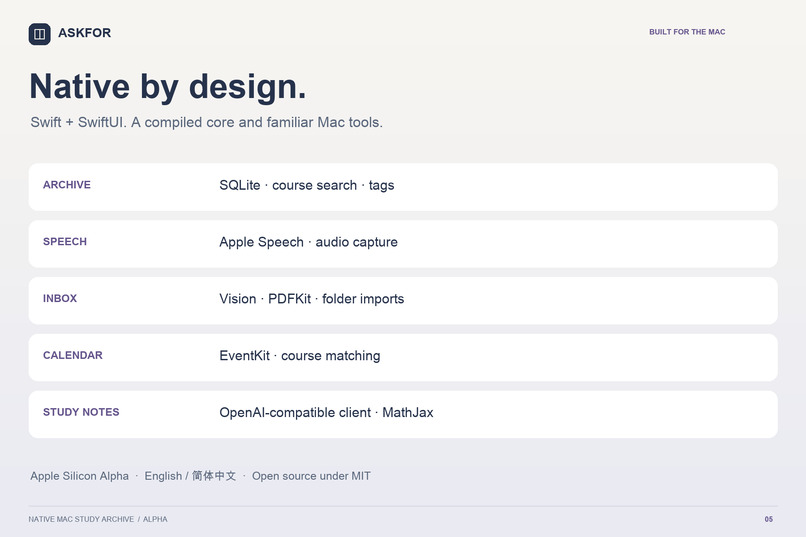
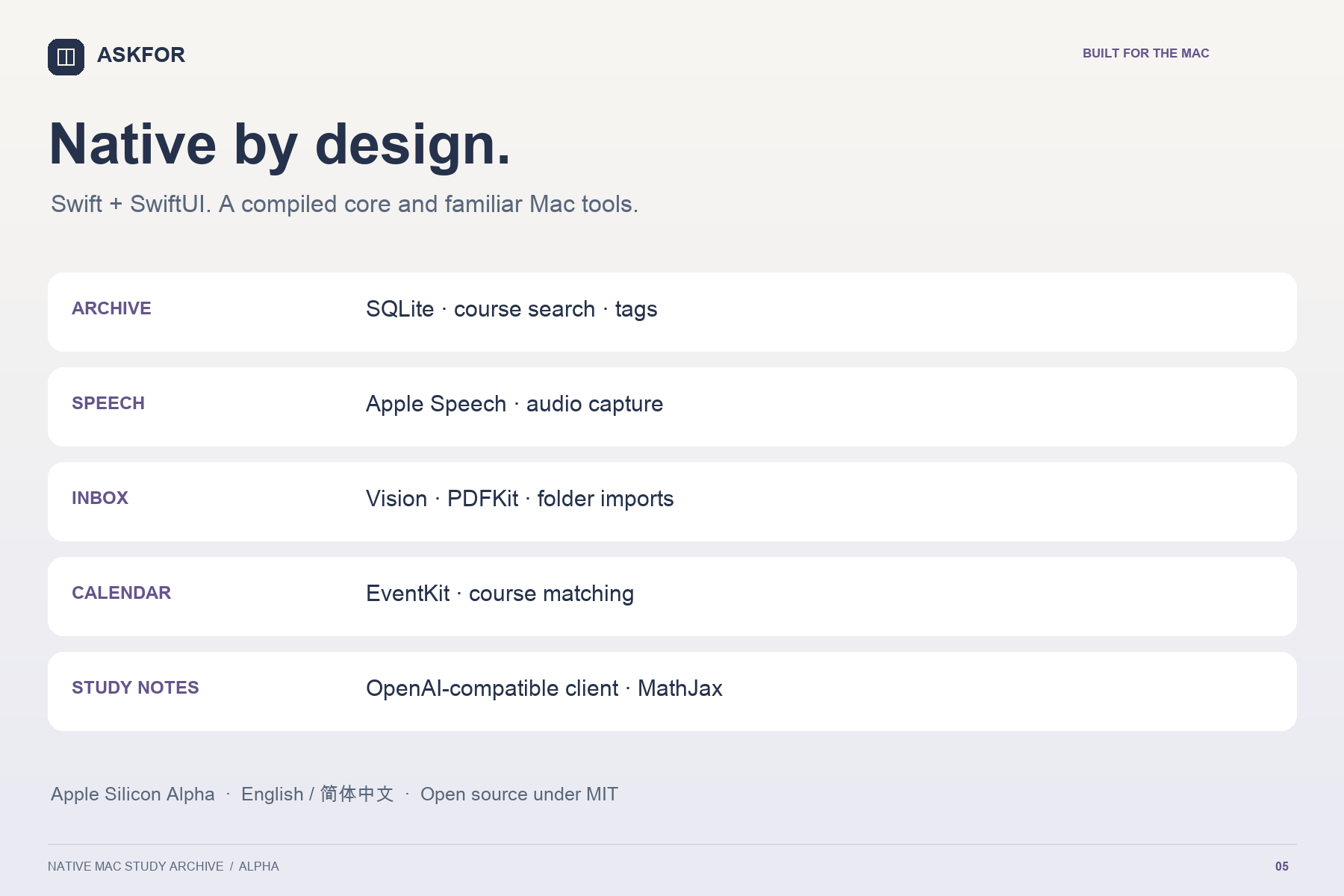
Native Swift and SwiftUI, with modules for the archive, speech, inbox, calendar and optional model connection.
Inspiration
A lecture ends, but learning does not. Recordings, notes, homework and corrections often end up in different places. Askfor gives those materials a home: a course archive that makes it easier to return to an explanation, revisit a mistake and keep building understanding.
The Chinese name, 求索, means to seek and explore. That is the spirit of the project: keeping useful material within reach while leaving the work of understanding with the learner.
What it does
Askfor is a native macOS application for collecting and revisiting study materials.
- Record or import audio and transcribe it using Apple's on-device speech frameworks.
- Organize recordings by course and tags, and search the archive.
- Collect PDFs and images through a folder inbox and recognize their text locally.
- Keep questions, incorrect answers and corrections in a mistake archive.
- Optionally generate study notes through an OpenAI-compatible model endpoint.
- Read Markdown notes with mathematical notation and export them as Markdown.
- Optionally match recordings to classes through macOS Calendar.
The interface supports English and Simplified Chinese, following macOS language preferences.
How it was built
Askfor uses Swift and SwiftUI, with a SQLite archive at its core. Five libraries separate archive and search logic, audio and speech processing, document imports, calendar matching and the optional model client.
Apple Speech provides on-device transcription; Vision and PDFKit handle document text recognition; EventKit supports calendar matching. Study notes render mathematical notation through bundled MathJax. The optional model client connects to a user-configured OpenAI-compatible API.
The app runs without an Electron shell, a Python runtime or a separate Whisper server. System speech assets may download when needed.
Challenges
Different study materials need different context. Audio needs its source recording and transcript; mistakes need both the original answer and the correction; mathematical notes need readable formulas and a portable export format.
Another challenge is making optional AI understandable. Recording, local processing and sending text to a model are separate actions. Askfor asks for recording authorization, discloses the AI destination and study content before sending, and preserves source recordings and transcripts after summarization.
Accomplishments
The project has a downloadable Apple Silicon Alpha, a modular native implementation, English and Simplified Chinese interfaces, and an open-source MIT release.
The release documentation records 127 passing tests, one skipped live-microphone test and no failures in its October 24, 2026 verification. UI checks covered isolated synthetic archives, note rendering, export and confirmation/cancellation paths. Full live recording and speech recognition, external model services and earlier supported macOS versions were not exercised in that documented verification.
What I learned
A study tool needs to make returning to material easy. Capture is only the beginning; organization, readable notes, corrections and export all affect whether an archive remains useful.
A local archive and optional AI processing also have different data flows. Clear controls and preserving source material are part of the product design.
What's next
Priorities include broader end-to-end validation of recording, transcription and model connections; testing across supported macOS versions; improving note-refresh behavior; and gathering feedback on course organization and review.
Try the Alpha
Download Askfor for Apple Silicon · Explore the source
The downloadable Alpha targets Apple Silicon and macOS 15 or later. It is ad-hoc signed and has not been notarized by Apple; see the release instructions for first launch and known limitations.
Recordings, transcripts, OCR and the archive are stored or processed locally. Optional AI sends study text and relevant metadata to the configured endpoint after disclosure. The receiving service's processing and retention policies apply. Local storage does not add app-level encryption.
The gallery and overview video use synthetic study content. The app preview was previously cleaned to remove screen-control overlays and the pointer. The video is a narrated product overview, not a live transcription or model-call recording; its narration is synthesized.


Log in or sign up for Devpost to join the conversation.