Qinance at a Glance
Qinance is already operating as a real business, not just a prototype.
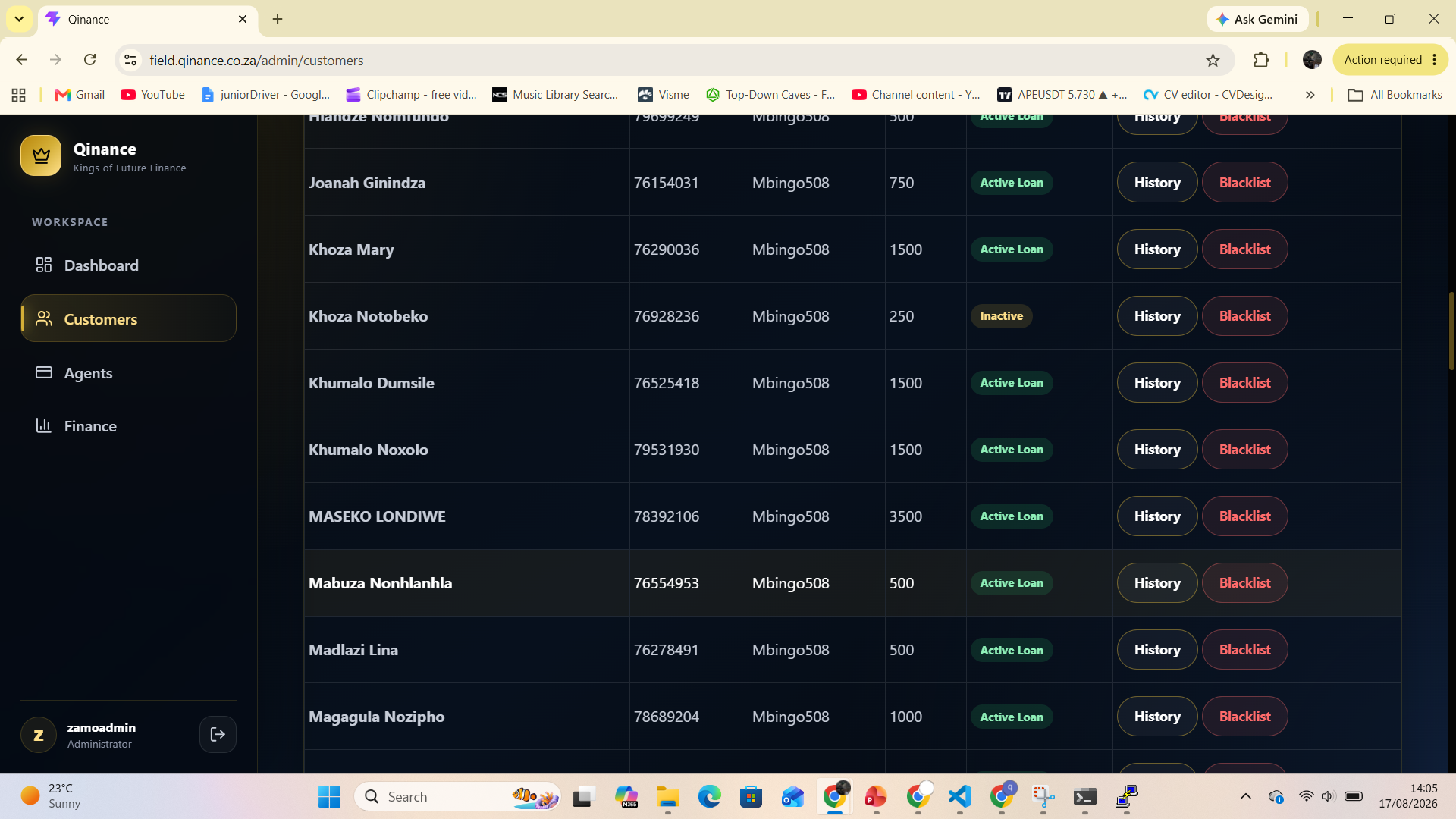
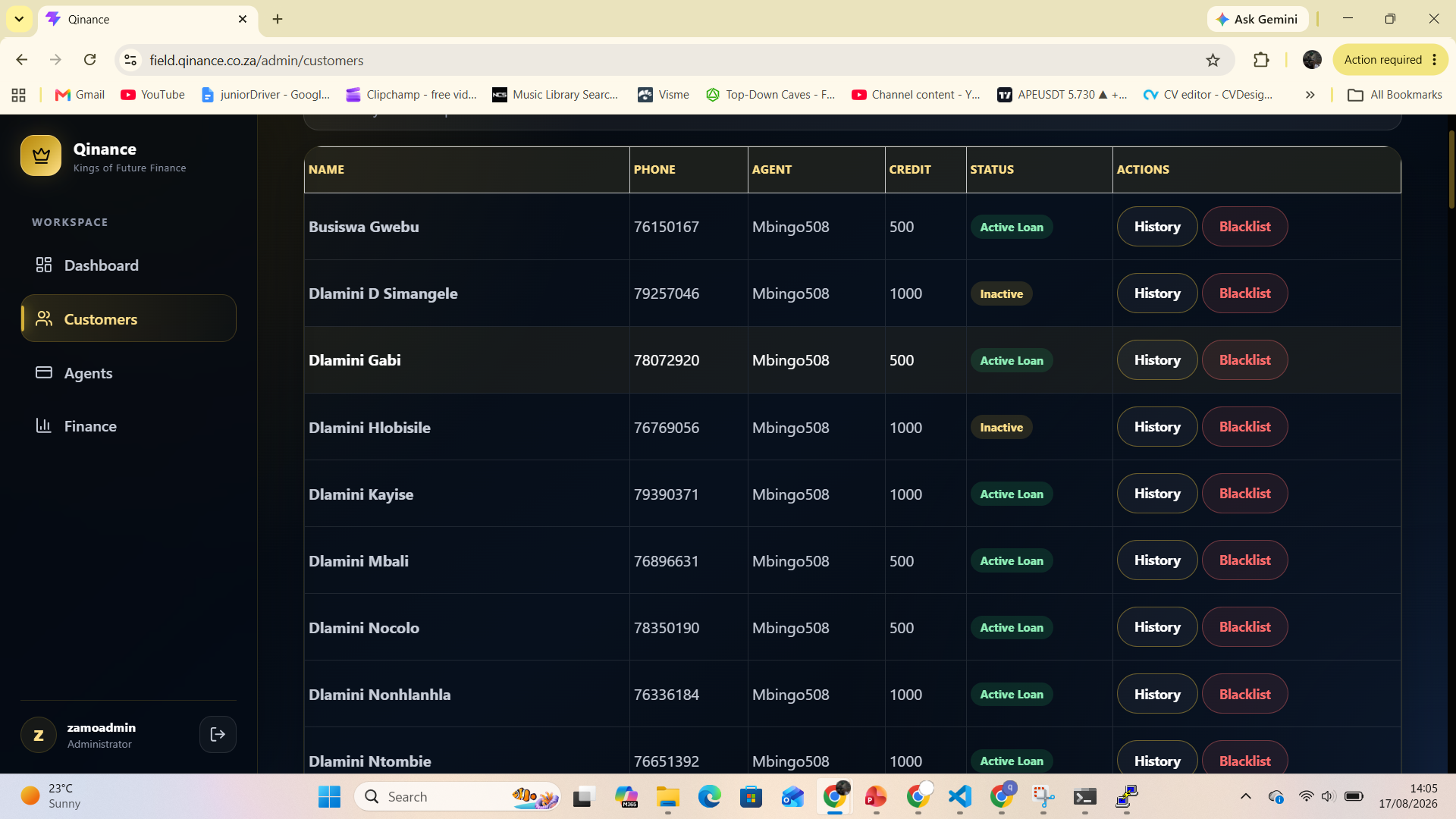
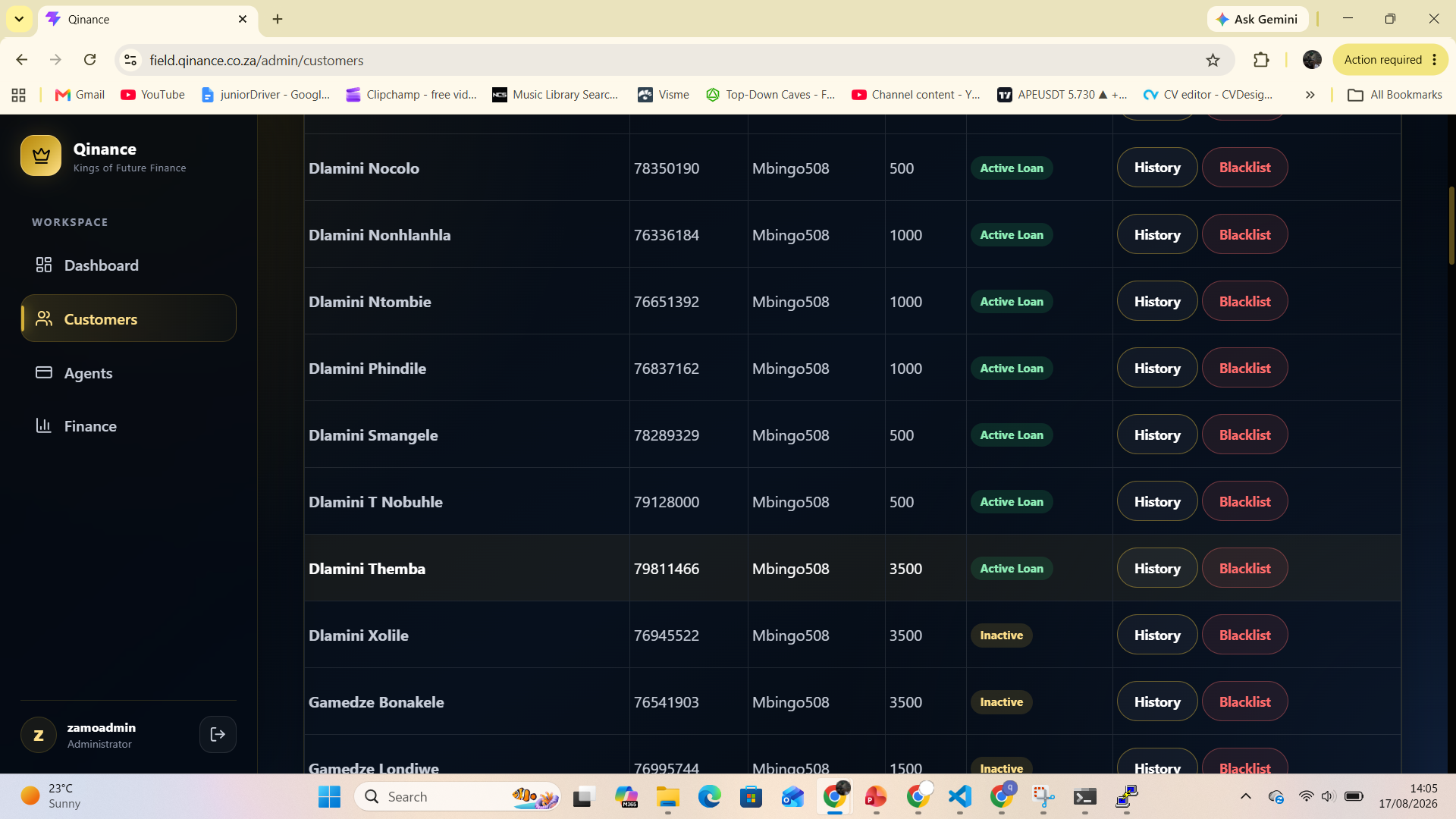
- 76 merchants onboarded
- $1,202 total revenue generated during the 90-day period
- $949 net profit after $253 in expenses
- Real merchant working-capital lending and daily repayments
- Revenue generated through independent sales of our financial services
- Operating in Eswatini, with a model designed to scale to larger SMEs and additional markets
Our 90-Day Business Traction
Qinance generated revenue throughout the judging period rather than relying on future revenue projections.
| Period | Revenue |
|---|---|
| May | $0.00 |
| June | $348.86 |
| July | $526.20 |
| August(from 1st to 15th) | $326.97 |
| Full 90 Days | $1,202.03 |
During the same period, Qinance recorded $253 in expenses and $949 in profit.
The revenue trajectory shows that the business moved from zero revenue at the beginning of the period to meaningful independent revenue as merchant lending activity increased.
Our traction is not based only on registrations. 76 merchants are onboarded, with real merchant lending and repayment activity taking place on the platform.
This matters because Qinance is not proposing that AI might eventually power a financial business. We are applying Gemini to a financial platform that is already acquiring merchants, generating revenue, issuing working-capital loans, and processing repayments.
Inspiration
Qinance started from a simple question: what if a payment platform could understand the financial context around every transaction and use that intelligence to provide better financial services?
We realized that payments are more than a way to move money. They create a continuous stream of information about how businesses operate, how customers spend, when demand changes, and how financial behaviour evolves.
We wanted to build an AI-powered payment operating system where payments form the backbone and financial services, commerce, and intelligence are built on top of that infrastructure.
We started in Eswatini with smaller merchants because this is the segment we can currently serve with our available lending capital. This is a starting point, not a limitation of the platform. The same infrastructure is designed to support businesses of different sizes as Qinance's network and capital base grow.
Our first financial use case became merchant working-capital financing. As we began onboarding merchants and observing real repayments, we discovered an important limitation of conventional affordability assessment: historical financial performance tells us what happened, but a short-term business loan is also affected by what is likely to happen during the repayment period.
That became the inspiration for our Gemini integration.
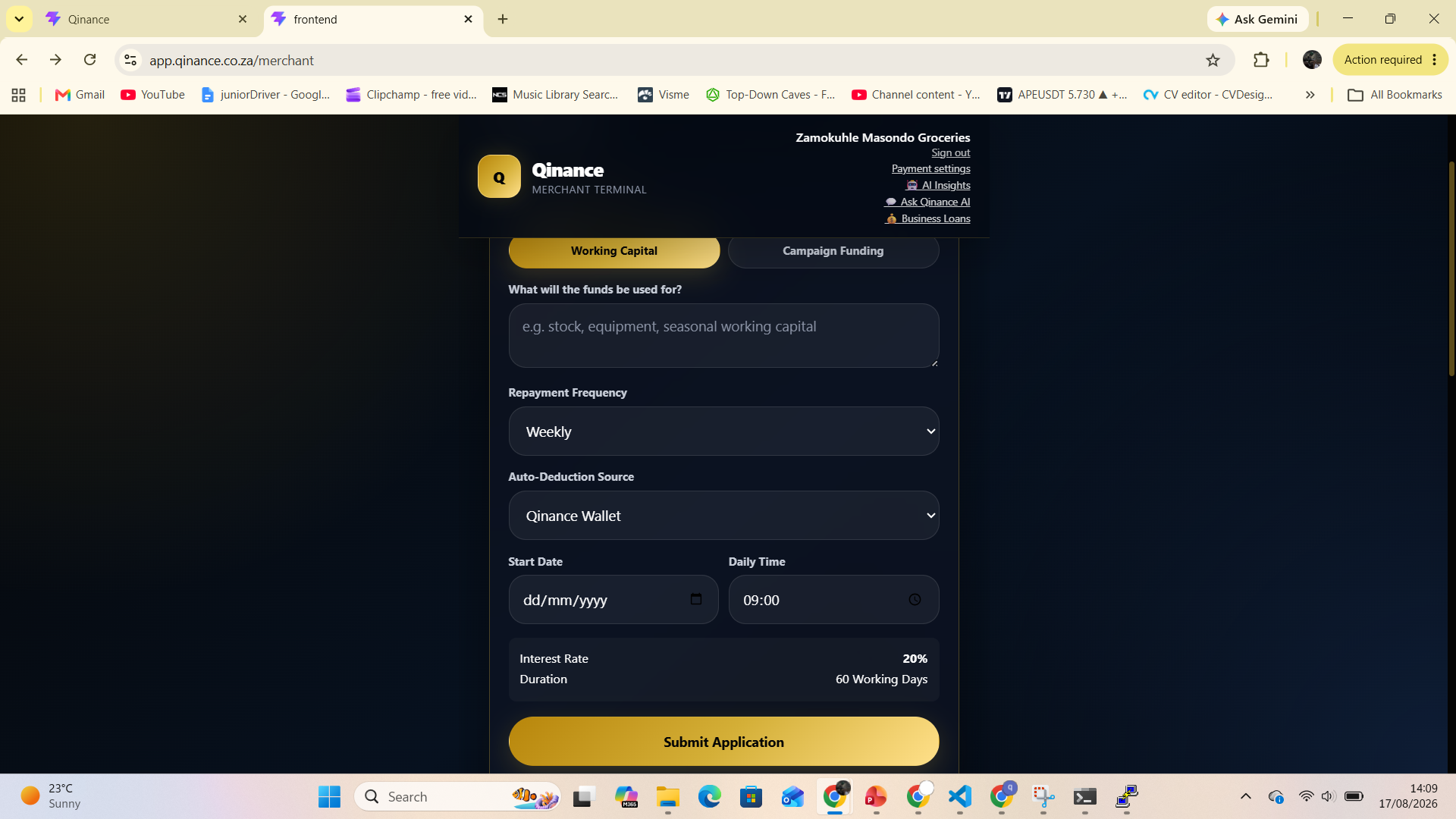
Today, 76 merchants are onboarded, and Qinance is already being used for real merchant lending and daily repayments.
What It Does
Qinance is an AI-powered payment operating system that combines payments, financial services, commerce, and AI intelligence.
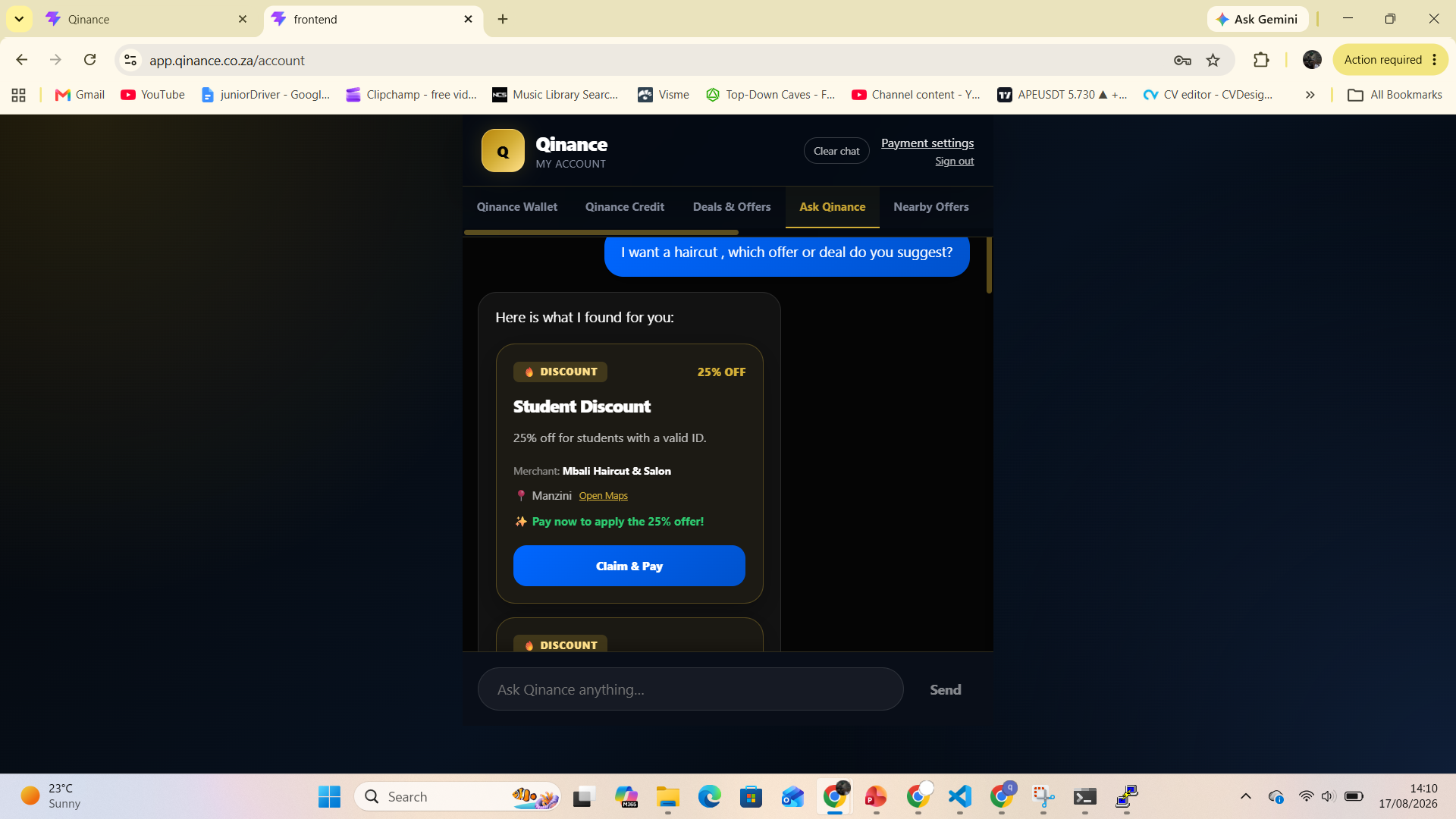
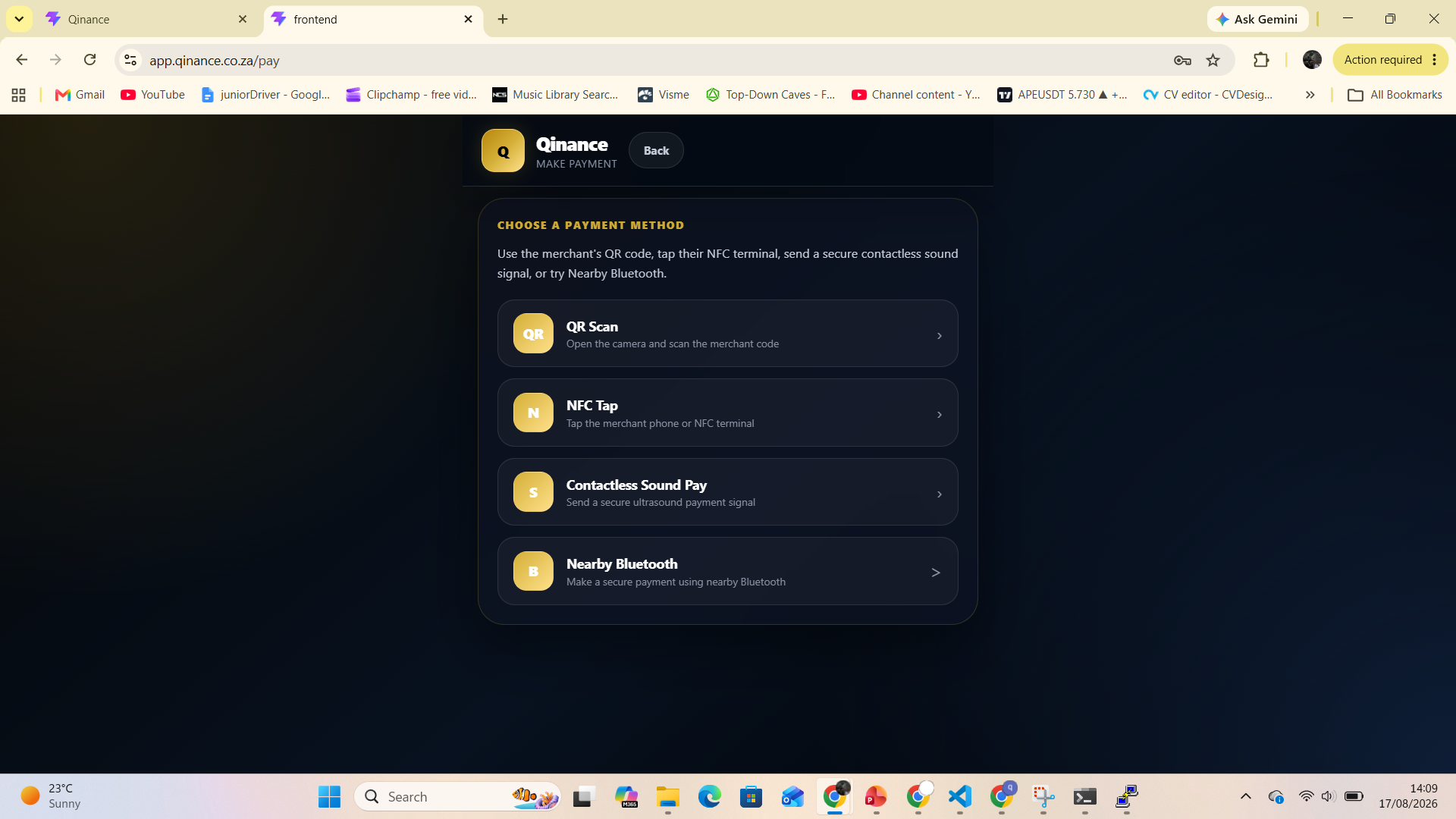
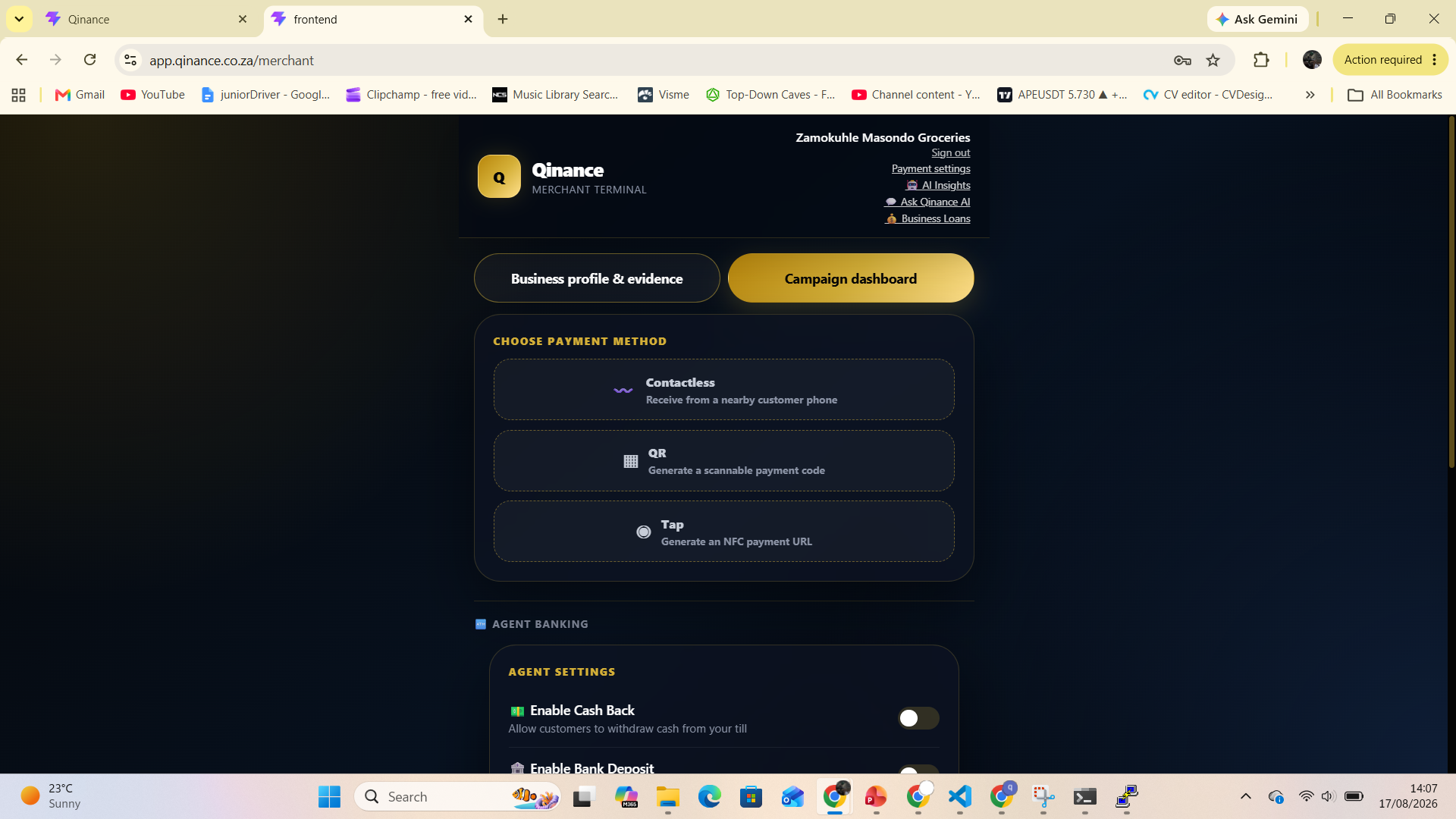
Payments are the backbone. Merchants can accept payments through Qinance, while customers can discover participating businesses, make payments, receive cashback, and access promotions. Financial services are built on top of this payment infrastructure.
AI-Powered Merchant Affordability
One of Qinance's core applications is short-term working-capital financing for merchants.
Traditional affordability calculations are primarily retrospective. They evaluate factors such as:
- Historical revenue
- Repayment behaviour
- Transaction performance
- Existing exposure
- Previous lending activity
These signals are extremely valuable, but they describe the past. Qinance adds a forward-looking layer using Gemini.
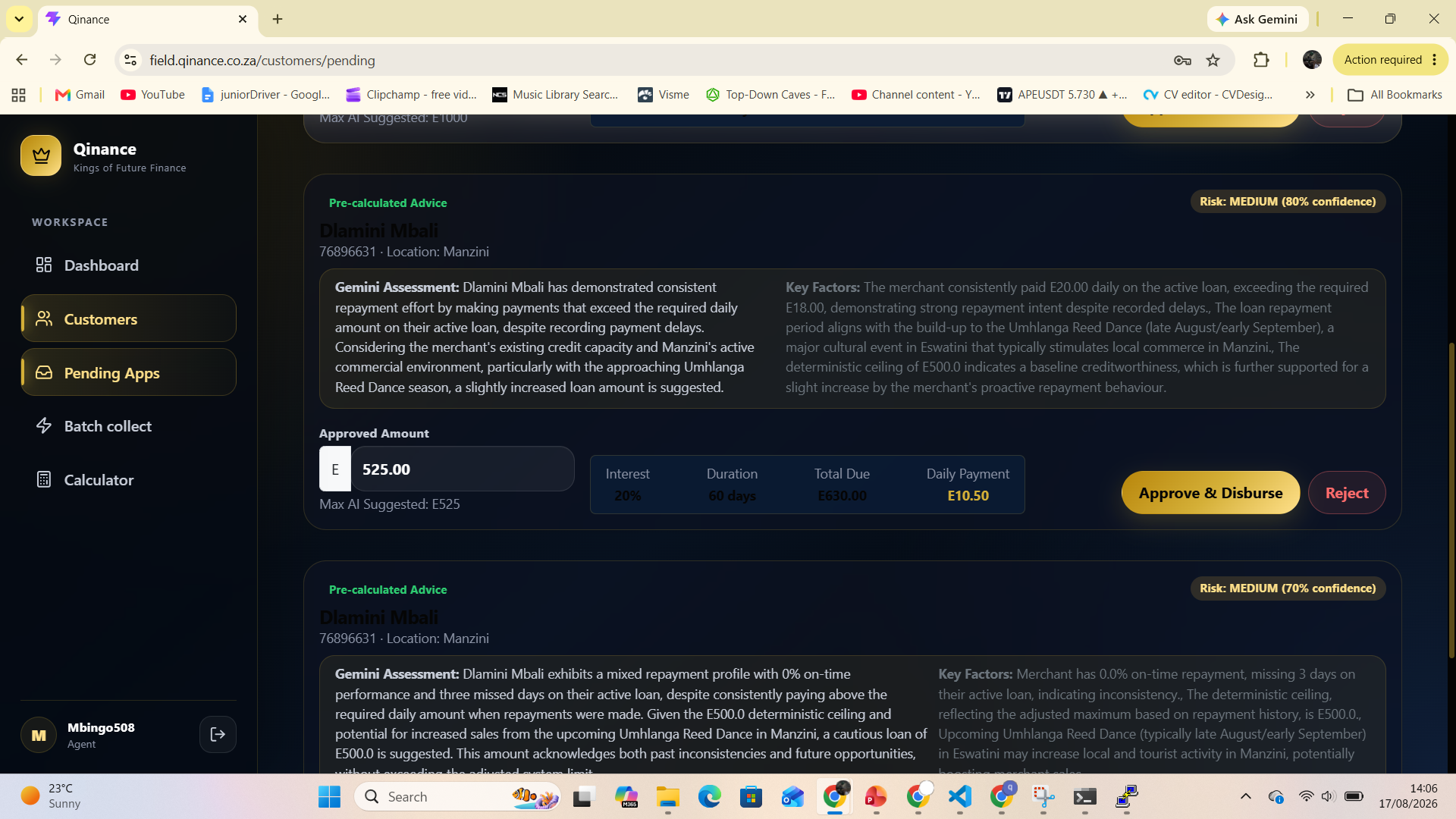
Because our merchant loans are typically short-term — around three months or 60 working days — events and conditions expected during that period can materially affect a merchant's ability to repay. To support local merchants transparently, loans carry a flat 20% fee over the 3-month loan term (~6.67% effective monthly rate).
Gemini evaluates the merchant's financial history together with contextual information such as:
- Upcoming local or international events
- Expected changes in customer activity
- Weather conditions, severe storms, or other disruptions
- Merchant location and business type
- Local operating conditions and future signals
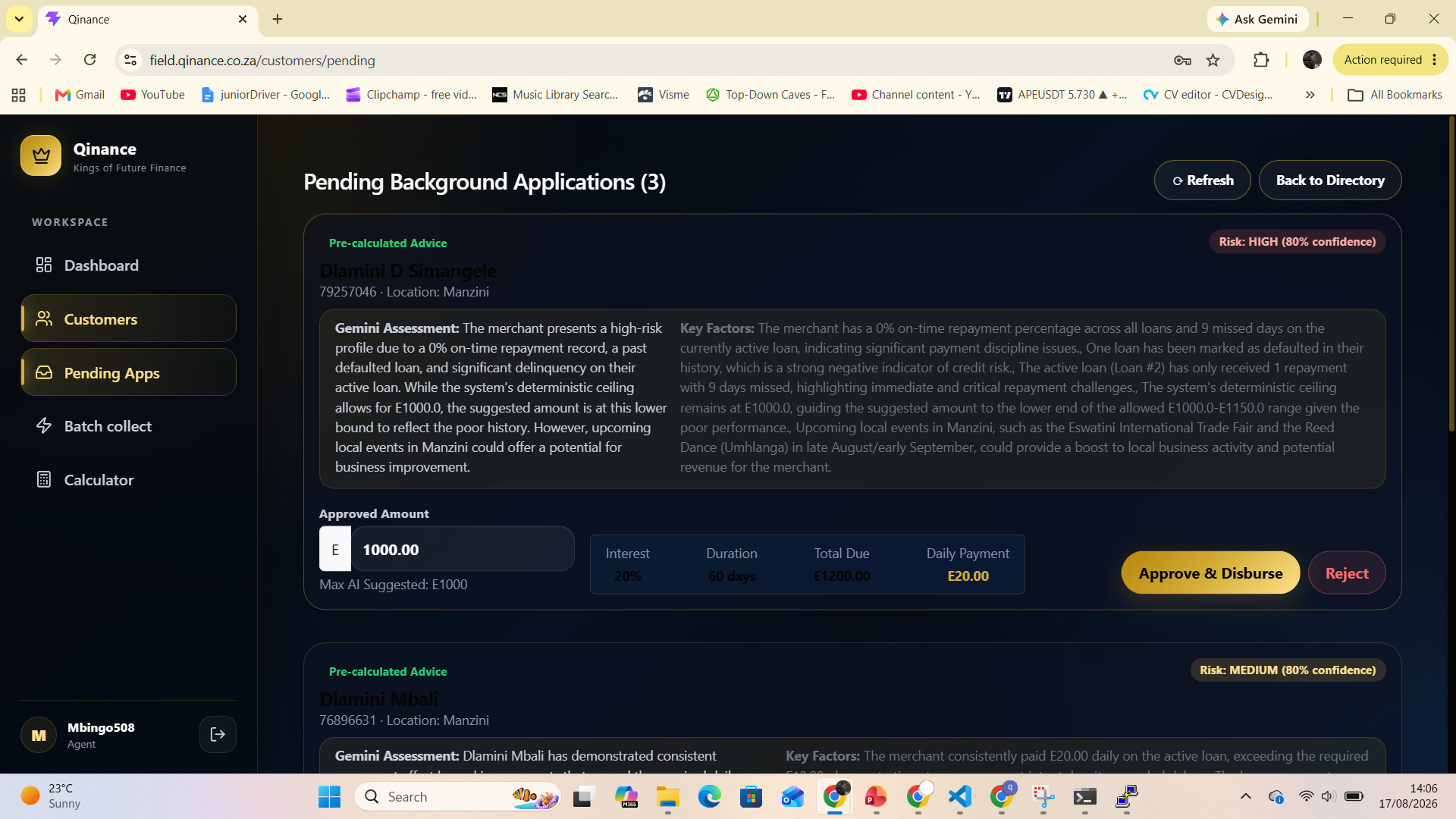
For example, a merchant with strong historical performance located near a major event may have an opportunity for increased demand. Gemini can identify that context and increase the merchant's calculated affordability within controlled limits. Conversely, if severe weather or another significant disruption is expected to affect the merchant during the repayment period, Gemini can reduce the calculated affordability.
Gemini does not simply explain the lending decision; it participates in determining affordability. The system combines the historical deterministic assessment with Gemini's contextual assessment to produce a consolidated affordability amount.
Gemini's influence is controlled by predefined thresholds. For example, a contextual adjustment can be limited to a defined range such as $\pm15\%$, while absolute lending, exposure, and policy limits remain enforced:
$$\text{Historical Financial Evidence} \longrightarrow \text{Gemini Contextual Assessment} \longrightarrow \text{Controlled Adjustment} \longrightarrow \text{Deterministic Risk Constraints} \longrightarrow \text{Final Affordability}$$
Autonomous Affordability and Progressive Trust
A major part of Qinance's scalability is that manual approval is not intended to remain necessary for every merchant and every loan.
- Pre-approved Merchants: The affordability workflow operates autonomously without requiring manual administrative review for every loan. These merchants have already met Qinance's predefined eligibility and risk conditions, allowing the system to process their affordability assessment automatically within established exposure limits.
- Non-pre-approved Merchants: Qinance uses a progressive trust model. A new merchant may initially require administrative review because Qinance has limited evidence about their repayment behaviour. After a merchant successfully completes three loans with good repayment performance, eligible merchants graduate to autonomous affordability assessment.
At that point, the system automatically evaluates:
- Historical repayment performance and transaction activity
- Existing exposure and previous lending behaviour
- Current affordability parameters
- Gemini's contextual assessment
- Predefined lending limits
This creates a clear operational progression:
$$\text{Initial Assessment} \longrightarrow \text{Supervised Lending} \longrightarrow \text{Demonstrated Repayment} \longrightarrow \text{Autonomous Affordability}$$
Human oversight remains available for exceptions. However, routine lending decisions are handled automatically for merchants who have demonstrated reliable behaviour. At 76 merchants, manual review may be manageable; at thousands or millions of merchants, manual approval does not scale. Qinance makes automation progressive so that operational capacity grows faster than administrative overhead.
Customer Financial Services
Merchant financing is only one service on the Qinance payment infrastructure. We are also building customer financial services such as salary advances, designed around predictable income and responsible limits. Customers can discover participating merchants, find nearby offers, receive discounts and cashback, and use Qinance as part of their everyday financial activity.
AI Business Intelligence
Gemini also powers business intelligence beyond lending:
- Daily merchant briefings
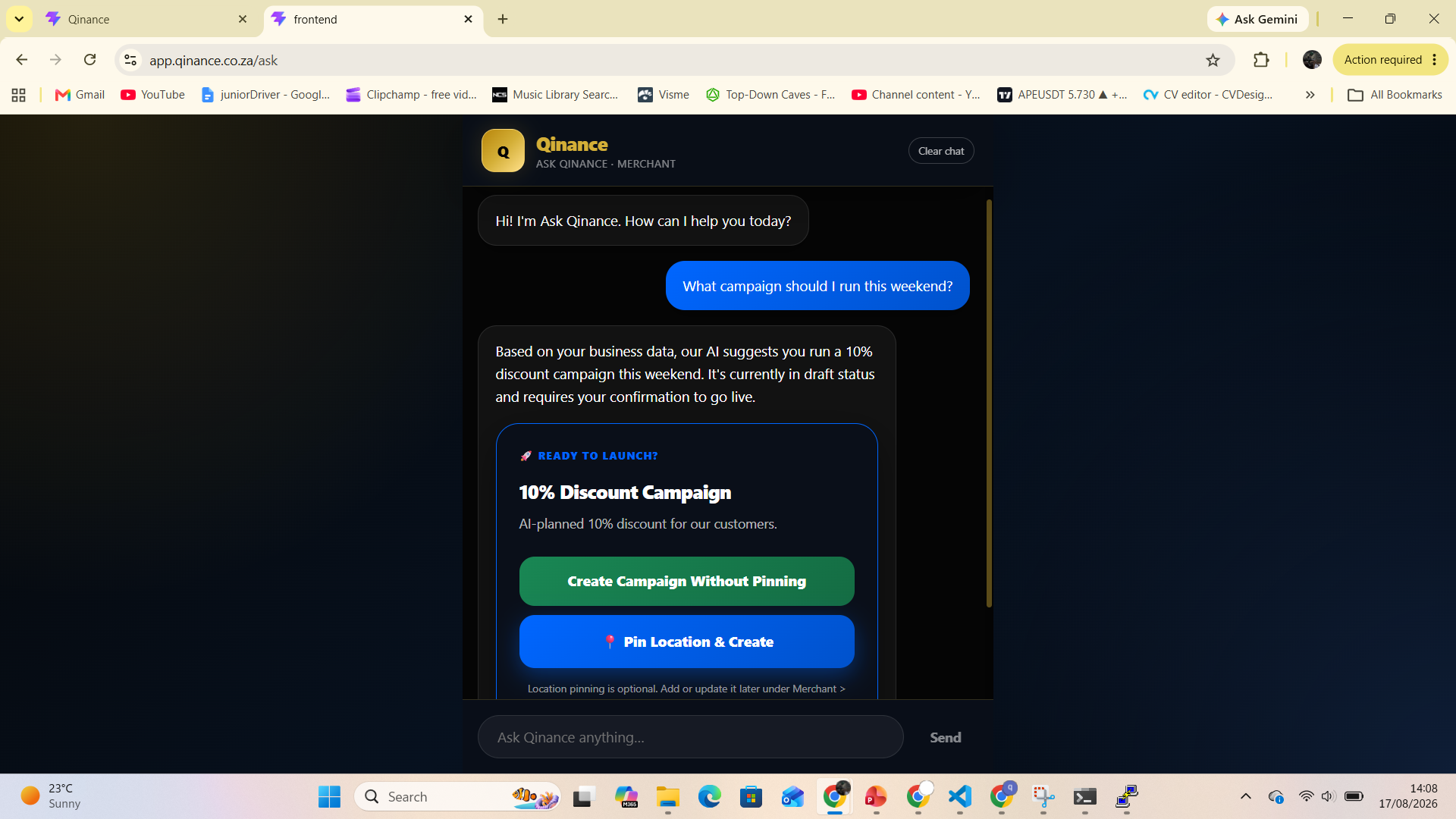
- Business insights and promotion recommendations
- Contextual financial assistance
- AI-powered recommendations based on merchant activity
$$\text{Payments generate activity} \longrightarrow \text{Activity creates financial context} \longrightarrow \text{AI understands context} \longrightarrow \text{Intelligence powers financial services}$$
How We Built It
We built Qinance as a connected ecosystem rather than a standalone AI application. The platform consists of backend financial services, merchant and customer applications, an Android application, payment infrastructure, and a Gemini-powered AI orchestration layer.
Our merchant affordability engine is a hybrid architecture:
- Deterministic Component: Establishes a baseline from measurable historical information (repayment performance, transaction activity, existing exposure, and affordability rules).
- Gemini Contextual Layer: Evaluates that baseline together with forward-looking signals to adjust affordability within a bounded $\pm15\%$ threshold.
- Hard Risk Constraints & Trust Pipeline: Enforces absolute policy boundaries and determines whether the loan executes autonomously or routes to administrative review.
Historical Financial Data
        │
        ▼
Deterministic Affordability
        │
        ├──────────────────────┐
        │                      │
        ▼                      ▼
Historical evidence      Gemini Context
                         ├─ Events
                         ├─ Weather
                         ├─ Location
                         ├─ Business conditions
                         └─ Future signals
                                │
                                ▼
                       Gemini Affordability
                                │
                                ▼
                    Controlled Adjustment
                                │
                                ▼
                  Consolidated Affordability
                                │
                                ▼
                     Hard Risk Constraints
                                │
                                ▼
                Merchant Trust / Eligibility
                         │            │
                  Manual Review    Autonomous
                         │            │
                         └──────┬─────┘
                                ▼
                       Final Loan Amount
The merchant trust layer is vital to scalability. New merchants require administrative review. After three successfully repaid loans, eligible merchants graduate to autonomous affordability, combining the reliability of deterministic financial rules with Gemini's contextual reasoning while progressively eliminating manual operational bottlenecks.
Challenges We Ran Into
- Cold-Start Financial Context: Traditional machine-learning systems require millions of historical transactions. As a new payment network, we needed to evaluate merchants with limited platform history. We solved this by pairing limited internal metrics with Gemini's ability to process qualitative, external forward-looking context.
- Calibrating AI Authority: We avoided both extremes — an LLM arbitrarily deciding loan values with no oversight, or an LLM acting merely as a passive reporting chatbot. We instituted explicit financial boundaries ($\pm15\%$ adjustment cap + hard policy exposure limits) where Gemini actively participates in decisioning inside deterministic rails.
- Scalability vs. Oversight: Building a two-sided payment network requires scaling lending without linearly increasing risk officers. Implementing progressive trust (graduating to autonomous execution after 3 repaid loans) allowed us to keep risk controlled without creating operational bottlenecks.
Accomplishments We're Proud Of
- Live Real-World Operation: Moved beyond a theoretical prototype to process real working-capital loans and daily repayments for 76 onboarded merchants.
- Proven Unit Economics: Generated $1,202 in revenue and $949 in profit on $253 in expenses during the 90-day judging period.
- Full-Stack Ecosystem: Built and connected an Android application, backend payment rails, merchant discovery/cashback engines, and an autonomous Gemini decision pipeline.
- Context-Aware Underwriting: Successfully deployed a hybrid lending engine that evaluates both proven historical data and dynamic upcoming risks/opportunities.
What We Learned
Our biggest lesson was that payments are not just transactions; they are a source of continuous financial context. AI becomes significantly more valuable when it is connected to real application data and decisions rather than operating as an isolated conversational interface.
Redefining Affordability
A conventional system asks: Can this merchant afford this loan based on what has happened before?
Qinance asks: What could materially change this merchant's ability to repay during the actual period of this loan?
| Metric / Context | Historical / Deterministic Only | Historical + Gemini Context |
|---|---|---|
| Repayment History | Excellent | Excellent |
| Historical Revenue | Strong | Strong |
| Existing Exposure | Low | Low |
| Expected Conditions During Loan | Not Considered | Severe/prolonged storm expected near merchant |
| Expected Business Disruption | Not Considered | Considered (temporary closure, foot traffic drop) |
| Calculated Affordability | $10,000 | Controlled Reduction (e.g., $8,000) |
| Decision Logic | Proven historical performance only | Proven history adjusted for upcoming disruption |
If a severe storm is expected during the repayment period, historical revenue alone overstates near-term repayment capacity. Gemini identifies this disruption, recommends a controlled reduction in affordability, and deterministic constraints keep the adjustment within predefined risk limits.
Real-World Validation: The Manzini Merchant Example
This forward-looking adjustment is not just theoretical; we validated it in production with a merchant in Manzini selling perishable goods. The merchant maintained a strong repayment history and initially requested a $50 loan.
Under our deterministic algorithm, their historical revenue and repayment record qualified them strictly for $50. However, the Qinance AI system identified an upcoming 3-week national event scheduled directly in front of their store at the Mavuso Trade Fair. Recognizing the impending surge in foot traffic and the heightened demand for fresh food items, Gemini applied a controlled contextual bump, increasing the approved loan amount to $55.
The merchant accepted the $55 loan, stocked extra perishable inventory for the trade fair, and repaid the loan ahead of schedule. This live result confirmed that Gemini could accurately forecast localized demand surges and safely unlock extra growth capital for merchants.
Learning When to Automate
Automation should be earned through demonstrated behaviour. A new merchant receives administrative oversight while Qinance gathers repayment data. After three successfully completed loans, the merchant's proven history unlocks autonomous affordability, allowing operational capacity to scale faster than administrative headcount.
What We Are and Are Not Claiming
We are not claiming that 76 merchants represents massive market scale. Our current traction is proof that the model operates in the real world, generates positive contribution margins, and manages real risk.
The core innovation is the decision framework itself:
$$\text{Historical Evidence} + \text{Forward-Looking Context} + \text{Deterministic Controls} + \text{Progressive Autonomy}$$
Proving that adding relevant future context to affordability decisions produces better risk-adjusted lending decisions at a small scale validates the architecture for deployment across much larger merchant networks.
Category Impact
Qinance redefines financial affordability by bridging the gap between retrospective data and future risk. Traditional credit scoring is strongest when the future perfectly resembles the past, but small businesses are sensitive to short-term disruptions and localized events.
$$\begin{matrix} \text{Historical Performance} \ + \ \text{Future Context} \ + \ \text{Deterministic Risk Controls} \end{matrix} \implies \mathbf{Context\text{-}Aware\ Affordability}$$
We are testing whether AI can responsibly close this information gap. By proving this context-aware decision model in a live business with 76 merchants, we establish a framework that can transform short-term SME affordability assessment at scale.
What's Next for Qinance
Our goal is to evolve Qinance into a full AI-powered payment operating system.
Completing the Qinance Network
- Merchants: Onboard businesses using working-capital B2B loans as the primary incentive to join the payment network.
- Customers: Introduce salary advances (early access to earned wages up to 15 days before payday via a stop-order deduction with a 1% fee), combined with localized deals, discounts, and cashback.
- Closed Ecosystem Loop: Merchants join $\rightarrow$ Customers join $\rightarrow$ Transactions generate payment activity $\rightarrow$ Context improves financial decisioning.
Preparing for the Regulatory Sandbox
We are awaiting enrollment by the Central Bank of Eswatini into their regulatory sandbox (expected within ~2 months) to test the broader payment system under an official regulatory framework.
Intelligent Commerce & Business Intelligence
As transaction volume grows, Gemini will expand beyond underwriting to provide automated inventory forecasting, promotion optimization, and daily operational briefings directly to merchants.
Scaling Autonomous Finance
By routing routine loan requests through our progressive trust pipeline:
$$\text{New Merchant} \longrightarrow \text{Supervised Review} \longrightarrow \text{Proven Repayment} \longrightarrow \text{Autonomous Affordability}$$
Qinance can scale transaction volume exponentially while reserving human administrative intervention strictly for policy exceptions and unusual risk conditions.
The long-term vision
Our long-term vision is not simply to build another wallet, lending application or AI assistant.
We are building an AI-powered payment operating system where payments provide the infrastructure, financial services create economic value, and Gemini provides the intelligence to understand both what has happened and what may happen next.
We started with 76 merchants in Eswatini.
Our immediate goal is to complete the network by bringing customers into the ecosystem, while preparing Qinance for regulatory testing of the full AI-powered payment system.
The ambition is much larger.
Built With
- djando
- djangoframework
- gemini
- gemini-api
- google-ai-studio
- google-cloud
- javascript
- kotlin
- python
- vertex-ai

Log in or sign up for Devpost to join the conversation.