-
-

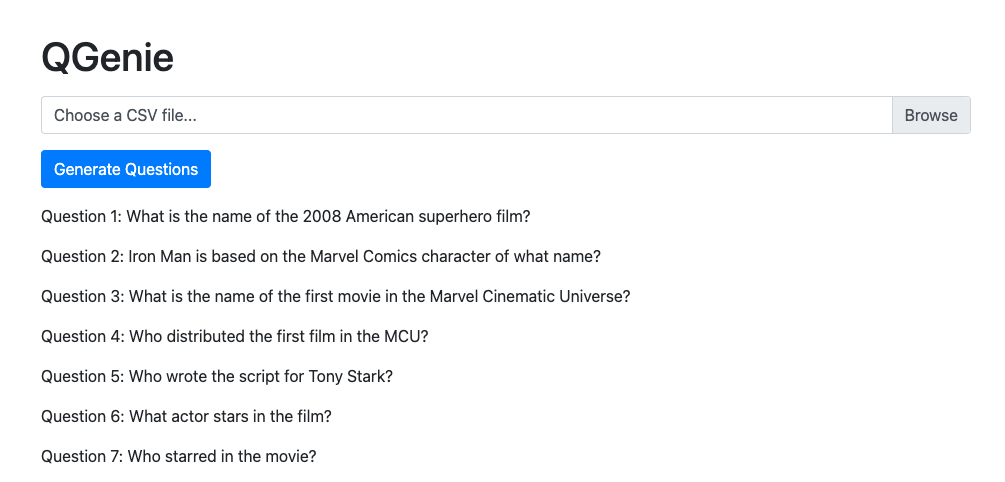
QGenie - Question Wizard
-
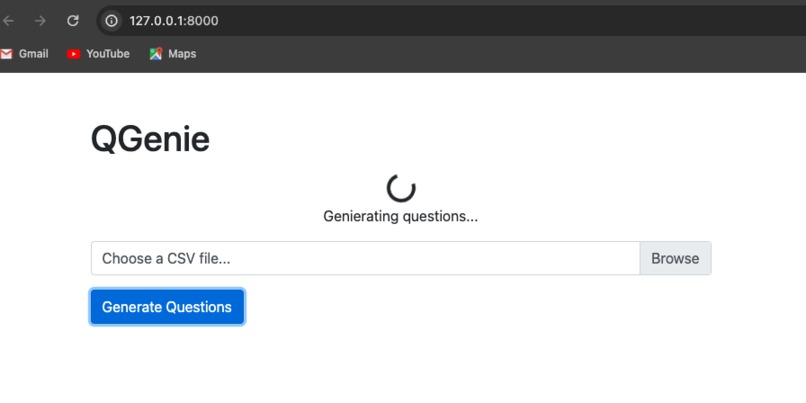
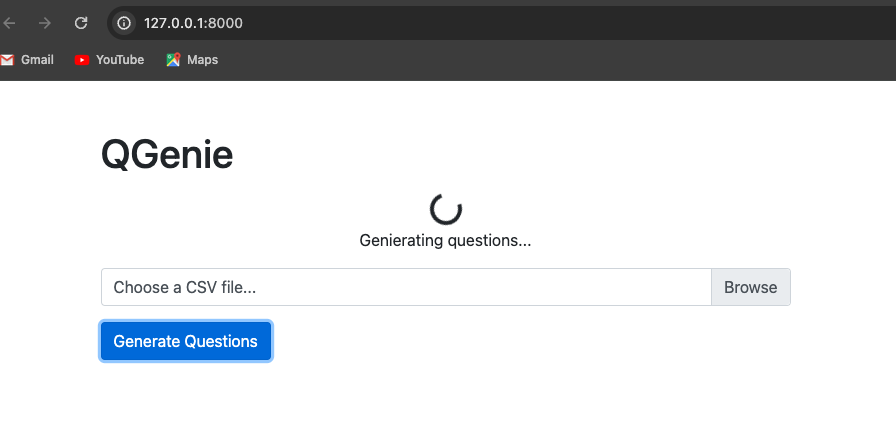
Home screen
-
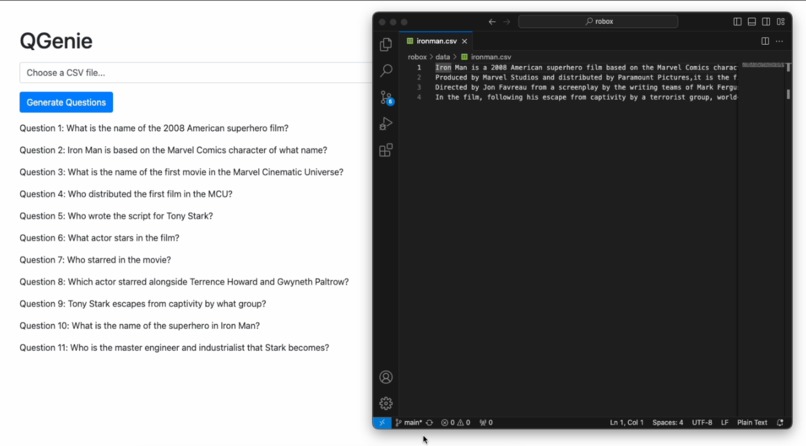
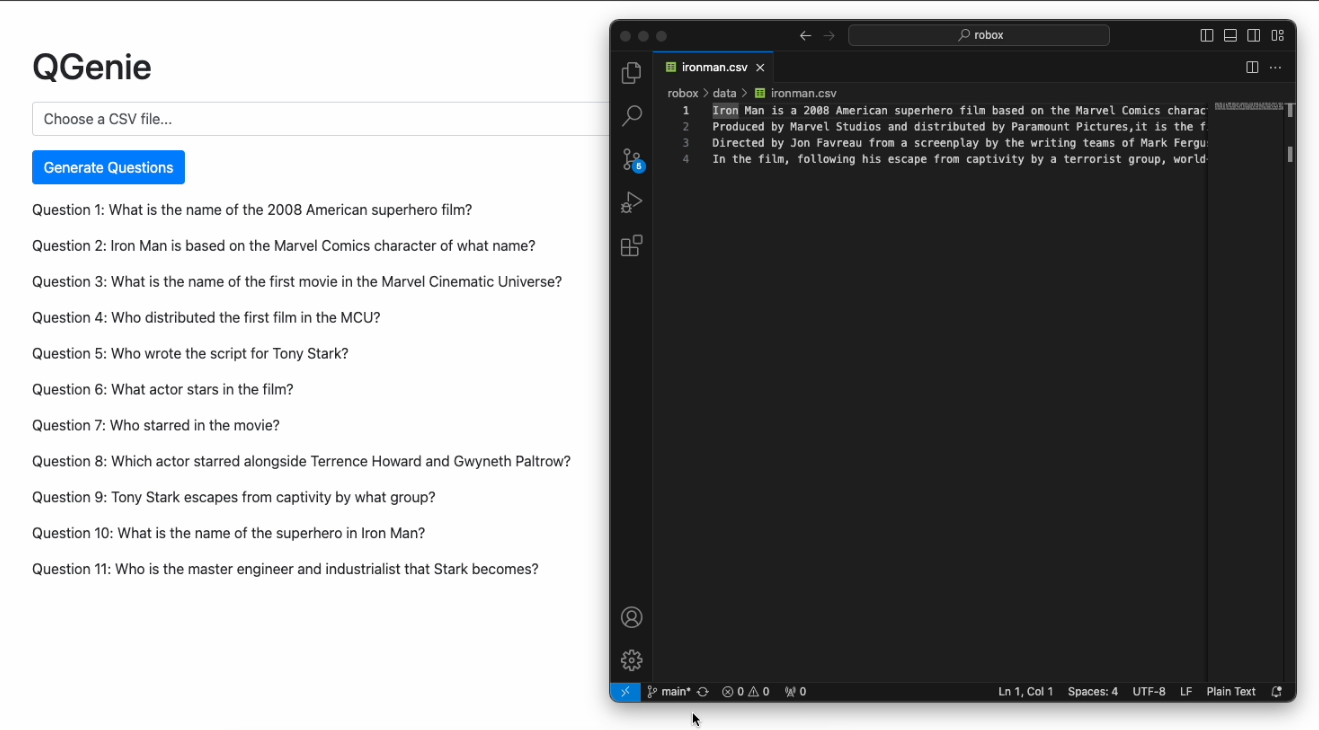
ironman.csv to questions
-
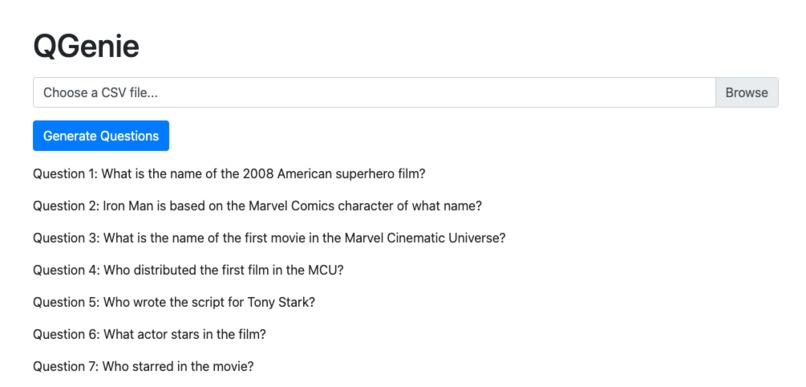
Generated questions from iron man doc

Inspiration
We developed QGenie with a unique perspective in mind. While most tools aim to provide answers to questions, we recognized the value of generating questions from educational content. Our goal was to empower students and learners with a valuable tool that can create questions based on the text they study. We believe that when students engage in the process of formulating questions related to their learning materials, it enhances their comprehension and retention. Teachers, too, can benefit from this tool by easily crafting questions tailored to their classroom needs.
What it does
QGenie is turns written stuff into questions using AI/ML NLP (Natural Language Processing]. Students can upload their notes or articles, and QGenie changes them into questions. It helps students know if they really understand the concepts from the content. This is the first version of QGenie, and we plan to make it even better in the future. You can use it easily - just download and run it, no coding needed since Docker used as packaging and distribution platform.
How we built it
We created QGenie by combining different pieces of technology to make it work:
Haystack: Haystack is an open-source framework for building production-ready LLM applications, retrieval-augmented generative pipelines and state-of-the-art search systems that work intelligently over large document collections. Learn more about Haystack and how it works.
Haystack pipelines: Haystack is built on the idea that great systems are more than the sum of their parts. By combining different nodes, you can create powerful and customizable systems. The pipeline is the key to making this modular approach work.
Question Generation Pipeline: The QuestionGenerator takes a Document as input and generates questions which it believes the Document can answer. This is almost the inverse of the Reader which takes a question and Documents as input and returns an Answer. QuestionGenerator models can be trained using question answering datasets.
In Haystack, there are two pipeline configurations that are already encapsulated in its own class:
- QuestionGenerationPipeline
QuestionAnswerGenerationPipeline
Docker: To make it easy for you to use, we put everything in a special box called Docker. It's like having a complete QGenie in a small, easy-to-carry box. Just download and run it.
Challenges we ran into
In our early AI and machine learning exploration, we encountered a challenge: picking the right tool for our project. We discovered that the AI and ML world offers many choices, which can be overwhelming. To create QGenie, we put in extra effort to find a tool that is easy to use and has strong community support. After some exploration, we found Haystack, which stood out as a perfect fit. Haystack simplifies turning text into questions, making our project user-friendly and efficient. Thanks to this discovery, we built QGenie with ease.
Accomplishments that we're proud of
We take pride in creating something valuable for the education community. QGenie is a tool that can help students and teachers, making learning and teaching more effective. We've also made it user-friendly by packaging it in a container, so you can use it without needing to be an AI or ML expert. Just download and run it—it's that simple.
What we learned
Throughout our journey, we gained valuable insights into the world of artificial intelligence (AI) and machine learning (ML). We delved into AI and ML concepts, discovering how machines can understand and process human language, which is at the core of QGenie. We also realized the wealth of existing ML resources that simplify development, allowing us to build a powerful tool for education.
One key lesson was the importance of utilizing wrappers around ML concepts, such as pipelines. These wrappers streamline the process and enable us to harness the benefits of AI and ML outcomes without starting from scratch. This approach not only saved us time but also made QGenie more accessible to users. Additionally, we discovered the power of tools like Haystack, which simplifies the transformation of text into questions, and Docker, which makes deploying and running QGenie a breeze.
What's next for QGenie
The journey for QGenie is far from over, and we have exciting plans for its future:
- Model Enhancements: We aim to improve the efficiency of the model by exploring larger and more powerful language models (LLM). This will lead to even smarter and more contextually accurate question generation.
- Performance Boost: We are committed to enhancing QGenie's performance, making it faster and more responsive to user needs. This means smoother and more efficient question generation.
- Optimized Docker Images: We plan to reduce the size of the Docker images to make QGenie more lightweight and easier to deploy.
- Cloud-based Service: One of our major goals is to transform QGenie into a cloud-based Software as a Service (SaaS). This will enable everyone to access it conveniently without the need for downloading and running it locally. QGenie will be readily available in the cloud, making it accessible to a broader audience.
We are excited about these future developments, as they will further enhance QGenie's capabilities and accessibility, making it an even more powerful and user-friendly tool for the education community and beyond. We look forward to sharing these improvements with you in the near future.

Log in or sign up for Devpost to join the conversation.