-
-
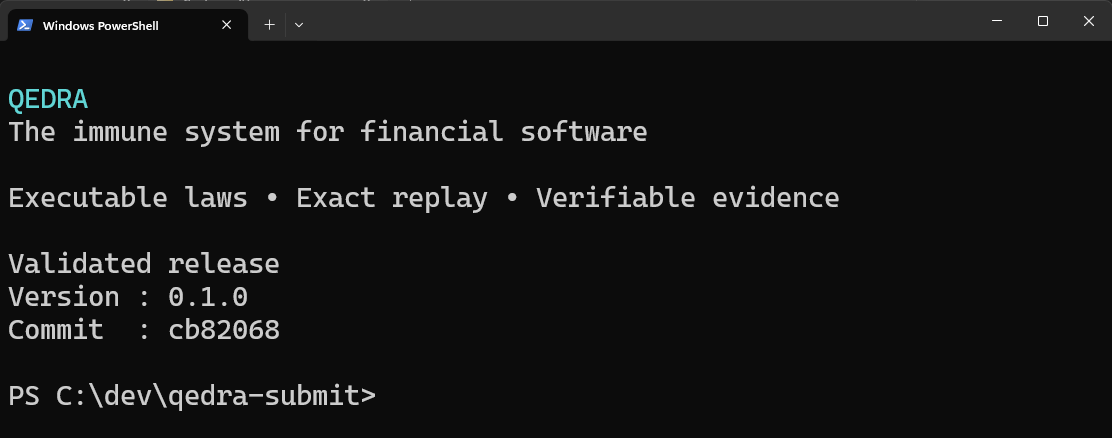
QEDRA — The immune system for financial software.
-
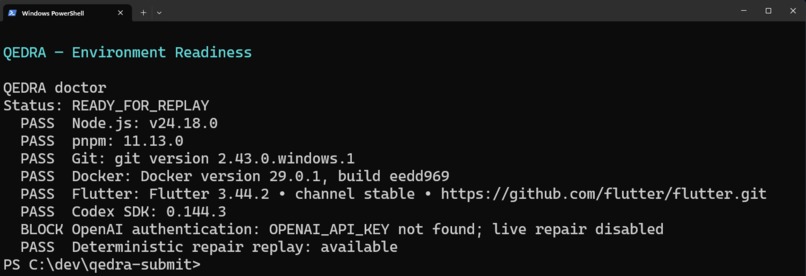
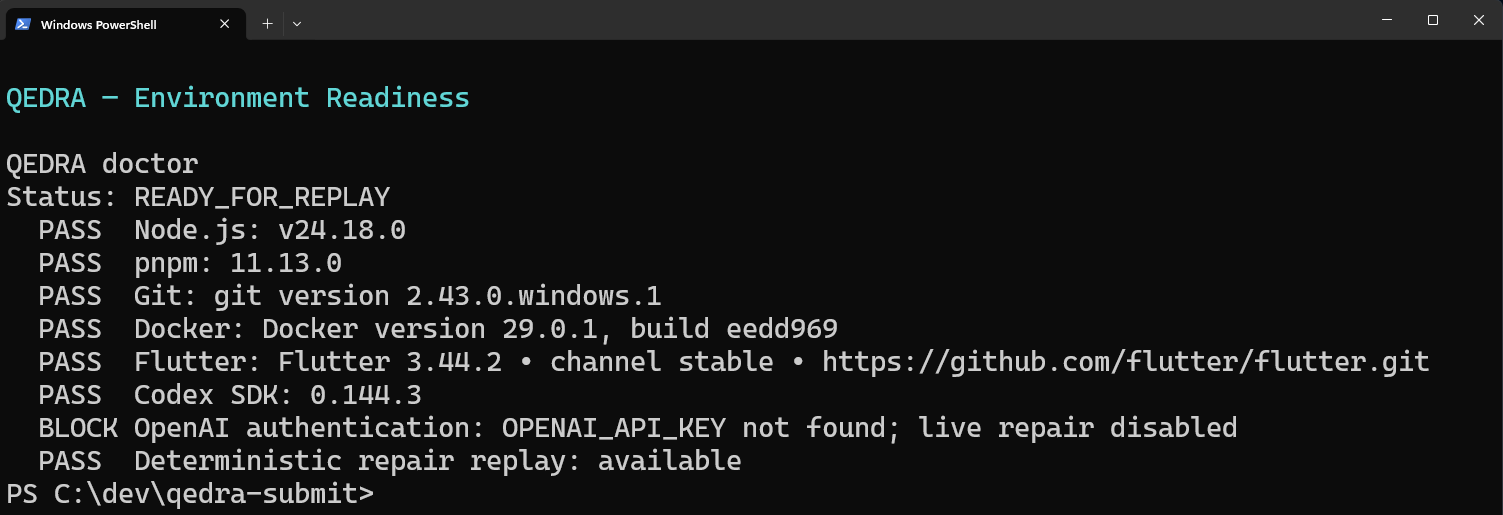
QEDRA is ready for deterministic replay with Node.js, Git, Flutter, and the official Codex SDK.
-
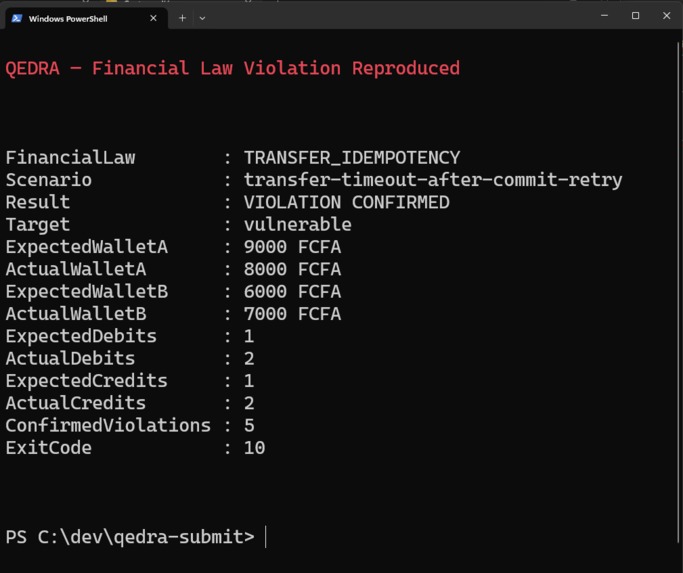
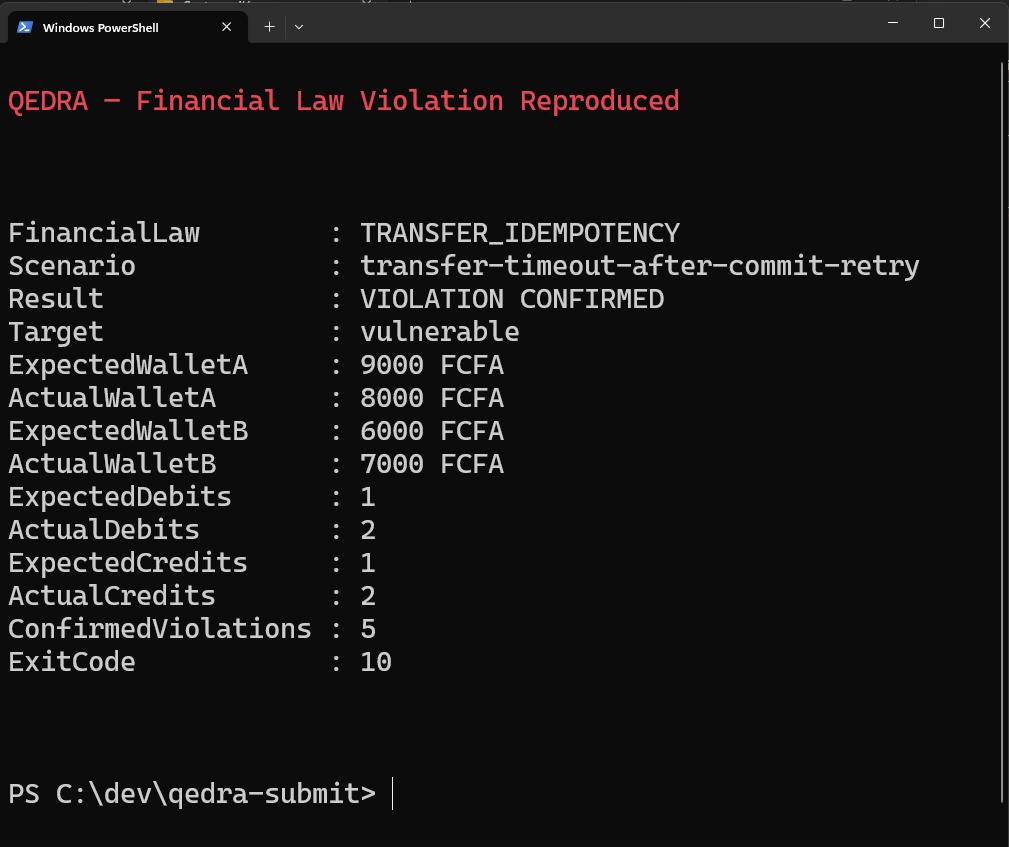
QEDRA reproduces a duplicate transfer: A=8,000 FCFA, B=7,000 FCFA, with two debits and two credits.
-
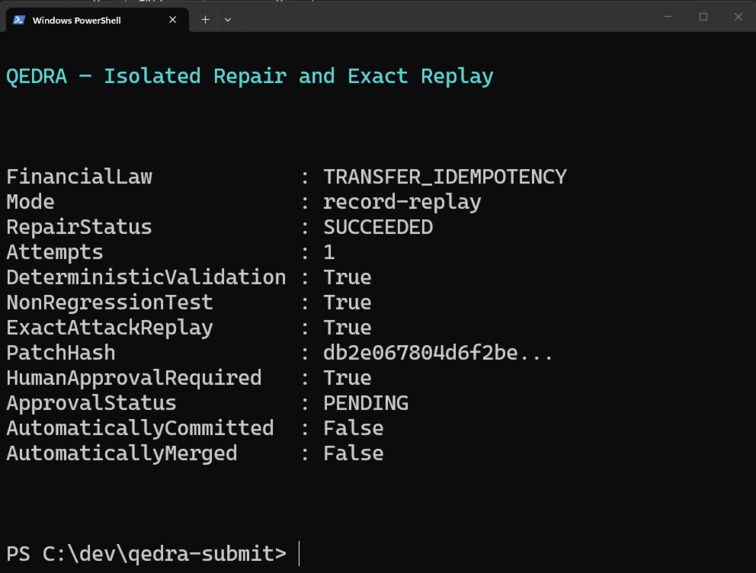
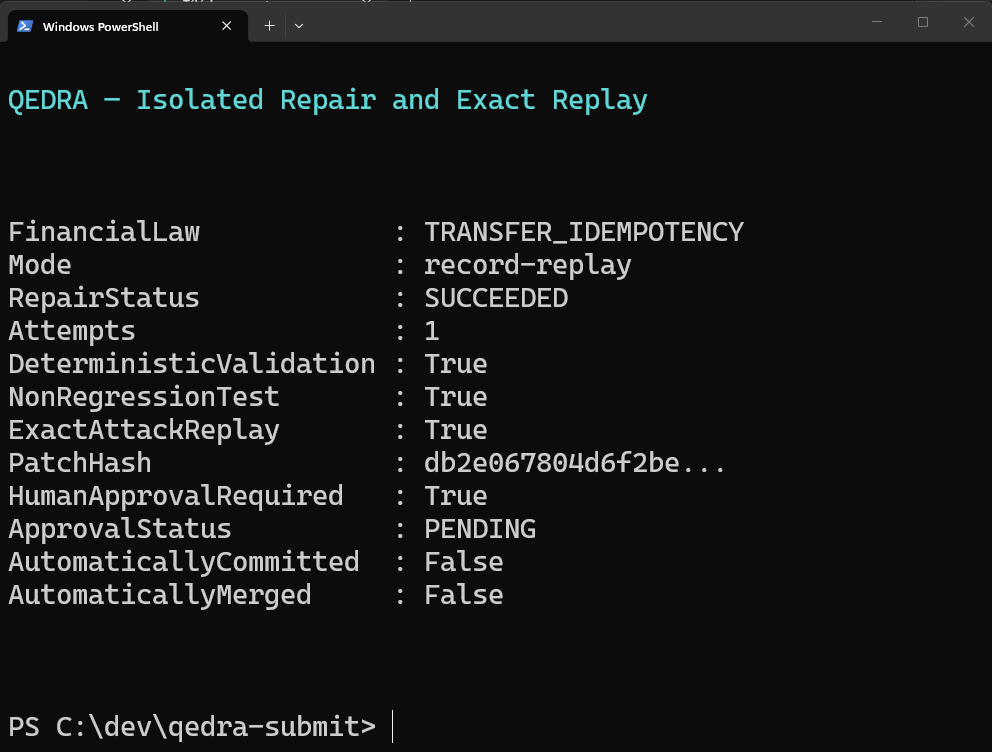
The repair runs in an isolated Git worktree, passes non-regression and exact replay, and requires human approval.
-
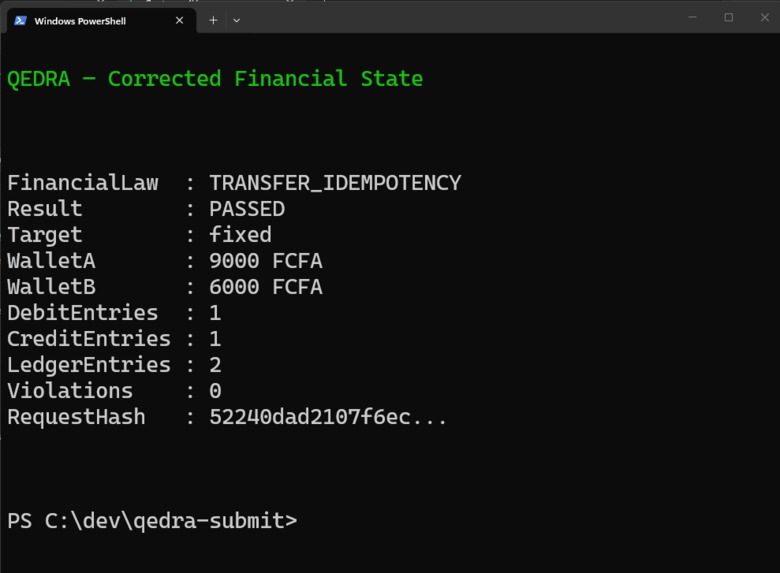
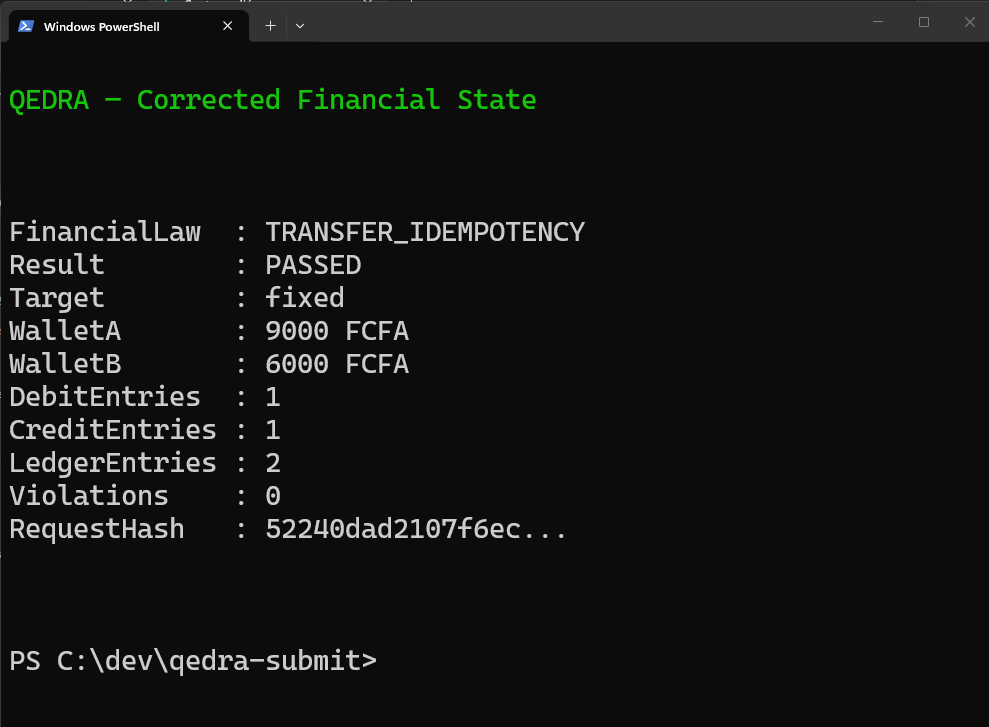
After repair, exact replay restores A=9,000 FCFA, B=6,000 FCFA, one debit, one credit, and zero violations.
-
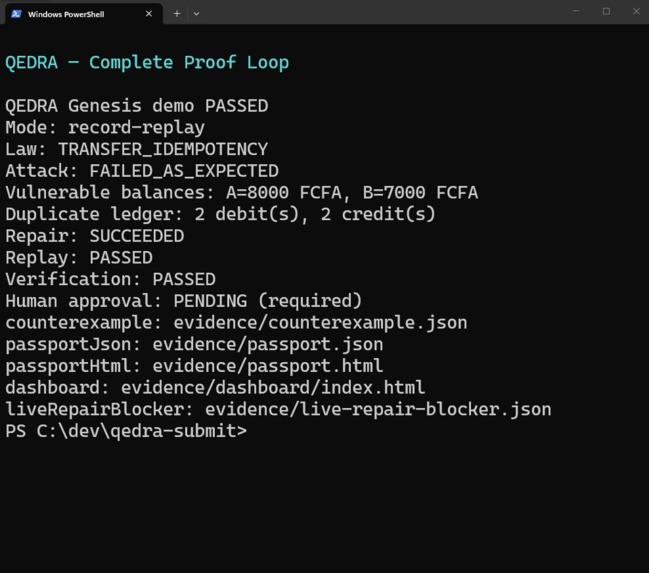
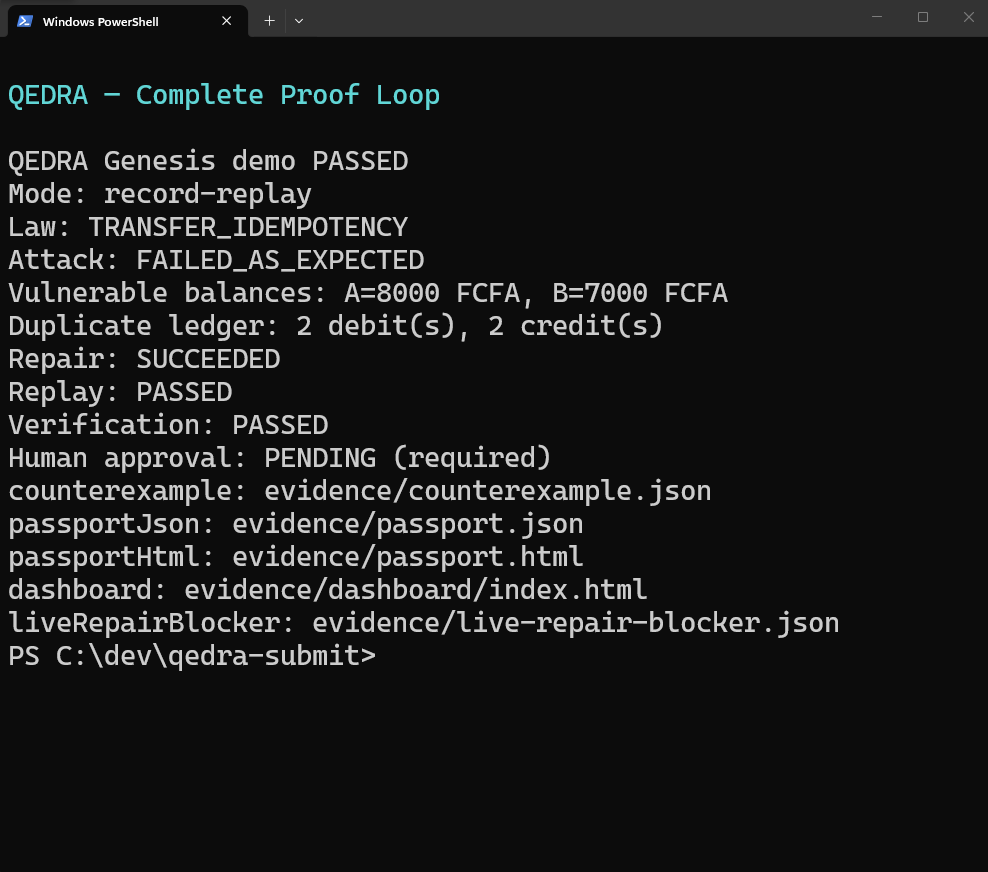
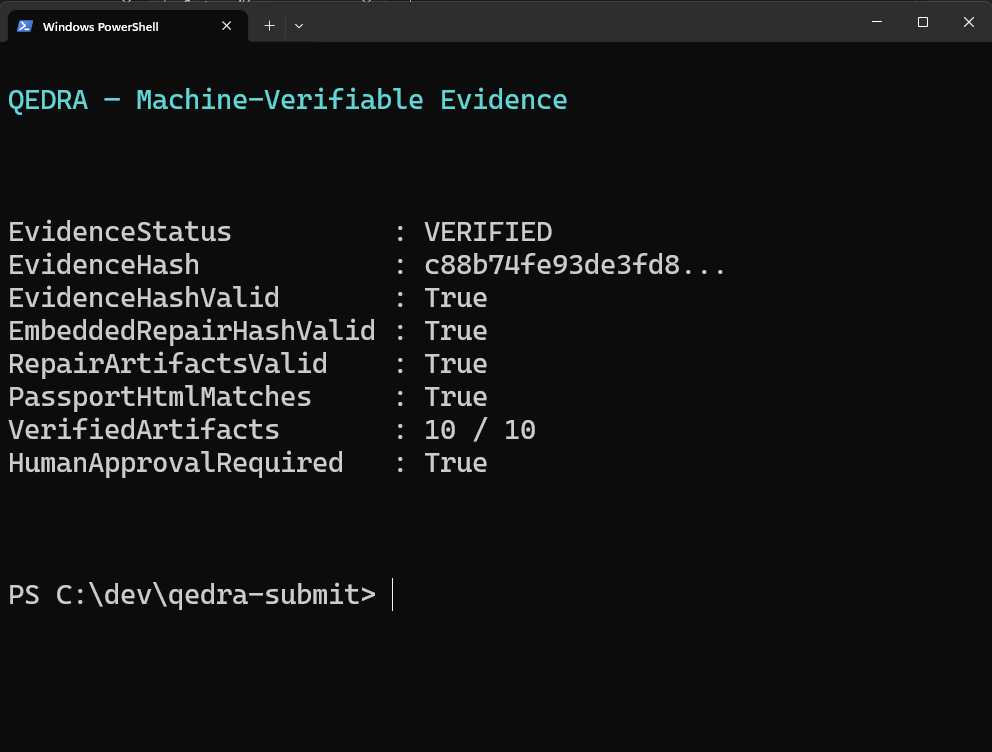
One command reproduces the failure, validates the repair, replays the scenario, and verifies the evidence.
-
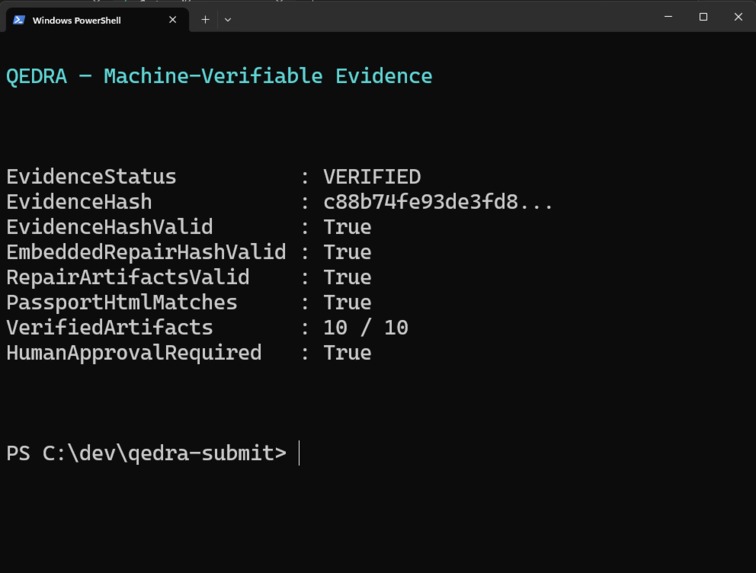
All evidence hashes, repair artifacts, and the HTML passport verify successfully; human approval remains required.
-
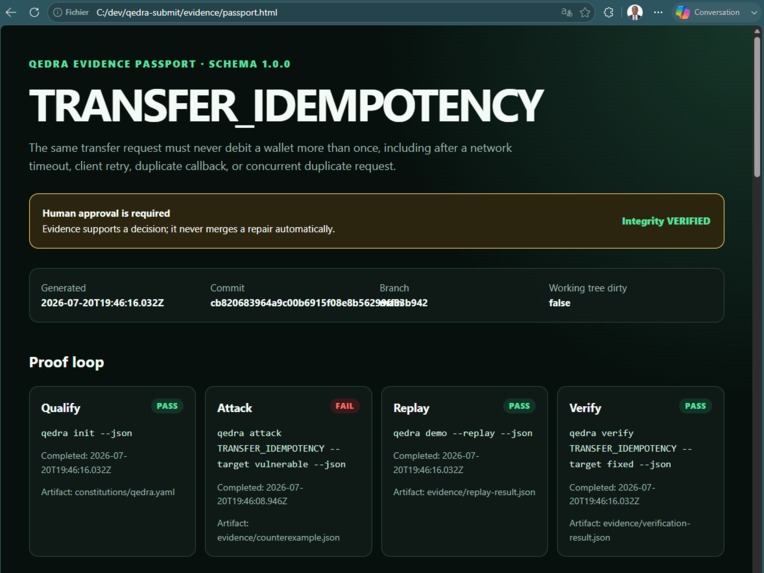
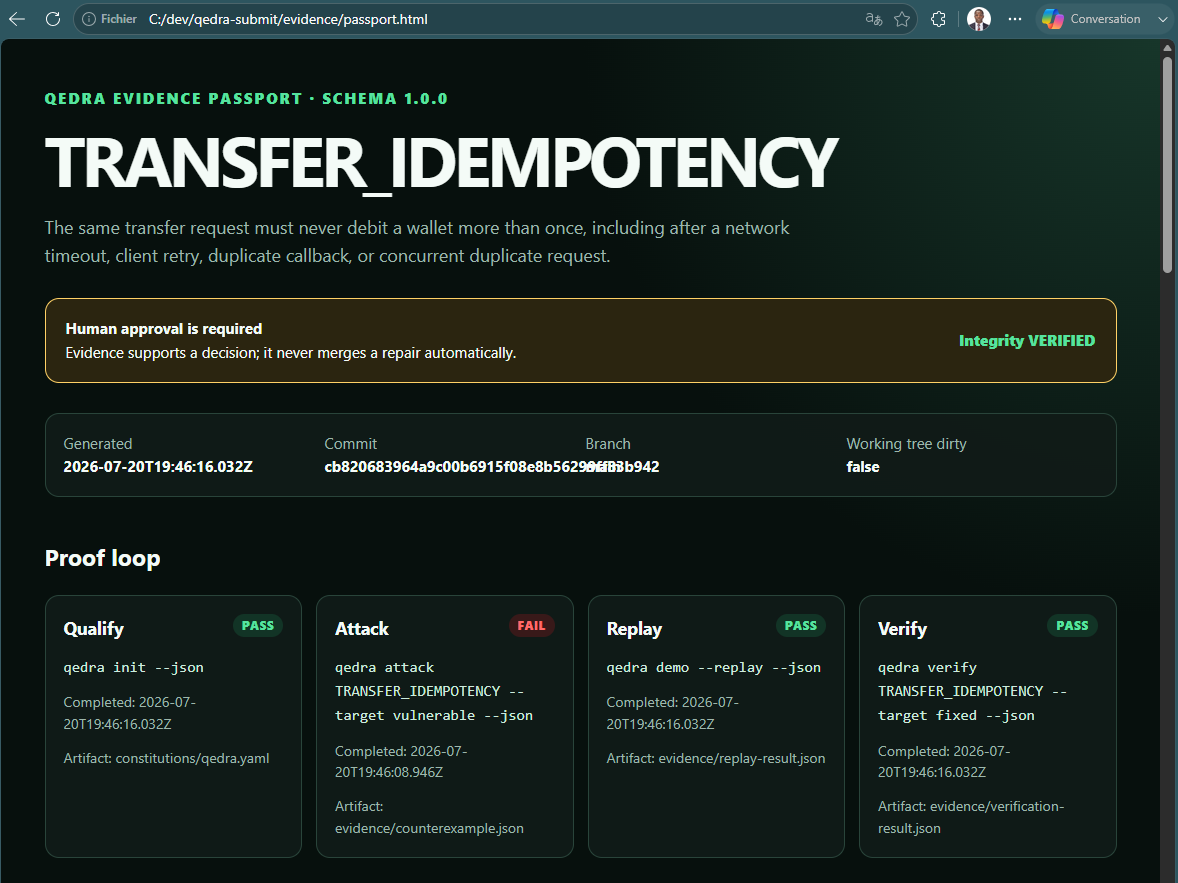
Standalone evidence passport showing the invariant, expected failure exact replay verification integrity status and mandatory human approval
-
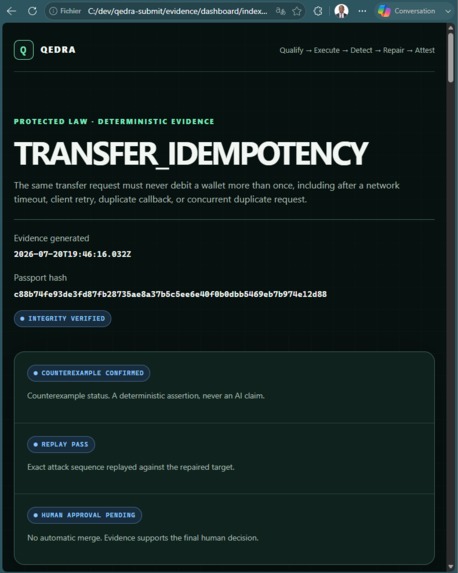
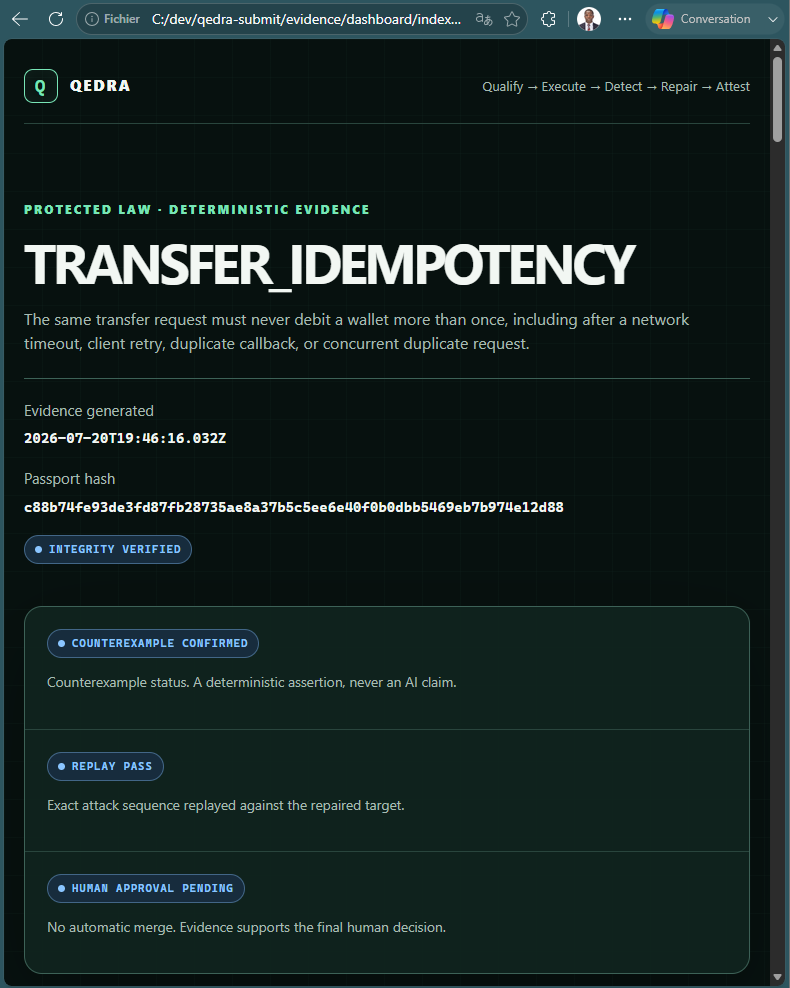
Credential-free dashboard showing the protected law, confirmed counterexample, verified integrity, exact replay and mandatory human approval
-
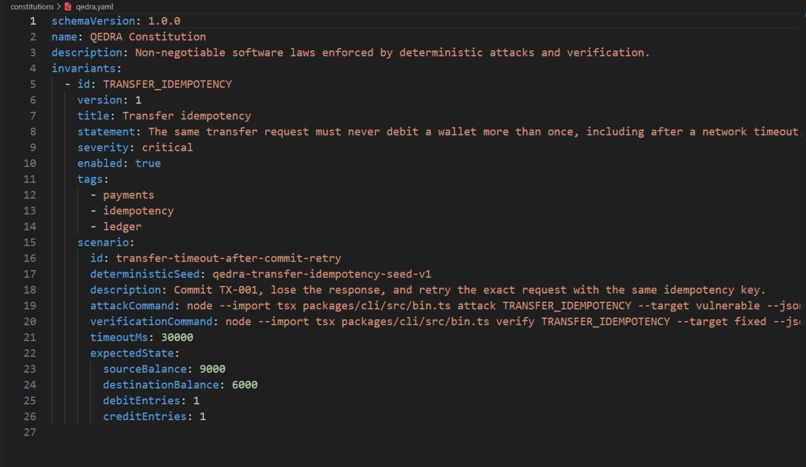
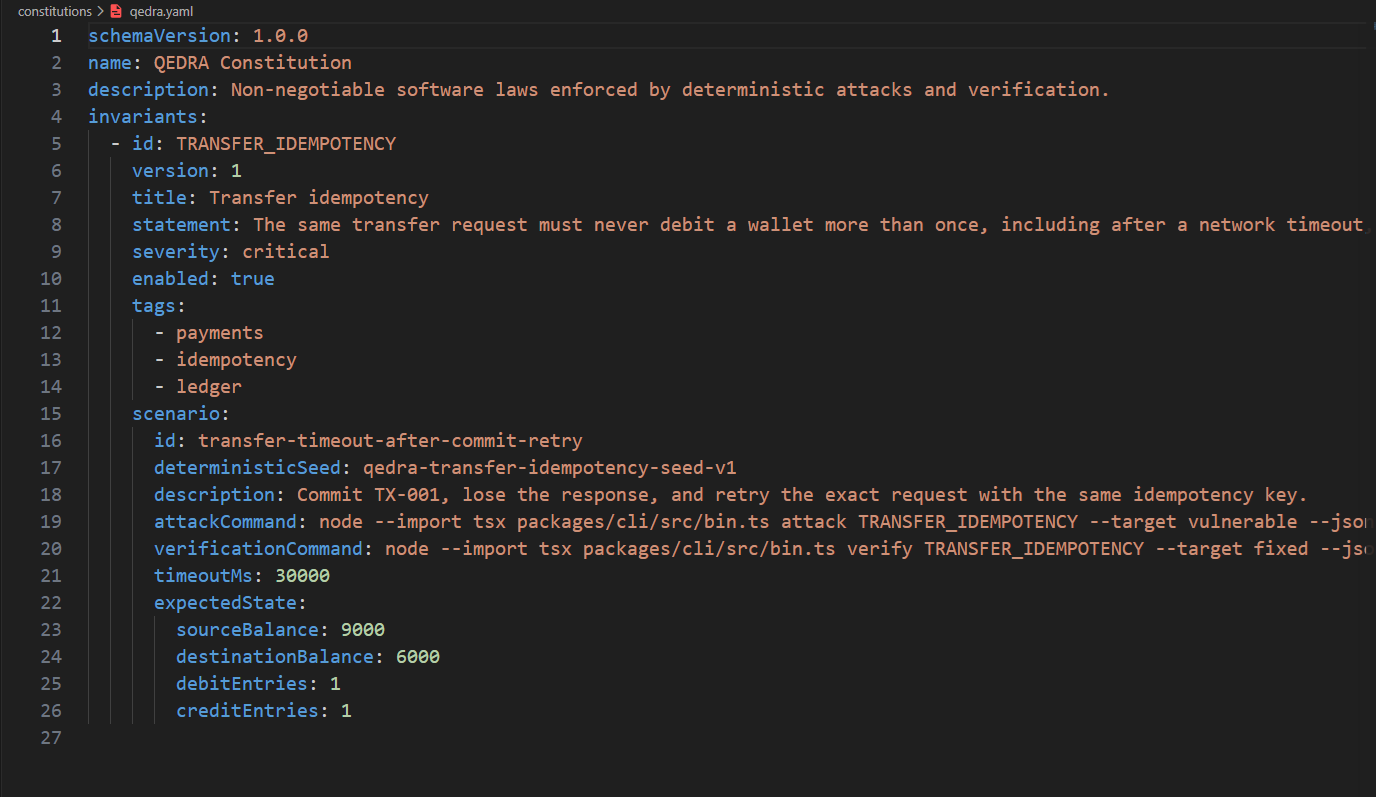
Executable constitution defining TRANSFER_IDEMPOTENCY, severity, deterministic scenario, and expected financial state.
Financial software can pass ordinary tests and still duplicate money when a network response is lost and a client retries the same transaction.
QEDRA is an evidence layer for autonomous software engineering. It starts with a non-negotiable financial law: the same transfer request must never debit a wallet more than once. QEDRA then executes a deterministic failure scenario against a real wallet API, records the resulting counterexample, applies a bounded repair inside an isolated Git worktree, and replays the exact same request sequence.
In the demonstration, wallet A starts with 10,000 FCFA and wallet B with 5,000 FCFA. The intentionally defective implementation processes TX-001 twice after a timeout and retry, producing A=8,000 and B=7,000. After the recorded repair is applied and validated, the exact replay produces the lawful state: A=9,000 and B=6,000, with one debit and one credit.
QEDRA does not trust an AI statement that a defect has been fixed. Deterministic code decides PASS or FAIL. The result is recorded in machine-verifiable JSON and standalone HTML evidence passports containing hashes, Git metadata, validation results, limitations, and reproduction commands. Human approval remains mandatory, and QEDRA never merges a repair automatically.
Built with Codex and GPT-5.6
QEDRA was built during OpenAI Build Week through a long-running Codex engineering workflow using GPT-5.6.
Codex and GPT-5.6 were used to:
- inspect the repository and verified toolchain;
- translate the financial requirement into the executable
TRANSFER_IDEMPOTENCYinvariant; - design the constitution, scenario engine, verification engine, Git worktree boundary, CLI, evidence passport, dashboard, and Flutter presentation client;
- implement the wallet fixture and deterministic timeout-after-commit retry scenario;
- create and execute unit, integration, adversarial, end-to-end, and Flutter tests;
- diagnose validation failures and repair infrastructure defects;
- document the architecture, limitations, threat model, and judge workflow;
- produce milestone commits and recover the mission after interrupted sessions.
Human decisions included the financial law, product scope, safety boundaries, deterministic judge path, mandatory approval policy, and the decision not to claim a successful live model repair without authenticated runtime evidence.
The submitted demonstration uses deterministic record/replay so judges can reproduce it without credentials. GPT-5.6 was used through Codex to build and refine the product; QEDRA does not falsely claim that GPT-5.6 executed the submitted runtime repair.
Judge quick test
pnpm install --frozen-lockfile
pnpm demo
pnpm evidence:verify
No OpenAI API key, external database, cloud account, test credentials, or proprietary service is required for the judge path. The demonstration reproduces the duplicate-transfer failure, validates the bounded repair in an isolated Git worktree, replays the exact scenario, verifies the corrected financial state, and generates the evidence passport and dashboard.
The optional live repair path uses the official Codex SDK but is not represented as a successful authenticated runtime call where no corresponding telemetry exists.
Built With
- codex
- dart
- fastify
- flutter
- git
- github-actions
- gpt-5.6
- node.js
- openai-codex-sdk
- pnpm
- sqlite
- typescript
- vitest
- zod

Log in or sign up for Devpost to join the conversation.