-
-
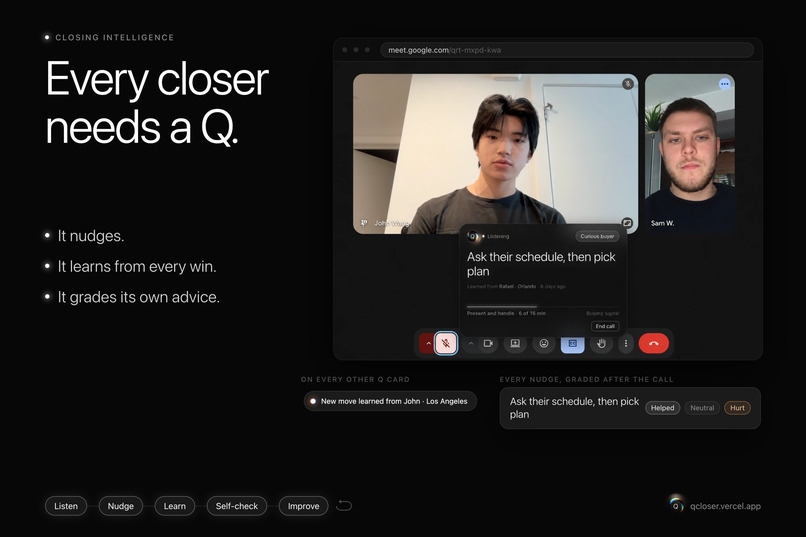
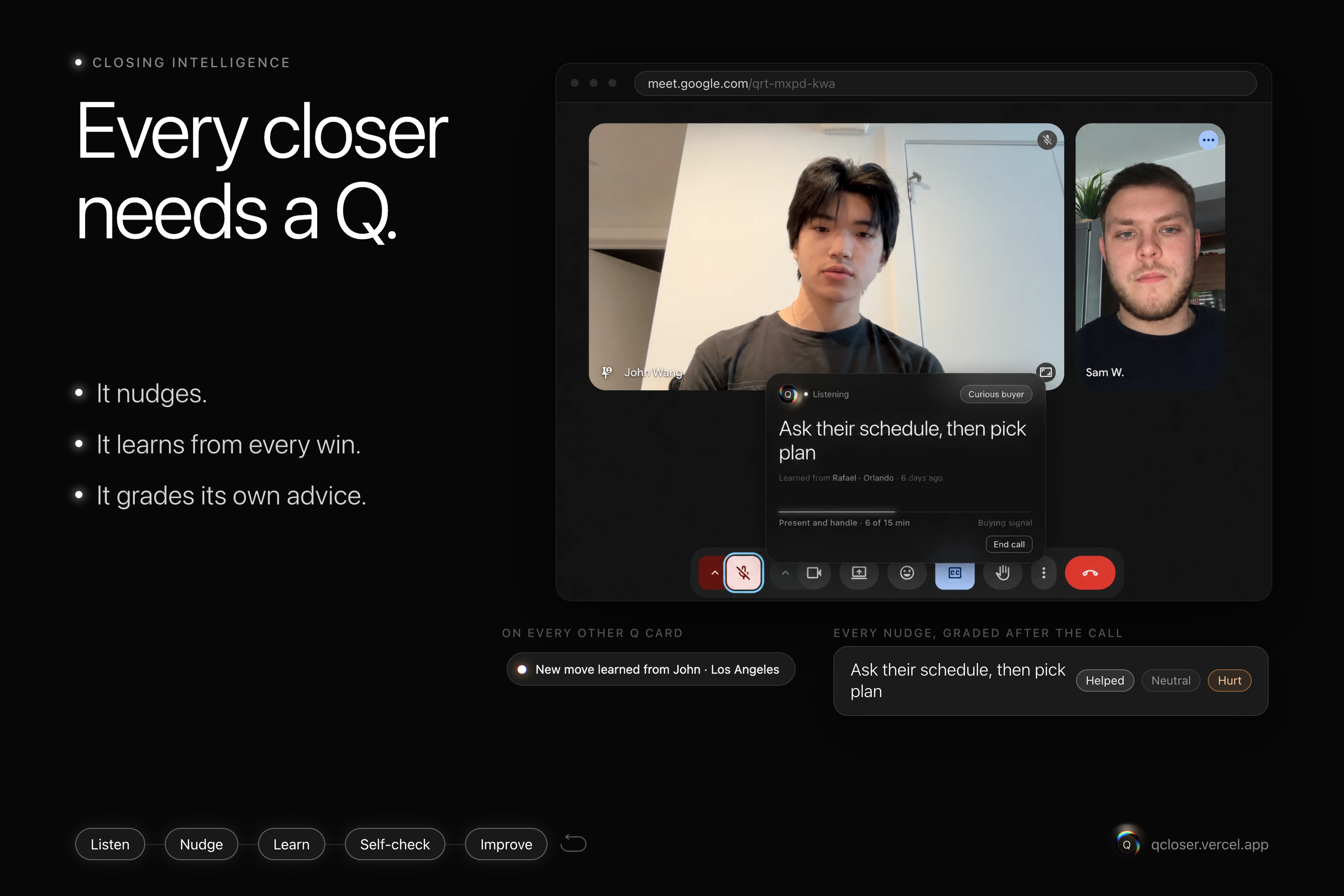
Every closer needs a Q. Live nudges on a real Google Meet call.
-
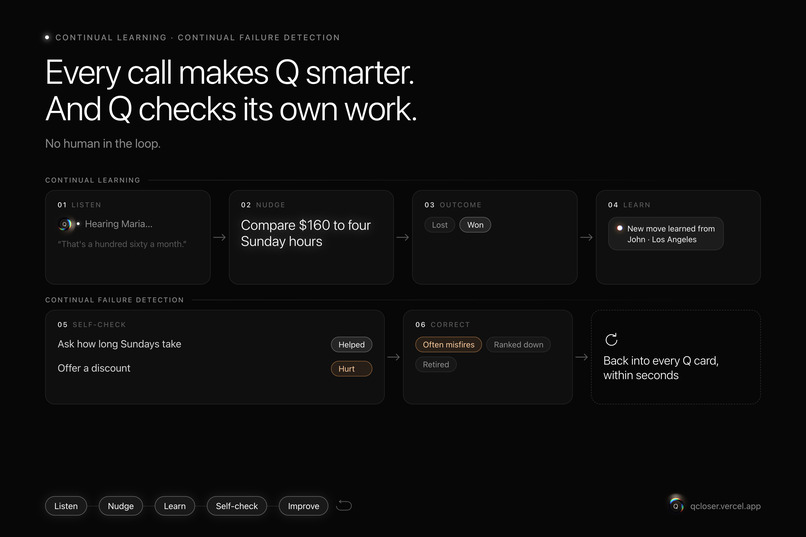
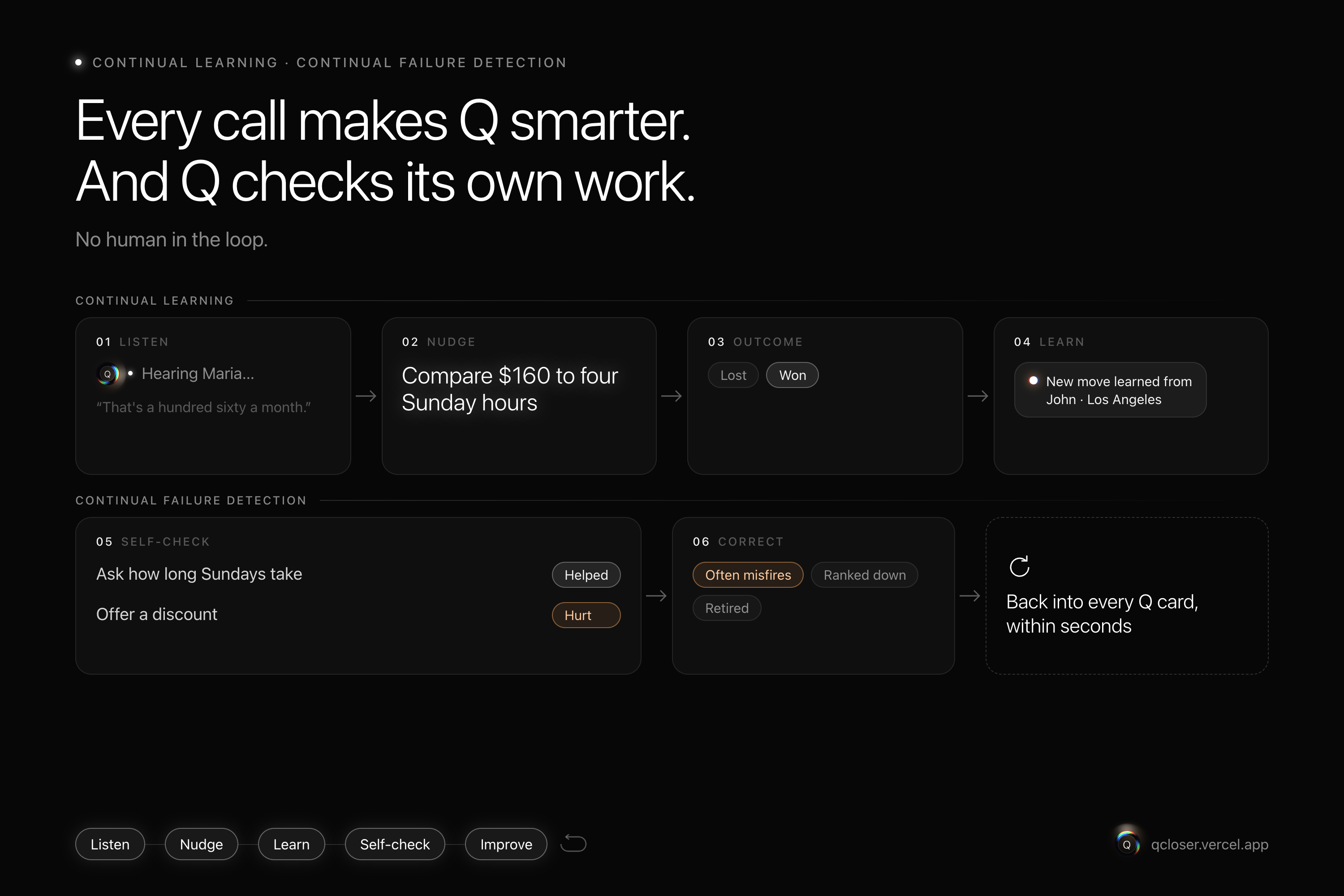
Continual learning and failure detection: every call teaches Q, and Q grades its own advice. No human in the loop.
-
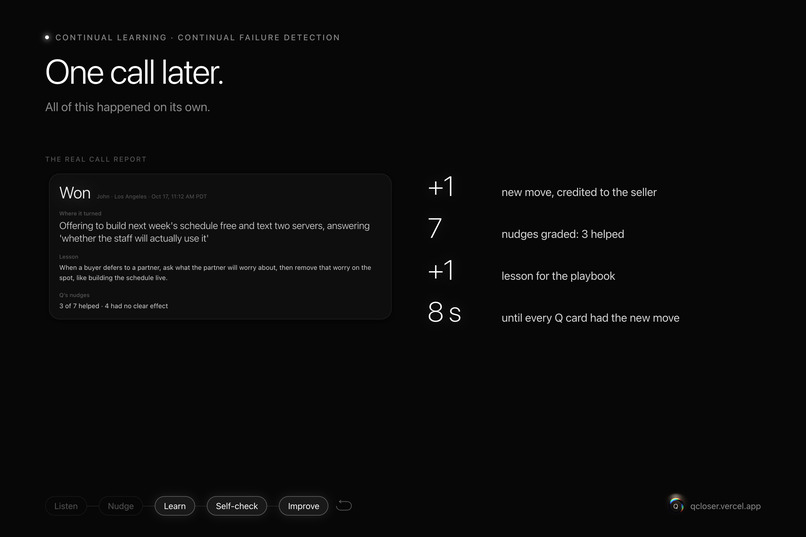
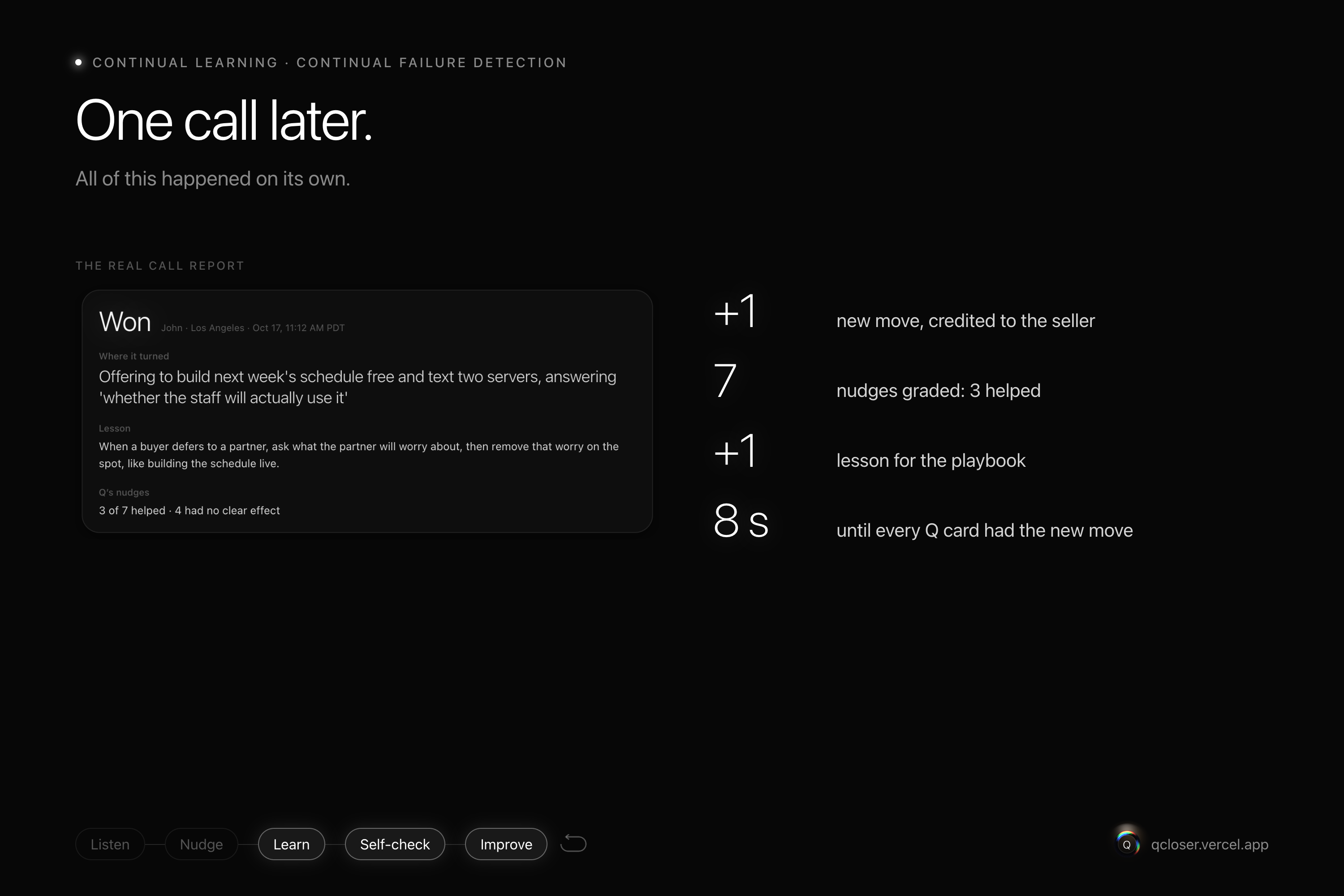
One call later: a new move learned, 7 nudges graded, a lesson saved, and the move on every Q card 8 seconds after the win.
-
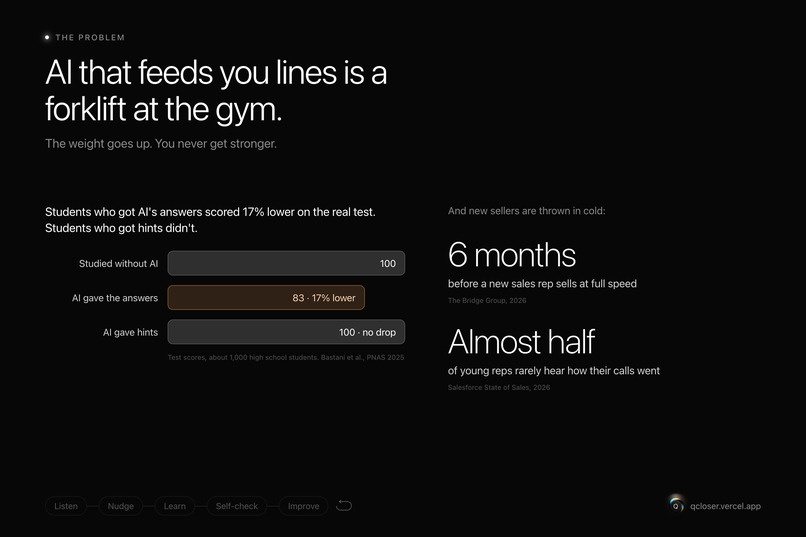
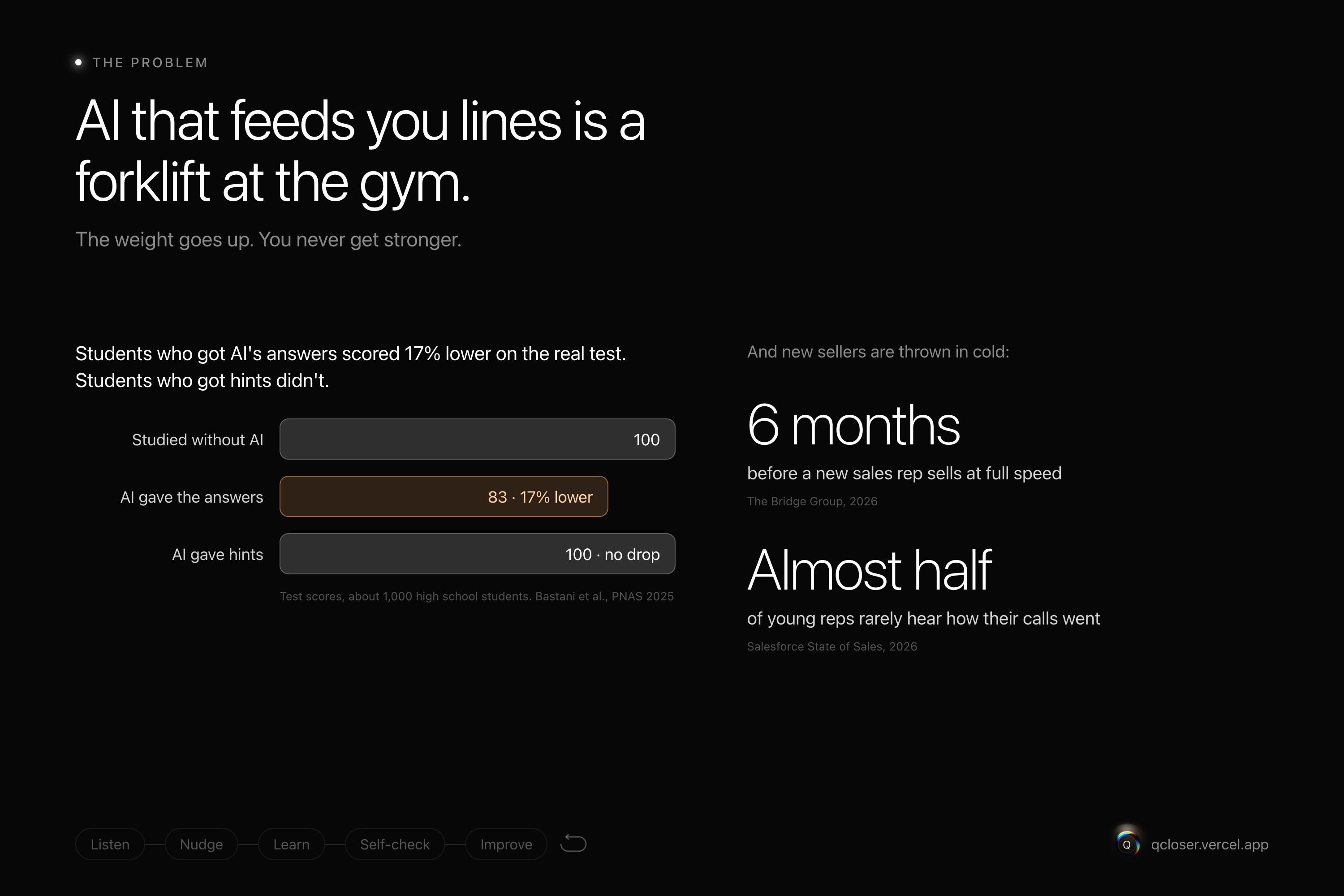
AI that feeds you lines is a forklift at the gym. Students fed AI answers scored 17% lower on the real test.
-
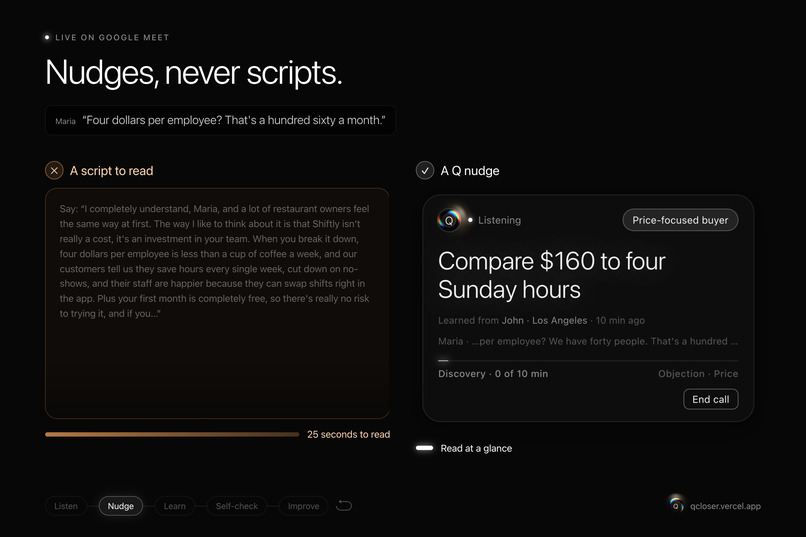
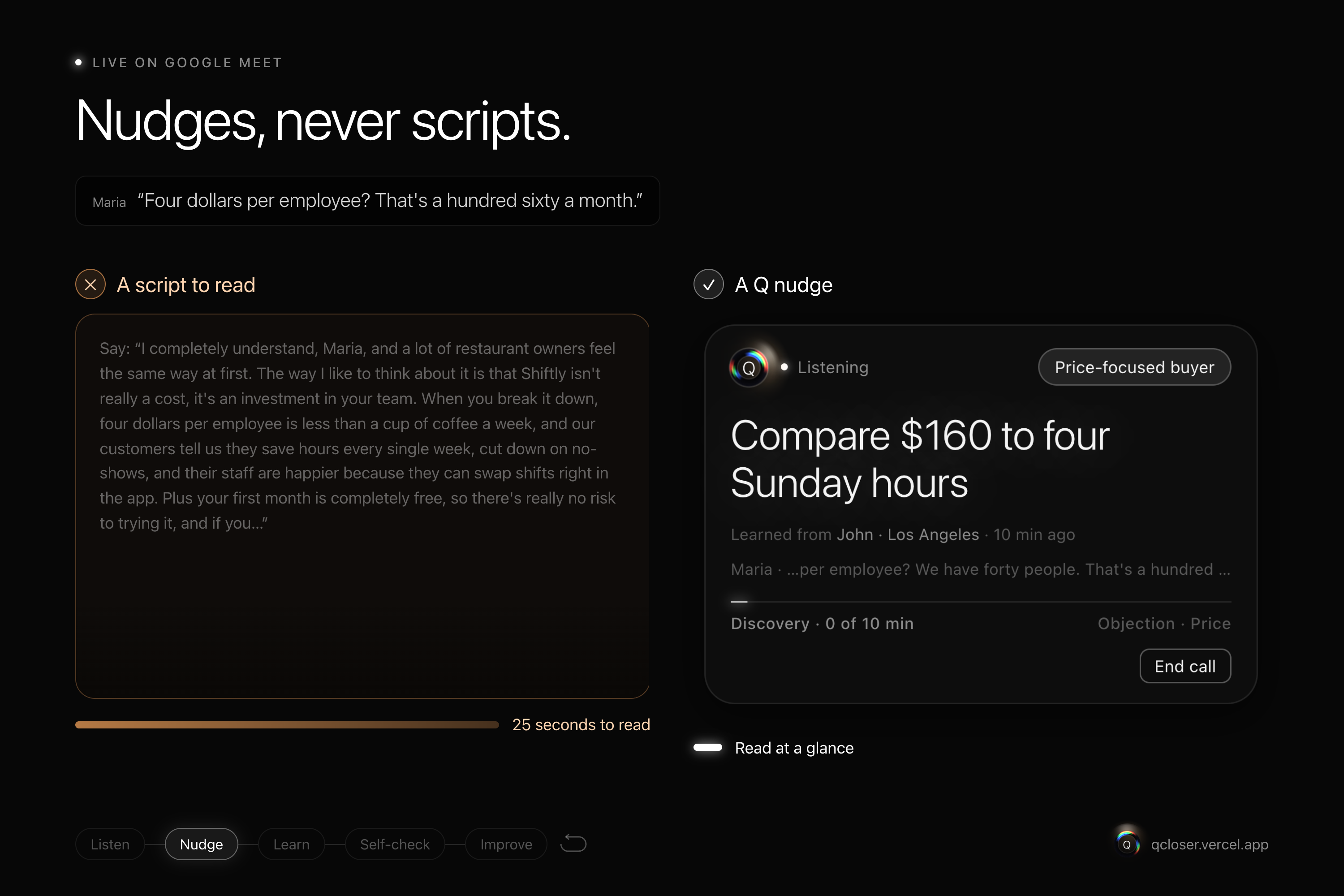
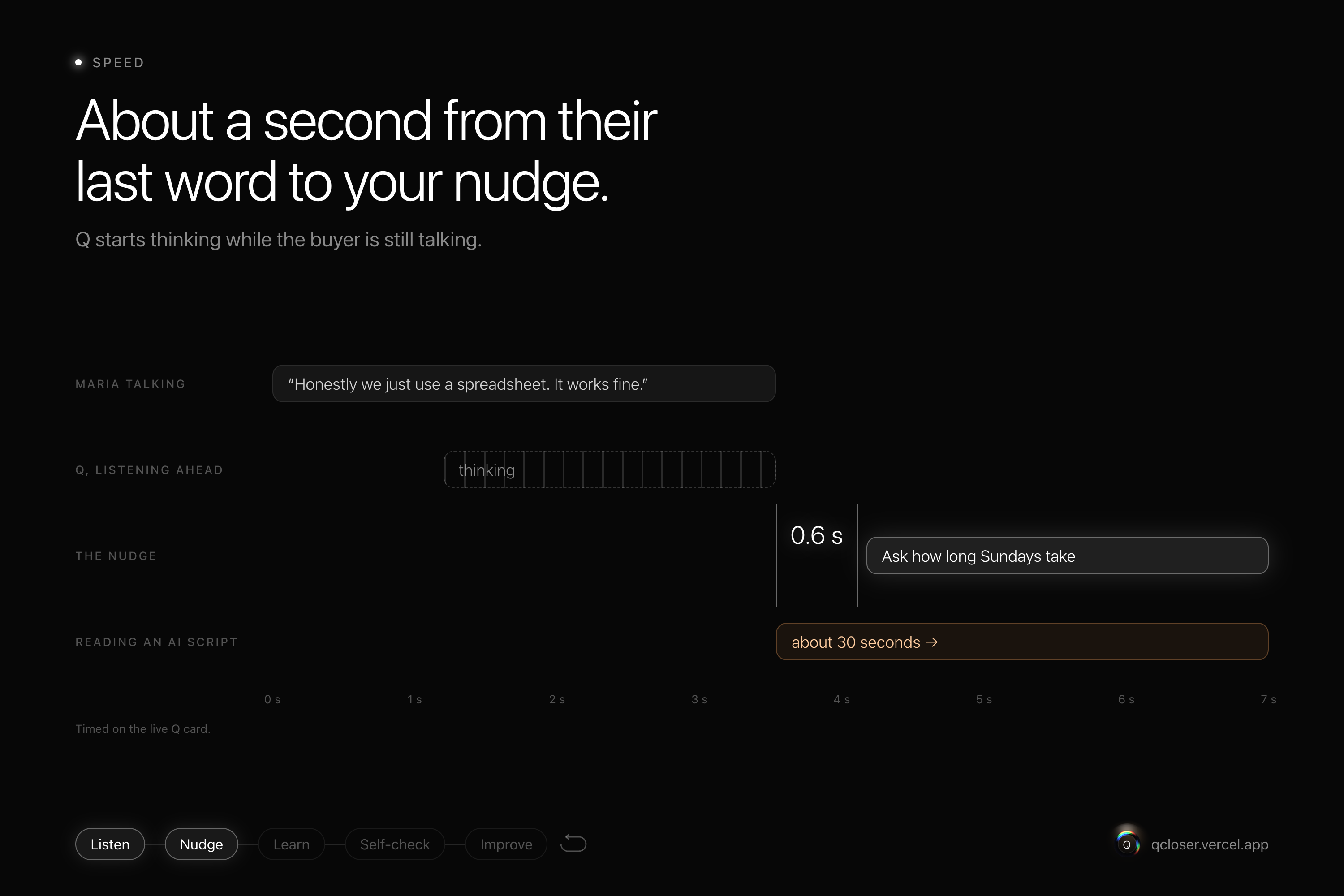
Nudges, never scripts. A script takes 25 seconds to read. A Q nudge takes a glance.
-
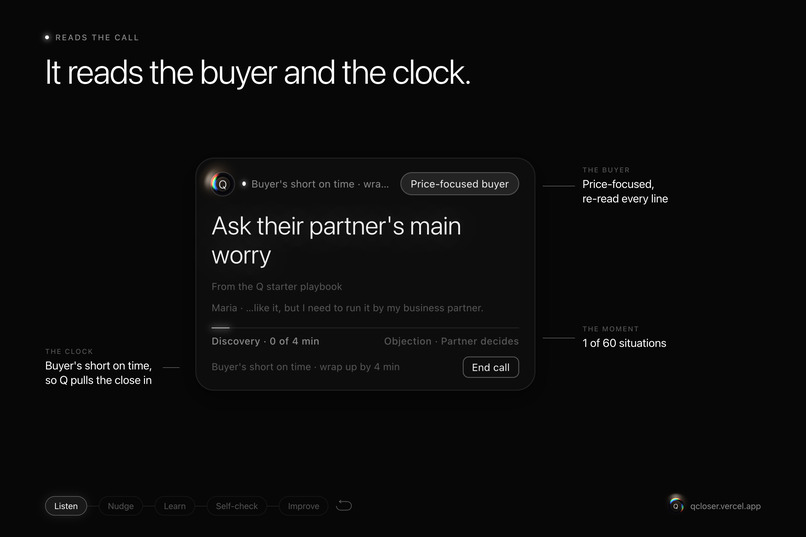
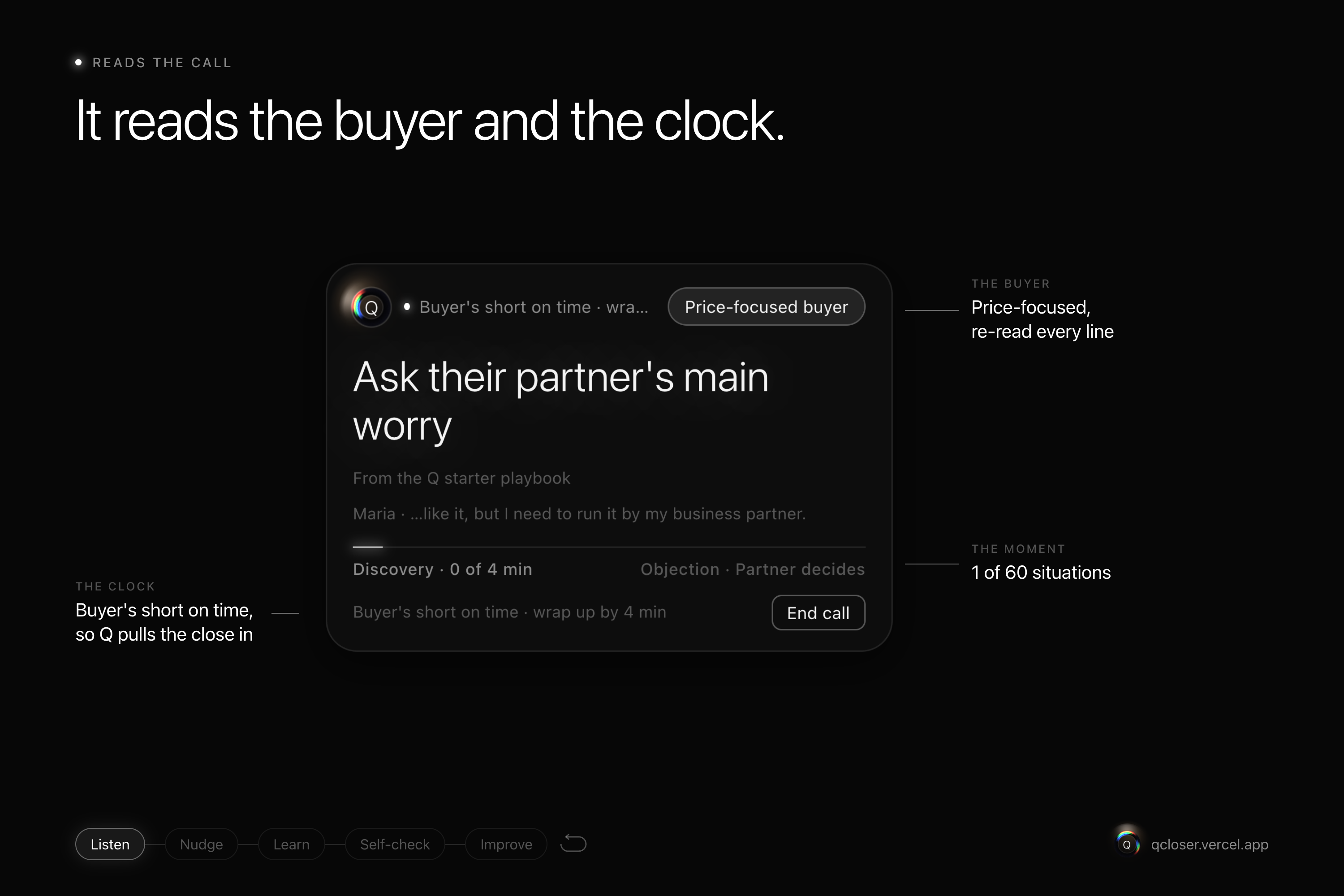
Q reads the buyer and the clock, and pulls the close in when the buyer is short on time.
-
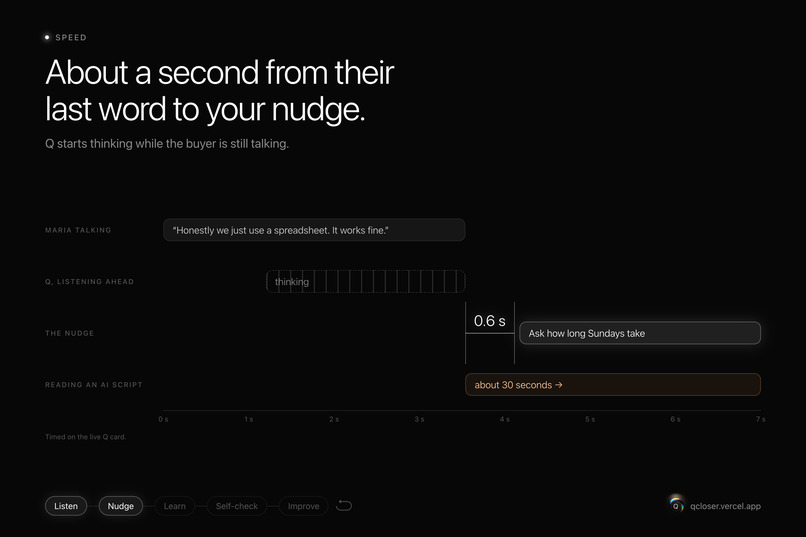
Q thinks while the buyer talks, so the nudge lands about a second after they stop.
-
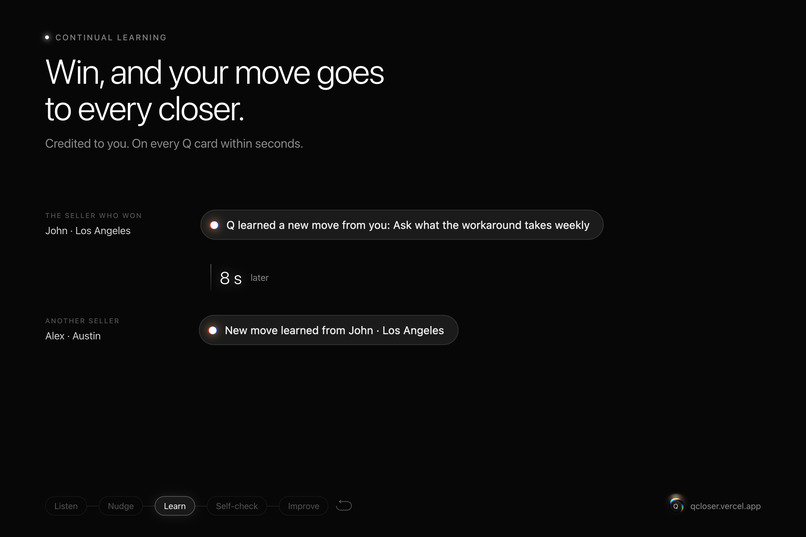
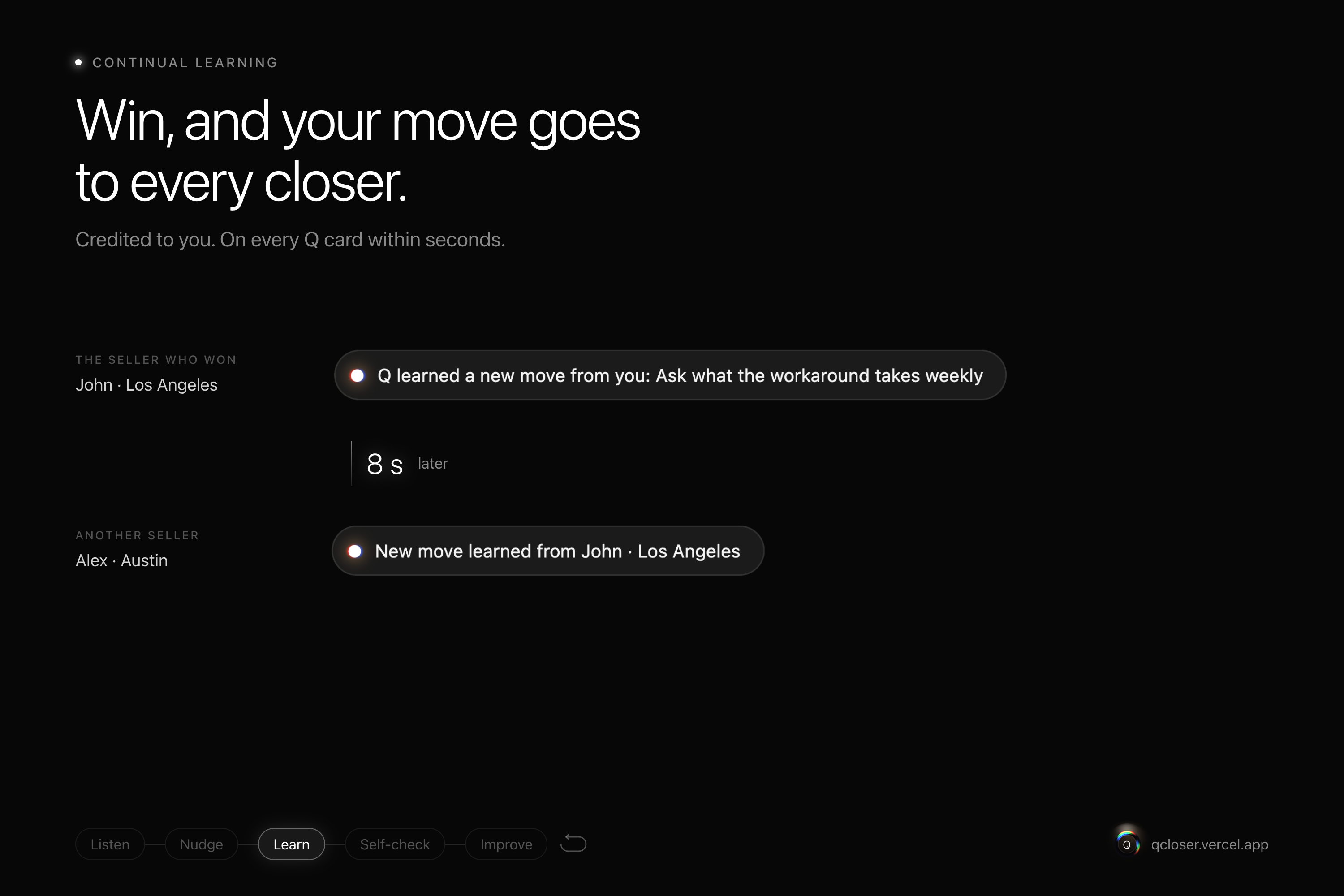
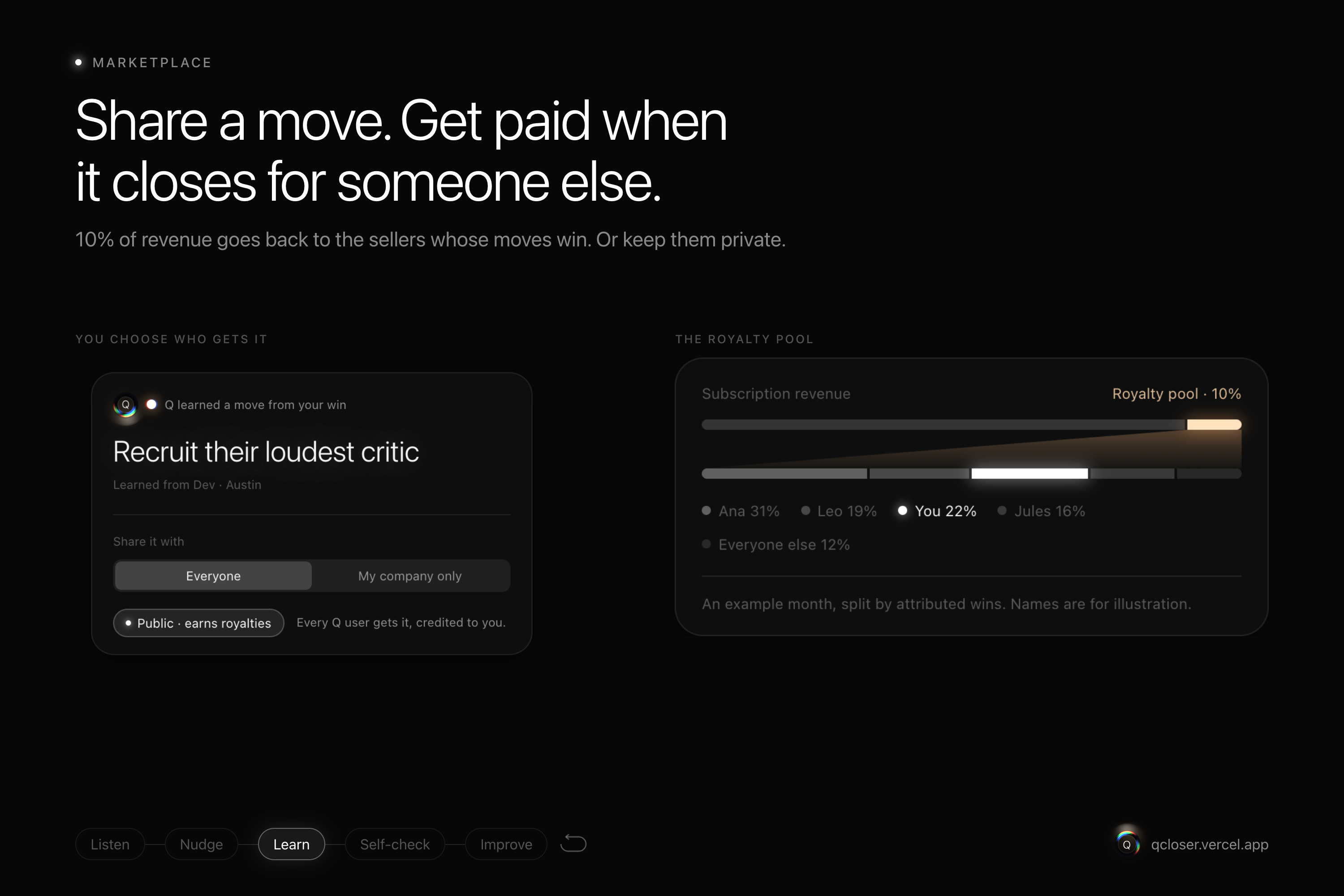
Win, and your move goes to every Q card in seconds, credited to you.
-
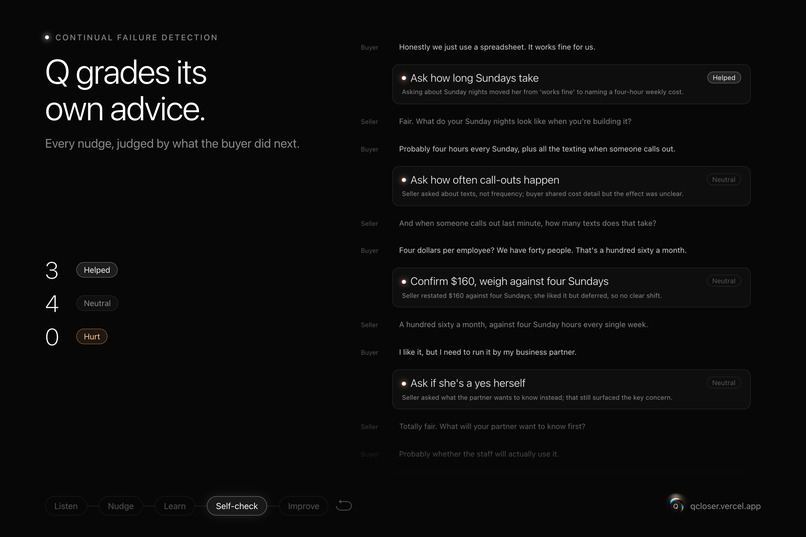
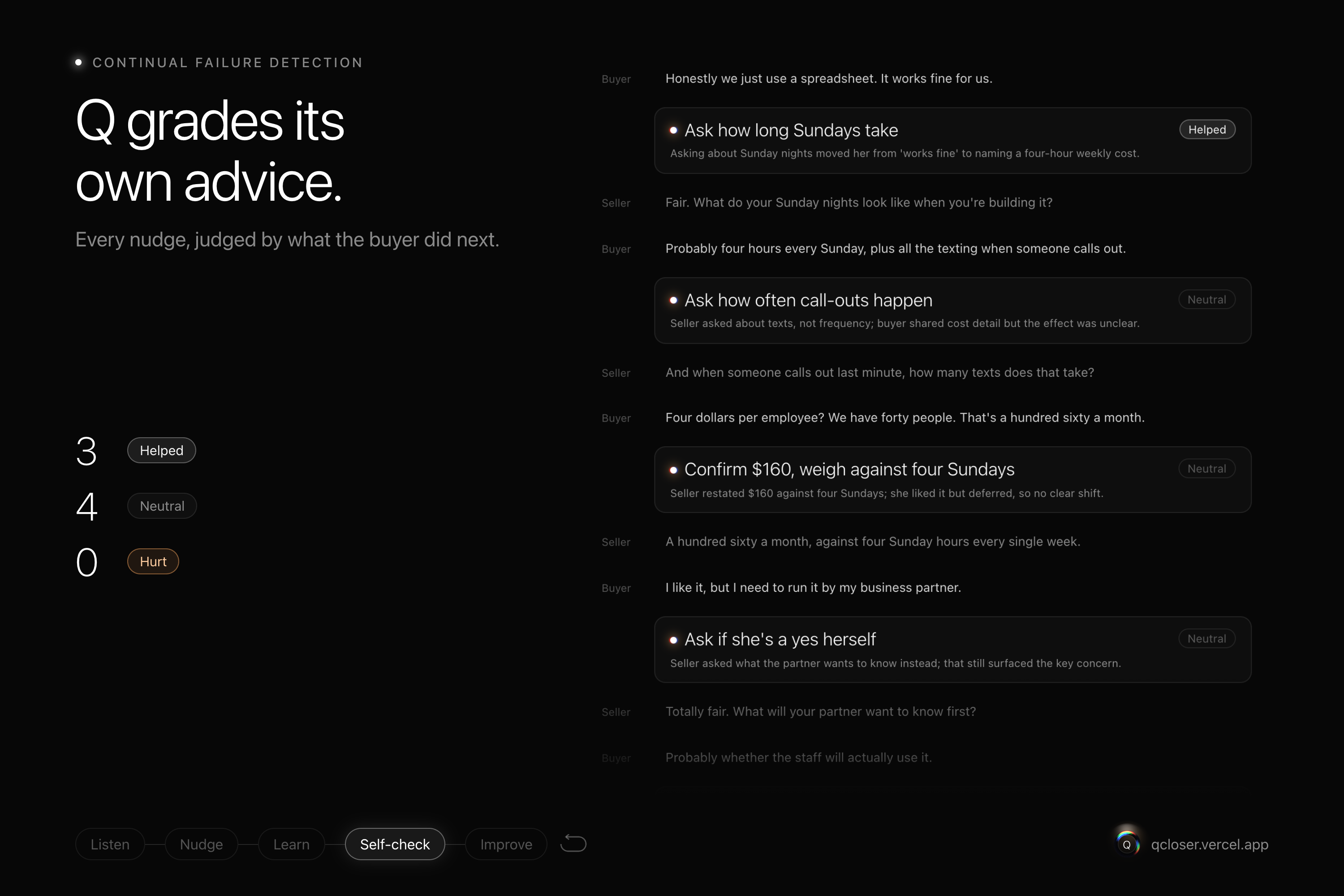
Q grades every nudge by what the buyer did next: helped, neutral or hurt.
-
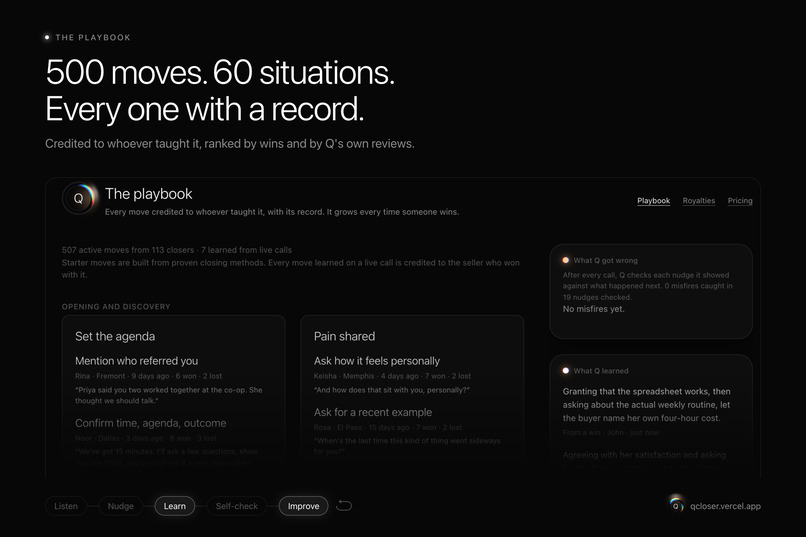
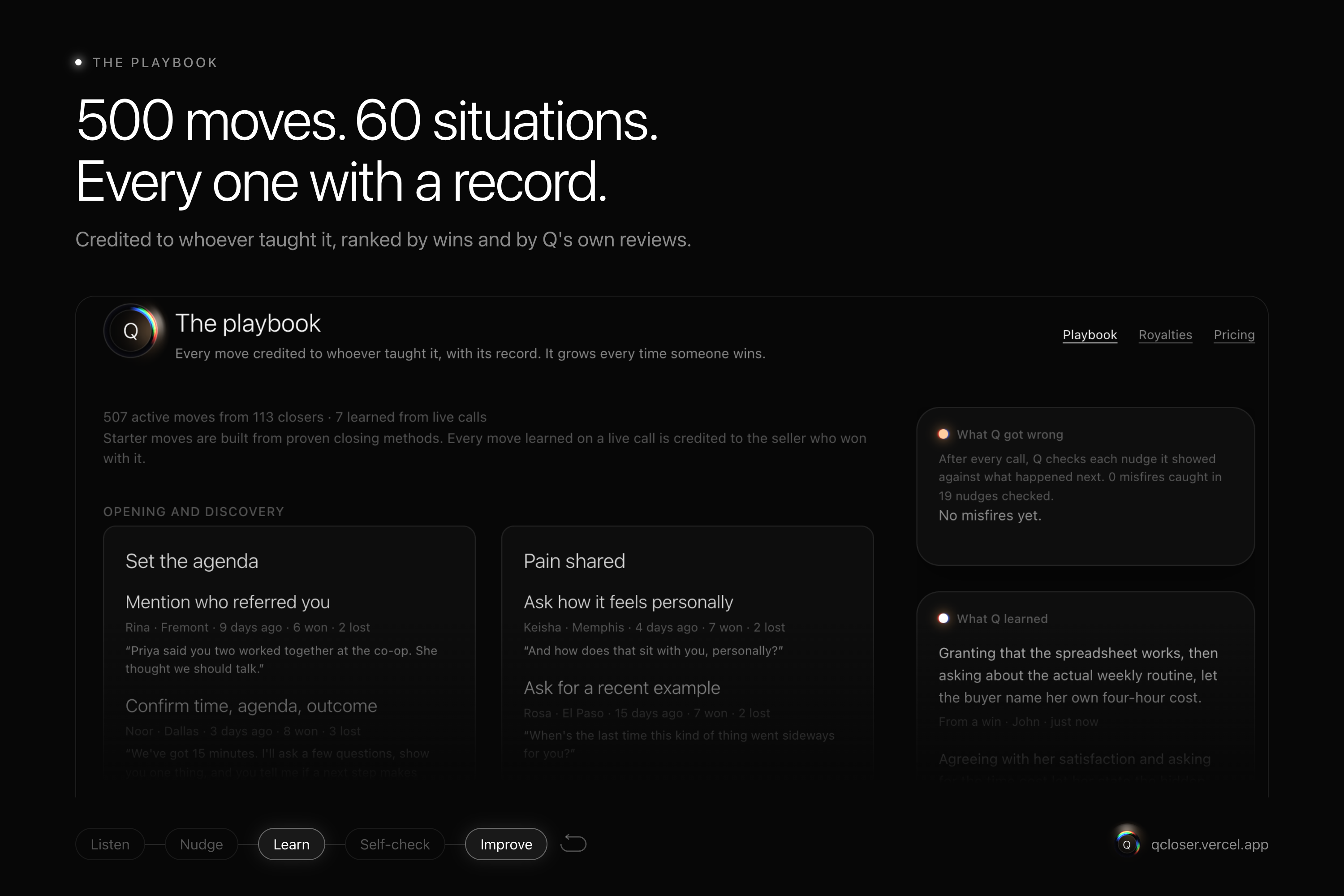
500 moves across 60 situations, ranked by wins and by Q's own reviews.
-
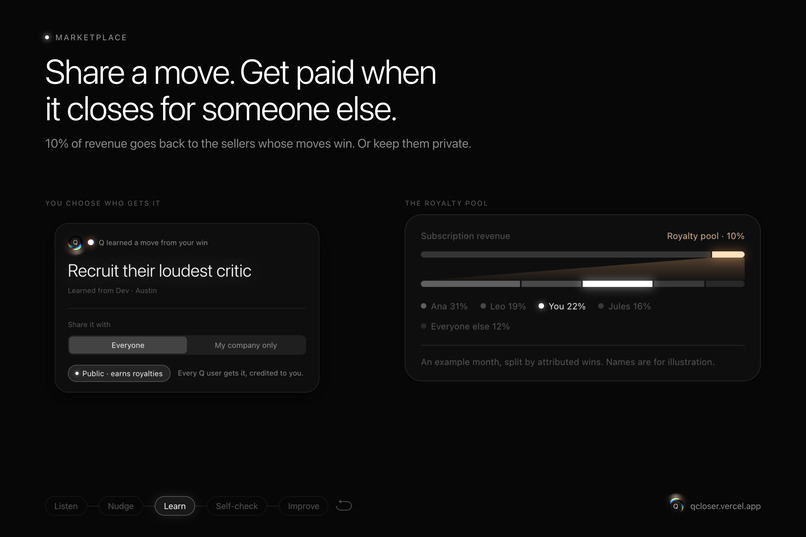
Share a move. Get paid when it closes for someone else.
-
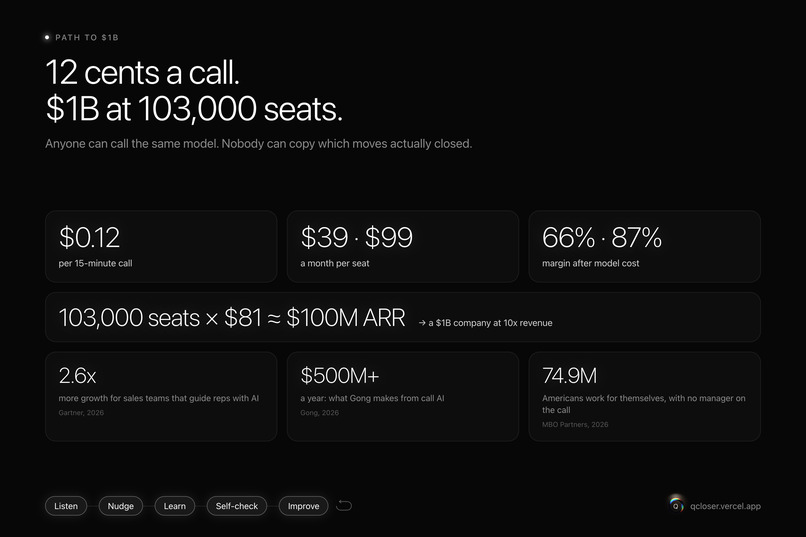
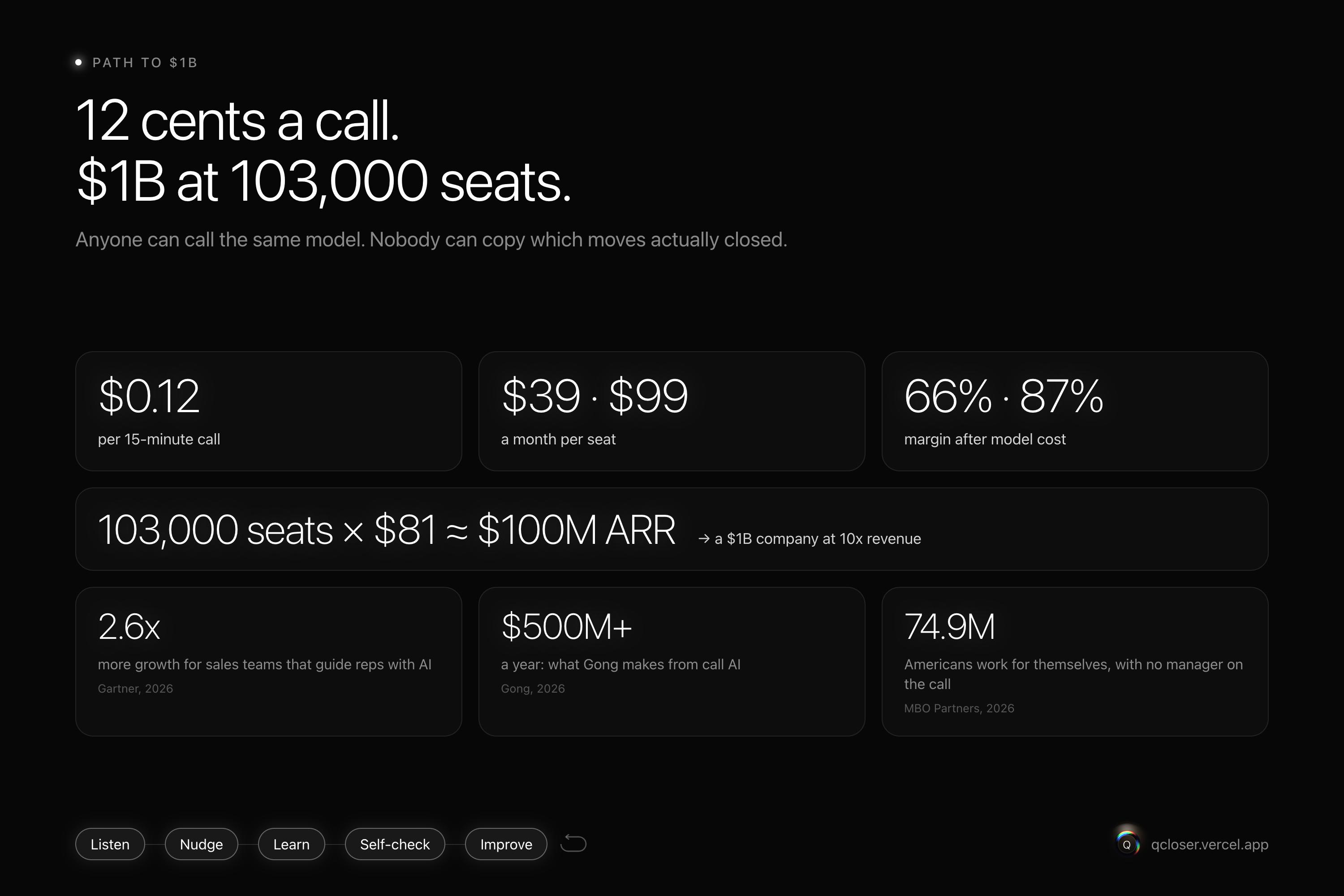
12 cents a call. $1B at 103,000 seats.
-
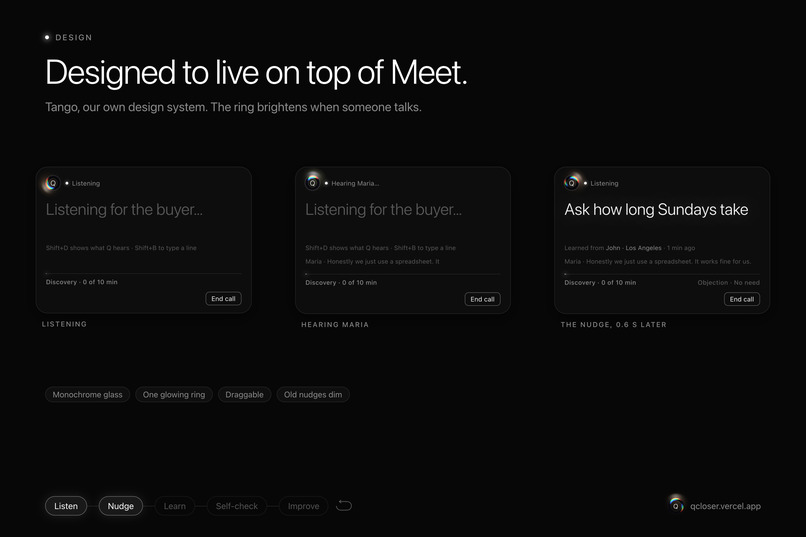
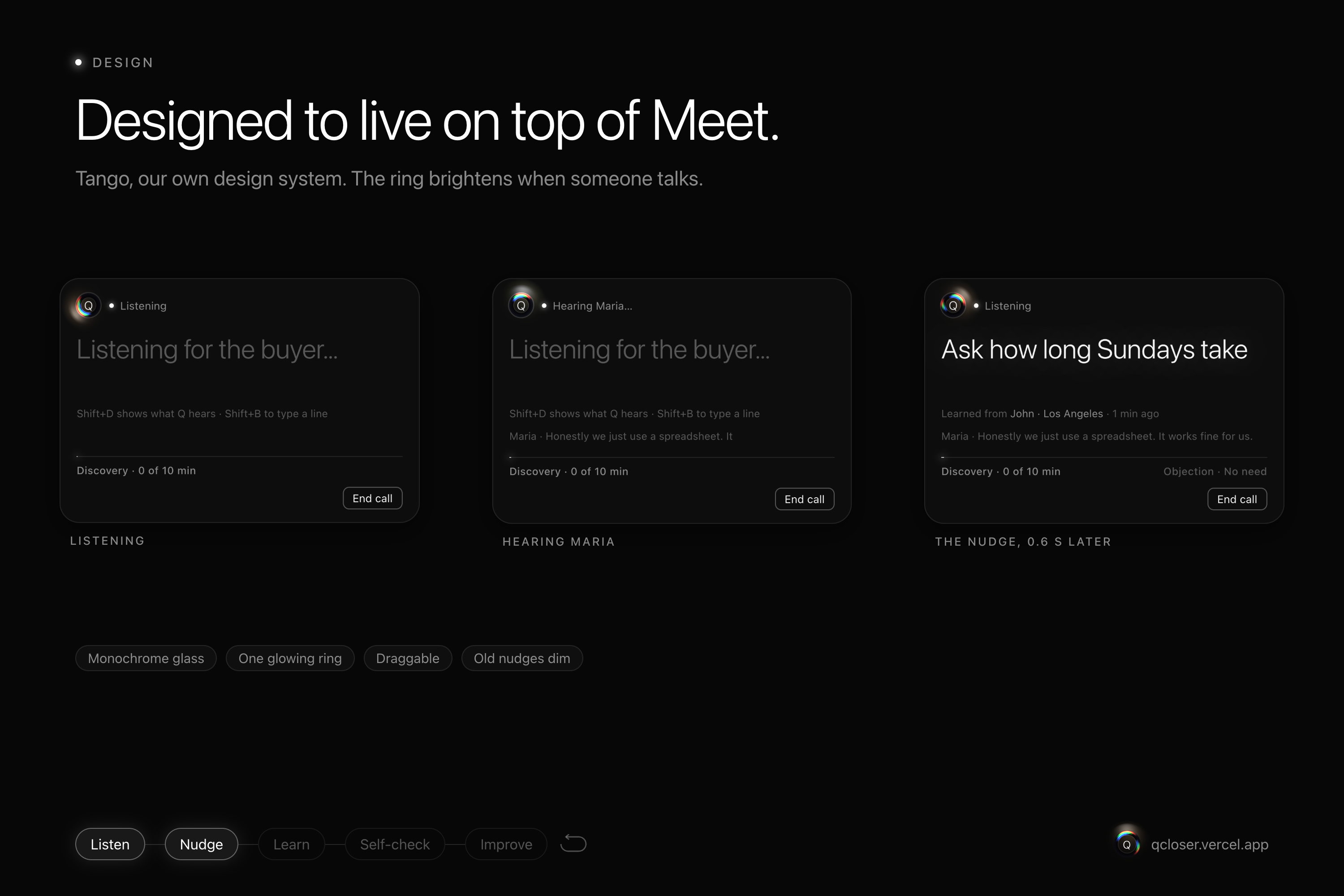
Tango, our own design system, built to live on top of Google Meet.
-
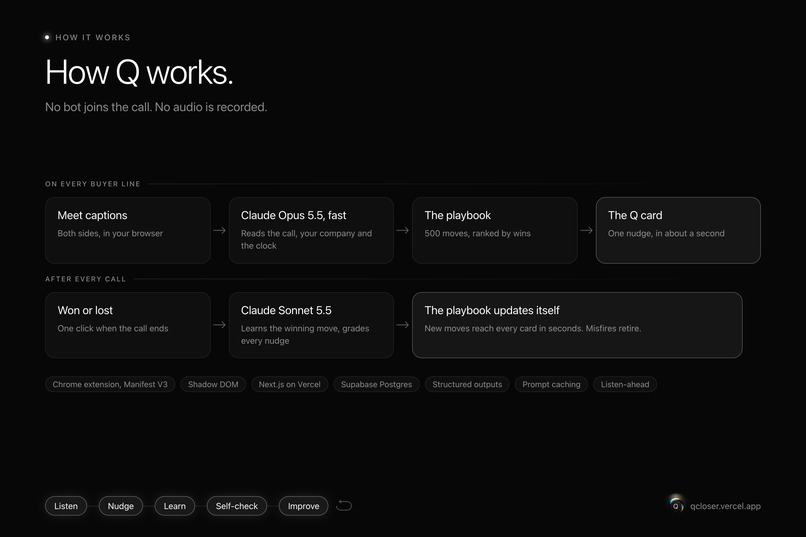
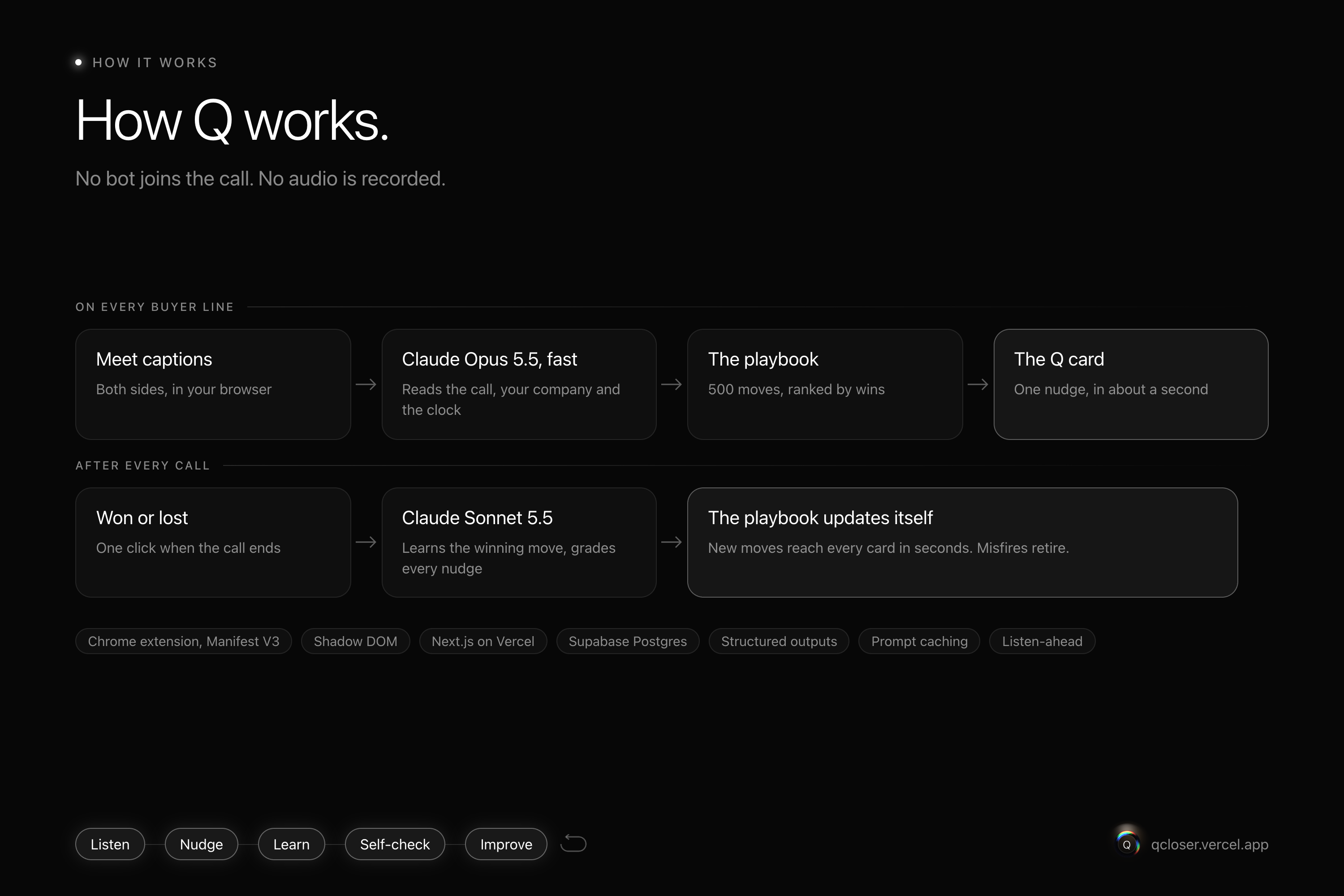
How Q works: Meet captions, Claude Opus 5.5, the playbook, and a learning loop after every call.
Inspiration
"Sell me this pen" is the most famous sales test there is, and most people freeze. Millions of people take that test for real every year, and more of them are young, independent and learning the craft from TikTok and YouTube. They're thrown in cold, with nobody beside them on the call.
The AI they reach for feeds them lines to read. It sounds like a script, and they never learn to sell. When a great sales rep improvises something that closes, it disappears when the call ends.
James Bond never goes into the field without Q handing him the right gadget at the right moment. Every closer needs a Q: the right move at the right moment, at a glance, from a playbook that learns and remembers what works.
The market
- Sellers keep coming. The US fills about 1.67 million sales jobs every year, about 243,000 of them B2B sales roles. [1]
- They're young and on their own. About 30% of US B2B reps are under 35. [2] 74.9 million Americans work independently, and full-time independents are up 114% since 2020. [3] Sales and business development were the fastest-growing fully remote job categories in the first half of 2026. [4]
- They learn from their feeds. 63% of US adults under 30 use TikTok [5], and 63% of Gen Z workers have taken career advice from Reddit, YouTube or TikTok. [6]
- And they're struggling. 48% of account executives hit quota, and ramp is up to 6.2 months, the longest the Bridge Group has ever recorded. [7] SDR attrition runs 40% a year. [8] 46% of Gen Z reps rarely get feedback on their sales conversations. [9]
- Guidance is what wins. Sales orgs that give reps AI next-best-action guidance are 2.6x more likely to grow. [10] And buyers still want a person: by 2030, 75% of B2B buyers will prefer human-led sales over AI. [11] Q makes that person better instead of replacing them.
- Buyers pay for call AI. Gong passed $500M in annual recurring revenue, growing more than 55% a year. [12] Sales enablement platforms are a $6.0B market, projected to reach $21.2B by 2033. [13]
Why nudges, not scripts AI that feeds you the exact line is a forklift at the gym: the weight goes up, and you never get stronger. The research agrees.
- A paragraph is too slow. Adults read about 238 words a minute [14], so a 120-word AI answer takes 30 seconds to read while the buyer waits. A nudge takes a glance.
- Answers make you weaker. In a randomized trial with about 1,000 high school students, the ones given ChatGPT's answers scored 48% higher in practice, then 17% worse on the exam once the AI was gone. Students whose AI gave hints instead didn't take the hit. [15]
- It happens to experts too. After doctors got used to AI help, their unaided adenoma detection rate fell from 28.4% to 22.4%. [16]
- And to developers. In Anthropic's own randomized trial, developers who learned a new library with AI scored 50% on the follow-up quiz, against 67% without it. The ones who used AI to ask questions instead of handing over the work scored 65% or higher. [17]
- Saying it yourself is how it sticks. Generating an answer beats reading one, by almost half a standard deviation across 86 studies. As Bjork and Bjork put it, being told what you could work out yourself robs you of the learning. [18] [19]
- Buyers can hear a script. Customers detect script use in a conversation, and across more than 31,000 salespeople, reps who adapt to the buyer perform better on real sales numbers. [20] [21]
- Live help makes new reps fast. With a real-time AI assistant, support agents two months in performed like six-month veterans, and kept their edge when the AI went down. [22] Q delivers that ramp while the seller does the talking.
- Coaching wins deals. Teams with dynamic coaching win 66% of forecast deals; teams that leave coaching to chance win 44%. [23] Q coaches on every call, in the moment it matters.
So Q never hands you a line. It tells you where to steer, you say it your way, and every call makes you a better closer. Your best moves go out to every closer on Q.
What it does
What it does Q listens to your sales call and shows you, at a glance, what the best salespeople would do next. Every win teaches it something new.
I call it closing intelligence: the moves that are winning right now, getting sharper with every deal. Q is a Chrome extension that floats a card over Google Meet, with a playbook of 500 moves across 60 situations that grows with every win.
Hears both sides. Q reads Meet's live captions (the seller's own are labeled "You"). No audio capture, no extra transcription service.
- Nudges, never scripts. When the buyer objects, warms up, or the call drifts, the card flashes a short nudge telling the seller where to steer. "I don't need a pen" becomes "Ask what contracts they sign". The seller says it their own way.
- Every nudge has a source. Each one comes from a playbook move and shows who it was learned from: "Learned from John · Los Angeles".
- Fits this buyer and this company. Claude reads the whole call, a saved company profile and an optional pre-call brief, tags the buyer (skeptical, rushed, price-focused or curious), picks the best move, and fits it to the buyer: "Offer 0% financing, about 190 monthly". Q starts thinking while the buyer is still talking, so nudges land about a second after they stop.
- Watches the clock, and the clock follows the buyer. The seller sets the call length (10, 15, 30 or 45 minutes). The card shows the phase (Discovery, Present and handle, Close window, Ask for the sale), and nudges push toward the close as time runs low. The target adapts: it extends when the buyer is engaged or says there's no rush, and pulls in when they're short on time or going quiet.
- Learns from every call. End call leaves Meet and asks Won or Lost. On a win, Claude extracts the seller's own winning move and adds it to the playbook, credited to them; every other Q card shows "New move learned from John · Los Angeles" within about 3 seconds. Moves that keep losing retire on their own. Every call, won or lost, leaves a lesson in the "What Q learned" feed.
- Grades its own advice. After every call, Q judges each nudge it showed from what happened next: helped, neutral or hurt, with a reason. The card says how its nudges did, a call report shows every verdict inline, and moves that keep hurting lose rank and retire.
- You choose who gets your moves. Everyone (credited, and earning royalties every time the move helps another seller close) or My company only, so another salesman won't get your best lines unless you want them to.
- A playbook you can browse. The playbook shows every move grouped by situation (objections, emotional worries, closing moments, pacing), with its win and loss record, how often it helped or hurt, the line behind it, New and Retired tags, the lessons feed and a "What Q got wrong" panel.
How I built it
- In-call overlay: Chrome extension, Manifest V3, plain JavaScript, no build step. The card lives in a Shadow DOM so Meet's CSS can't touch it.
- Backend/web pages: Next.js 16 (App Router, TypeScript, Tailwind) on Vercel
- Playbook database: Supabase Postgres: moves, calls, lessons and nudge reviews. The extension only talks to Q’s API.
- Brain: Claude through the Anthropic API: Claude Opus 5.5 in fast mode for live nudges, with Claude Sonnet 5.5 as the fallback; Claude Sonnet 5.5 for learning, call reviews, and self error detection and correction. Structured outputs (Zod schemas) and prompt caching.
- Live updates: Every Q card polls /api/updates every 3 seconds Hearing the call. A MutationObserver watches Meet's captions region, found through ARIA roles and page structure rather than Meet's obfuscated class names. Meet rewrites a caption while the person is still talking, so a line counts as final once it stops changing for a moment or the speaker changes. Meet's own caption bar is hidden with opacity (so Meet keeps rendering it) and Shift+C brings it back. Shift+D shows what Q hears; Shift+B types a buyer line if captions fail.
Picking a nudge (/api/cue): For each finished buyer line, Claude gets the playbook, the company profile, the brief, call stats (minutes used of the target, seller talk share, talking streak), the nudges already shown, and the whole call. It returns, in this order: the moment (one of 60 situation types, or none), the buyer type, the aim (probe, answer, acknowledge, calm or advance), and two picks, each a concrete nudge plus the playbook move it uses. The order is deliberate: Claude commits to what the nudge must do before writing it, and writes the nudge before naming the move, so it doesn't just echo the move. The server then:
- maps each pick to a real playbook move, so every nudge traces to a credited source; prefers a specific nudge over one that repeats a move word for word or repeats an earlier nudge;
- keeps Claude's first pick (its best fit) unless the other has a clearly better record: its after-call reviews, plus a Bayesian win-rate edge, (wins + 1) / (uses + 2), with a bonus when the move won with this buyer type, once both moves have real use; about 15% of the time gives a newly learned move a fair try, except in sensitive moments (grief, feeling judged, money trouble, hostility) or when the buyer asked a direct question, where the best-fitting move always wins. Speed. Listen-ahead: while the buyer is still talking, the card asks Q about the words so far; requests overlap and only the newest answer shows, so the nudge is ready or nearly ready when the buyer stops. Live nudges run on Claude Opus 5.5 in fast mode at low effort, falling back to Claude Sonnet 5.5 if fast mode errors or stalls. The instructions, playbook and company profile are cached, so each nudge only sends what changed; the playbook is kept in memory and refreshed every 5 seconds, and the card warms the cache when a call starts. On the live site, nudges land about a second after the buyer stops. Model cost on Q's standard model: about $0.0017 per nudge, about $0.12 per 15-minute call.
Continual learning (/api/learn): When a call ends, Q saves it, adds a use (and on a win, a win) to every move it showed, and retires any move with 8 or more uses and under a 25% win rate. In parallel, Claude Sonnet 5.5 reviews the call and, on a win, finds the seller's own lines right before the buyer moved toward yes. It names the tactic behind them as a short, reusable move, keeps the seller's real line and a one-sentence lesson, and skips anything already in the playbook. New moves go live for every Q card on the next poll.
Monitoring its own errors (web/lib/review.ts): The review reads the transcript with every nudge marked at the line where it appeared, and returns the turning point, one lesson (for wins and losses alike) and, for each nudge: whether the seller used it, what the buyer did right after, a verdict (helped, neutral or hurt) and a one-line reason. It's told to be calibrated, not generous: an unused nudge is always neutral, and a win doesn't make a nudge helpful. Each verdict goes on the move's record and nudges its ranking by at most 0.2 either way, so one bad call can't sink a good move. A move that has hurt at least twice, and more than twice as often as it helped, is flagged "Often misfires" and retires after 4 or more reviews.
Behaving well: Q never uses an insecurity, grief or money trouble as leverage, never pushes someone who is struggling, and only uses facts from the call, the profile or the brief (no invented prices, offers or claims).
Challenges I ran into
- Meet's captions. Obfuscated class names, and captions that rewrite themselves mid-sentence. I anchored on ARIA and structure and finalized lines on a short settle time.
- Generic nudges. My first fast setting kept copying the generic move ("Ask what would convince them"). I compared model settings with a script on cases that weren't in the prompt's examples. Claude Sonnet 5.5 with thinking off gave clearly more specific nudges at about 1.5 seconds median, so it became the default. Later, on held-out cases plus the demo beats, Claude Opus 5.5 in fast mode scored higher in my judged comparison and answered faster, so it now runs live nudges, with Sonnet as the fallback. Making Claude write the nudge before naming the move, and penalizing echoes, cut generic copies further.
- Too slow to feel live. Waiting for the buyer to finish before asking Q added a visible pause. Listen-ahead asks while they're still talking, so the nudge lands about a second after they stop.
- The therapist problem. Once Q got emotionally smarter, it started asking feelings question after feelings question and forgot to close. Now empathy is one beat, then a pivot to commitment; Q never stacks probing questions, and the right move depends on the clock.
- Learning too little. The first learning prompt rejected a sharper version of a known tactic as a duplicate. I calibrated it to learn a move when it's new or meaningfully sharper.
Accomplishments that I'm proud of
- It works on real Google Meet calls, both sides, with no audio capture.
- The whole learning loop runs live: in my test, one won call taught Q "Flip roles, let them sell it" from a single improvised line in about 3 seconds, and it showed up in the feed every other Q card reads.
- Nudges stay specific to the call. On my demo call, the same buyer line got the same idea 3 out of 3 times ("Ask which pen closes deals"; "Compare $40 to ten-year lease").
- Q grades its own advice. Every nudge gets a verdict and a reason after the call, and the ranking and retirement rules act on them, with no person in the loop. Not only does it get better moves with each call, but it gets better at judging which moves it served were actually helpful or in error.
- 60 situation types, including personal moments like grief, embarrassment and money trouble, each with its own rules.
- A card design that feels alive without being noisy.
What I learned
- Judge AI quality on cases that aren't in the prompt. Q looked great on its own examples and generic on new ones.
- Relevance beats win rate. A move that wins often is still a bad nudge in the wrong moment, so Claude ranks fit first and win rate breaks ties.
- A short nudge forces a decision. A paragraph can hedge; a nudge you read at a glance has to pick a direction.
- Losses teach as much as wins. Every call now leaves a lesson.
What's next for Q: your cue to close
- Zoom, Microsoft Teams and phone dialers, with Q's own transcription so Q isn't tied to Meet's captions.
- Manager analytics for teams: which moves win for which reps, objection trends and ramp tracking.
- Win and loss verified from CRM closed-won deals instead of a button.
- Enterprise controls: buyer notice and consent, retention settings, SSO and audit logs.
Built With
- anthropic-api
- chrome
- javascript
- manifest
- next
- supabase


Log in or sign up for Devpost to join the conversation.