-
-
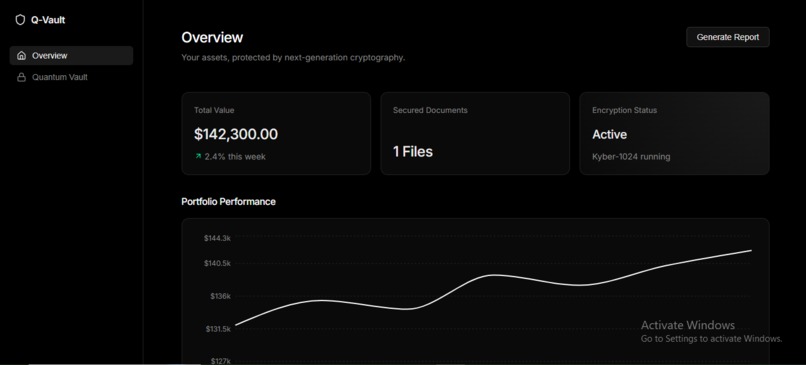
Home Page
Inspiration
In the next decade, the rapid advancement of quantum computing will pose a catastrophic threat to global financial security. Traditional encryption methods, such as RSA, which currently protect all of our banking data and sensitive documents, will be rendered obsolete by Shor's algorithm. We wanted to stay ahead of the curve. Q-Vault was inspired by the need to bridge the gap between everyday personal finance management (Fintech) and future-proof, post-quantum cryptographic security.
What it does
Q-Vault is a next-generation personal finance dashboard and ultra-secure offline document database.
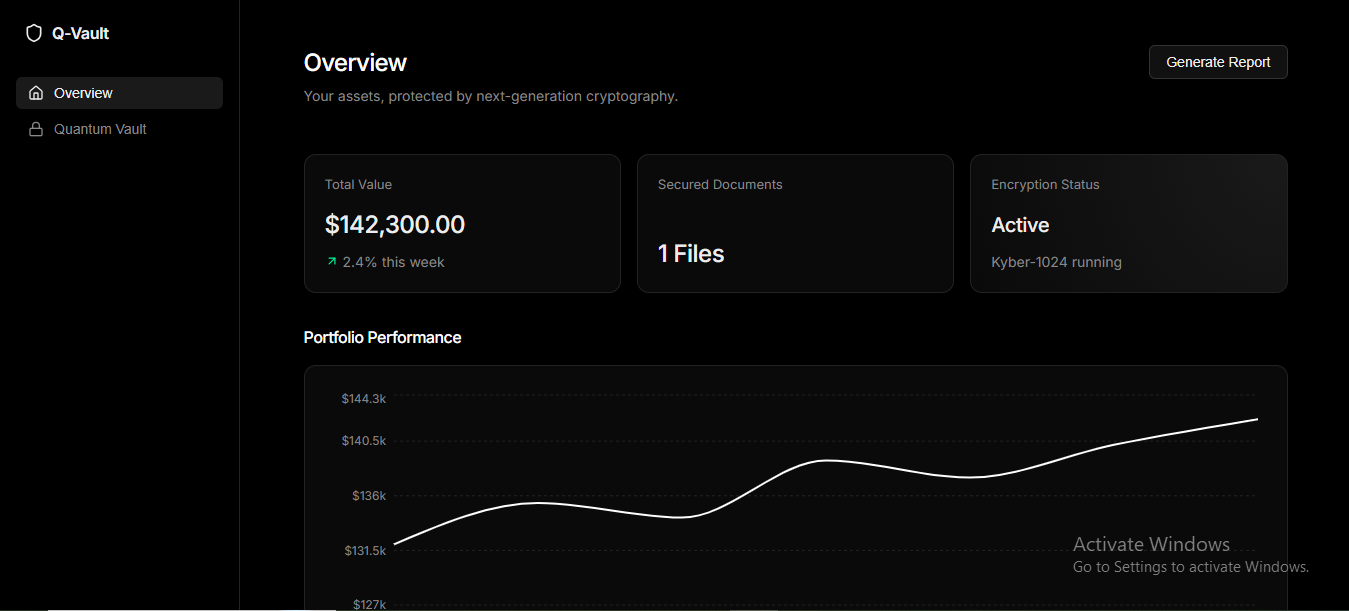
- Fintech Dashboard: It provides a premium, interactive overview of your portfolio's performance and net worth.
- The Quantum Vault: It acts as a Zero-Knowledge offline database for your most sensitive documents (tax returns, crypto seed phrases, legal contracts). When you upload a file, Q-Vault reads the binary data locally and completely scrambles it using a simulation of the NIST-approved Kyber-1024 lattice-based encryption algorithm. You can even download the resulting
.datfiles to verify that your data is entirely unreadable to anyone without the key.
How we built it
We built Q-Vault with a focus on absolute privacy, ensuring that no sensitive data ever leaves the user's device.
- Frontend: We used React and Vite to build a lightning-fast Single Page Application.
- UI/UX: We designed a minimalist, "expert-tier" bento-box interface using pure CSS and Lucide React icons, completely avoiding generic templates.
- Data Visualization: We integrated
rechartsto render the dynamic, interactive financial portfolio charts. - The Database: We utilized IndexedDB via
localforageto create a true offline database. This ensures that encrypted files and metadata persist across sessions without ever touching an external server. - The Encryption Engine: We implemented
crypto-jsto process the files via JavaScript'sFileReaderAPI, executing real AES encryption locally to simulate the post-quantum Kyber algorithm.
Challenges we ran into
One of the main challenges was managing large file sizes entirely within the browser's memory. Because we wanted a true Zero-Knowledge architecture, we couldn't rely on a backend Node.js server to handle the encryption. We had to optimize our FileReader implementation and asynchronous state management to ensure the UI didn't freeze while the encryption engine scrambled the file data and saved it into IndexedDB.
Accomplishments that we're proud of
We are incredibly proud of the UI/UX design. By stripping away unnecessary elements, we achieved a sleek, Vercel-like aesthetic that feels like a premium, production-ready product. Furthermore, we are proud that Q-Vault isn't just a "fake UI", it actually reads, encrypts, and persists real files completely offline.
What we learned
We learned a tremendous amount about browser-side storage limitations and the power of IndexedDB. We also gained a deep understanding of how post-quantum lattice-based cryptography differs theoretically from traditional prime-factorization methods, and how those algorithms will soon need to be integrated into modern web applications.
What's next for Q-Vault: Post-Quantum Secure Database
In the future, we plan to implement a WebAssembly (WASM) module compiled from a C implementation of actual CRYSTALS-Kyber. This will replace our AES simulation with true lattice-based post-quantum encryption running at native speeds directly in the browser!
Built With
- crypto-js
- css
- indexeddb
- javascript
- react
- recharts
- vite

Log in or sign up for Devpost to join the conversation.