-
-
q-swarm vision
-
vision
Inspiration
During disasters such as earthquakes, floods, and building collapses, rescue teams often face dangerous and inaccessible environments where every minute matters. Drones can help assess these areas, but coordinating multiple drones without reliable GPS or communication infrastructure remains a significant challenge.
This inspired us to build Q-Swarm Vision, an AI-powered system that explores how computer vision, intelligent navigation, and swarm coordination can work together to support disaster response. Our vision is to help autonomous drones identify hazards, adapt to changing conditions, and work together to provide useful information to human rescuers.
What it does
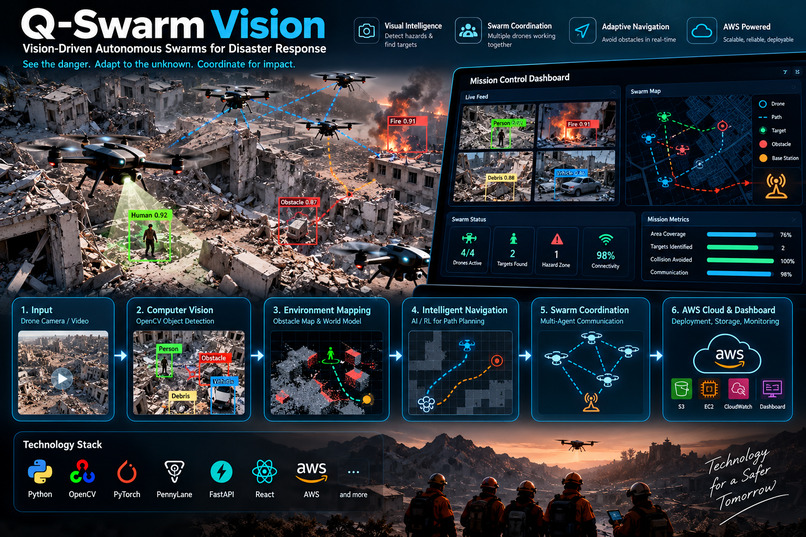
Q-Swarm Vision is designed to connect visual perception with intelligent decision-making in multi-drone environments.
- Visual intelligence: Uses OpenCV to process images and video, identify relevant objects, and detect potential obstacles.
- Adaptive navigation: Uses visual observations and environmental information to plan routes around obstacles.
- Swarm coordination: Models multiple drones navigating together while accounting for collisions, search coverage, and communication connectivity.
- Communication awareness: Monitors the simulated communication network and evaluates how movement affects connectivity to the base station.
- AWS integration: Supports cloud-based application deployment, mission-data storage, monitoring, and visualization.
- Quantum AI exploration: Investigates variational quantum circuits as a potential component of reinforcement learning, with classical baselines used to evaluate their effectiveness.
Our objective is to create a system where visual observations can influence navigation decisions, rather than stopping at object detection alone.
How we built it
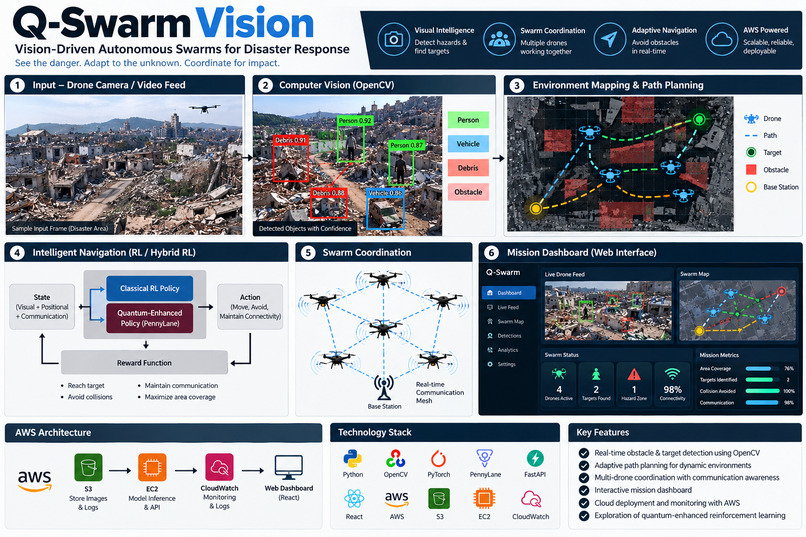
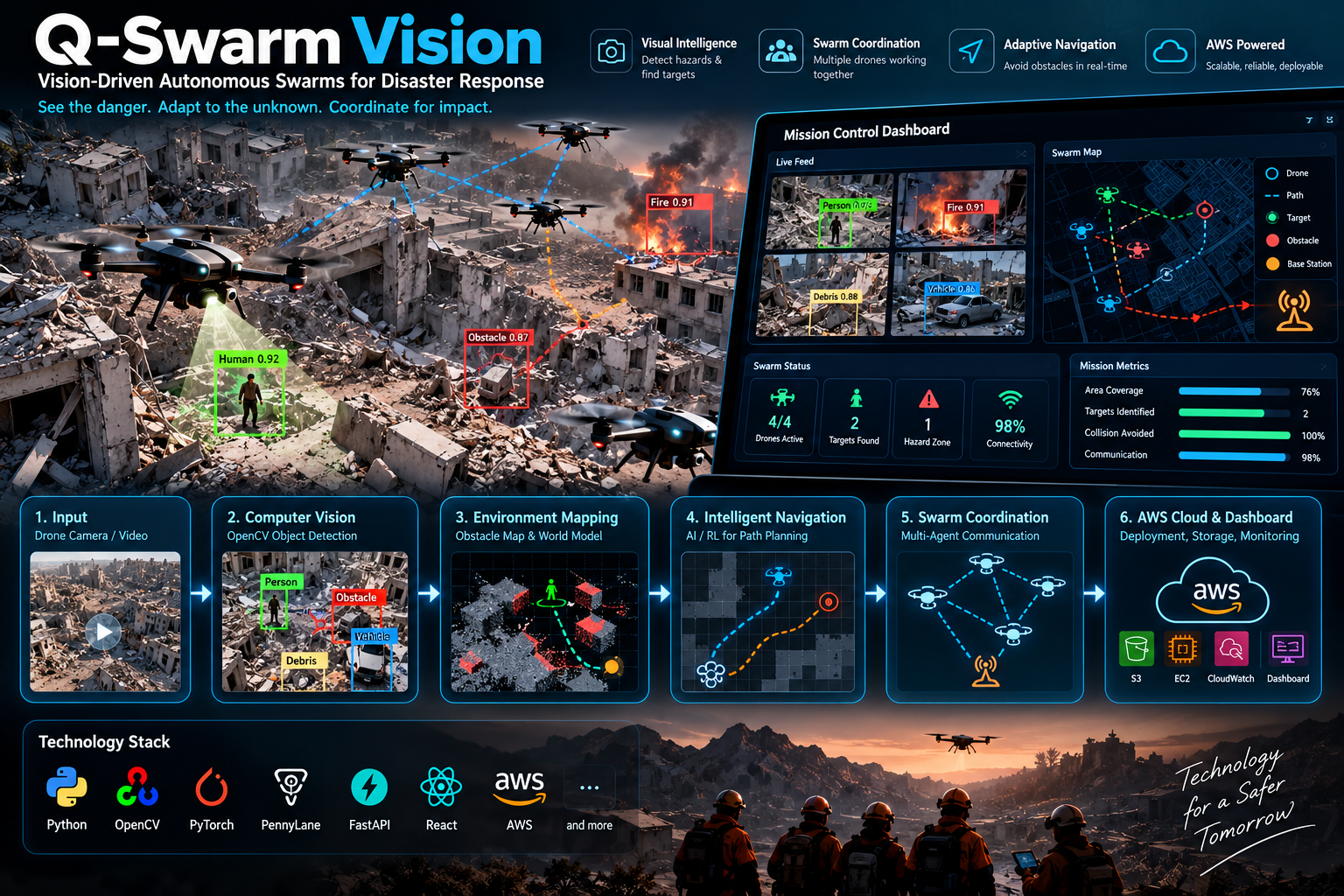
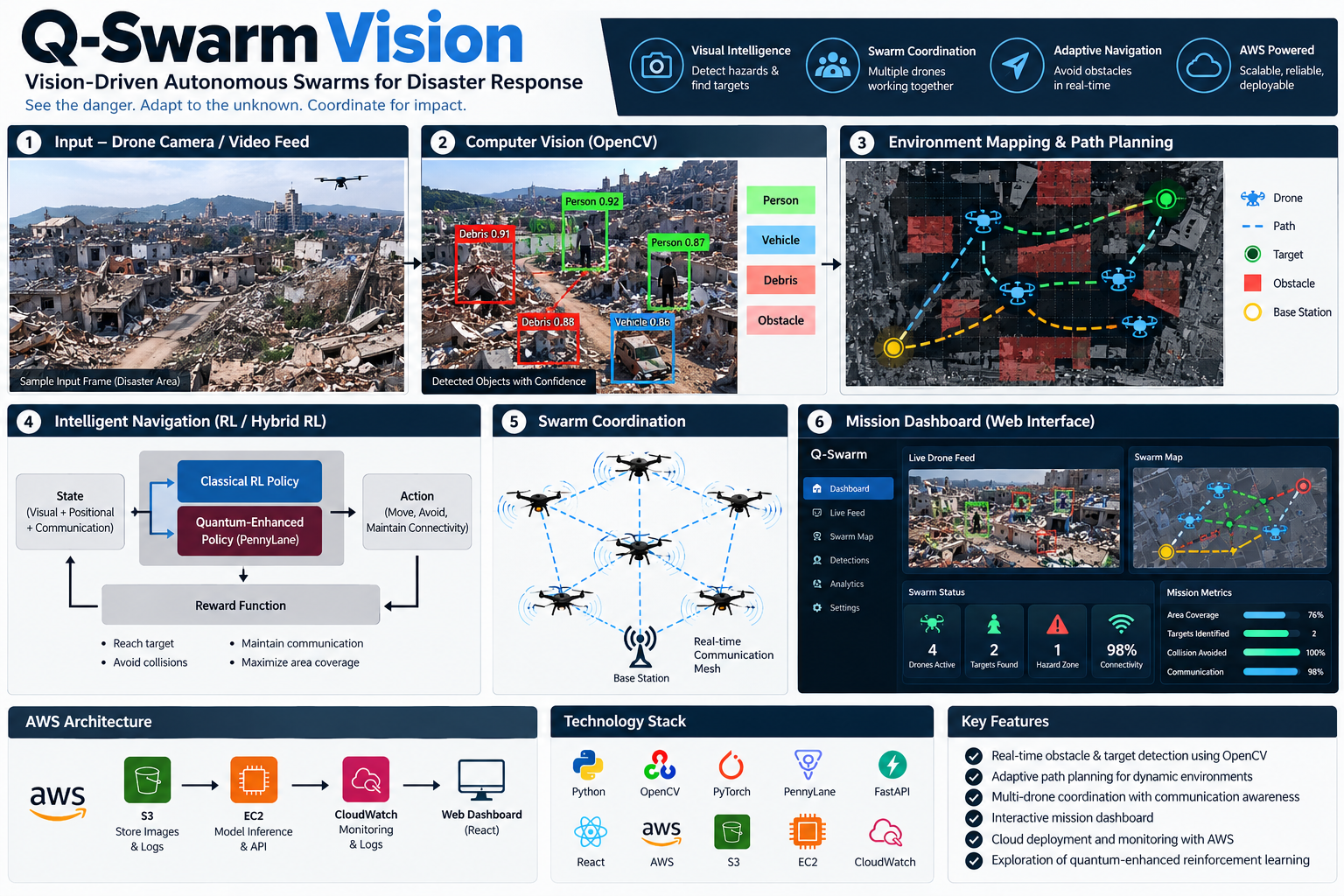
We designed Q-Swarm Vision around a perception-to-action pipeline.
First, OpenCV processes visual data to extract information about obstacles and potential targets. This information can be used to construct a local representation of the environment. A navigation policy then evaluates possible actions based on target direction, obstacle risk, and the positions of nearby drones.
For swarm coordination, the system models drone positions and communication links as a dynamic network. Navigation decisions can be evaluated against both task progress and the need to maintain connectivity.
The planned technical stack includes Python, OpenCV, reinforcement learning, and a React-based dashboard, with AWS providing supporting cloud infrastructure. We are also exploring a hybrid quantum-classical architecture using parameterized quantum circuits to investigate compact policy learning.
Our development approach emphasizes modular components, reproducible experiments, and measurable evaluation so that individual parts can be tested before they are integrated into the complete system.
Challenges we ran into
One of our biggest challenges is connecting computer vision to useful navigation decisions. Detecting an obstacle is only the first step; the system must also determine how to avoid it safely.
Another challenge is coordinating several drones simultaneously. A route that works for one drone may create a collision risk or disconnect another drone from the communication network.
Integrating reinforcement learning introduces additional difficulties, including reward design, training stability, and generalization to unfamiliar environments.
The quantum component presents a separate research challenge. A circuit with fewer trainable parameters does not automatically provide better performance or lower computational cost. We therefore need controlled comparisons between quantum and classical models, including measurements of task success, inference latency, training time, and noise sensitivity.
Accomplishments that we're proud of
We are proud to have developed a project concept that connects computer vision, autonomous navigation, multi-agent coordination, and quantum machine learning around a meaningful real-world problem.
Rather than approaching object detection as an isolated task, Q-Swarm Vision focuses on how visual information can influence the behavior of an autonomous swarm.
We are also building the project around measurable objectives and reproducible evaluation. This allows us to investigate not only whether the system can navigate, but also whether it can avoid collisions, maintain communication connectivity, and adapt to changing conditions.
Our greatest motivation is the possibility of using intelligent autonomous systems to help emergency responders assess dangerous environments while reducing unnecessary human exposure to risk.
What we learned
This project has helped us understand that building a useful AI system requires much more than choosing a model or achieving a high accuracy score.
Computer vision must connect to an environmental representation, navigation decisions must account for uncertainty, and swarm behavior must balance individual objectives with collective safety.
We also learned the importance of evaluating complete systems rather than isolated components. A model that performs well in a controlled example may struggle when obstacles move or communication links fail.
Finally, exploring quantum machine learning has reinforced an important principle: quantum computing should be evaluated through experiments, not assumptions. Comparing different circuit designs against fair classical baselines is essential to understanding where quantum methods may be useful.
What's next for Q-Swarm
Our next goal is to develop and validate a complete end-to-end prototype, progressing from visual perception to navigation and multi-drone coordination.
We plan to:
- Improve visual detection and tracking under challenging environmental conditions.
- Extend the simulation to multiple drones and dynamic obstacles.
- Implement communication-aware path planning and monitor network connectivity.
- Integrate the application with AWS for deployment, mission-data storage, and monitoring.
- Build an interactive dashboard showing camera observations, detected hazards, drone trajectories, and communication links.
- Compare classical reinforcement learning with variational quantum policies using repeatable experiments.
- Investigate noisy quantum simulation and, where feasible, demonstrate circuit execution on quantum hardware.
Our long-term vision is to create a reliable, adaptable system that helps autonomous drones work together in environments where conventional navigation and communication assumptions may fail.
Q-Swarm Vision — See the danger. Adapt to the unknown. Coordinate for impact.
Built With
- amazon
- amazon-web-services
- artificial-intelligence
- computer-vision
- fastapi
- github
- machine-learning
- multi-agent
- opencv
- pennylane
- python
- pytorch
- react
- reinforcement-learning

Log in or sign up for Devpost to join the conversation.