-
Q Sense AI
Inspiration
Waiting is one of those everyday problems that people have simply learned to tolerate.
In hospitals, diagnostic centers, government offices, banks, clinics, and college offices, people are often given a token number and told which token is currently being served. But that doesn't answer the question that actually matters:
"When will it be my turn?"
I realized that a queue position alone doesn't tell someone whether they need to sit there for 5 minutes or 45 minutes.
This inspired me to build Q-Sense AI — a predictive queue intelligence platform designed to turn raw queue activity into useful, personalized waiting-time information.
My goal was simple:
Don't just tell people where they are in the queue. Tell them when they should come back.
What it does
Q-Sense AI estimates a user's waiting time based on live queue conditions and continuously adapts its prediction as the queue changes.
Instead of simply displaying:
Currently Serving: A113
Q-Sense AI can show:
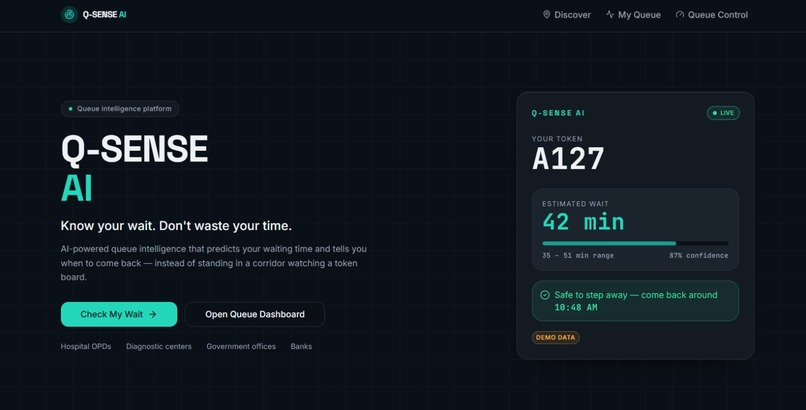
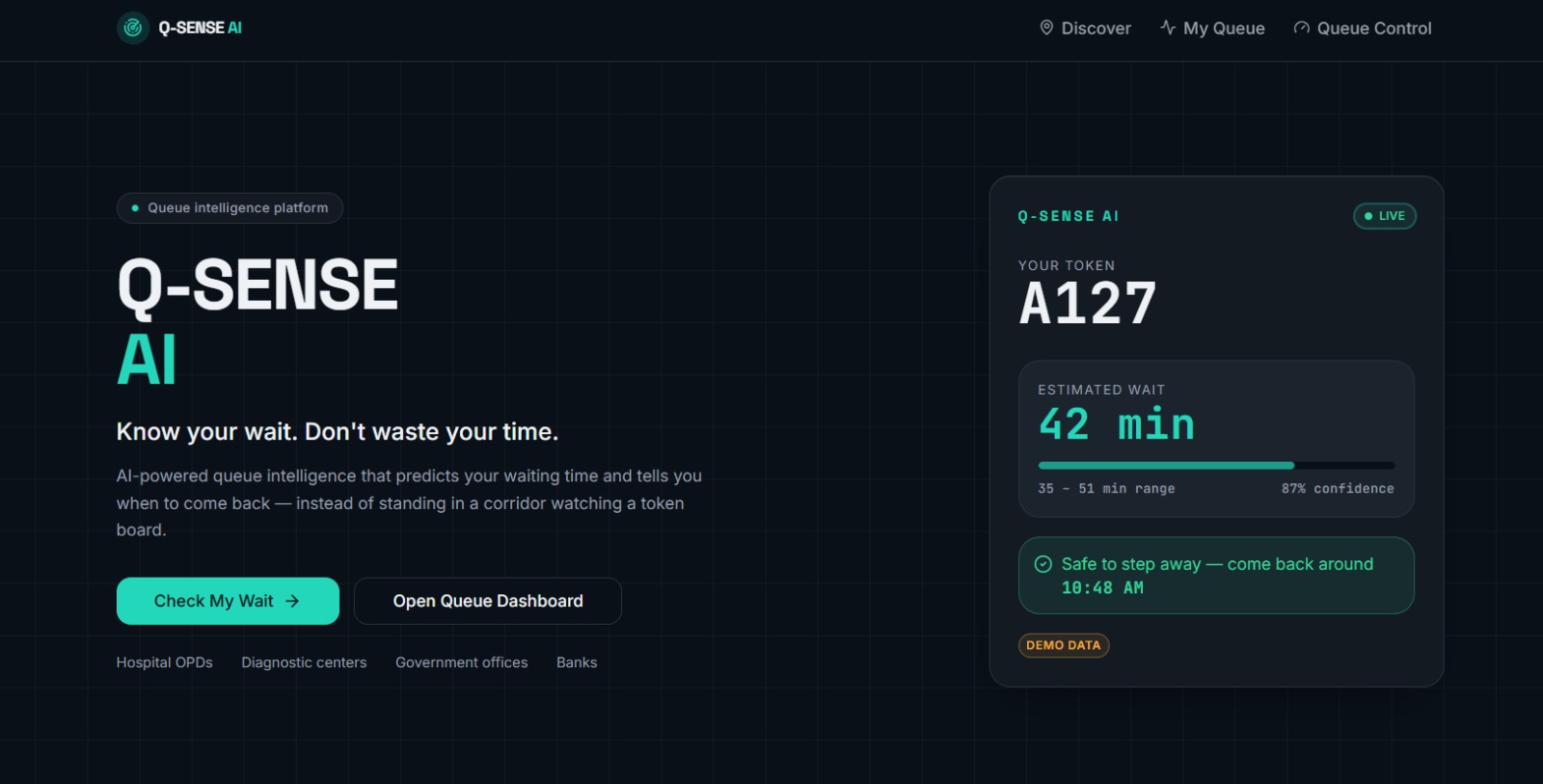
Your Token: A127 Estimated Wait: 42 minutes Expected Range: 35–51 minutes Confidence: 87%
It can then recommend:
🟢 SAFE TO STEP AWAY
Recommended return: 10:48 AM
The platform includes:
👤 Personalized Wait Prediction — estimates waiting time based on queue position, service rate, active counters, and recent queue movement. 📊 Prediction Range & Confidence — provides a realistic range instead of pretending that an exact future time is guaranteed. 🔄 Adaptive Queue Intelligence — recalculates predictions when service speed, counters, or queue movement changes. 🚶 Don't Wait Recommendation — tells users when they can temporarily leave and when they should return. 🔔 Smart Notifications — alerts users as their turn approaches. ⚡ Live Queue Simulation — demonstrates predictions changing as tokens are served. 🚨 Anomaly Detection — identifies unusual patterns such as sudden slowdowns, counter inactivity, or unexpected token movement. 🏢 Operator Dashboard — provides an overview of queue health, service rate, active counters, and current queue conditions. 🔢 Multi-Counter Support — incorporates multiple active service counters into the prediction.
The core loop is:
Observe → Analyze → Predict → Update
How we built it
I built Q-Sense AI using Lovable as an AI-powered development platform, using React and TypeScript for the application, Tailwind CSS and ui for the interface, Recharts for data visualization, and Supabase for backend/database functionality.
Challenges we ran into
- Predicting something that constantly changes
A queue is not static.
A person's waiting time can change because of skipped tokens, priority cases, additional counters, service delays, or changes in service speed.
The challenge was therefore not simply calculating a waiting time, but creating a system that could continuously adapt to new queue conditions.
- Avoiding false precision
One of the biggest design decisions was avoiding the impression that Q-Sense AI knows the exact future.
Instead of saying:
"Your turn will be at 10:48 AM."
the system provides:
Estimated Wait: 42 minutes Expected Range: 35–51 minutes Confidence: 87%
This makes the prediction more transparent and realistic.
- Making predictions understandable
A complex prediction model isn't useful if users cannot understand the result.
I therefore focused on presenting the most important information first:
YOUR TOKEN → ESTIMATED WAIT → EXPECTED RANGE → SAFE TO STEP AWAY → RETURN TIME
This makes the application useful even for someone who only looks at the screen for a few seconds.
- Demonstrating intelligence without requiring a massive real-world deployment
A production queue prediction system could require large amounts of historical and real-time data.
For the hackathon prototype, I created a live simulation that demonstrates how the prediction engine could respond to changing conditions.
This allowed me to show the complete concept:
Queue Movement → Prediction → Change Detection → Recalculation → Notification
Accomplishments that we're proud of
I am proud of turning a simple token-number system into a more useful time-intelligence system.
The biggest accomplishment is the "Don't Wait" concept.
Instead of assuming that users must remain physically present until their token is called, Q-Sense AI estimates whether they have enough time to step away and return later.
I am also proud of building both sides of the experience:
For users
"When should I return?"
For operators
"What is happening with my queue?"
The live simulation, prediction range, confidence indicator, anomaly detection, and operator dashboard make the prototype more than a static waiting-time calculator.
What we learned
The biggest lesson I learned was that prediction is more useful when uncertainty is communicated honestly.
A prediction should not simply output one number. It should help users understand:
what is likely to happen how uncertain the prediction is whether conditions are changing what action they should take
I also learned that good product design can turn complex technical functionality into something immediately understandable.
The prediction engine may involve multiple signals, but the user should not have to understand the underlying calculations.
They simply need to know:
"How long will I wait, and can I leave?"
What's next for Q-Sense AI
My long-term vision is to turn Q-Sense AI into a real-time queue intelligence platform that can work across hospitals, diagnostic centers, government offices, banks, educational institutions, and other high-volume service environments.
Future versions could include:
📡 Real-time queue detection using IoT sensors 👁️ Computer-vision-based queue monitoring 🤖 Historical machine-learning forecasting 📱 SMS and WhatsApp notifications 🏢 Dynamic counter allocation 🚨 Predictive congestion alerts 🌍 Multi-location analytics ⚙️ Automatic resource recommendations 🏥 Integration with hospital and government systems 🔐 Privacy-preserving analytics
I would also improve the prediction engine using larger historical datasets and real-world queue patterns to make estimates more accurate and reliable.
Ultimately, I want Q-Sense AI to change the way people think about queues.
A queue should not only answer:
"Where am I?"
It should answer:
"When should I be there?"
Q-Sense AI
Know your wait. Don't waste your time.
Built With
- lovable

Log in or sign up for Devpost to join the conversation.