-
-
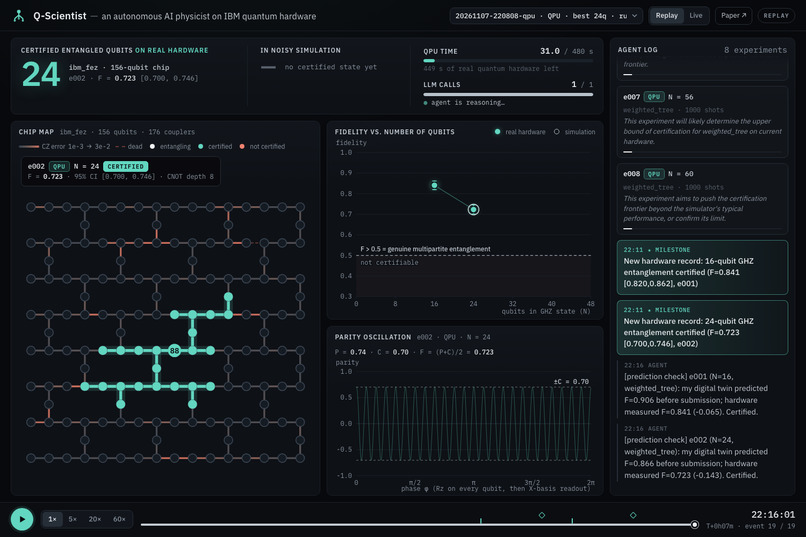
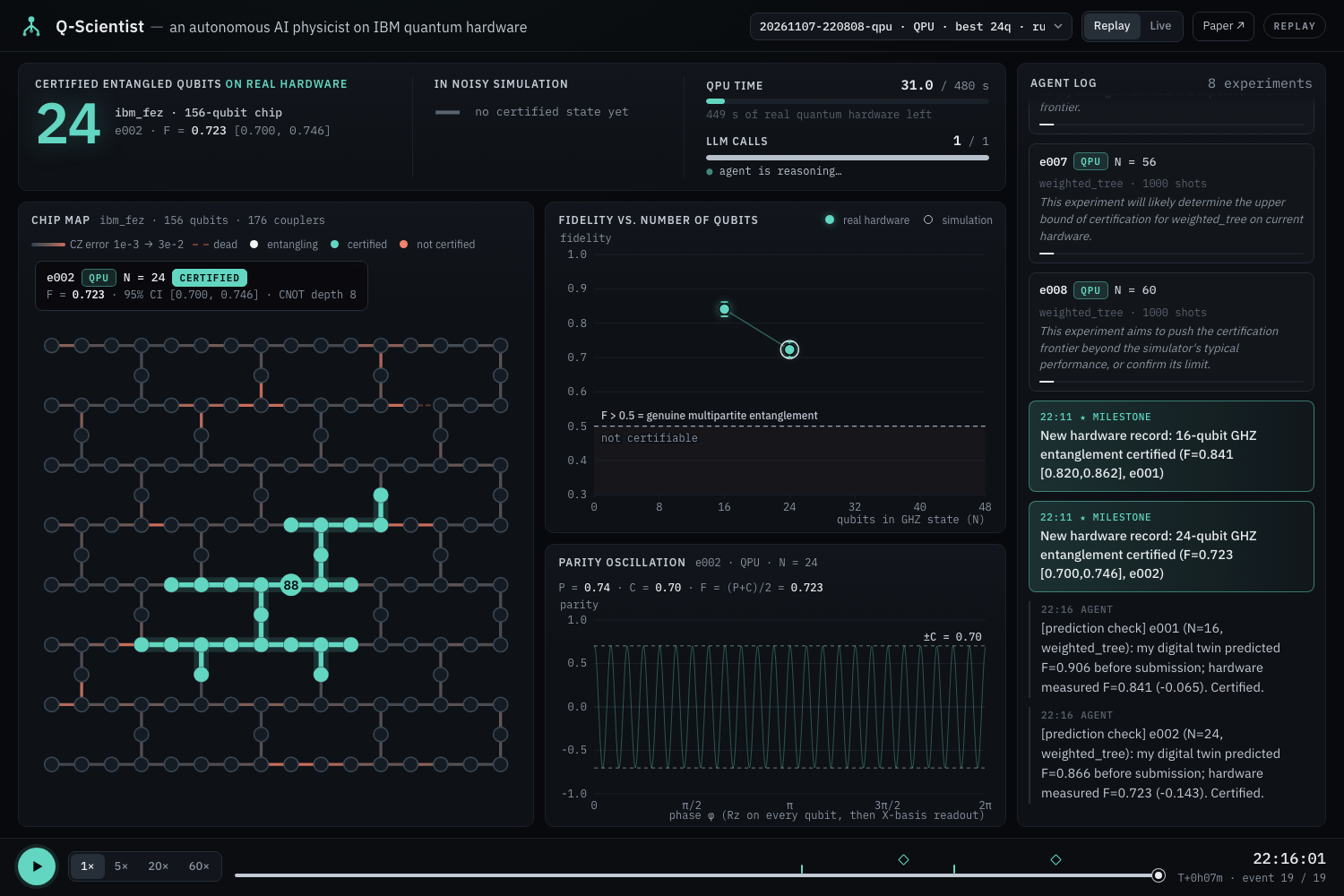
Mission control replaying the real ibm_fez run: a 24-qubit GHZ state certified (F = 0.723), with the agent's chosen qubits lit on the chip.
Inspiration
"How many qubits can this chip really entangle?" is a simple question with a hard answer. You have to choose a layout on a 156-qubit heavy-hex lattice, shape the circuit, decide on error suppression, and then prove entanglement rather than assume it. That loop of hypothesis → experiment → analysis is exactly what a scientist does. I wanted to see whether an AI could run that loop on real quantum hardware, honestly: recording its predictions before the data exists, and not claiming a result until it has survived a re-run.
What it does
Q-Scientist is an autonomous AI agent that runs GHZ-entanglement experiments on IBM's real 156-qubit ibm_fez through Qiskit, and writes its own paper.
- Reads the live chip. Pulls
ibm_fezcalibration (T1/T2, readout and CZ error for every qubit and coupler) and draws the chip map. - Plans like a scientist. The AI agent designs a batch of experiments (GHZ sizes, circuit layout, shots) and writes a hypothesis for each one.
- Pre-registers predictions. Before anything runs, every experiment goes through a digital twin, a fast noise simulator I built that is driven by the live calibration. The predictions are frozen to disk first.
- Runs on real hardware. Each experiment is one Qiskit Runtime SamplerV2 job, with dynamical decoupling, measurement twirling and the agent's chosen physical qubits pinned.
- Certifies entanglement properly. Fidelity comes from populations plus parity oscillations, with readout mitigation and bootstrap 95% confidence intervals. A state only counts as genuinely multipartite entangled if the lower bound is above 0.5.
- Confirms before it claims. After reading the first results, the AI agent designs a second round, and a validator forces it to include a pre-registered re-run of the largest certified result. If the re-run fails, that result is not claimed.
- Writes the paper. A PDF with methods, figures, limitations and IBM job IDs. Every number is computed from the run log, never typed by the AI.
- Replays the night. A live mission-control site shows the agent's reasoning, the qubits it chose on the chip, and every result.
Results (real IBM hardware, ibm_fez)
| GHZ size · circuit | Twin prediction (frozen first) | Hardware fidelity [95% CI] | Entangled? |
|---|---|---|---|
| 16 · error-weighted tree | 0.906 | 0.841 [0.820, 0.862] | ✅ certified |
| 24 · error-weighted tree | 0.866 | 0.723 [0.700, 0.746] | ✅ certified (record) |
| 24 · breadth-first tree (round 2) | 0.845 | 0.842 [0.720, 0.972] | ✅ certified (noisier) |
| 24 · linear CNOT chain | 0.705 | 0.107 [0.031, 0.163] | ❌ |
| 28 / 32 / 36 · tree | 0.815 / 0.796 / 0.776 | 0.580 / 0.537 / 0.489 | ❌ |
| 40 · tree (round 1) | 0.727 | 0.654 [0.520, 0.788] | ✅ by 0.02, then failed its re-run |
| 40 · same qubits, 2× shots (round 2 re-run) | 0.726 | 0.414 [0.326, 0.486] | ❌ |
| 48 / 56 / 60 · tree | 0.648 / 0.604 / 0.642 | 0.455 / 0.319 / 0.244 | ❌ |
- Record: 24 qubits of genuine multipartite entanglement, F = 0.723 [0.700, 0.746]. A second 24-qubit run with a different tree also certified (on overlapping qubits, 20 of 24 shared).
- The confirmation step caught a false positive. Round 1 certified 40 qubits by a hair (lower bound 0.520, while 32 failed). The validator had already forced a re-run of the best result into round 2, before any results existed. Same qubits, twice the shots: F = 0.414, not certified. So 40 qubits is not claimed, in the paper, on the site or in the log.
- Circuit shape is the difference between entangled and not. At 24 qubits, a shallow tree (two-qubit depth 8) reached F = 0.723, while a linear CNOT chain (depth 23) on the same chip collapsed to 0.107. A tree that ignores error rates did just as well (0.842), so the win comes from depth, not from error-weighting the layout.
- 12 hardware experiments in two rounds, using 322 s of the free 600 s (under a self-imposed 480 s cap).
How I built it
- Qiskit: GHZ circuits built as shallow trees over the coupling map, transpiled with a fixed
initial_layoutso the agent's chosen qubits are exactly what runs. Parity-oscillation circuits are generated by parameter binding. - Qiskit Runtime:
QiskitRuntimeService+SamplerV2in job mode, dynamical decoupling (XpXm), measurement twirling, andjob.usage()for exact QPU budget accounting. - Digital twin: a custom Pauli-frame noise simulator in numpy that handles 80 qubits in about 7 seconds (Qiskit Aer's MPS method took about 7 minutes at 30 qubits). It models gate errors, idle decoherence and readout error from the live calibration.
- Agent: a large language model, with hard budget caps on model calls and QPU seconds that are charged before spending, and validators that keep its plans safe and informative.
- Paper and site: matplotlib figures and HTML rendered to PDF; a vanilla JS/SVG mission-control replay deployed on Vercel.
Challenges I ran into
- The queue.
ibm_fezhad about 20,000 pending jobs, and round 1 waited about 6 hours. An agent that waits for each result would finish one or two experiments in a night, so I rebuilt the hardware path to plan a whole round, submit everything at once and collect results asynchronously. - Simulation speed. Aer took minutes per experiment, too slow for an agent loop, so I wrote a simulator that takes seconds.
- Honest statistics. A naive fidelity estimate let non-entangled states appear just above 0.5 from shot noise. I added bias correction and a test that separable states are never certified.
- LLM gotchas. The model's hidden reasoning tokens silently truncated its JSON plan, and its first plan was over-optimistic (it started at 40 qubits). Guardrails now force a safe anchor experiment and a meaningful comparison.
Accomplishments that I'm proud of
- 24 qubits of genuine multipartite entanglement on real IBM hardware, with a tight confidence interval.
- A pipeline that refused to publish a lucky 40-qubit result: the pre-registered re-run failed, so it isn't claimed.
- A full pipeline from live calibration to published paper and replay site, with 65 automated tests.
What I learned
- The digital twin predicted all 12 experiments would certify; 4 did. It overestimated fidelity in all 12 (mean +0.24, range +0.003 to +0.597), generally more at larger sizes, which points to correlated noise (crosstalk, leakage, drift) that per-gate calibration numbers don't capture.
- Results near the threshold need confirmation. 40 qubits certified while 32 didn't, and the re-run did not reproduce it (a lucky draw, possibly plus calibration drift). Without the confirmation step, I would have claimed a result that did not hold up.
- Readout mitigation is a double-edged sword: at large sizes it amplifies noise (some mitigated parities exceed the physical ±1), so the tightest interval, not the highest number, is the evidence to trust.
What's next for Q-Scientist
- Error detection and post-selection to push the certified size further.
- An unmitigated-fidelity check and more re-runs at 28 to 36 qubits, where results sit right at the threshold.
- Let the agent re-plan around the qubits its twin mispredicts, since those show where the noise model is wrong.
How AI was used
Built with help from an AI coding assistant, which the organizers allow. At runtime, an AI agent built on a large language model plans the experiments. Every number in the paper is computed from the run log, never typed by a model.
Links
- Live mission control (replay the night): https://q-scientist.vercel.app
- Code: https://github.com/mayankgoel214/quantum-scientist
- Paper (PDF): https://github.com/mayankgoel214/quantum-scientist/blob/main/runs/20261107-220808-qpu/paper/paper.pdf
- Demo video: https://youtu.be/k1bR6KvyxzI
