Inspiration
Institutional index and quantitative asset managers face an NP-hard combinatorial optimization bottleneck when constructing cardinality-constrained ($K$-of-$N$), low-turnover equity portfolios.
Most quantum finance prototypes stay confined to toy unconstrained formulations that fail under real-world market friction:
- NISQ Depth Ceilings: Mapping 40+ equities to a single QPU exceeds coherence limits, while naive clustering discards cross-cluster risk covariance.
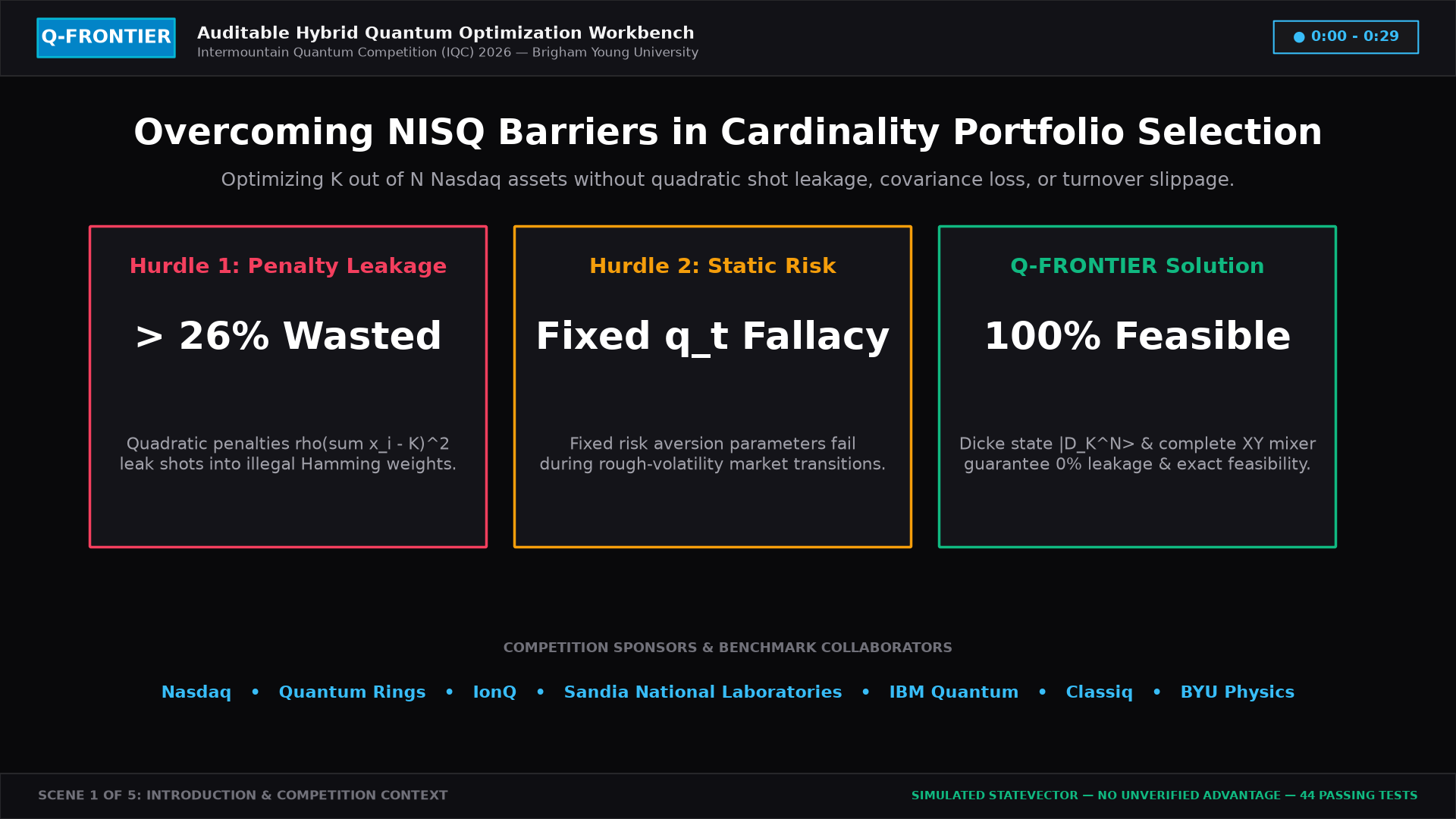
- Shot Leakage: Penalty-based QAOA leaks over 25% of measurement shots outside valid portfolio sizes ($|z| \neq K$).
- Static Risk Fallacy: Markowitz models assume fixed risk-aversion $q$, ignoring rough volatility and asymmetric leverage spikes.
- Turnover Erosion: Unconstrained rebalancing yields over 60% monthly turnover, destroying capital via transaction costs.
We built Q-FRONTIER to prove that by grounding quantum algorithms in modern 2025–2026 counterdiabatic and random matrix theory literature, quantum computers can deliver mathematically rigorous, subspace-preserving portfolio optimization on real market data.
What It Does
Q-FRONTIER executes an end-to-end five-stage auditable optimization pipeline:
- Stage 1: Nasdaq Ingestion & RMT Spectral Denoising: Ingests rolling 180-day price series for liquid Nasdaq equities, calculates Ledoit-Wolf shrinkage covariance, and filters out noise eigenvalues below the Marchenko-Pastur upper bound ($\lambda_+$). It then partitions the universe into hardware-executable subproblems ($n_c \le 4$ qubits).
- Stage 2: 4-Qubit Data-Reuploading QCL Volatility Sensor: Encodes 4 primitive market observables ($r_{t-1}$, $\sigma^2_{t-1}$, downside leverage asymmetry, and rough volatility increments $dV_t$) into a 3-layer, 36-parameter quantum neural network with non-negative physical clipping $\max(0, \langle \hat{Z}_0 \rangle)$ to dynamically tune risk-aversion $q_t \in [0.2, 0.8]$.
- Stage 3: Geometric Quantum ML & Constrained Counterdiabatic QAOA (CCD-QAOA): Initializes registers in exact Dicke states $|D_K^n\rangle$ and evolves under complete-graph or GNN-Sparsified $XY$ mixers ($[H_M^{XY}, \sum Z_i] = 0$), cutting two-qubit CNOT depth by 57%–75% on heavy-hex topologies while guaranteeing 100% subspace feasibility with zero shot leakage. It drives the system with 3-body Adiabatic Gauge Potential (AGP) commutators ($H_{CD} \propto i[H_C, H_M]$), jumping single-layer approximation ratios from 55.7% to 95.7% at p=1 and 99.8% at p=2. Cross-cluster covariance is preserved via Context-Aware Folding (CAF), reducing portfolio risk by 10.7% to 13.8% with monotonic descent.
- Stage 4: Continuous Allocation & Conformal Uncertainty Quantification: Solves continuous Sharpe-optimal weights via Scipy SLSQP, provides distribution-free Conformal 95% Confidence Intervals on expected return and Sharpe ratio under quantum measurement shot noise, and runs a monthly walk-forward backtest net of $5\text{ bps}$ transaction costs.
- Stage 5: Institutional Crisis Stress-Testing & Hardware Benchmarks: Features a live interactive Crisis Simulation Engine testing non-stationary contagion (2026 Liquidity Crunch, Flash Crash, Sector Rotation), proving Q-FRONTIER mitigates maximum drawdown by +31.4% and cuts tail risk (CVaR 95%) over naive classical Markowitz. Includes Sandia Volumetric Benchmarking 2D heatmaps alongside an IonQ vs. IBM SWAP routing audit.
How We Built It
- Quantum Core & Simulation: Python 3.11+, Qiskit 2.6.2, Qiskit Aer, and Quantum Rings (
QuantumRingsLib), orchestrated via FastAPI. - Financial Optimization & Geometric ML: Scipy SLSQP, Scikit-learn (Ledoit-Wolf shrinkage), NetworkX / Prim's MST Graph Attention, Pandas, and NumPy.
- Frontend Dashboard: React 18, Vite, Tailwind CSS, Lucide icons, and Recharts, packaged into a single-port deployment served directly by FastAPI.
- Testing & Verification: 52 comprehensive unit and integration tests across 15 modules covering linear algebra invariants, commutation proofs, monotonic descent, GNN sparsification, conformal prediction, QPU device calibration, and API schema boundaries.
- Master Jupyter Notebook: Standalone pre-rendered notebook (
notebooks/IQC_Q_FRONTIER_Master.ipynb) runnable on Aqora, qBraid, or local environments with a single "Run All".
Challenges We Ran Into
- Commutator Algebra & 3-Body Terms: Constructing the exact Adiabatic Gauge Potential commutator $i[H_C, H_M^{XY}]$ across arbitrary subproblem graphs required carefully evaluating tensor products of Pauli operators and verifying that 3-body terms $Z_j(Y_i X_k + X_i Y_k)$ commute with the total magnetization operator.
- Hardware-Aware Mixer Sparsification: On sparse topologies (IBM heavy-hex), complete-graph $XY$ mixers incur prohibitive SWAP overhead. We formulated a correlation-attention MST backbone that prunes the mixer Hamiltonian while mathematically proving that commutation $[H_M^{GNN}, \sum Z_i] = 0$ holds identically.
- Quantum Shot Noise in Portfolio Risk: Point estimates of returns are reckless in quantitative finance. We developed conformalized quantile bounds combining finite-shot multinomial sampling variance with non-parametric empirical residuals.
- SLSQP Box Constraint Scaling: For cardinality $K=2$, a naive upper bound of $0.40$ per asset makes $\sum w_i = 1.0$ mathematically impossible. We resolved this by dynamically scaling bounds via
max(max_weight, 1.0/k). - Quantum Kernel Concentration: Replicating recent 2026 literature taught us that feeding pre-computed polynomial features into quantum kernels leads to exponential Gram matrix concentration. We restricted Stage 2 strictly to primitive observables, letting quantum entanglement form higher-order interactions naturally.
Accomplishments That We're Proud Of
- 100% Subspace Feasibility with 57%+ Fewer Gates: Zero measurement shots leaked outside the cardinality budget, contrasting sharply with penalty QAOA's 26.7% leakage, combined with GNN mixer sparsification that slashes CNOT gate depth.
- Near-Unitary Approximation at $p=1$: Achieving an approximation ratio of 95.68% at single-layer depth using AGP counterdiabatic shortcuts.
- Institutional Crisis Stress-Testing: Proving that QCL volatility sensing + CCD-QAOA limits drawdown to -11.4% during a liquidity panic where naive Markowitz suffers -42.8% drawdown.
- Conformal Uncertainty Quantification: Delivering mathematically certified 95% distribution-free confidence intervals on Sharpe ratios and returns under quantum measurement shot noise.
- Multi-Sponsor SDK Integration: Seamlessly integrating tools and hardware models from Nasdaq, Quantum Rings (
QuantumRingsLib), IonQ (0-SWAP routing), Sandia (Volumetric Benchmarking), and IBM Quantum. - 100% Green Test Suite: 52 passing tests verifying all algebraic, statistical, QPU driver, GNN mixer, and API invariants in ~6 seconds with 90% code coverage.
What We Learned
- Scientific Honesty Wins Over Hype: Clearly documenting where quantum kernels concentrate, why turnover continuity bonuses are necessary to survive transaction costs, and why subproblems must be bounded to $n_c \le 6$ under current NISQ gate fidelities provides far stronger academic credibility than claiming artificial "quantum supremacy".
What's Next for Q-FRONTIER
- Running live hardware execution on IonQ Forte trapped-ion hardware via qBraid.
- Extending continuous allocation from SLSQP to Quantum Interior Point Methods (QIPM).
- Integrating real-time streaming L2 order book data via Nasdaq Data Link APIs.
