
Inspiration
Behind every banking campaign is a limited amount of time, money and human effort. Banks have thousands of customers, but they cannot reach everyone. Every phone call costs money, every campaign has limited capacity, and every decision matters.
The problem is that identifying customers who might be interested is only half the job. Banks also need to decide whom to contact, how much to spend and whether the campaign has a realistic chance of achieving its goals.
We wanted to build something that connects all these decisions instead of treating them as separate problems.
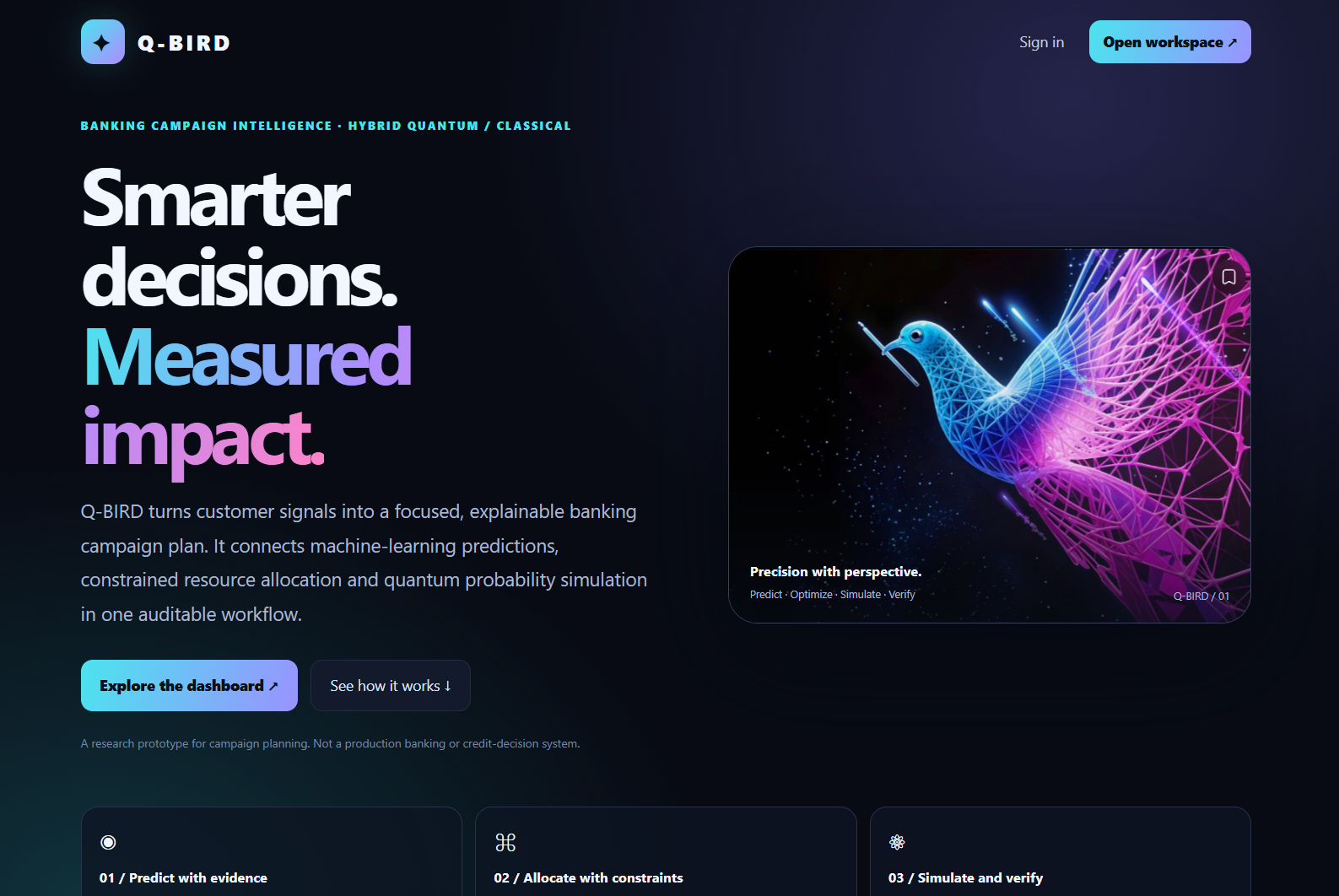
This inspired us to create Q-BIRD, a hybrid quantum-classical banking intelligence platform. The bird represents awareness, precision and the ability to see the bigger picture.
Our vision was simple: make better banking campaign decisions through intelligent predictions, smarter resource allocation and transparent quantum experimentation.
What it does
Q-BIRD is a campaign intelligence and decision-support platform that helps banks identify potential customers, optimize campaign resources and estimate the likelihood of achieving a successful campaign outcome.
It works through three connected stages:
1. PULSE - Customer Intelligence
PULSE predicts which customers are most likely to subscribe to a banking product.
- Analyses customer information using machine learning.
- Compares Logistic Regression, Random Forest and Extra Trees.
- Evaluates models using precision, recall, PR-AUC, ROC-AUC and Brier score.
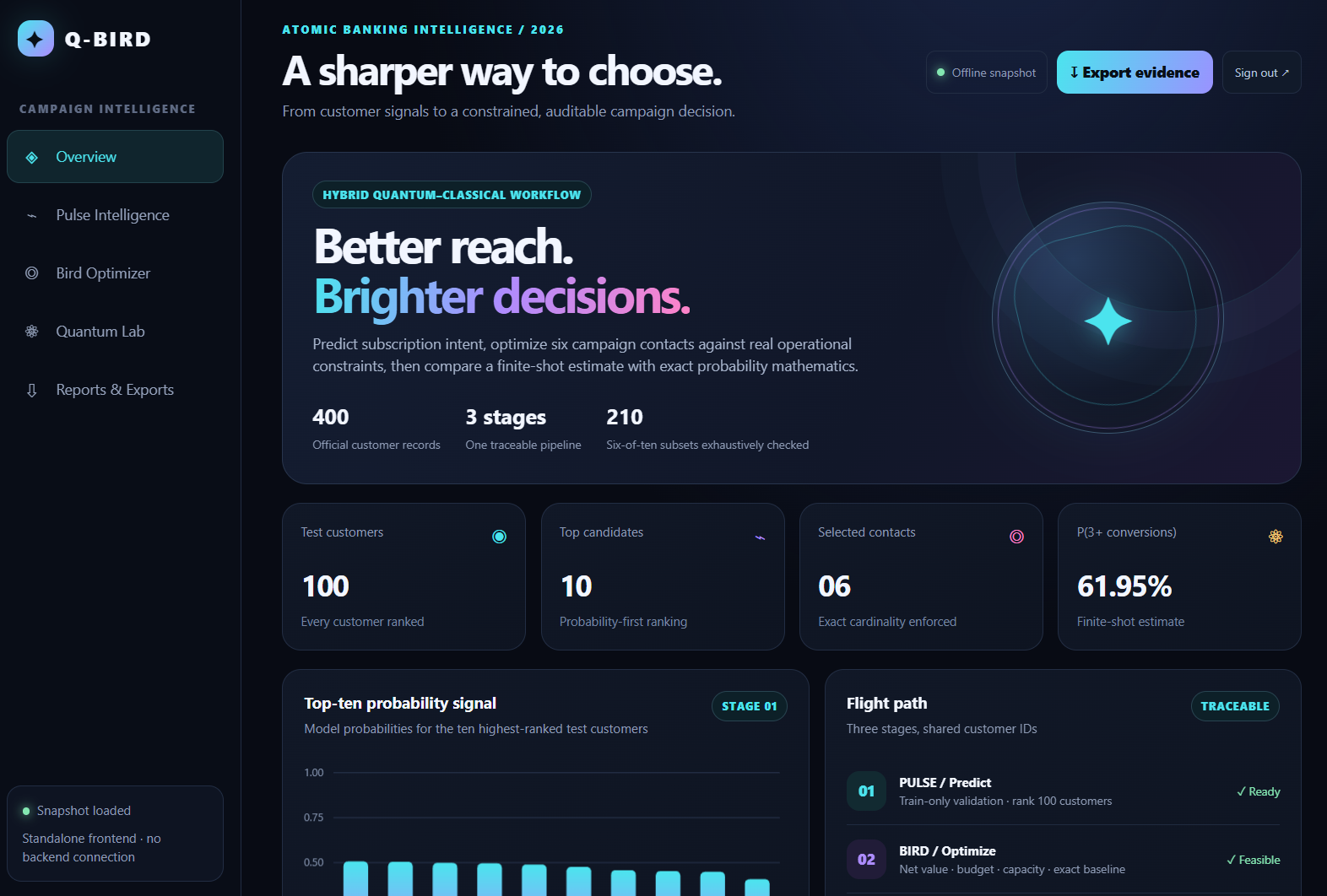
- Ranks 100 unseen customers according to their predicted subscription probability.
- Identifies the top 10 potential customers.
2. BIRD - Intelligent Resource Optimization
Finding interested customers is not enough. Banks also need to work within their budgets and operational limits.
BIRD takes the top 10 candidates and selects exactly six customers.
- Uses predicted subscription probability, expected deposit value and contact cost.
- Maximizes expected net value.
- Maintains the budget limit of 25 and capacity limit of 22.
- Uses a QUBO-based optimization formulation and a custom QAOA-style experiment.
- Compares the selected solution against all 210 possible six-customer combinations using classical brute-force optimization.
This allows us to check whether our optimization result is actually the best feasible solution.
3. FAIR - Quantum Probability Simulation and Analysis
FAIR takes the six selected customers and estimates the probability that at least three of them subscribe.
- Maps the six customers to six qubits.
- Encodes individual subscription probabilities using RY rotations.
- Runs a seeded finite-shot simulation.
- Calculates the exact probability using a Poisson-binomial method.
- Compares the result with a 500,000-trial Monte Carlo simulation.
- Makes simulation noise and estimation errors visible.
Other platform features
- Quantum Lab: Displays qubit mapping, probability calculations and simulation results.
- Noise Observatory: Designed to examine noise, measurement errors and circuit behaviour.
- Reports & Exports: Provides downloadable CSV and JSON results.
- Campaign Dashboard: Brings predictions, optimization results and simulation information together.
- Bird-inspired interface: A custom homepage, interactive dashboard and demo sign-in experience built around our central mascot.
How we built it
We built Q-BIRD using a combination of machine learning, mathematical optimization, quantum circuit experimentation and web development.
Our architecture separates the frontend, backend and computational pipeline so that each part has a clear responsibility.
Technology stack:
- Frontend: React, JavaScript, HTML and CSS.
- Backend: Python and FastAPI.
- Machine Learning: Scikit-learn, Pandas and NumPy.
- Optimization: QUBO formulation, custom statevector QAOA-style experiment and classical exhaustive search.
- Quantum simulation: Six-qubit circuit design, RY rotations and seeded shot simulation.
- Data processing: Pandas and NumPy.
- Visualization: Interactive dashboard components and charts.
- Storage and outputs: CSV and JSON result files with experiment metadata.
Our computational workflow
We started with the official participant workbook containing 300 labelled training records and 100 unlabelled test records.
The data was processed separately to avoid using information from the test set during training. We compared three machine learning models using stratified five-fold validation and selected the Random Forest model based on PR-AUC, with Brier score as a tie-breaker.
The selected model was then used to generate predictions for the 100 test customers.
Next, we connected those predictions to the campaign's operational information. We calculated the expected net value of each candidate and formulated the six-customer selection problem with budget and capacity constraints.
Finally, we used the selected customers' probabilities to prepare the six-qubit simulation and compared its output against independent mathematical and classical benchmarks.
Current experimental results
Our current saved prototype run produced the following results:
- Selected model: Random Forest.
- Out-of-fold PR-AUC: 0.2160.
- Out-of-fold ROC-AUC: 0.6371.
- Brier score: 0.1197.
- Precision@10: 0.30.
- Stage 2 optimization objective: 50.2902.
- Classical optimum: 50.2902.
- Relative optimality gap: 0%.
- Budget used: 10 out of 25.
- Capacity used: 17 out of 22.
- Exact Stage 3 probability: 0.624789.
- Quantum-simulation shot estimate: 0.619507.
- Monte Carlo estimate: 0.625520.
The selected six customers in our saved run were:
C0079, C0170, C0338, C0183, C0327, C0256.
These results demonstrate that our selected solution matched the exact classical optimum for this particular optimization instance.
The Stage 3 simulation used a seeded NumPy shot simulator with approximately 0.1% measurement bit-flip noise because Qiskit Aer was unavailable in the saved execution environment. Our Stage 2 implementation was a custom QAOA-style statevector experiment, not a Qiskit-transpiled circuit.
We have kept these distinctions clear rather than claiming quantum hardware execution or quantum advantage.
Challenges we ran into
One of our biggest challenges was connecting three very different computational stages into one working system.
A prediction model can identify customers with a high chance of subscribing, but that does not automatically mean selecting them is the best business decision. We had to connect predictions with expected value, contact costs, budget and operational capacity.
Another challenge was making sure our results were mathematically correct. Since our optimization problem involved selecting six customers from ten, we used exhaustive classical search to check all 210 possible combinations. This gave us a reliable reference for evaluating our optimizer.
The quantum simulation also required careful validation. A finite number of measurements can produce slightly different results from the exact mathematical probability. We therefore added an exact Poisson-binomial calculation and a Monte Carlo comparison.
We also faced challenges with the limitations of our development environment, particularly the availability of quantum simulation libraries. Instead of pretending that we had executed on quantum hardware, we clearly documented the simulator fallback and its limitations.
Finally, designing an interface that could present complex calculations in a simple and enjoyable way was another challenge. We wanted the platform to feel approachable without hiding the technical work happening behind it.
Accomplishments that we're proud of
We are proud that we brought prediction, constrained optimization and probability simulation together into one connected workflow.
Some of our biggest accomplishments include:
- Built a three-stage hybrid quantum-classical decision-support pipeline.
- Compared three machine learning models using training-only validation.
- Generated predictions for all 100 test customers.
- Selected six unique customers from the top ten candidates.
- Matched the exact classical optimum in our saved optimization run, achieving a 0% optimality gap.
- Implemented a six-qubit probability simulation.
- Validated the estimated conversion probability against exact mathematical and Monte Carlo results.
- Developed a bird-themed frontend with a landing page, demo sign-in and campaign intelligence dashboard.
- Created a FastAPI backend for pipeline execution and result downloads.
- Structured the project around reproducible CSV and JSON outputs, documented seeds and technical documentation.
Most importantly, we are proud that we focused on making our decisions explainable and our results verifiable instead of simply presenting impressive-looking numbers.
What we learned
This project taught us that building an intelligent system is not just about choosing the right algorithm.
We learned that a good prediction must lead to a useful decision. A high probability does not always mean the highest business value, and an optimization result is only meaningful when its constraints are properly checked.
We also learned the importance of comparing quantum experiments with classical methods. Quantum computing is exciting, but it is equally important to understand its current limitations and report results honestly.
On the development side, we gained practical experience with machine learning pipelines, cross-validation, QUBO formulations, statevector simulations, probability calculations, API development and frontend integration.
Above all, we learned that complex technology becomes much more useful when people can understand what it is doing and why its decisions matter.
What's next for Untitled
Our next goal is to take Q-BIRD beyond a hackathon prototype and develop it into a practical campaign decision-support platform.
1. Improve the intelligence layer
We plan to test the models on larger and more diverse datasets, improve probability calibration, explore customer response uplift and evaluate model performance over time.
2. Strengthen quantum implementation
We want to integrate Qiskit Aer properly, add actual circuit transpilation, study hardware-compatible noise models and compare quantum experiments with classical optimization methods across larger problem sizes.
3. Build a production-ready platform
We plan to introduce secure authentication, encrypted data handling, role-based access, validated file uploads, separate experiment records and improved API security.
4. Add fairness and explainability
We want to expand group-level performance analysis, identify possible selection disparities and provide clearer explanations of why customers are selected. All fairness assessments will use appropriate, permitted data and defined evaluation criteria.
5. Explore the market opportunity
Our first target customers would be retail banks, banking CRM teams, campaign analytics departments and fintech companies.
We plan to speak with 10–15 potential users and industry stakeholders to understand their current campaign-planning difficulties. We would then explore a 4–8 week paid proof-of-concept with a banking or fintech partner using de-identified historical campaign data.
Our potential business models include paid pilot projects, annual SaaS subscriptions, private deployments and partnerships with existing CRM and banking technology providers.
Rather than assuming a market size without evidence, we plan to calculate our TAM, SAM and SOM using verified organization counts, customer interviews and realistic contract estimates.
6. Measure real-world impact
Our long-term goal is to test Q-BIRD against existing campaign-planning methods and measure conversion lift, net value per contacted customer, campaign cost, fairness and time saved by analysts.
We also want to keep a human approval step before any real customer outreach.
We do not claim that quantum computing currently gives us an advantage over classical methods. Our goal is to build a transparent hybrid system, understand where quantum methods may help and prove their value through measurable results.
Q-BIRD is only the beginning. We want to make every campaign decision more informed, every resource more meaningful and every result easier to trust.
Built With
- analytics
- banking
- fastapi
- financial
- fintech
- numpy
- optimization
- predictive
- python
- qiskit
- react
- scikit-learn
- simulation
- technology

