-
-
This project was developed and packaged as a long orchestration workflow spanning routing, recovery, validation, documentation, ev
-
Inspiration
Q-Base by MVS started from a simple belief: advanced computing should not make humans matter less. It should help us carry harder responsibilities with more clarity, more safety, and more dignity.
I built QB around the idea that quantum-style optimization and classical CPU logic are not rivals. They are a real team. The quantum side helps explore difficult decision spaces and surface strong options when constraints conflict. The classical side provides deterministic control, verification, policy enforcement, and execution. Together, they form a practical system for solving messy real-world problems instead of just producing flashy one-off outputs.
This matters most when life is already heavy. Seniors, caregivers, and people near end-of-life often deal with coordination overload: routines, safety, schedules, communication, and cognitive burden. We believe better orchestration tools can reduce that friction and return time, attention, and dignity to the people who need it most.
What it does
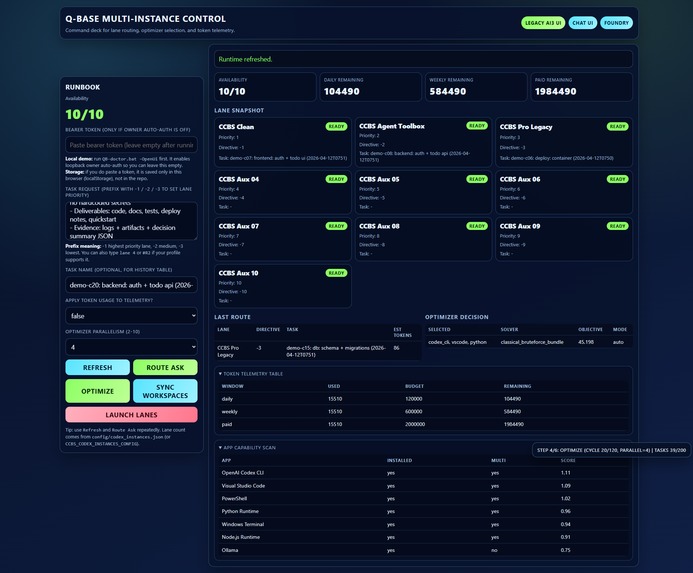
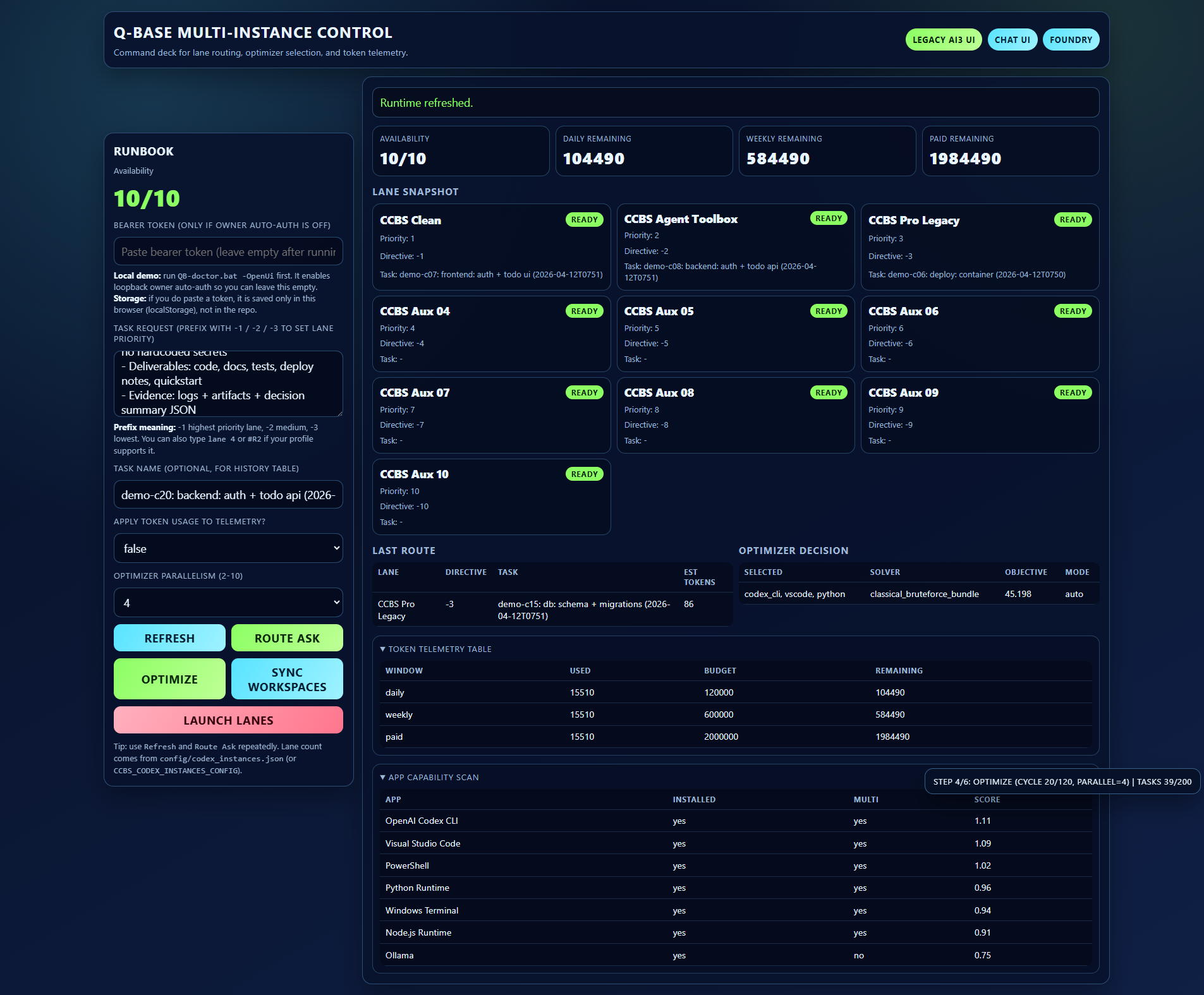
Q-Base (QB) is a local-first multi-agent orchestration system that coordinates work across multiple execution lanes, captures evidence, and keeps the workflow inspectable.
It provides:
- Multi-instance routing across task lanes
- Doctor/bootstrap recovery to return the environment to a working state
- A local UI for routing, optimization, and evidence review
- Automated proof/demo flows for reproducibility
- Optional Azure Quantum integration with a deterministic local fallback
In simple terms, QB is built to turn complex task execution into something structured, visible, and safer to operate.
Why QPU + CPU matters
The core thesis of this project is that search and certainty belong together.
$$ \text{Real Power} = \text{Exploration} + \text{Verification} $$
The QPU side contributes exploration, optimization, and search across competing choices.
The CPU side contributes:
- deterministic execution
- reproducibility
- validation
- policy enforcement
- evidence capture
That pairing matters because real human-support systems cannot run on novelty alone. They need both flexibility and proof. They need imagination and discipline.
How we built it
We built QB as a local-first orchestration runtime using Python, PowerShell, batch scripts, and browser automation.
Core parts include:
src/ccbs_appfor runtime behavior, routing, and application logicQB-doctor.batandscripts/qb_doctor.ps1for environment repair and startupscripts/codex_multi_manager.ps1for multi-instance lane coordinationautomation/capture_ui_demo.mjsandscripts/automate_demo.ps1for reproducible demo capture- a curated public repository surface with focused docs, tests, examples, and evidence assets
We also rebuilt the public repo to be smaller and cleaner than the internal workspace so the submission reflects the actual product story more clearly.
Challenges we ran into
The hardest part was not making the app run once. The hard part was making it reliable, explainable, and demo-safe.
Main challenges included:
- reducing noisy startup behavior
- managing multi-instance lane coordination cleanly
- making the public repo understandable without exposing internal clutter
- capturing visible proof instead of relying on claims
- balancing advanced orchestration with deterministic fallbacks
We also had to frame automation honestly. This project is not about avoiding work. It is about removing waste so human effort can go farther.
What we learned
We learned that the real product is not just the model output. The real product is the orchestration layer around it.
Good systems do more than generate results. They reduce friction, protect dignity, and create more time for care, presence, and love.
Good systems also:
- reduce confusion
- recover from failure
- expose evidence
- preserve human judgment
- make hard work safer and more repeatable
That lesson became central to QB. The value is not “AI did it for me.” The value is “the system helped me do serious work with more control.”
Why it matters
This project is ultimately about using stronger tools to help people live and work better.
If we can combine optimization, deterministic execution, and human-centered design correctly, we can build systems that help people:
- stay safer
- stay more independent
- reduce cognitive overload
- spend more time on care, judgment, and meaning instead of avoidable friction
That is the future QB is aiming at.
Not a future where humans are replaced.
A future where hard work carries us farther because our tools are finally strong enough to help us carry it.
What's next for Q-Base by MVS (QB)
Built With
- azure-quantum
- fastapi
- github
- javascript
- json
- playwright
- powershell
- python
- quantinuum
- rigetti

Log in or sign up for Devpost to join the conversation.