-
-
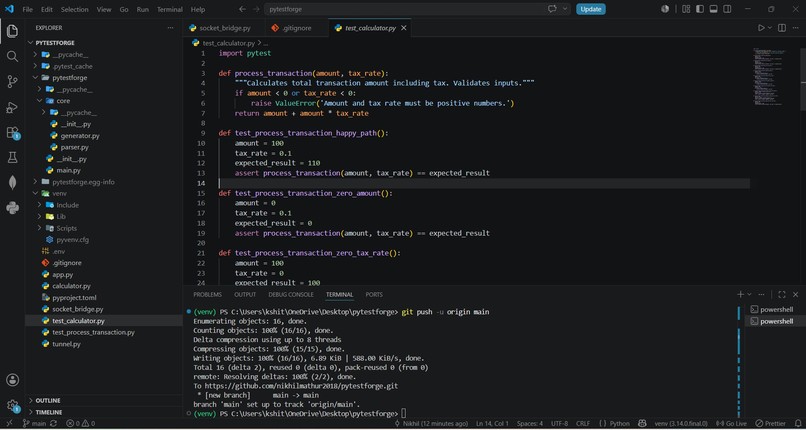
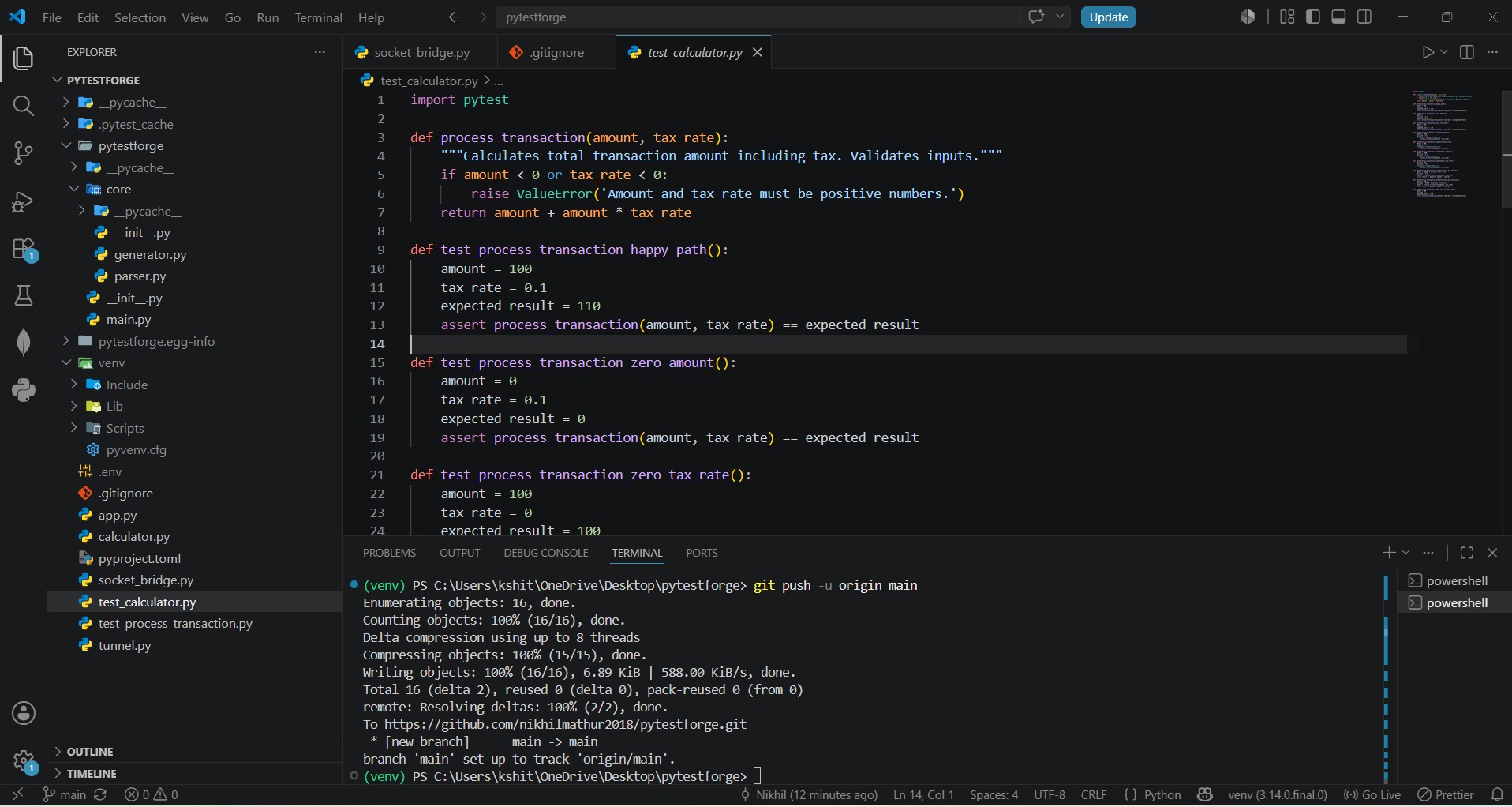
This is a Screenshot of the Code That I was Building on the Local Machine!
🧠 The Inspiration
Writing unit tests is universally recognized as a software development best practice, but it is also one of the most tedious manual chores a developer faces. Context-switching—leaving the terminal, copying code into a web browser AI interface, formatting the response, and manually generating separate files—kills developer velocity.
We built pytestforge to create a zero-friction, terminal-native testing pipeline. The core goal: allow developers to structurally analyze local source files and automatically drop robust, edge-case-validated pytest configurations into their workspace in under a second—without ever leaving their code editor.
⚙️ How We Built It
pytestforge acts as a seamless bridge between a developer's local environment and production-ready cloud automation. The architecture is split into three core layers:
- Static Code Analysis (AST Engine): Instead of treating source code as simple text, the engine leverages Python's native Abstract Syntax Tree (
ast) library to programmatically parse files locally. It isolates function nodes (FunctionDef), extracting signatures, docstrings, and syntax trees. - Cloud Orchestration Workflow: Using the
requestslayer, the parsed meta-payload is piped out securely to a custom, live cloud webhook hosted onviaSocket. The workflow processes the payload to frame comprehensive testing profiles. - Closed-Loop Response: The running local utility catches the incoming returned payload directly from the HTTP response loop stream. It automatically instantiates a file-writer process to write a completely isolated, clean
pytestsuite directly onto the developer's hard drive.
🚀 Challenges We Faced
Managing code integrity during automatic injection was a massive challenge. When working with dynamic test code generation, standard AI tools frequently hallucinate structure or output duplicated components that mask actual dependencies.
We initially hit barriers where test generation included duplicate function overrides inline. We engineered the architecture to enforce structured boundaries, turning what could have been an isolated sandbox script into an integration tool that explicitly imports modules directly from the local workspace repository (from repository import function).
📈 What We Learned
We deeply explored the power of structural parsing using Python’s AST module and realized that developer tools are most effective when they adapt to the user's workspace rather than forcing them to visit an external UI. We learned how to securely channel rapid network payloads through viaSocket workflows, utilizing custom response structures to feed files natively back to standard I/O streams on a user's machine.
🔮 What's Next for pytestforge
- Class & Object Support: Expanding the local parsing logic from standalone functions (
ast.FunctionDef) to wrap entire object-oriented class structures (ast.ClassDef). - Automated Mocking Systems: Integrating
unittest.mockconfigurations out of the box so that any functions referencing external network calls or active database queries are safely mocked automatically. - CI/CD Hook Integrations: Packaging the utility into an active pre-commit hook to block commits if an updated function lacks matching high-coverage unit tests.
Built With
- abstract-syntax-tree
- automation
- pytest
- python
- rest-api
- viasocket

Log in or sign up for Devpost to join the conversation.