-
-

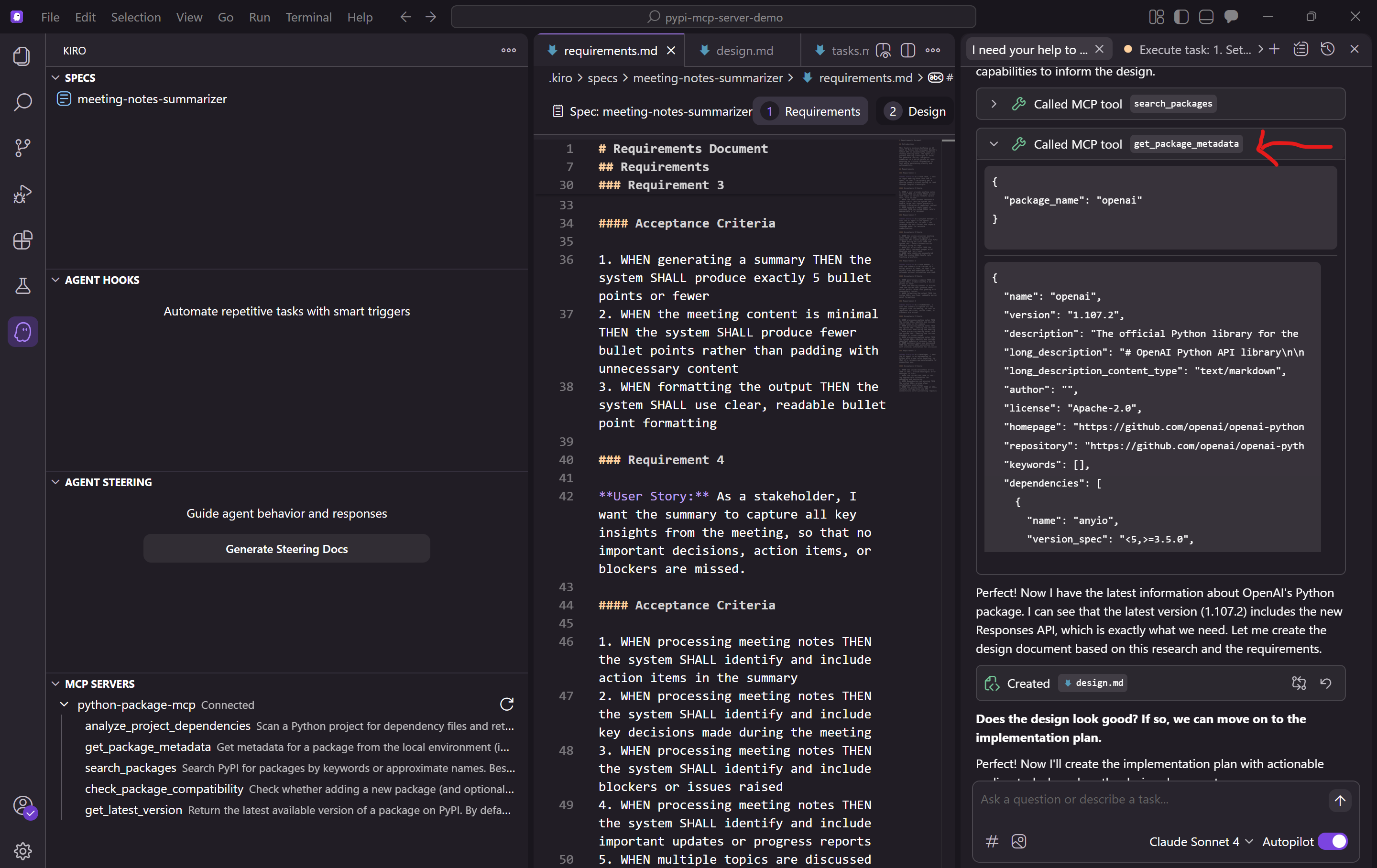
On the right, the user gives a requirement: ‘build an agent that summarizes stand-up meetings in ≤5 bullet points'
-
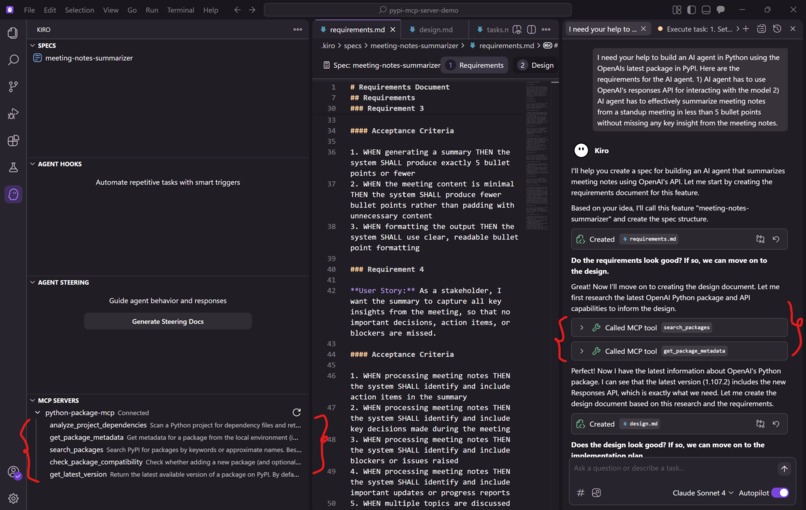
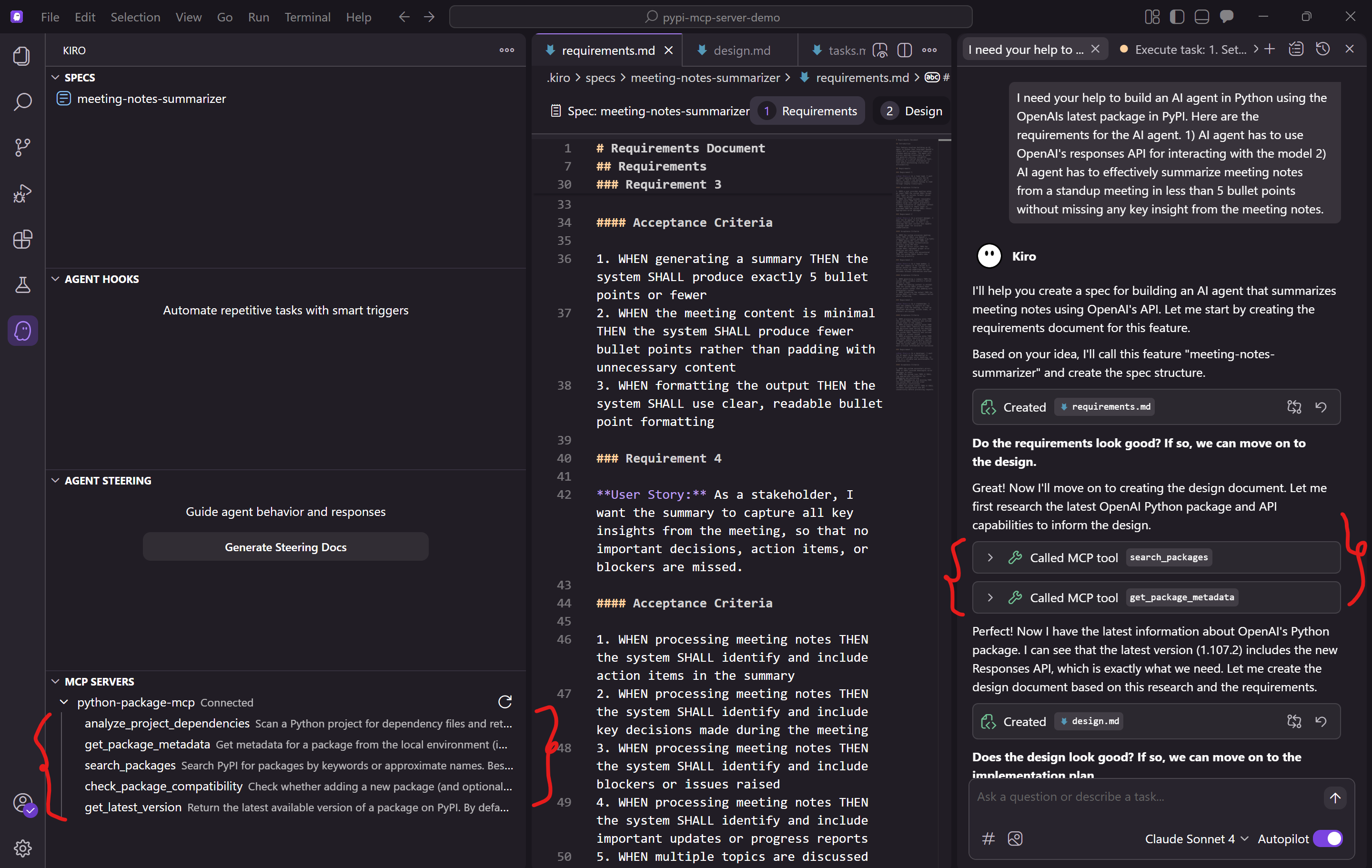
left panel lists our MCP server tools
-

Because the requirement mentions OpenAI’s latest Responses API, the agent calls our search_packages tool (see the card on the right)
-
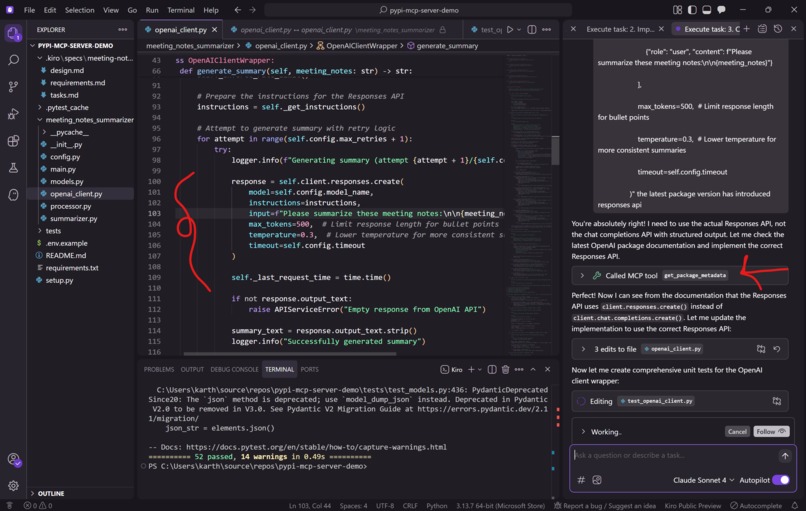
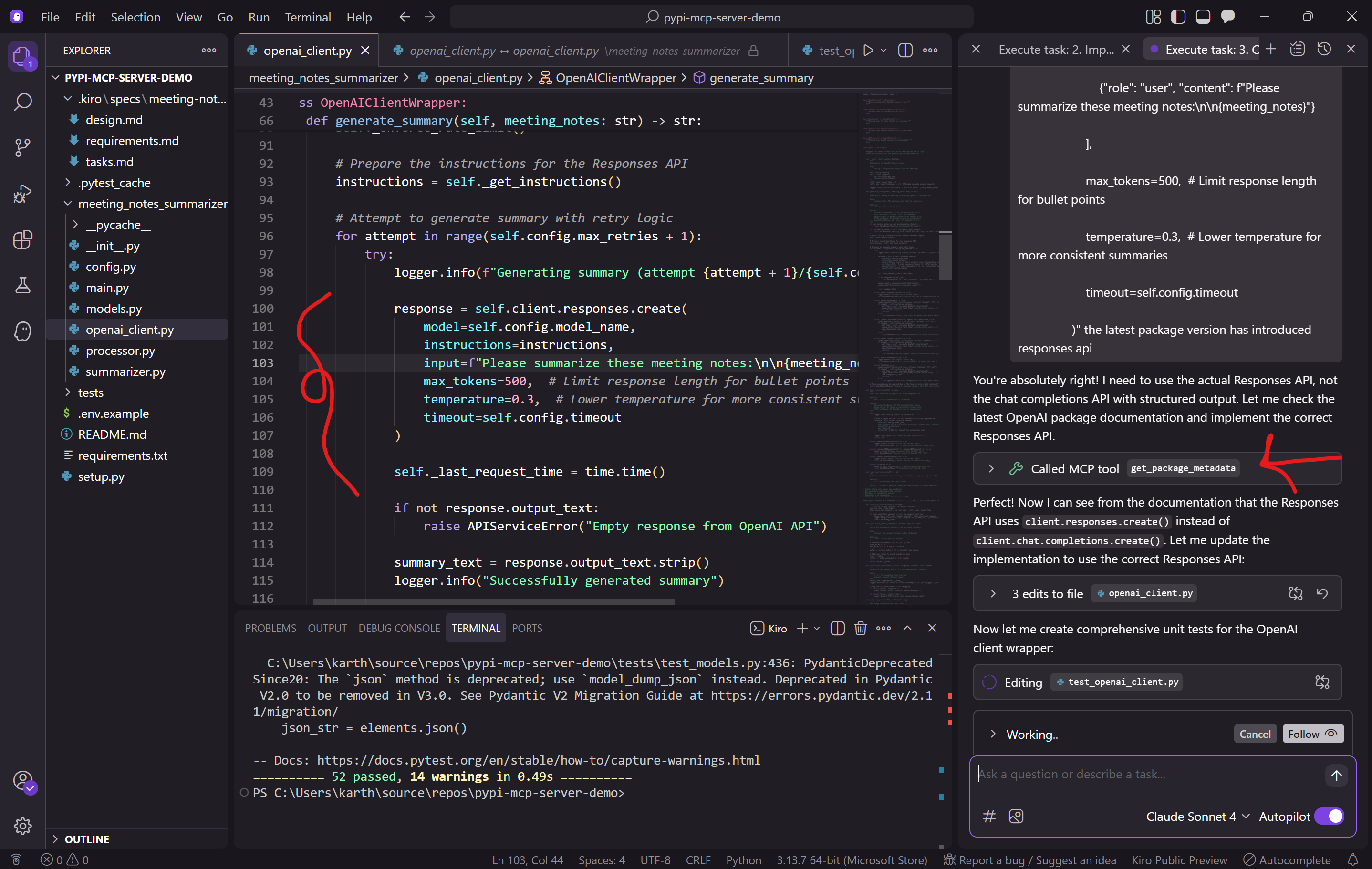
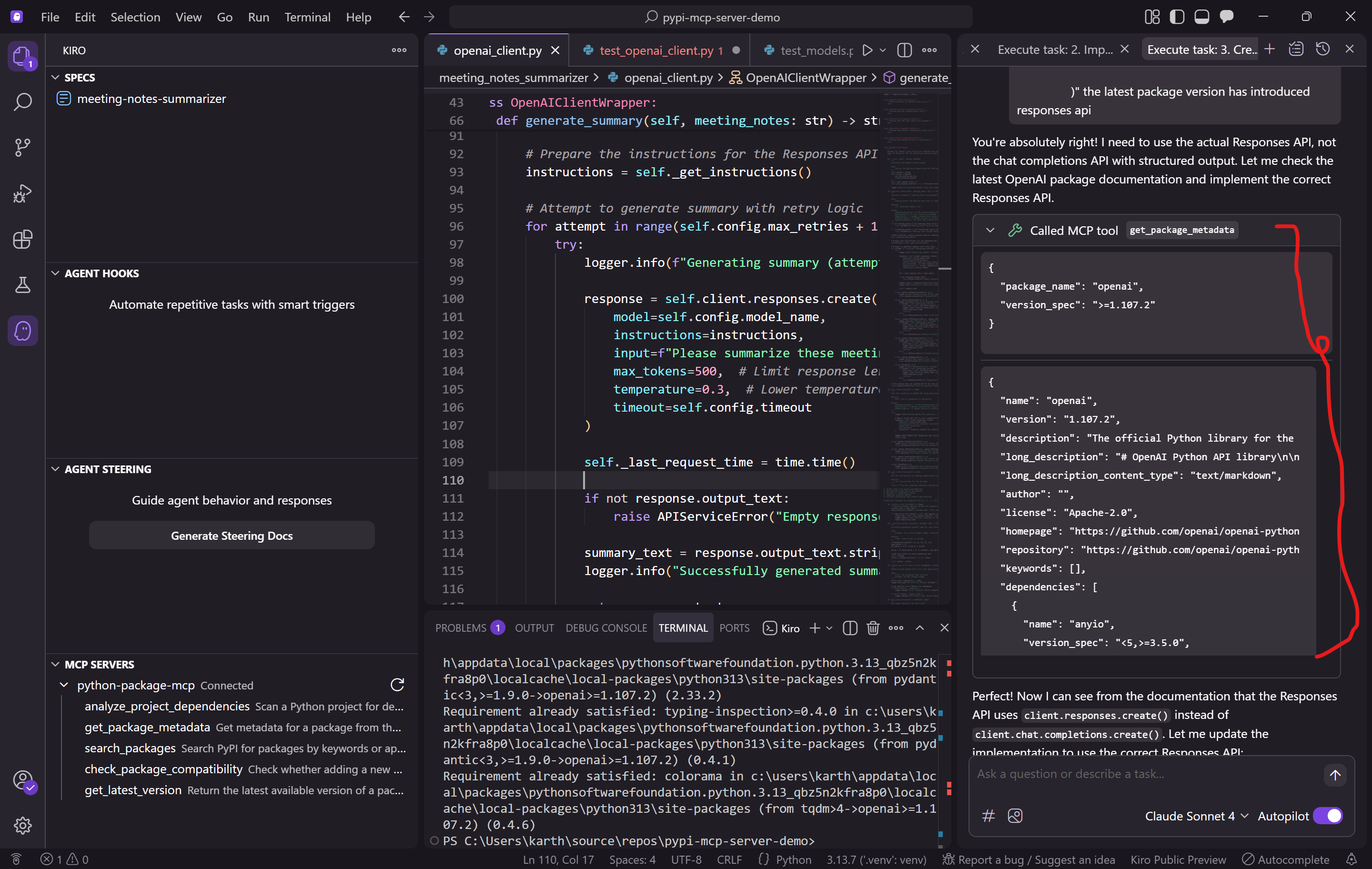
Next, the agent calls get_package_metadata for the chosen package. Our server goes cache-first for speed and falls back to PyPI
-

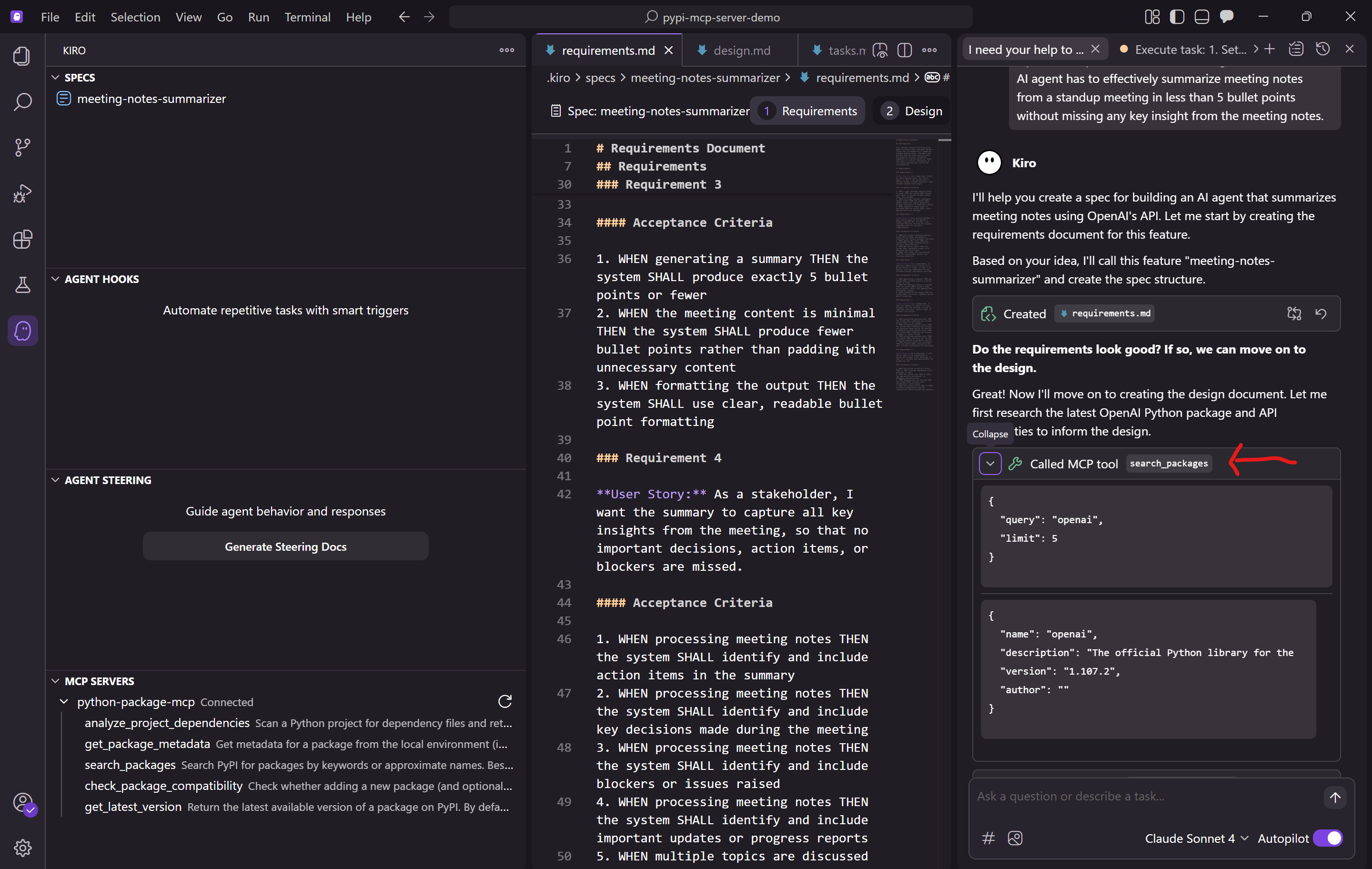
Armed with metadata, the agent creates the client code to use the Responses API (note the client.responses.create(...))
Inspiration
Students face a steep learning curve with evolving Python libraries:
- New releases arrive after model training (knowledge cutoff).
- APIs differ by version; blog examples often break.
- Time gets wasted on installs and dependency conflicts instead of learning.
We asked: What if an AI coding assistant always knew the **latest versions* and could tailor explanations and code to the exact version and API installed locally?* That’s what we built.
What it does (Education-Focused)
- Keeps coursework current: Discovers post-training library versions and surfaces version-specific APIs from package README/long description.
- Student productivity: Analyzes a student repo, flags conflicts early, proposes fixes, and runs tests as the quality gate.
- Tools for teachers: Given a lab spec, scaffolds starter code with compatible versions and verifies notebooks/assignments still run.
- Agentic loop: The assistant searches packages, fetches metadata, selects versions, edits code, and re-runs tests—with optional human approval.
How it helps students (simple scenarios)
- “Why doesn’t this example work?” → Assistant checks installed version, fetches metadata, shows the correct API for that version, and provides a working snippet.
- “Which library should I use?” → Assistant uses
search_packagesto find current options, explains trade-offs, then pins a version that won’t break the environment. - “My install failed.” → Assistant detects conflicting pins via
check_package_compatibility, suggests a resolution, and validates with tests.
How we built it
- Protocol & Tools (Python 3.8+ MCP server):
analyze_project_dependencies— readrequirements.txt/pyproject.tomlsearch_packages— discover and rank relevant librariesget_package_metadata— cache-first, PyPI fallback; shares README/long description for API usage examplescheck_package_compatibility— detect conflicts / range issuesget_latest_version— stable/prerelease selection policies
- Stack:
httpx(async HTTP), local-first caching with PyPI JSON API fallback, pytest for automated checks. - Workflow: Spec-driven prompts → tool calls → code changes → tests as the gate.
- Editor/assistant: Kiro AI Coding Editor (spec-to-code flow) or any MCP-compatible agent/editor.
Challenges we ran into
- Freshness vs. latency: Balancing cache hits with live PyPI lookups.
- Human-in-the-loop: Keeping approvals fast while the AI Coding agent iterates.
Accomplishments we’re proud of
- Turned a single, clear spec into working MCP tools + tests.
- Closed the knowledge-cutoff gap: Used a post-training version correctly.
- Cleaner, consistent implementations aligned with the spec.
- Showed how strong READMEs improve agent understanding of new APIs (fewer broken examples).
What we learned
- Spec-driven + tool-grounded beats prompt-only for reliability.
- Tests are the signal to proceed safely (great for grading & CI).
- Documentation quality matters, READMEs are immediate learning context.
What’s next (Education roadmap)
- RAG-for-tools: Send only the relevant slices of README/metadata to the model (less noise, better hints).
- Courseware helpers: Auto-update lab pins and open PRs when libraries change (keep assignments fresh).
- Lockfile support: Poetry/Conda for reproducible classrooms (fewer “works on my machine” issues).
- Evaluation harness: Fixture assignments with golden outputs (catch regressions early).
- Basic telemetry (opt-in, aggregate): Cache hit rate, metadata latency, conflict stats (help instructors make decisions; no student code stored).
Built With
Language: Python 3.8+
Protocol: Model Context Protocol (MCP)
Libraries: httpx, pytest
Data Source: PyPI JSON API
Approach: Local-first caching, spec-driven workflow, tests-as-gate
Alignment with VirtuHack Tracks
- Primary: AI in Education : Version-aware tutoring and code generation aligned to the actual installed version and API.
- Secondary: Student Productivity / Tools for Teachers — Fewer environment issues for students; faster, verified assignment scaffolds for instructors.
Meets Requirements: Functional prototype (MCP server + tools), demo, repo with setup, screenshots of flows.
Built With
- kiro
- mcp
- py-pi
- python
- python-package-index

Log in or sign up for Devpost to join the conversation.