Inspiration
Small businesses are entering the age of artificial intelligence, but many still operate with disconnected tools for customer communication, quotations, payments, and financial administration.
AI can generate recommendations, but commercial transactions require something more: authorization, verifiable execution, accountability, and trust.
PYME OS — AI Commerce & Payment Agent was conceived to bridge this gap.
The project builds upon the broader PYME OS vision of accessible, intelligent business management and focuses on a concrete challenge: transforming a customer request into a structured commercial offer and a secure, traceable PayPal payment.
Our guiding principle is simple: AI should accelerate business decisions without removing human control over financial transactions.
What it does
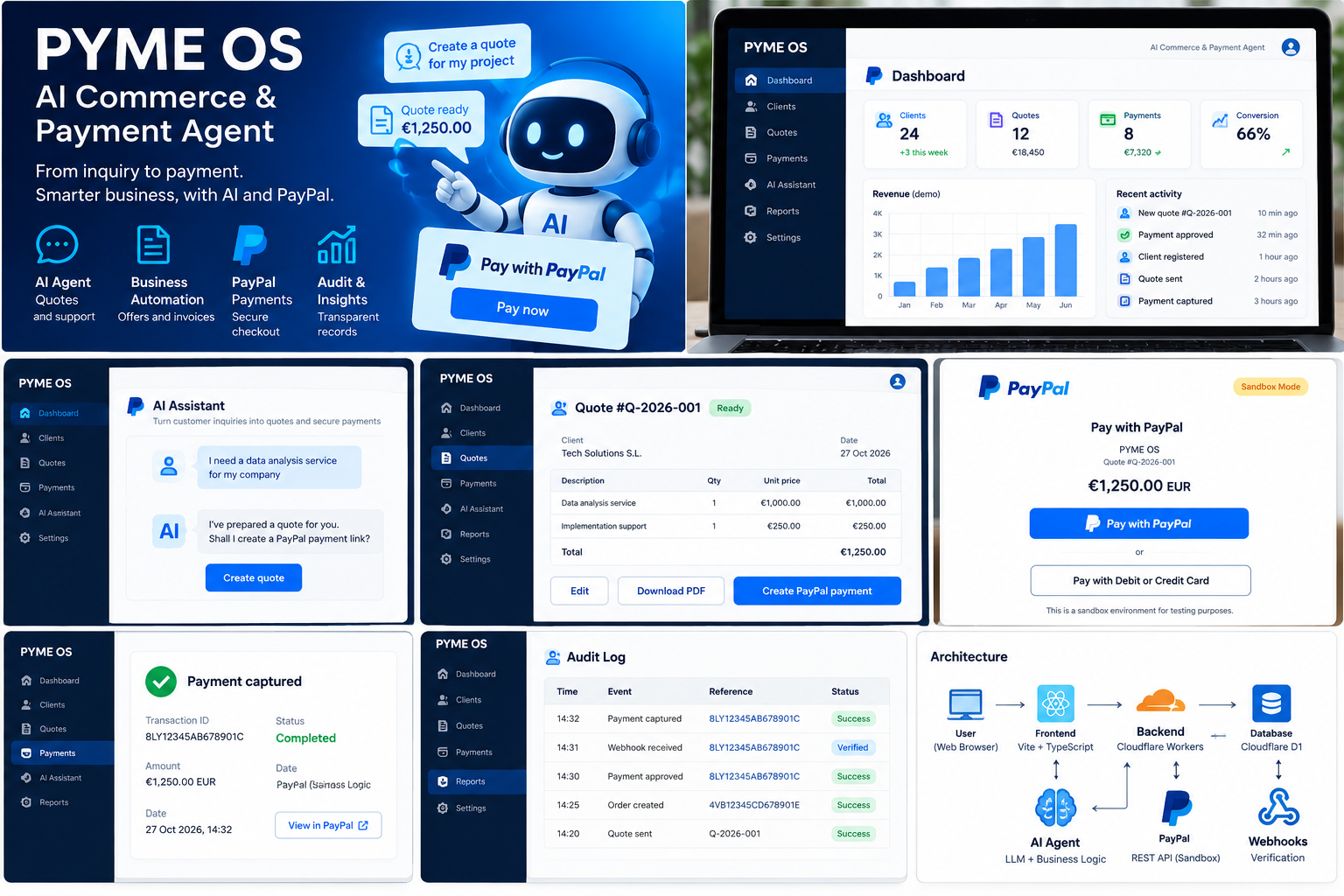
PYME OS is an AI-powered commerce platform designed specifically for freelancers, microenterprises, and small businesses.
The application is being developed around six core capabilities:
- AI Commerce Assistant: Interpret natural-language customer requests and identify the products or services required.
- Intelligent Quotations: Generate structured commercial quotations with itemized prices and transparent calculations.
- Human Authorization: Require explicit user confirmation before initiating payment-related operations.
- PayPal Integration: Create and manage checkout transactions using the PayPal Orders API in Sandbox mode.
- Transaction Verification: Reconcile payment responses and verified webhook events with internal records.
- Auditable Records: Maintain traceable histories connecting customer requests, quotations, authorized actions, and payment outcomes.
The intended experience is straightforward:
Customer request → AI-assisted quotation → Human approval → PayPal checkout → Verified payment status → Audit record.
The platform is designed to distinguish sandbox transactions from actual revenue and prevent AI-generated information from being represented as verified financial evidence.
How we built it
The project is structured as a lightweight, cloud-native application intended to operate without dedicated server infrastructure.
The selected technical architecture includes:
- Frontend: Vite and TypeScript for a responsive web interface.
- Backend: Cloudflare Workers for secure API execution.
- Database: Cloudflare D1 for quotations, transaction references, and audit records.
- AI orchestration: Structured natural-language processing with validated outputs and controlled actions.
- Payments: PayPal REST APIs, beginning with the Orders API and Sandbox environment.
- Security: Server-side credential management, transaction authorization, webhook signature validation, and idempotent payment processing.
- Deployment: Cloudflare's infrastructure and an independently maintained source repository.
The system separates AI recommendations from financially consequential operations. The language model does not receive unrestricted authority to execute payments.
At this stage, the project architecture, use cases, and demonstration concept have been defined. The integrated application and its end-to-end PayPal Sandbox payment flow still require implementation and verification.
Challenges we ran into
The project presents several important engineering challenges.
- Balancing AI autonomy with financial control.
AI can interpret a business request, but it must not independently authorize an unexpected payment. Our architecture therefore requires explicit approval before transaction execution.
- Preventing inaccurate financial information.
AI-generated quotations must be validated against deterministic calculations, currency precision rules, and predefined business constraints.
- Establishing reliable payment verification.
Creating a checkout session is not equivalent to confirming a completed payment. The application must distinguish order creation, approval, capture, failure, and webhook verification.
- Maintaining trustworthy audit records.
Commercial accountability requires clear relationships between the original request, the quotation, the approved amount, the PayPal transaction identifier, and the verified final state.
- Making advanced AI affordable for small businesses.
The solution is designed around lightweight infrastructure and a modular architecture to minimize deployment and operational costs.
These challenges guide the implementation and testing priorities.
Accomplishments that we're proud of
The initial design phase has established:
- A clearly defined AI-commerce use case centered on real small-business workflows.
- A human-in-the-loop payment authorization model.
- A proposed architecture integrating AI, PayPal, and auditable transaction records.
- A structured transaction lifecycle distinguishing proposed, authorized, and verified operations.
- A development direction that prioritizes accessible infrastructure and reusable components.
- A dedicated product identity and demonstration concept for the PayPal AI Hackathon.
The next milestone is to substantiate this design with a working deployment, automated tests, and a reproducible PayPal Sandbox transaction.
What we learned
Designing AI-driven commerce highlights an essential distinction between generating a plausible answer and executing a trustworthy business transaction.
A successful payment agent requires more than conversational intelligence. It needs deterministic validation, explicit authorization, secure API integration, reliable event handling, and independently verifiable outcomes.
We also recognized that traceability is not an optional reporting feature. It is a foundational requirement for financial automation.
The central lesson is that effective agentic commerce must combine intelligence, human agency, transaction integrity, and accountability.
What's next for PYME OS — AI Commerce & Payment Agent
Our development roadmap prioritizes:
- Implementing the responsive frontend and functional commerce dashboard.
- Connecting the application to PayPal Sandbox credentials.
- Completing the Orders API workflow with explicit human confirmation.
- Implementing secure payment capture and webhook verification.
- Connecting quotations, payment states, and audit records to persistent storage.
- Integrating the AI assistant with structured, validated business actions.
- Executing reproducible end-to-end tests, including failed and duplicate payment events.
- Publishing the open-source hackathon implementation with installation instructions and a technical demonstration video.
Beyond the hackathon, PYME OS aims to evolve into an accessible AI-commerce solution for European small businesses, supporting transparent transactions, practical automation, and responsible deployment of artificial intelligence.
Our vision: make intelligent commerce accessible without sacrificing human control or financial trust.
Built With
- agentic-commerce
- ai-agents
- artificial-intelligence
- audit-logging
- cloudflare-d1
- cloudflare-pages
- cloudflare-workers
- css3
- html5
- human-in-the-loop
- javascript
- json
- large-language-models
- oauth-2.0
- payment-processing
- paypal-orders-api
- paypal-rest-api
- paypal-sandbox
- paypal-webhooks
- rest-api
- sql
- transaction-reconciliation
- typescript
- vite


Log in or sign up for Devpost to join the conversation.