-
-
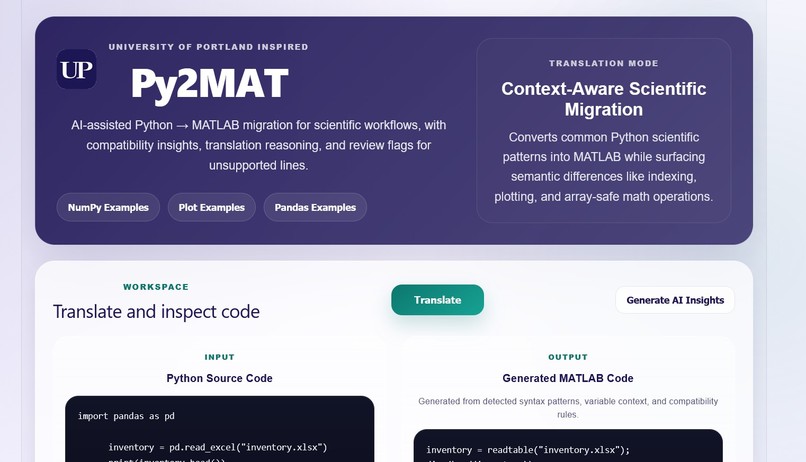
Py2MAT
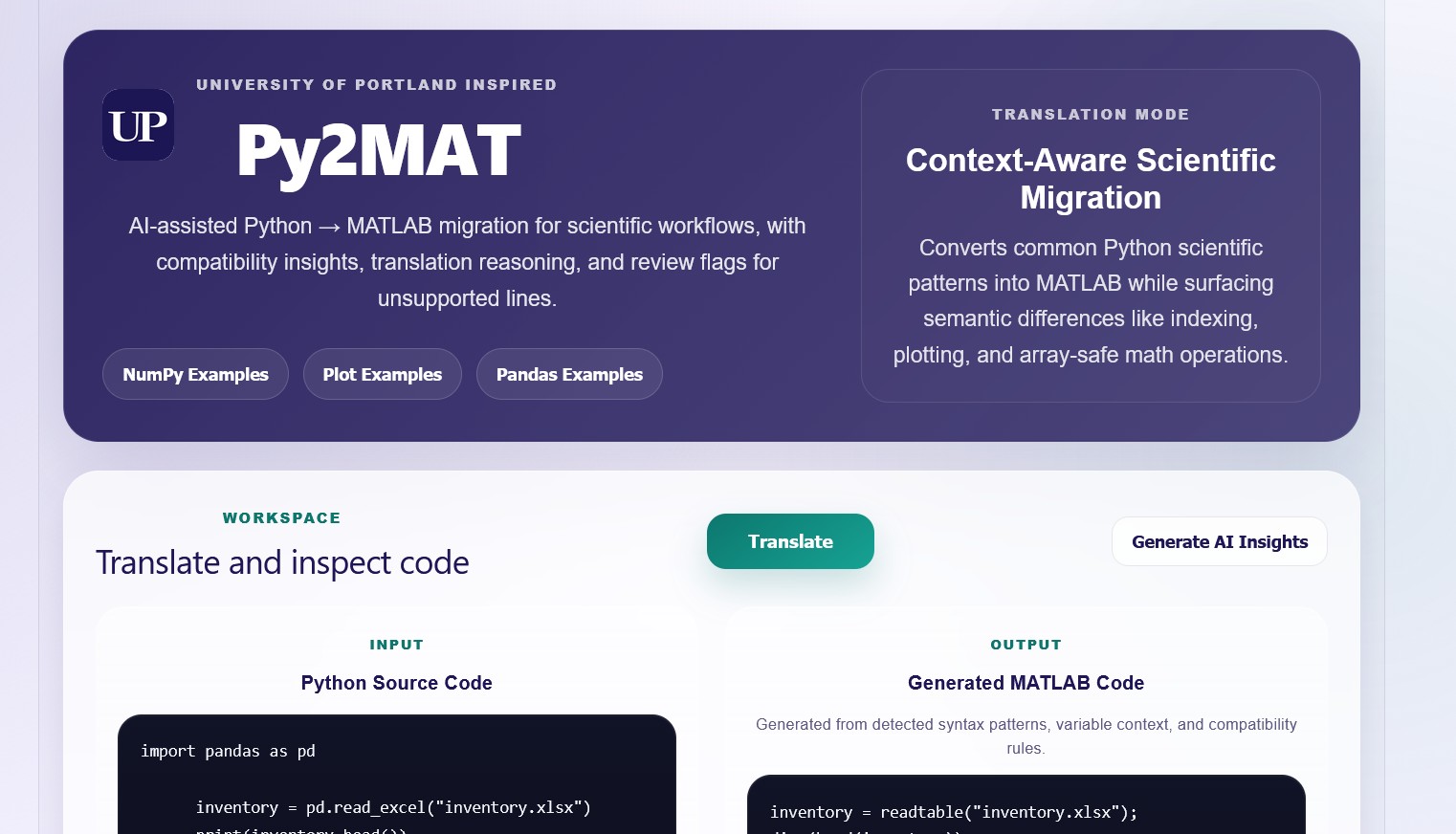
Py2MAT was inspired by the challenge of migrating scientific code between Python and MATLAB, where differences go beyond syntax and include subtle semantic behaviors like element-wise operations, array handling, and plotting conventions. Our tool converts Python scientific code into MATLAB while providing compatibility insights, translation explanations, and AI-assisted migration reviews to help users understand and trust the output rather than blindly accept it. We built Py2MAT as a full-stack application using React for the frontend and Spring Boot for the backend, with a rule-based translation engine that detects common scientific patterns and maps them to MATLAB equivalents, combined with a hybrid AI layer using Claude to generate contextual explanations and fallback logic when needed. One of the biggest challenges was handling semantic differences safely, deciding when to translate, warn, or flag unsupported constructs without producing incorrect code, while also integrating AI in a way that enhances reliability rather than replacing it. We are proud of building a system that goes beyond simple translation by combining deterministic logic with AI reasoning, presenting results through a clean UI with separate panels for output, insights, and review, and ensuring transparency in every step. Through this project, we learned that code translation is fundamentally about understanding meaning, not just syntax, and that the best systems combine structured logic with intelligent assistance. Moving forward, we plan to expand support for more complex workflows, improve semantic analysis, and evolve Py2MAT into a broader cross-language migration assistant for scientific computing.
I immigrated Python code to MATLAB using Java.

Log in or sign up for Devpost to join the conversation.