-
-
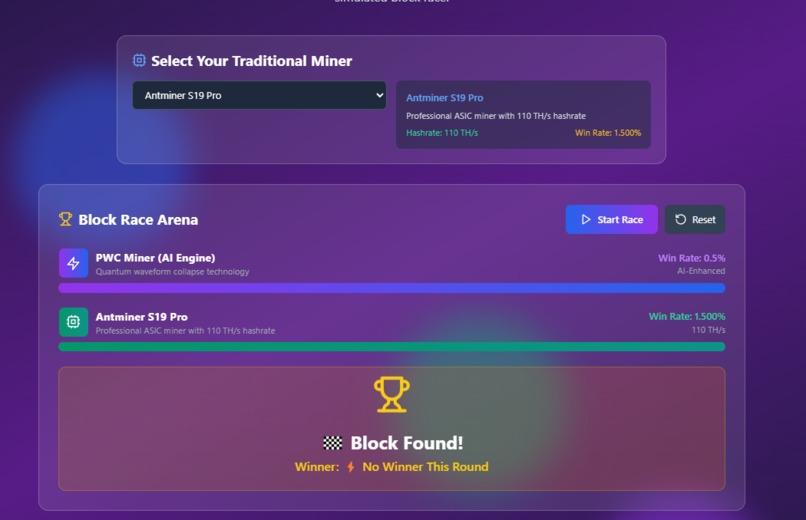
Race against asics
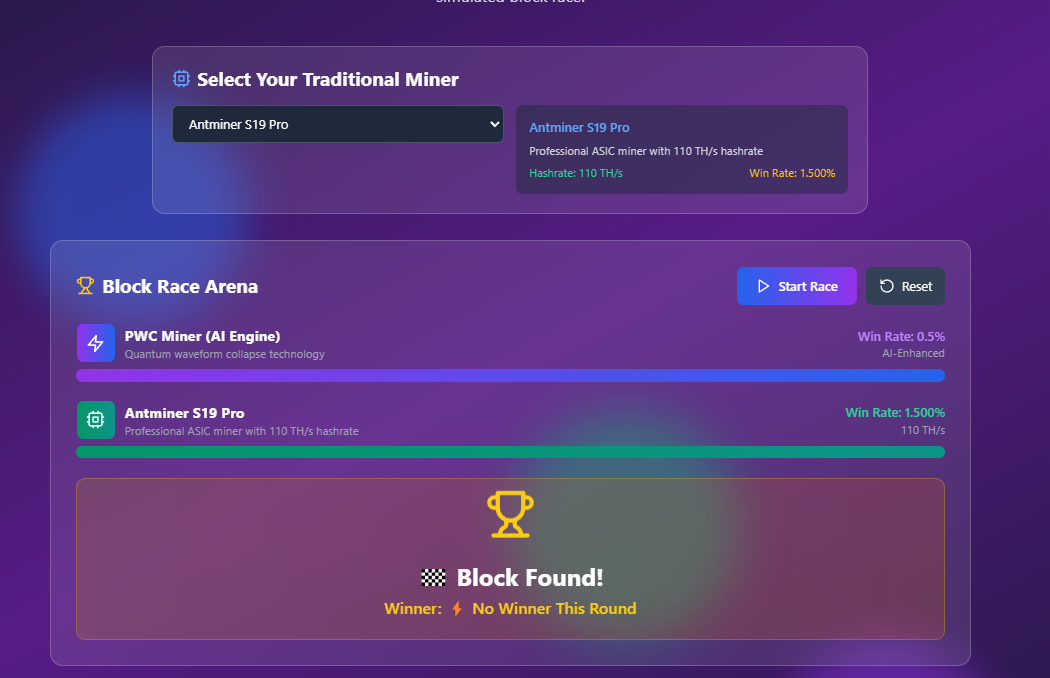
⚙️ PWC Miner Simulator – Project Story 💡 About the Project The PWC Miner Simulator was developed to visualize and compare how a Predictive Waveform Collapse (PWC) Miner performs against a traditional brute-force Bitcoin miner. This project simulates both mining styles side-by-side, helping users understand the time, energy, and success differences between smart prediction and raw hashing power.
🎯 Inspiration The idea came during a Bolt.new hackathon while researching innovative ways to "beat Bitcoin" through smarter, more energy-efficient mining strategies. Instead of relying on brute-force ASICs making billions of guesses, I envisioned a system that could reduce randomness using algorithmic prediction—and needed a way to test and show this in action.
🧠 What I Learned Visual simulation helps bridge the gap between abstract math and real-world mining outcomes.
Traditional mining is powerful but wasteful—predictive approaches may be slower initially, but offer smarter pathways to discovery.
Users engage better with interactive tools that explain mining logic through gamified feedback.
🛠️ How I Built It Platform: Built using Bolt.new for rapid prototyping and deployment.
Frontend: Designed in React + Tailwind CSS to visualize miner progress, success rates, and energy usage in real-time.
Simulator Logic: Written in JavaScript to model both the brute-force and predictive methods using adjustable probability curves.
Customization: Allows users to tweak variables such as energy cost, hashrate, and prediction accuracy to run comparative tests.
🧗 Challenges Faced Balancing realism and speed—ensuring simulations give meaningful insights without long run times.
Modeling probabilistic success in a way that’s both statistically sound and easy for users to understand.
Creating a UI that clearly shows the divergence in mining outcomes between the two methods.
🏁 Outcome The PWC Miner Simulator is a proof-of-concept that demonstrates the viability of smart mining through interactive experimentation. It allows users to:
Compare block discovery times and energy costs.
See how prediction-based mining can compete with brute force.
Explore new ideas in crypto mining beyond raw hashrate.
Built in Bolt.new to visualize the future of intelligent mining.
Built With
- bolt
- javascript
- react


Log in or sign up for Devpost to join the conversation.