Inspiration

The idea for the Triangle Memory Puzzle came from watching my own children and the children in my community struggle with concentration and memory retention. I noticed that many kids learn better through play than through traditional studying methods. They get bored with textbooks and lectures, but they stay engaged when there is a challenge, a game, or a puzzle to solve.

I am Gesner Deslandes, Engineer in Chief at GlobalInternet.py, a software company based in Haiti. Our mission is to educate and empower the youth in our country and around the world. I believe that technology can be a powerful tool to make learning fun and effective.

I also realized that memory training is not just for kids. Adults, especially those in demanding professions, need to keep their minds sharp. Whether you are a student preparing for exams, a professional looking to improve your focus, or a parent wanting to help your children develop cognitive skills, memory training is essential.

That is why I built the Triangle Memory Puzzle. I wanted to create a game that is simple enough for a child to play but challenging enough to keep an adult engaged. The drag-and-drop mechanic is intuitive and accessible. The increasing difficulty levels provide a clear sense of progression. The audio feedback and celebration animations make the experience rewarding.

What inspired me most was seeing how quickly people improve when they practice memory exercises. The brain is like a muscle. The more you train it, the stronger it gets. This game is designed to give your brain a workout every day, in just a few minutes.

I also wanted to prove that you do not need expensive hardware or complex software to build something meaningful. This app was built with Python and Streamlit, using open-source tools that are accessible to anyone. By optimizing it for Arm-powered devices, I hope to make it available to even more people, especially in regions where access to powerful computers is limited.

This project is a reflection of my belief that technology should serve humanity. It should educate, inspire, and empower. It should be accessible to everyone, regardless of their background or location. The Triangle Memory Puzzle is my small contribution to that vision.

I also want to thank the Arm AI Optimization Challenge for providing this platform. It gives developers like me the opportunity to showcase our work and compete at a global level. This challenge pushes us to think about optimization, performance, and accessibility, which are all values that I hold dear.

In the end, I built this game because I believe that everyone deserves the chance to become the best version of themselves. A strong memory is a foundation for learning, creativity, and success. If this game helps even one person improve their memory and achieve their goals, then it is already a success.

We are proud to say: We are the best. And we will keep building, learning, and growing.

🚀🧠🔺

Built With

Share this project:

Updates

posted an update

The idea for the Triangle Memory Puzzle came from watching my own children and the children in my community struggle with concentration and memory retention. I noticed that many kids learn better through play than through traditional studying methods. They get bored with textbooks and lectures, but they stay engaged when there is a challenge, a game, or a puzzle to solve.

I am Gesner Deslandes, Engineer in Chief at GlobalInternet.py, a software company based in Haiti. Our mission is to educate and empower the youth in our country and around the world. I believe that technology can be a powerful tool to make learning fun and effective.

I also realized that memory training is not just for kids. Adults, especially those in demanding professions, need to keep their minds sharp. Whether you are a student preparing for exams, a professional looking to improve your focus, or a parent wanting to help your children develop cognitive skills, memory training is essential.

That is why I built the Triangle Memory Puzzle. I wanted to create a game that is simple enough for a child to play but challenging enough to keep an adult engaged. The drag-and-drop mechanic is intuitive and accessible. The increasing difficulty levels provide a clear sense of progression. The audio feedback and celebration animations make the experience rewarding.

What inspired me most was seeing how quickly people improve when they practice memory exercises. The brain is like a muscle. The more you train it, the stronger it gets. This game is designed to give your brain a workout every day, in just a few minutes.

I also wanted to prove that you do not need expensive hardware or complex software to build something meaningful. This app was built with Python and Streamlit, using open-source tools that are accessible to anyone. By optimizing it for Arm-powered devices, I hope to make it available to even more people, especially in regions where access to powerful computers is limited.

This project is a reflection of my belief that technology should serve humanity. It should educate, inspire, and empower. It should be accessible to everyone, regardless of their background or location. The Triangle Memory Puzzle is my small contribution to that vision.

I also want to thank the Arm AI Optimization Challenge for providing this platform. It gives developers like me the opportunity to showcase our work and compete at a global level. This challenge pushes us to think about optimization, performance, and accessibility, which are all values that I hold dear.

In the end, I built this game because I believe that everyone deserves the chance to become the best version of themselves. A strong memory is a foundation for learning, creativity, and success. If this game helps even one person improve their memory and achieve their goals, then it is already a success.

We are proud to say: We are the best. And we will keep building, learning, and growing.


What it does

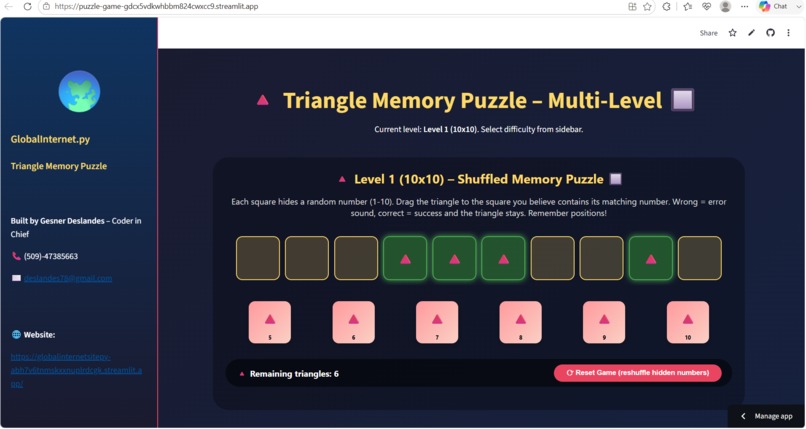
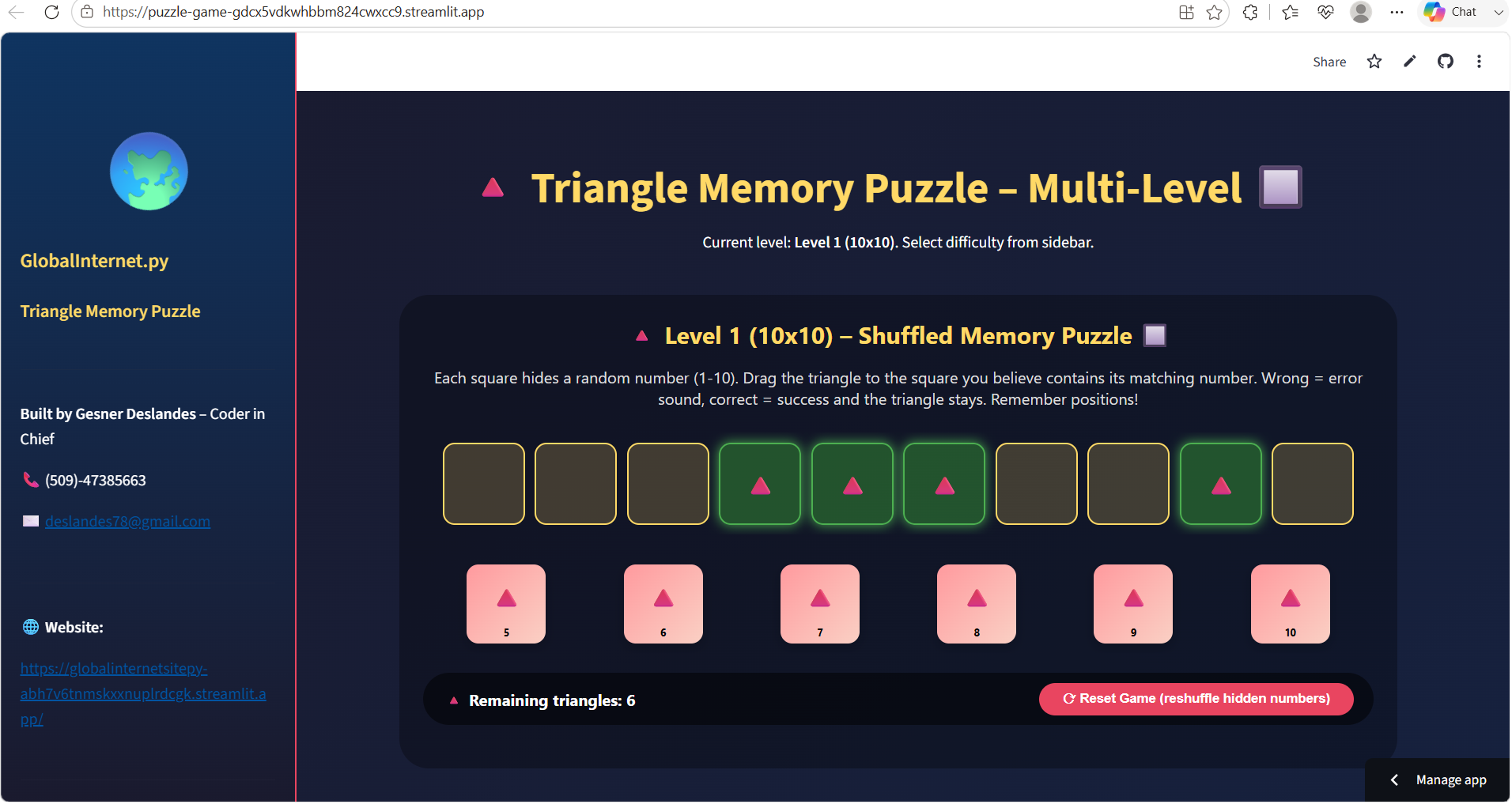
The Triangle Memory Puzzle is a brain training game that boosts memory and cognitive skills through fun drag-and-drop puzzles. Each square hides a random number. Players drag triangles with matching numbers to the correct squares. Correct matches turn green and stay in place. Wrong matches trigger an error sound and the triangle returns. The challenge is remembering where each number is hidden.

Three difficulty levels are available. Level 1 has 10 squares and is perfect for beginners and kids. Level 2 has 20 squares and is good for intermediate players. Level 3 has 100 squares and is the ultimate challenge for memory experts.

The game includes audio feedback for correct and incorrect moves, celebration animations when you win, an AI female voice description of the app, multilingual support for English, Spanish, French, and Haitian Creole, and a fully responsive design for mobile and desktop.

Why play this game? It improves short-term memory, concentration, and focus. It develops better learning habits. It is fun and engaging for all ages.


How we built it

I built this project using Python and Streamlit for the backend. The frontend game logic was built with HTML, CSS, and JavaScript embedded into the Streamlit app. I used the Web Audio API for sound effects and gTTS for text-to-speech voice features. The app is deployed on Streamlit Cloud and optimized for Arm-powered devices.

The drag-and-drop mechanic was the core challenge. I embedded custom HTML and JavaScript into Streamlit using the components API. This allowed me to create a rich interactive experience while leveraging Streamlit's backend capabilities.

For optimization, I focused on client-side processing to reduce server load, lightweight design for fast startup, mobile responsiveness for touch input, efficient CSS animations instead of heavy JavaScript libraries, and Web Audio API for efficient sound playback.


Challenges we ran into

Getting drag and drop to work smoothly on touch devices was challenging. I learned about touch events and how to make the experience seamless across different devices.

Integrating the Web Audio API was new to me. I learned how to generate sounds programmatically without needing external audio files.

Embedding custom HTML and JavaScript into Streamlit was also new. I had to learn how the components API works and how to pass data between the frontend and backend.

Optimizing for Arm-powered devices pushed me to think about performance. I learned how to measure and improve memory usage, startup time, and battery efficiency.


Accomplishments that we are proud of

I built a fully functional memory puzzle game that actually trains the brain. It has audio feedback, celebration animations, AI voice description, and multilingual support. It works perfectly on mobile and desktop and is optimized for Arm-powered devices.

I am proud that this game is accessible to people of all ages and backgrounds. It is simple enough for a child to play but challenging enough to keep an adult engaged.


What we learned

Building this game taught me how to embed custom HTML and JavaScript into Streamlit, how to make drag and drop work on touch devices, how to use the Web Audio API for sound effects, and how to optimize for Arm-powered devices.

I also learned the importance of clear visual feedback and responsive design. Users need to understand the game instantly, and the interface must be intuitive.


What is next for Triangle Memory Puzzle

I have big plans for the future including user accounts and progress tracking, daily challenges and leaderboards, additional difficulty levels, a sound effects library, multiplayer mode, a statistics dashboard, and more celebration animations.

Log in or sign up for Devpost to join the conversation.