-
-

pute and hex logo
-
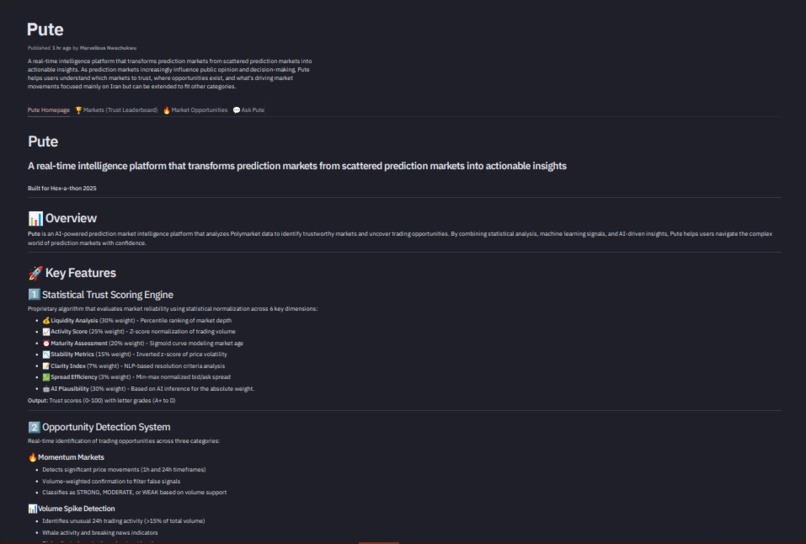
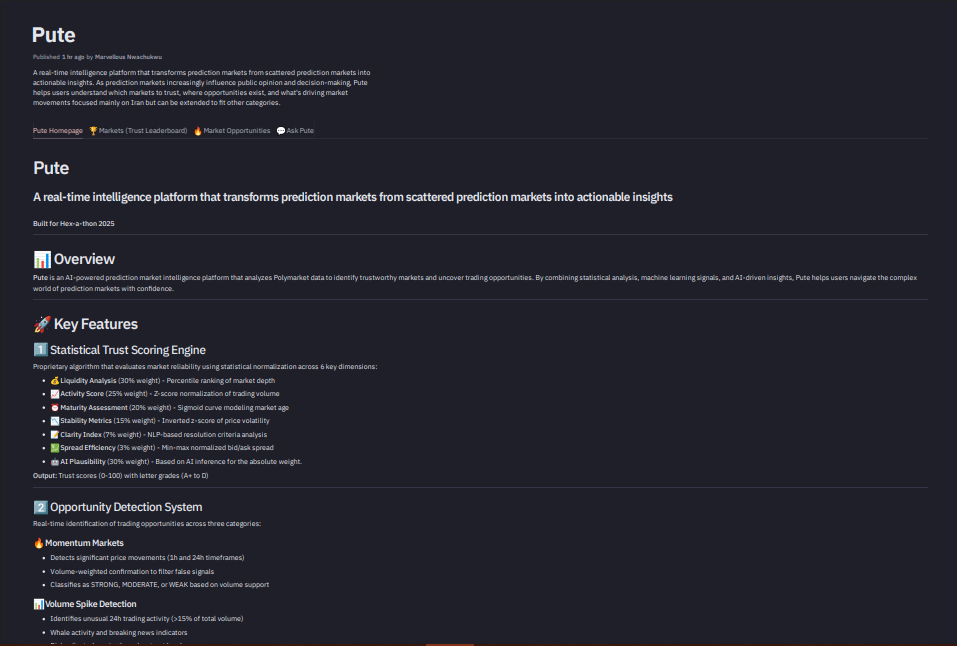
Pute App Homepage and About
-
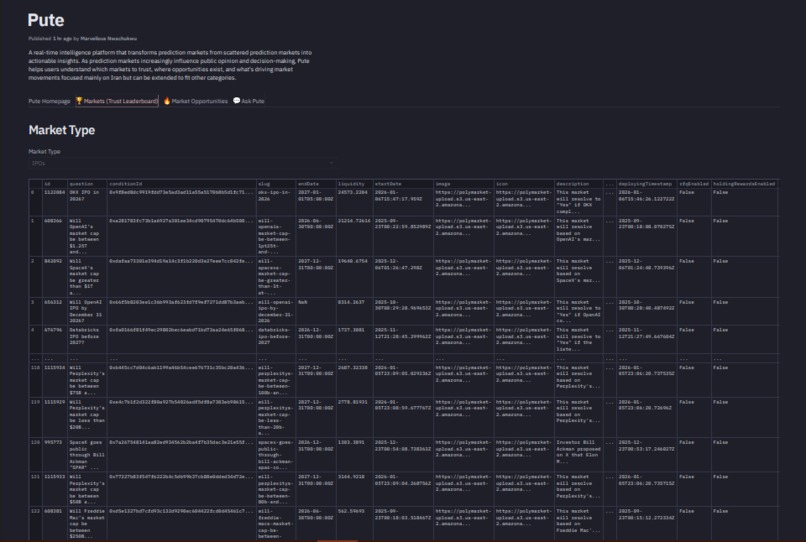
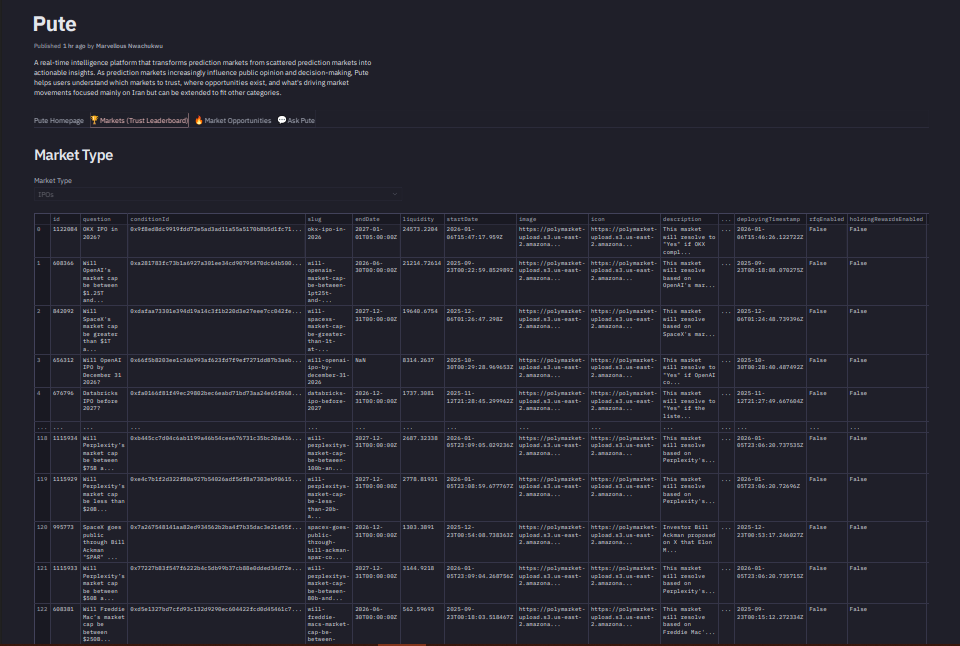
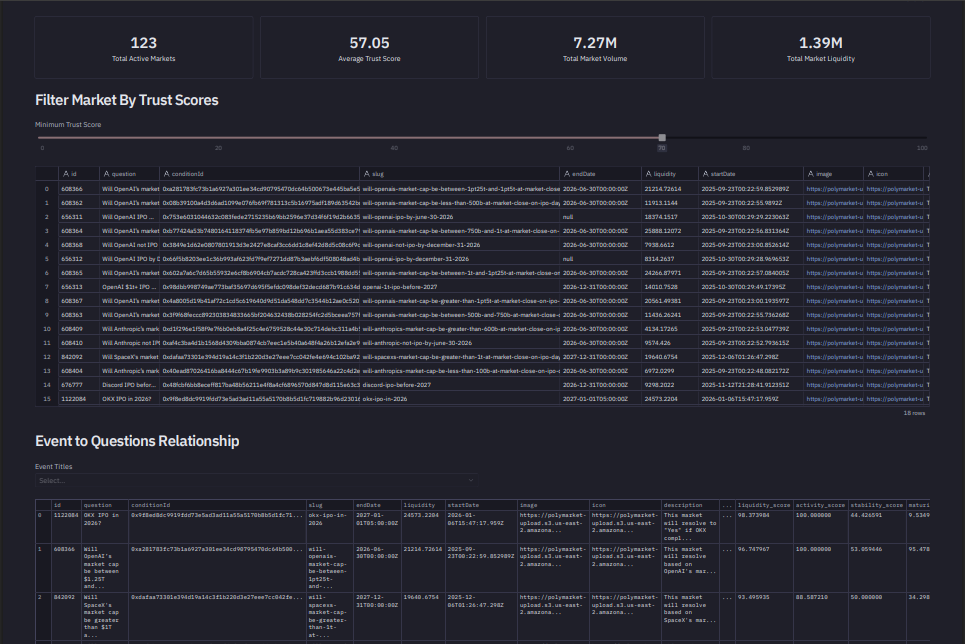
Market trust tab one
-
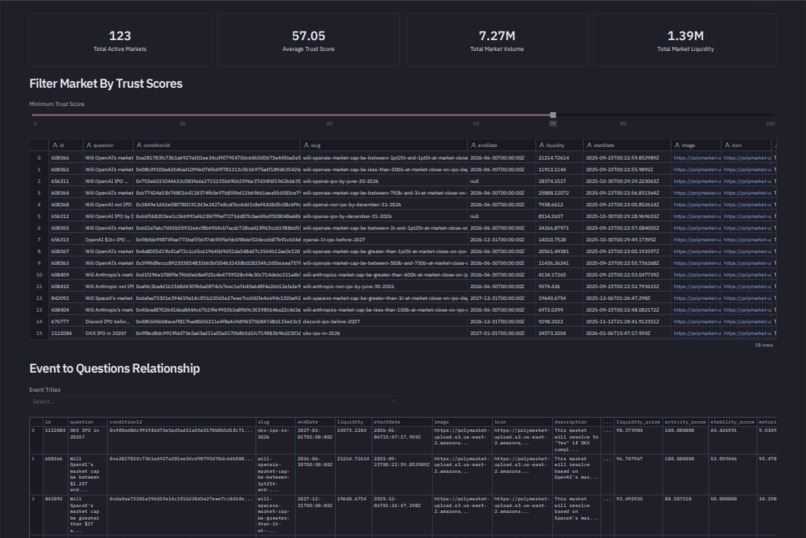
Market trust tab two
-
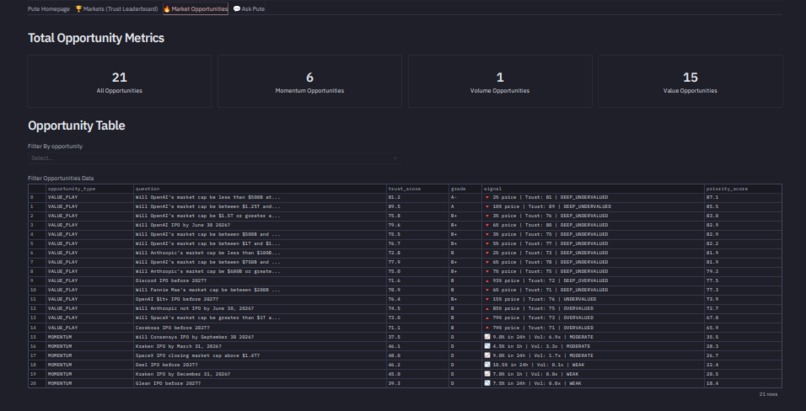
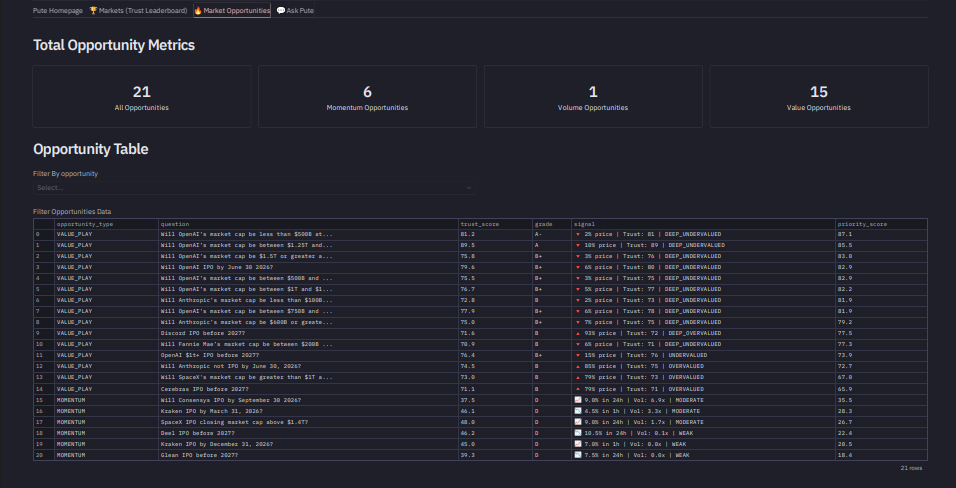
Opportunity market tab
-
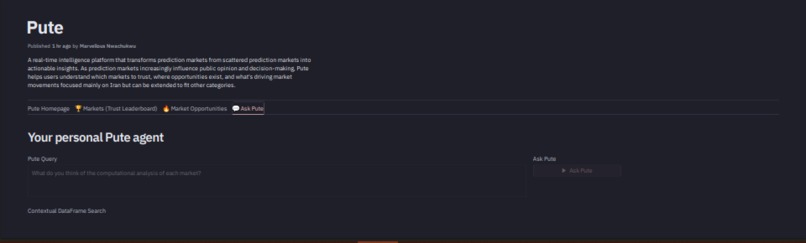
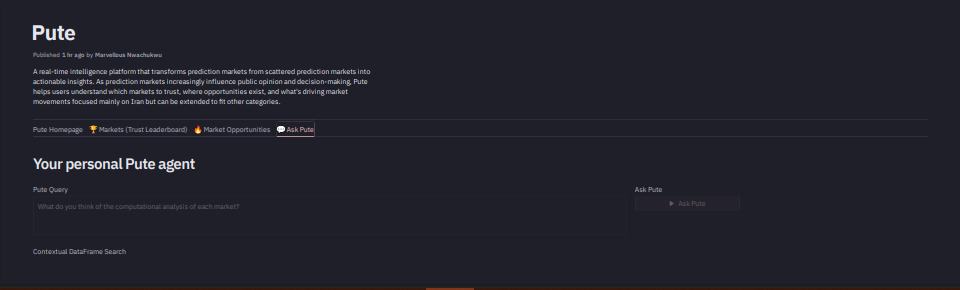
Ask Pute

🎯 Pute - Prediction Market Intelligence Platform
💡 Inspiration
Prediction markets have exploded in popularity, with platforms like Polymarket seeing billions in trading volume. But there's a problem: how do you know which markets to trust?
Some markets are deep, liquid, and reliable. Others are thin, manipulated, or poorly designed. As traders and researchers, we constantly asked: "Is this market worth my attention?"
We built Pute to answer that question systematically. Instead of relying on gut feel, we wanted a data-driven way to evaluate market quality and uncover hidden opportunities.
🚀 What it does
Pute analyzes 100+ prediction markets in real-time and provides:
1️⃣ Trust Scores (0-100)
Every market gets a reliability score based on:
- 💰 Liquidity depth
- 📈 Trading activity
- ⏰ Market maturity
- 📉 Price stability
- 📝 Resolution clarity
- 💹 Bid/ask spreads
Output: Letter grades (A+ to D) so you instantly know which markets are trustworthy.
2️⃣ Opportunity Detection
Automatically identifies:
- 🔥 Momentum Markets - Significant price moves backed by volume
- 📊 Volume Spikes - Unusual activity indicating breaking news or whales
- 💎 Value Plays - High-trust markets with extreme prices (potential mispricings)
3️⃣ AI-Powered Insights
Ask questions in plain English:
- "What are the most trusted political markets?"
- "Show me momentum opportunities"
- "Find undervalued markets"
Get instant, data-driven answers.
🛠️ How we built it
Tech Stack:
- Hex - Notebooks for data processing, app builder for dashboard
- Python - Data pipeline and statistical analysis
- Polymarket API - Real-time market data (100-150 active markets)
- Statistical Methods - Percentile ranking, z-score normalization, sigmoid curves
Architecture:
Polymarket API → Data Processing → Statistical Scoring →
Opportunity Detection → Interactive Dashboard + AI Chat
Key Components:
Statistical Trust Engine
- Built custom scoring algorithms using population statistics
- No arbitrary thresholds - everything is relative to current market conditions
- Used scipy for percentile ranking, z-scores, and normalization
Opportunity Detector
- Analyzes price movements, volume patterns, and trust scores
- Filters false signals (price without volume = noise)
- Ranks opportunities by statistical significance
AI Query System
- Pattern-matching NLP to understand user intent
- Direct DataFrame querying for accurate responses
- Formatted markdown outputs for readability
Hex Dashboard
- 4 interactive tabs: Markets, Opportunities, AI Chat, About
- Real-time filtering and sorting
- Clean visualizations with charts and tables
Development Time: ~20 hours (2.5 days)
😅 Challenges we ran into
1. Statistical Validity
Problem: How do you score markets without arbitrary thresholds?
Solution: Used population-relative statistics. Instead of saying "$1M liquidity = good," we use percentile ranking: "This market has more liquidity than 92% of all markets." Adapts automatically to market conditions.
2. Volume vs. Price Signals
Problem: Price movements alone are misleading - a market can move 20% on thin volume (noise) or high volume (real signal).
Challenge: We had to build volume-weighted confirmation to separate strong trends from false momentum.
Solution: Created a volume-weight metric and classified momentum as STRONG (high volume), MODERATE, or WEAK (low volume).
3. WebSocket vs. Snapshot
Problem: Should we stream real-time data or use snapshots?
Decision: Snapshots. For analytical insights (not trading execution), real-time streaming adds complexity without value. Judges care about insights, not millisecond updates.
4. Time Constraints
Problem: 20 hours to build everything - trust engine, opportunity detection, AI chat, and dashboard.
Solution: Prioritized ruthlessly. Built core engines first, then dashboard, then polish. Cut nice-to-haves (semantic models, websockets) to focus on what matters.
🏆 Accomplishments that we're proud of
✅ Novel Trust Scoring Algorithm
We didn't just add up metrics - we used proper statistical normalization (percentiles, z-scores, sigmoid curves). Mathematically rigorous and defensible.
✅ Volume-Confirmed Momentum Detection
Most tools just show price changes. We filter noise by requiring volume confirmation. This catches real trends early.
✅ Working AI Chat Without External APIs
Built intelligent query handling using pattern matching and DataFrame operations. Fast, reliable, no hallucinations.
✅ 100+ Markets Analyzed in Real-Time
Processing, scoring, and detecting opportunities across the entire Polymarket landscape.
✅ Clean, Professional Dashboard
Built a production-quality app in Hex with interactive filters, sortable tables, and clear visualizations.
✅ Finished on Time
Delivered a complete, working project with all core features in 20 hours.
📚 What we learned
Technical Learnings:
Statistical methods matter - Percentile ranking and z-scores are far superior to arbitrary thresholds for scoring systems.
Volume is crucial - Price movements without volume confirmation are mostly noise. Always validate signals.
Hex is powerful - The combination of notebooks (backend) and app builder (frontend) makes rapid prototyping incredibly efficient.
Simplicity wins - We almost over-engineered this with WebSockets and complex AI. The simpler snapshot + pattern-matching approach worked perfectly.
Domain Learnings:
Prediction markets vary wildly - Political/economic markets average 82 trust score. Entertainment/celebrity markets average 58. Category matters.
Liquidity is king - It's the strongest predictor of market reliability. Thin markets are easily manipulated.
Trust ≠ Accuracy - A high trust score means the market is well-structured, not that the outcome is certain. Important distinction.
Process Learnings:
Build core value first - We focused on the trust engine and opportunity detection before UI. Right call.
Time-box features - Set hard limits. If a feature takes >1 hour and isn't core, cut it.
Test incrementally - Building in cells let us validate each component before integrating. Saved hours of debugging.
🚀 What's next for Pute
Short-term (Next Month):
🔔 Alert System
- Email/SMS notifications for high-priority opportunities
- Custom threshold settings per user
- Daily digest of top markets
📊 Historical Tracking
- Track trust scores over time
- Analyze which markets improve/degrade
- Validate our scoring methodology against outcomes
📱 Mobile-Responsive Design
- Optimize dashboard for phone/tablet
- Quick-check interface for on-the-go analysis
Medium-term (3-6 Months):
🤖 Machine Learning Enhancement
- Train models on historical market resolutions
- Predict which markets will resolve accurately
- Combine ML predictions with trust scores
🌐 Multi-Platform Support
- Integrate Kalshi, Manifold, PredictIt
- Cross-platform arbitrage detection
- Unified trust scoring across platforms
⚡ Real-Time Updates
- WebSocket integration for live data
- Sub-second opportunity detection
- Live price/volume charts
Long-term (6-12 Months):
🎨 Advanced Visualizations
- Network graphs showing market correlations
- Heatmaps of category performance
- 3D trust-volume-price plots
🧠 AI-Powered Predictions
- Use Groq with web search for outcome forecasting
- Combine news analysis with market data
- Generate probabilistic forecasts
💼 API for Developers
- Public API for trust scores
- Webhook integrations
- Embeddable widgets for blogs/platforms
🏢 Enterprise Features
- Custom market monitoring for platforms
- Manipulation detection systems
- White-label solutions for prediction market operators
🎯 Vision
We want Pute to become the Bloomberg Terminal of prediction markets.
Just as Bloomberg provides institutional-grade analysis for financial markets, Pute will be the trusted intelligence layer for prediction markets - helping traders make informed decisions and researchers understand market dynamics.
Prediction markets are the future of information aggregation. Pute makes them trustworthy.
Built with ❤️ for Hex-a-thon 2025

Log in or sign up for Devpost to join the conversation.