Inspiration
Firefighters operate in resource-constrained, high-stakes environments where reliable connectivity can be scarce. In many disaster zones, as seen in the recent LA fire, Wi-Fi and cellular networks are often unavailable. Despite these challenges, these brave men and women stand as society’s protectors, risking their lives to save others and preserve our communities.
In the U.S. alone, there were an estimated 374,300 residential building fires in 2022, leading to 2,720 deaths and \$10.82 billion in property loss. Wildfires can be equally catastrophic: in 2024, over 64,000 wildfires burned ~8.92 million acres, with human activity responsible for about 85% of them.
Having grown up in California, our team has witnessed firsthand the intensity of wildfires and the need for on-device intelligence and drone reconnaissance for robust backend support. Our goal with PUSHPA: Pyro UAV System for High-risk Patrol and Alerting is to empower these everyday heroes by providing them with AI-driven, on-site decision support even when no Wi-Fi or cloud connectivity is available.
What It Does
PUSHPA (Predictive UAV and Smart Headset for Proactive Assistance) is a multi-component system that integrates autonomous drones, wearable edge computing (via Meta Glasses), and an AI agentic layer (LangChain):
Wearable Meta Glasses
- Perform on-device vision language model to interpret the situation
- Offer spoken alerts when identifying structural weaknesses or obstacles.
Autonomous Drone Integration
- Uses MAVLink for flight commands and telemetry, with live video streaming.
- Commands from Meta glasses
- Uses MAVLink for flight commands and telemetry, with live video streaming.
Agentic AI (LangChain)
- Translates human commands (e.g., “Scan that building for hotspots”) into orchestrated tasks for the drone and glasses.
- Monitors real-time sensor/data feeds to adjust flight paths or highlight new hazards on the glasses interface.
- Translates human commands (e.g., “Scan that building for hotspots”) into orchestrated tasks for the drone and glasses.
On-Device Edge Compute
- Deployed a mobile vision-language model onto a Samsung device.
- Implements a “20x optimized convolution” (code link) (code is under myconv_cpu/) pipeline with Fused Winograd transforms for near-instant object detection—crucial in scenarios where cloud APIs aren’t accessible.
- Deployed a mobile vision-language model onto a Samsung device.
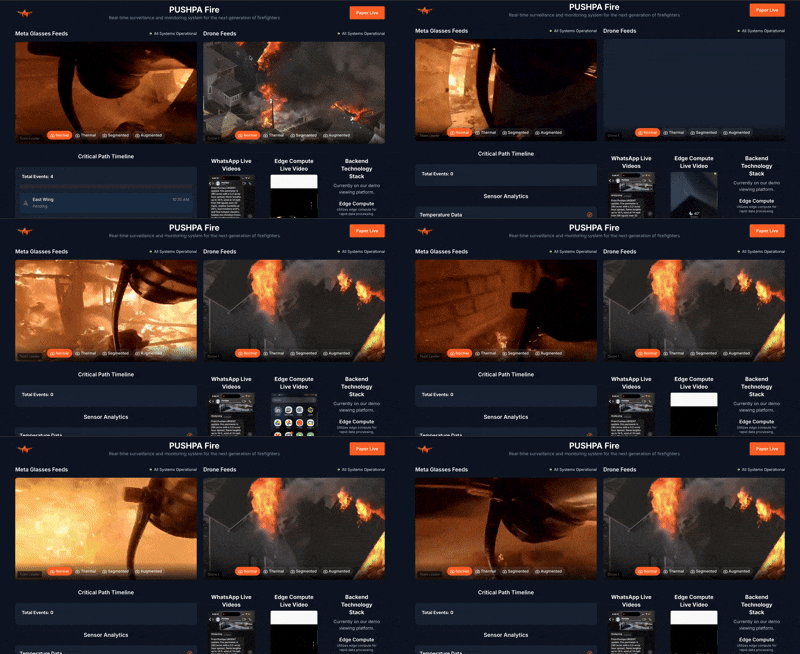
Backend analytics for reconnaissance
- Live feed from drone and meta glasses
- Live analytics from vision language model
Overall, PUSHPA automates many of the manual processes frontline responders face, so they can focus on saving lives and containing the emergency.
How We Built It
Hardware / Drone + Glasses Hacking
- We lacked official SDKs for both the drone and Meta Glasses.
- We mirrored and screen-recorded the drone feed using OBS; for the glasses, we adapted an existing hack (tutorial link) to inject custom overlays and run real-time inference.
- We lacked official SDKs for both the drone and Meta Glasses.
On-Device AI and Edge Compute
- We deployed our AI models (MobileVLM, OCR pipeline, plus SAM v2 + Gemini for more advanced tasks) onto a Samsung Galaxy.
- Because Android restricts custom executables, we wrapped the inference engine in a specialized library and used partial model quantization to run everything locally, no cloud required.
- We deployed our AI models (MobileVLM, OCR pipeline, plus SAM v2 + Gemini for more advanced tasks) onto a Samsung Galaxy.
20x Optimized Convolution Pipeline
- Implemented a “Hybrid Convolution” approach that switches between a direct convolution path and Winograd F(2,3) transforms for 3×3 kernels.
- Employed blocking (256-sized channel blocks) and partial loop unrolling to boost cache usage and throughput.
- Achieved a 20x speedup in inference time on edge devices compared to naive baselines—key in no-Wi-Fi zones.
- Implemented a “Hybrid Convolution” approach that switches between a direct convolution path and Winograd F(2,3) transforms for 3×3 kernels.
Agentic AI with LangChain
- A Node.js service receives user instructions from WhatsApp or the glasses.
- LangChain orchestrates sub-steps (e.g., “drone take off,” “survey building,” “report structural damage”), each of which calls our custom flight controller or the on-device vision pipeline.
- Results are relayed back as JSON or text, displayed in AR or sent via WhatsApp.
- A Node.js service receives user instructions from WhatsApp or the glasses.
Front-End and UI
- Next.js + TypeScript for a live telemetry dashboard that merges drone video, sensor readings, and AI findings.
- WebSockets (Socket.IO) stream real-time updates for the user, showing bounding boxes or route maps.
- We also tested a “bookmarklet hack” to interface with Facebook Messenger for additional chat-based commands.
- Next.js + TypeScript for a live telemetry dashboard that merges drone video, sensor readings, and AI findings.
Challenges We Ran Into
No Official SDKs
- Screen-recording the drone feed and hacking the glasses AR pipeline were not trivial. We had to rely on mirrored streams, custom overlays, and incomplete documentation.
Android Restrictions
- Deploying our optimized models on Samsung hardware required tricky workarounds to run custom inference. We built specialized wrappers to bypass prohibited executables.
Model Integration
- Merging the SAM v2 segmentation model, Gemini data-generation model, and real-time sensor data (drone, glasses) into one cohesive system was extremely complex.
Security & Robustness
- We had to ensure that unauthorized users couldn’t hijack the drone or spam the glasses with misleading overlays. Proper token handling and prompt-based AI injection security were also essential.
Accomplishments That We're Proud Of
Real-Time Edge Inference
Achieving near-zero-latency AR overlays and object detection without relying on Wi-Fi or external cloud APIs.Fused Winograd and 20x Speedup
Demonstrating a robust on-device CNN pipeline tailored for local hardware, critical for disaster scenarios with minimal connectivity.Unified UI + Synthetic Testing
We designed an intuitive interface and used Gemini to generate synthetic data for validating our system under pseudo-wildfire conditions.Agentic AI Orchestration
Our LangChain-based system seamlessly coordinates instructions—from “count forested areas” to “locate potential hazards”—across drones, glasses, and the user’s smartphone or browser.
What We Learned
Edge AI is Crucial
In many disasters, Wi-Fi is completely absent. On-device inference ensures continuous operation and real-time insights.Workarounds Are Sometimes Inevitable
Official SDKs might be nonexistent. We learned to mirror video, hook into hidden AR pipelines, and build custom libraries for local inference.Complex Systems Demand Modular Design
By keeping subsystems (drone logic, glasses inference, AI agent, UI) separate, we could iterate quickly without breaking the entire platform.Prompt Security & Input Validation
Large Language Models can be manipulated by malicious prompts. We employed strict input checks and user authentication to thwart unauthorized access.
What's Next for PUSHPA FIRE
Multi-User AR Collaboration
Let entire squads of firefighters share real-time overlays—e.g., each vantage point combined into a global map.Advanced Predictive Analytics
Extend our system to forecast fire spread, structural collapse, or toxic gas pockets—again without needing a live internet connection.Further Hardware Compatibility
Officially integrate with more drone manufacturers and AR devices, removing the need for “hacks.”Live Field Trials
We plan to partner with fire departments and emergency services to test in real-world conditions, collect feedback, and refine.Industrial and Agricultural Extensions
Beyond firefighting, we can adapt the same architecture for warehouse inventory scanning, industrial inspections, or crop health mapping—particularly in remote areas lacking internet.
Ultimately, PUSHPA keeps first responders safer and better-informed, combining drones, edge compute, and a powerful AI agent into a cohesive system that saves time, protects property, and—most importantly—helps save lives.
Most Creative On-Device AI Deployment
We deployed a specialized on-device CNN pipeline on a Samsung Galaxy with fused Winograd transforms for near-zero-latency inference. This 20x speedup enabled advanced hazard detection without relying on Wi-Fi or cloud services.
Edge Operator Optimization Champion
Our custom kernel-level optimizations minimized overhead and maximized throughput for real-time hazard detection. By leveraging a highly efficient local inference engine, we delivered robust, high-performance edge compute under disaster conditions.
Best Use of Gemini
We harnessed Gemini to generate synthetic data under pseudo-wildfire conditions, helping us rapidly iterate and refine our drone and AR detection pipelines. This approach ensured our system’s resilience and accuracy when deployed in real-world disaster scenarios.
Best Use of Vercel@___ in Edge AI track
We built a Next.js + TypeScript telemetry dashboard and deployed it on Vercel, streaming live drone feeds and AI-generated bounding boxes. Vercel’s serverless architecture let us scale effortlessly for real-time analytics and edge AI workloads.
Health Command Center
We integrated wearable Meta Glasses that offer spoken alerts on structural weaknesses or obstacles, acting as a personal health and safety command center. By giving responders continuous hazard awareness, we reduce the physical risks they face in the field.
Waterproof Beach WindSurf Hack
Our UAV system and AR overlays are designed to operate in wet or windy conditions, enabling first responders to handle coastal emergencies without losing critical data. Waterproof enclosures and robust drone controls ensure uninterrupted rescue efforts in challenging environments.
Replit Boost
We leveraged Replit for streamlined, collaborative coding, allowing our team to rapidly prototype and share updates on the AI pipeline. Replit’s integrated environment made it easy to debug and iterate on new features.
DevOps Genetic Workflow
We implemented an end-to-end CI/CD pipeline to automatically test and deploy AI model updates and drone firmware. This DevOps approach minimized downtime and ensured quick delivery of new capabilities to the field.
Harder, Better, Buiding: Best Use of Data Hack
We combined drone video, AR sensor data, and real-time analytics to train and refine our local detection models. This multi-modal data integration gave our system the depth needed to proactively identify hazards and provide actionable insights.
Lap the lines of LangChain
Our LangChain-based agent interprets user commands and coordinates tasks between the drone, Meta Glasses, and on-device AI. This agentic layer seamlessly executes complex processes—like building scans for hotspots—and delivers alerts in AR or via text channels.


Log in or sign up for Devpost to join the conversation.