PURSUIT — AI Opportunity Discovery & Decision Intelligence
Inspiration
Finding professional opportunities is not necessarily the hardest part of a career search. The harder part is deciding which opportunities are actually worth pursuing.
People can spend hours searching jobs, hackathons, grants, programs, and freelance opportunities, then even more time reading requirements, comparing them with their experience, identifying gaps, and deciding whether the opportunity is worth the effort.
I built PURSUIT to turn that repetitive process into an end-to-end AI-assisted decision workflow.
Instead of simply answering "What opportunities are available?", PURSUIT tries to answer:
"Which opportunities are worth my time, and why?"
What It Does
PURSUIT is an AI-powered opportunity discovery and decision intelligence system for professionals, job seekers, students, and career changers.
A user creates a profile, can upload supporting documents such as a résumé, and tells PURSUIT what kinds of opportunities they are looking for.
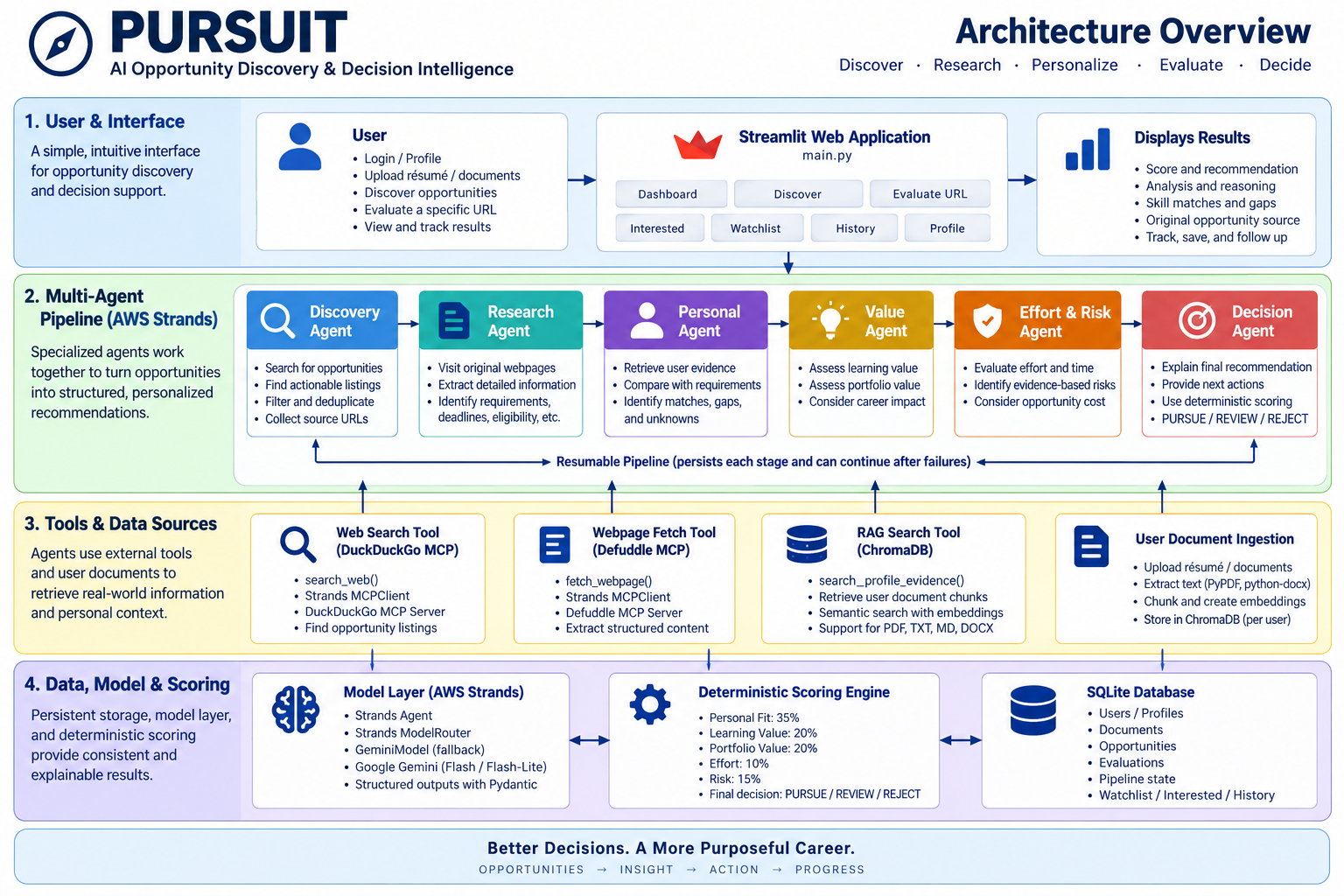
PURSUIT then uses specialized AI agents to discover real opportunities, research their original sources, compare requirements against the user's own evidence, assess learning and portfolio value, consider effort and risk, and produce a final recommendation:
PURSUE, REVIEW, or REJECT.
Users can inspect the reasoning, skill matches and gaps, next actions, and original opportunity source instead of receiving only a search result.
How I Built It
PURSUIT is built with the AWS Strands Agents SDK as a multi-agent system.
Rather than giving one AI model a large prompt and asking it to do everything, I separated the workflow into specialized agents for discovery, research, personal fit, value, effort and risk, and final decision explanation.
PURSUIT also uses web-search and webpage-research tools so agents can work with real opportunities. User documents are converted into searchable personal evidence using retrieval-augmented generation (RAG), allowing an opportunity to be evaluated against the individual user's background.
One important design decision was to separate AI reasoning from final scoring. Agents interpret evidence, but the numerical score and final recommendation thresholds are calculated deterministically in Python. This makes the result more consistent and easier to understand.
I also made the workflow resumable. If an API, model, or web-research stage fails halfway through an evaluation, completed work can be preserved and the pipeline can continue later instead of starting from the beginning.
Challenges
The biggest challenge was discovering real opportunities rather than merely relevant-looking web pages. Search results sometimes returned personal profiles, articles, duplicate listings, or pages containing the right keywords but no actual opportunity. I had to strengthen discovery filtering, source validation, deduplication, and URL handling.
Another challenge was preventing missing information from becoming a false negative. If a résumé does not mention a particular requirement, that does not necessarily mean the person lacks that skill. PURSUIT therefore distinguishes between Match, Partial, No Match, and Unknown.
I also had to balance discovery coverage with speed and limited model quotas. Searching everything everywhere can produce better coverage but makes an agent unnecessarily slow and expensive. The workflow therefore tries to stop when the requested opportunity targets have been satisfied.
Finally, building a multi-agent system introduced real reliability problems: model failures, web pages that cannot be extracted, API limits, and interrupted evaluations. These challenges led to the resumable pipeline and clearer boundaries between agents.
What I Learned
Building PURSUIT taught me that creating a useful AI agent is much more than connecting an LLM to an API.
The difficult questions are what the agent should be allowed to conclude, what evidence it should trust, which tasks should be handled by AI, which should remain deterministic, and what should happen when information is missing or a tool fails.
I also learned the value of giving agents focused responsibilities rather than expecting one model to perform an entire complex workflow.
Most importantly, I learned that useful agent systems need constraints as much as intelligence. Sometimes the most important behavior is knowing when the available evidence is not strong enough to make a claim.
Why PURSUIT Matters
There are already many platforms that help people find opportunities. PURSUIT focuses on what happens after discovery.
People have limited time. Applying for every possible job, joining every program, or pursuing every opportunity is not realistic.
PURSUIT is designed to help users move from:
"I found an opportunity."
to:
"I understand this opportunity, how it fits me, what I could gain from it, and whether it deserves my time."
That is the problem I wanted PURSUIT to solve.
Built With
- amazon-web-services
- aws-strands-agents-sdk
- chromadb
- defuddle-mcp
- duckduckgo-mcp
- google-gemini
- model-context-protocol-(mcp)
- pydantic
- pypdf
- python
- python-docx
- sqlite
- strands
- streamlit

Log in or sign up for Devpost to join the conversation.