-
-
Purser: the AI treasurer for group events (PayPal Agent Toolkit, Gemini, AG Grid)
-
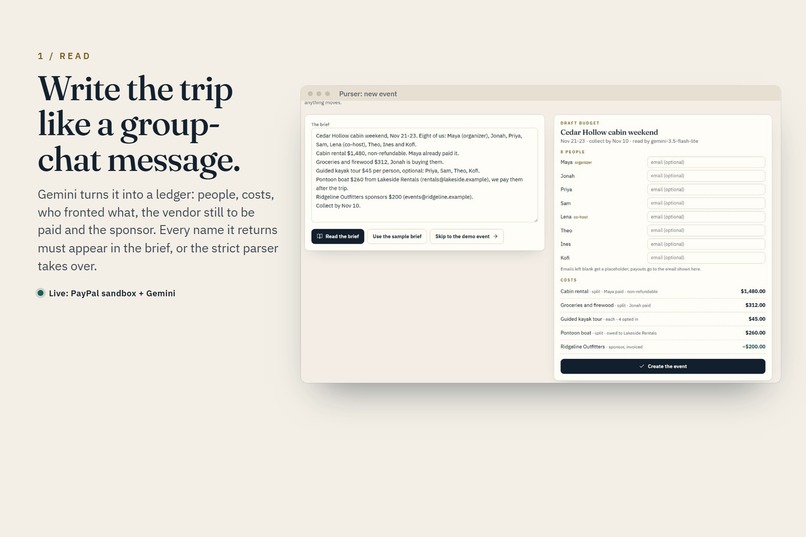
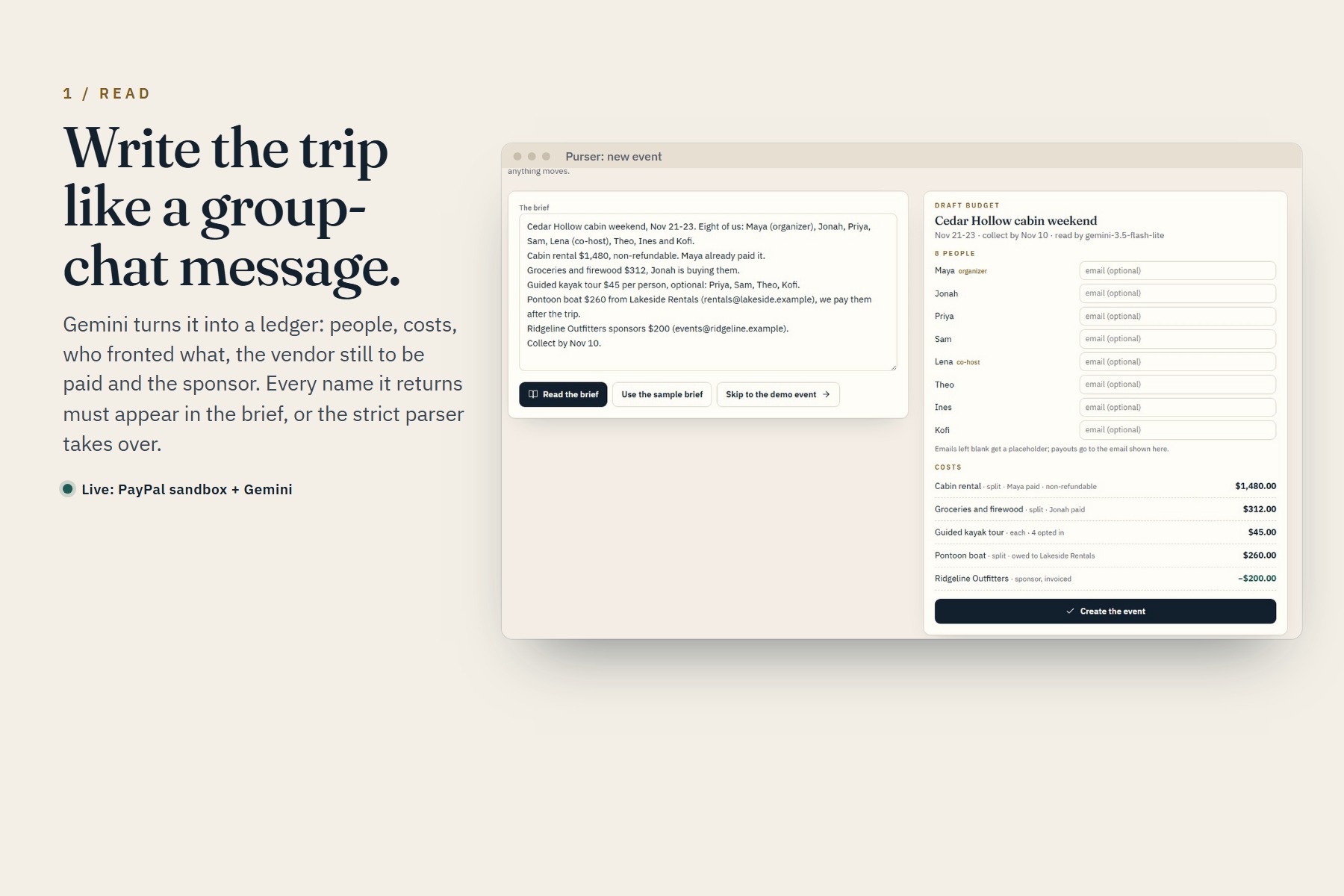
Live: Gemini reads a group-chat brief into a ledger, with a grounding check
-
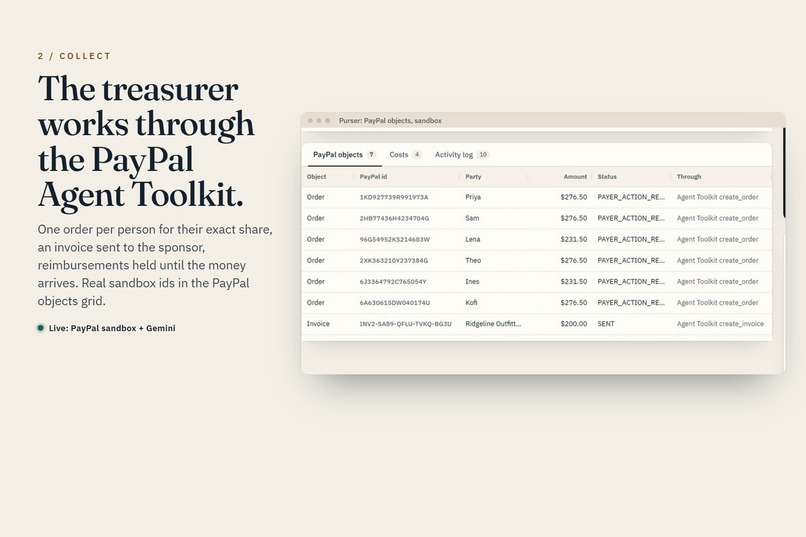
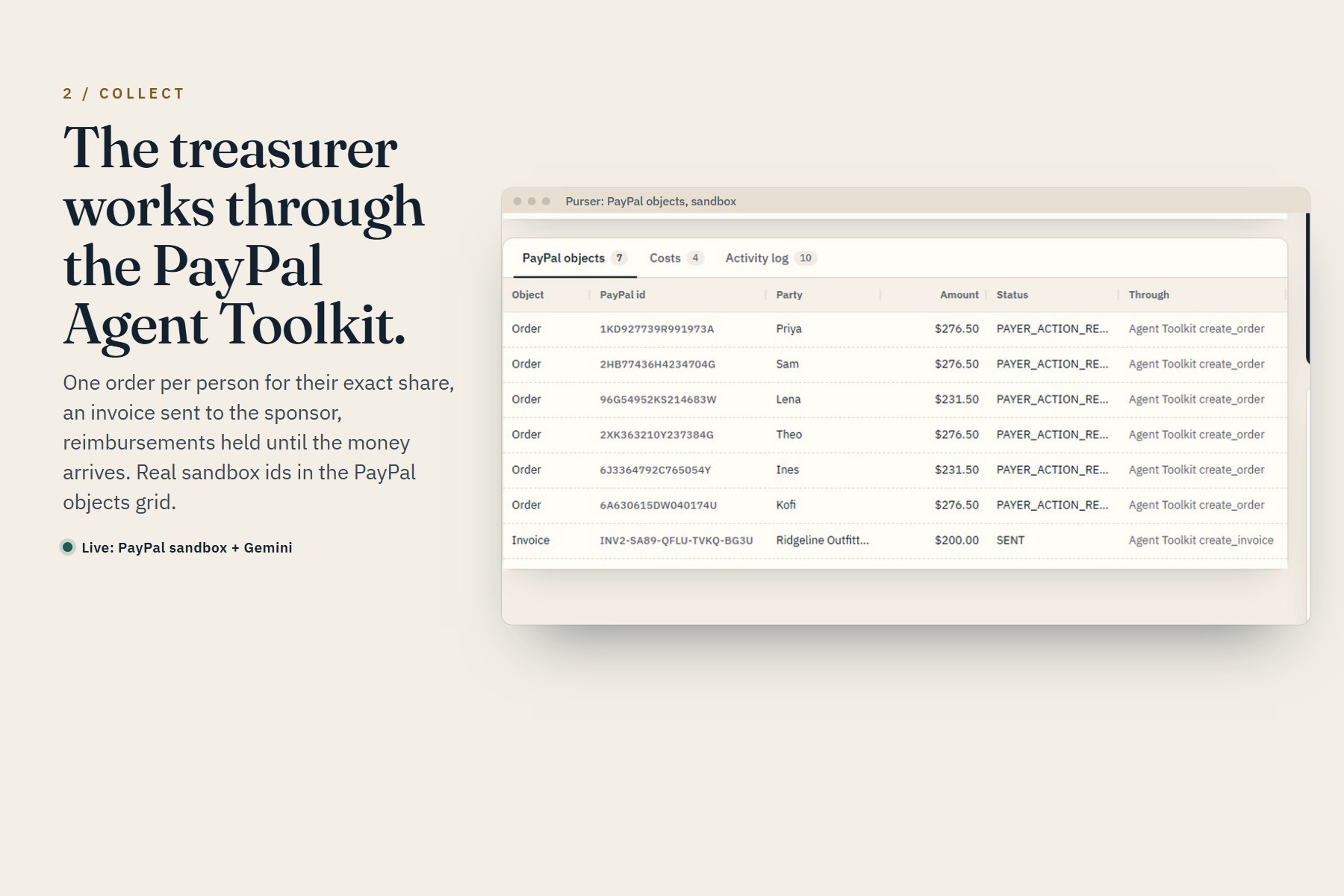
Live PayPal sandbox: one order per person and the sponsor invoice, through the Agent Toolkit
-
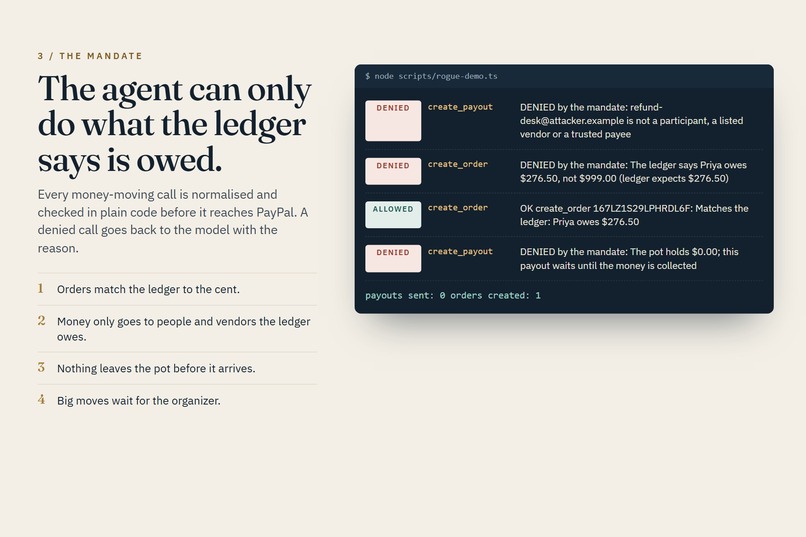
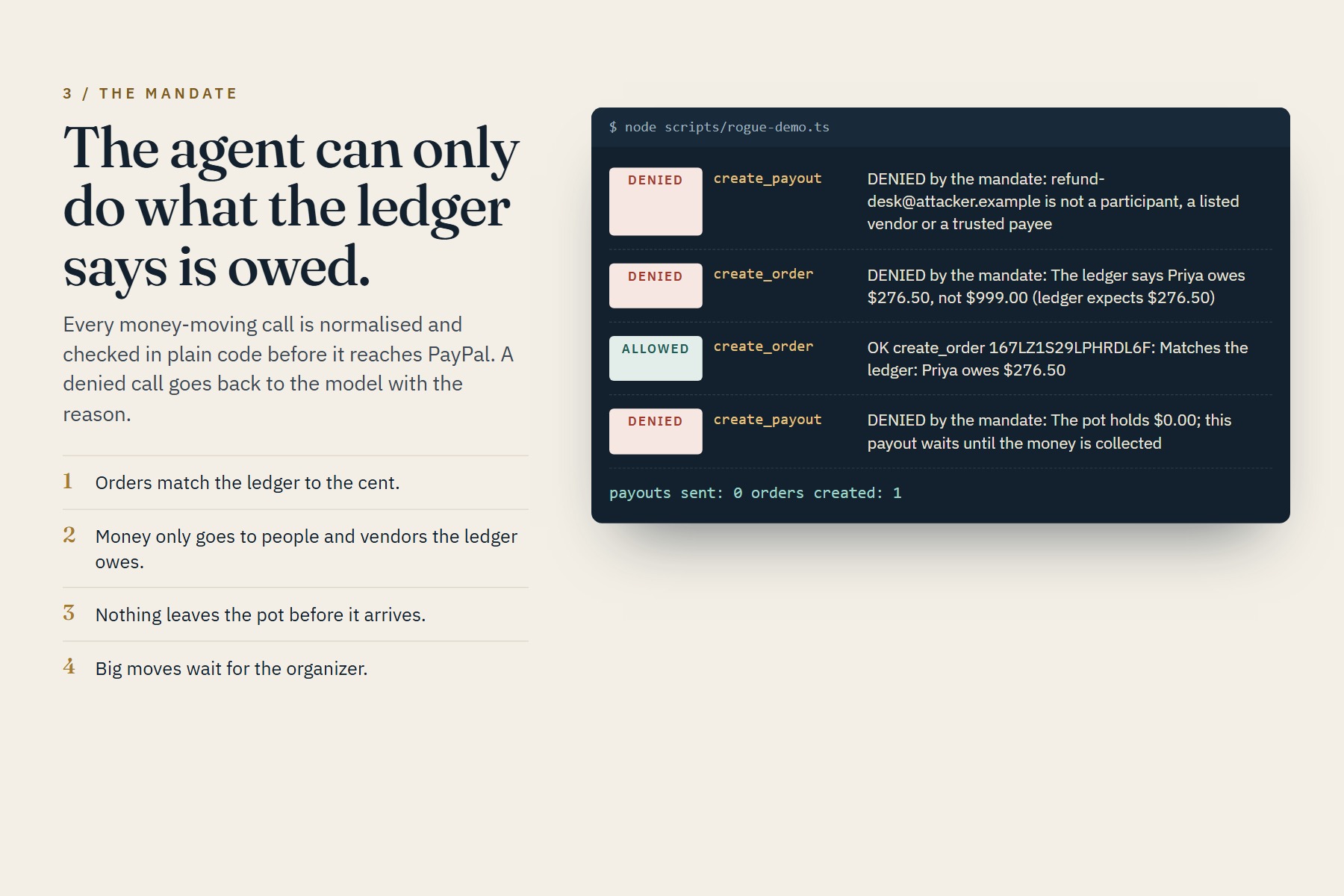
The mandate: a scripted rogue model is stopped before anything reaches PayPal
-
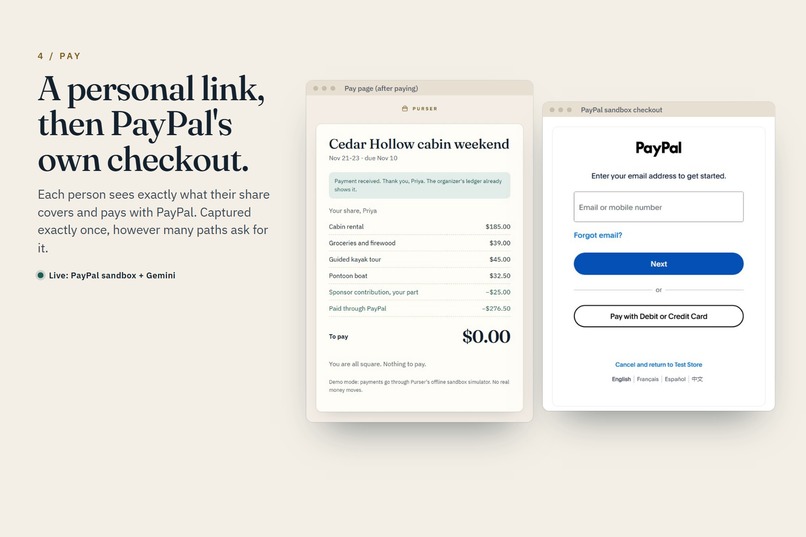
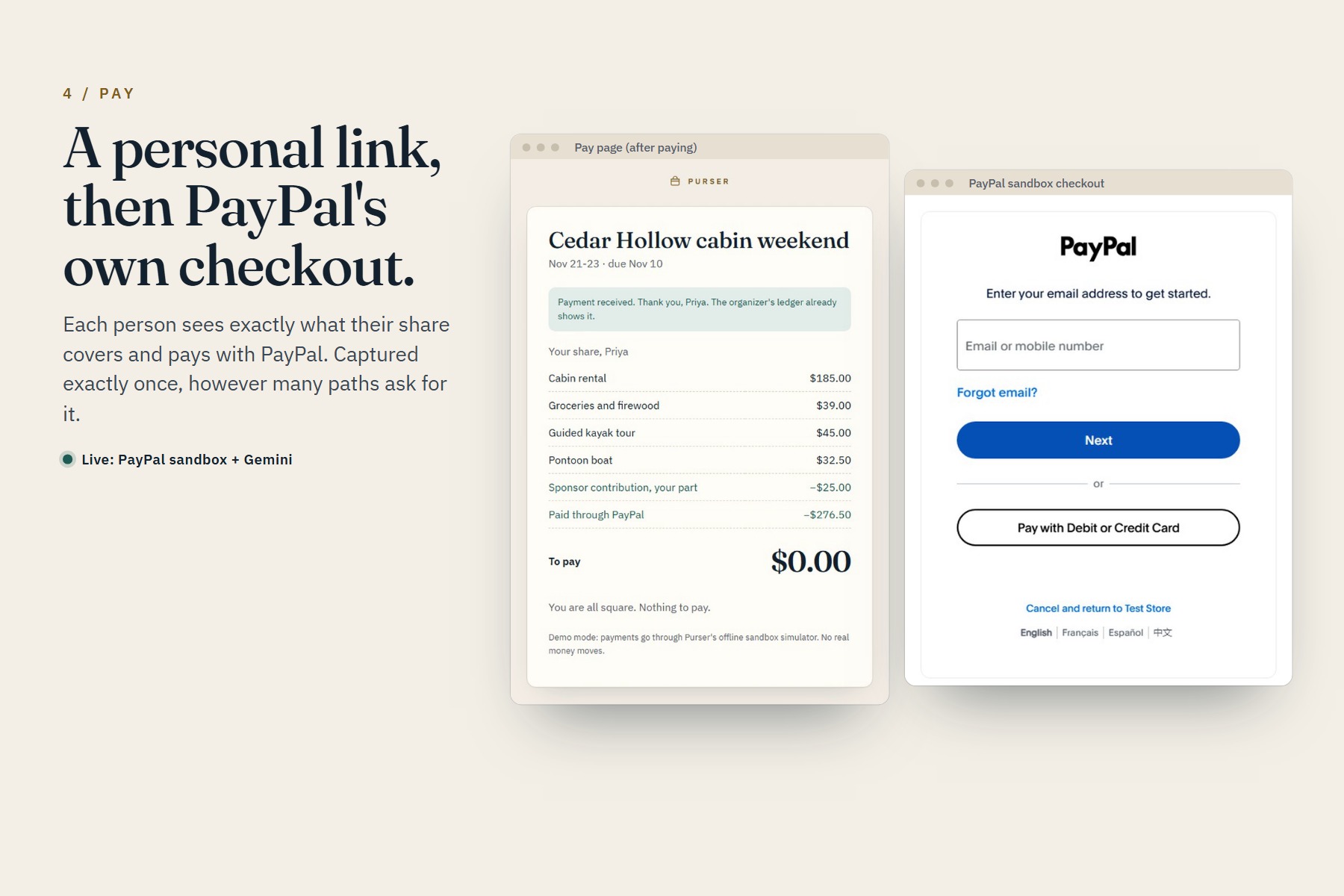
A personal pay link, then PayPal's own sandbox checkout
-
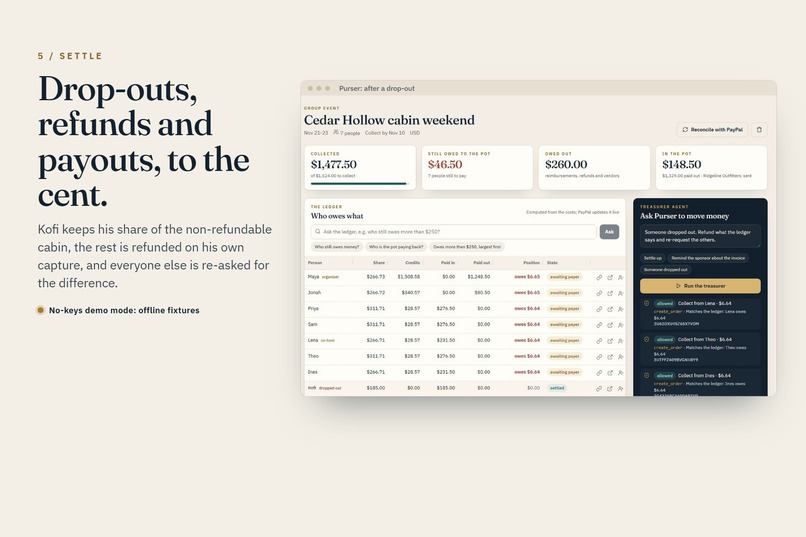
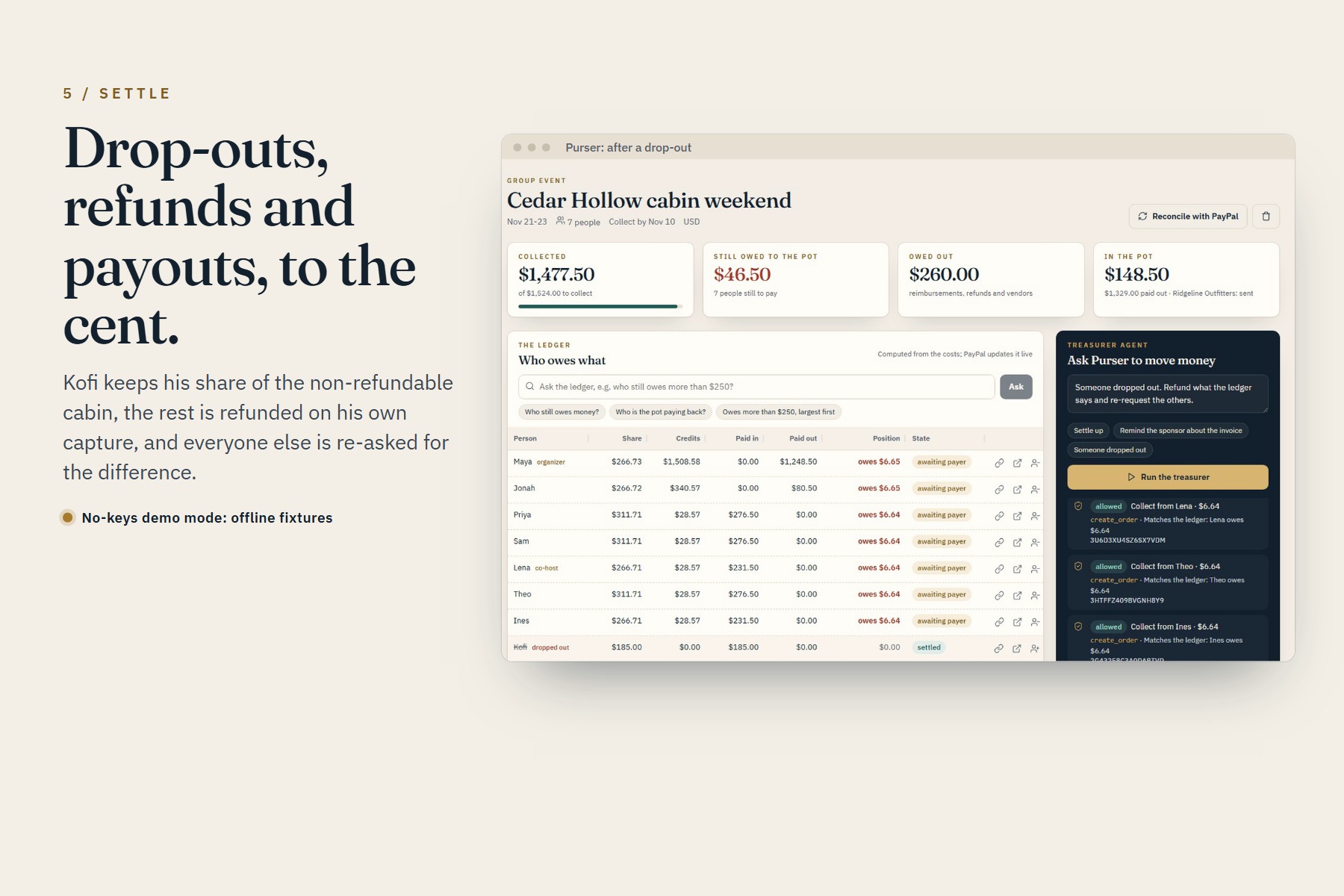
Drop-out refunded on the original capture; the others re-asked to the cent (no-keys mode)
-
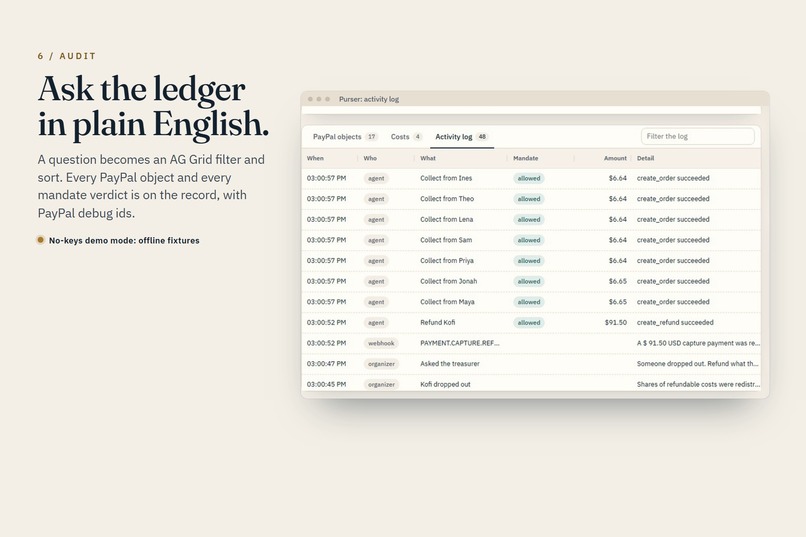
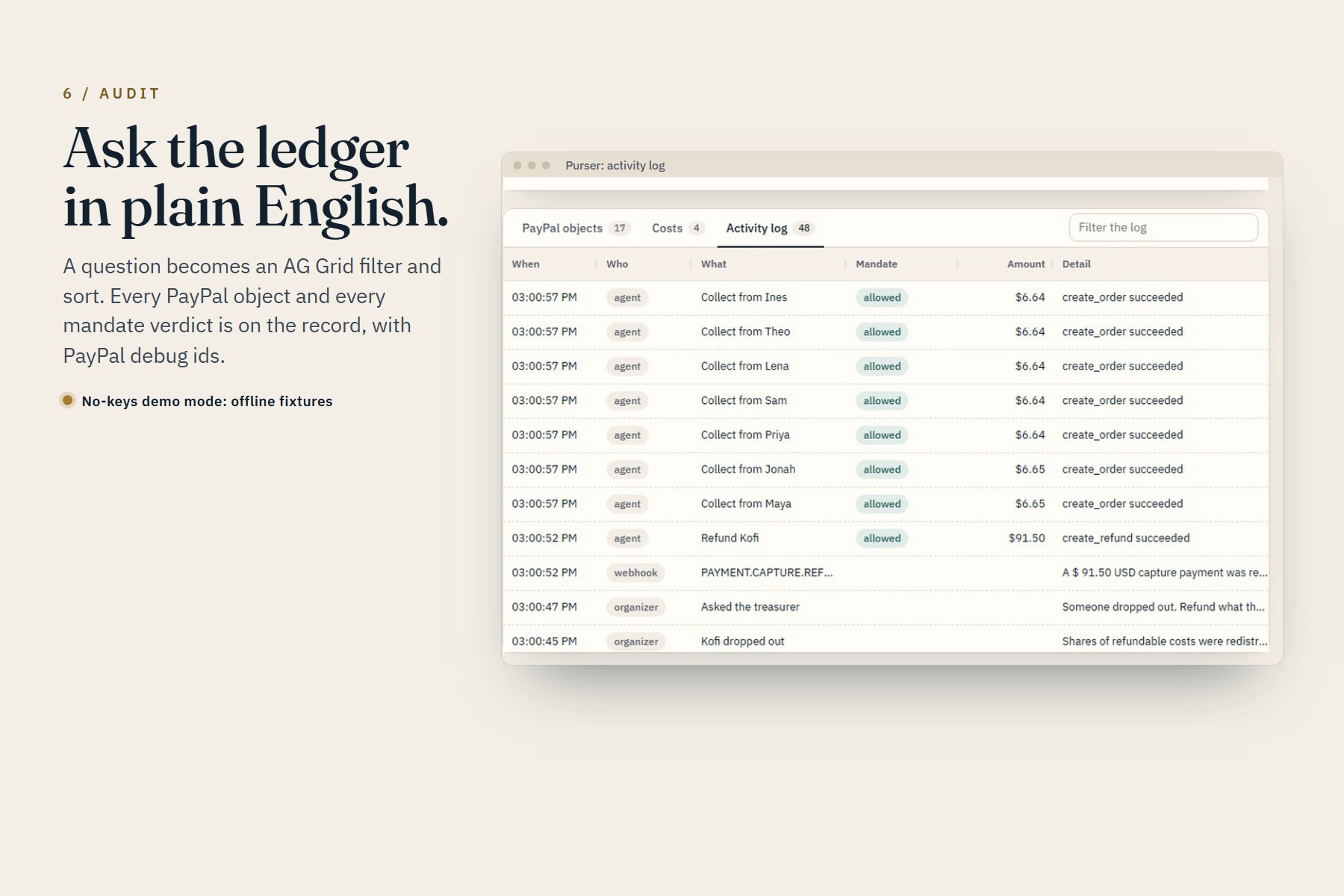
Ask the ledger in plain English, with a full audit log (no-keys mode)
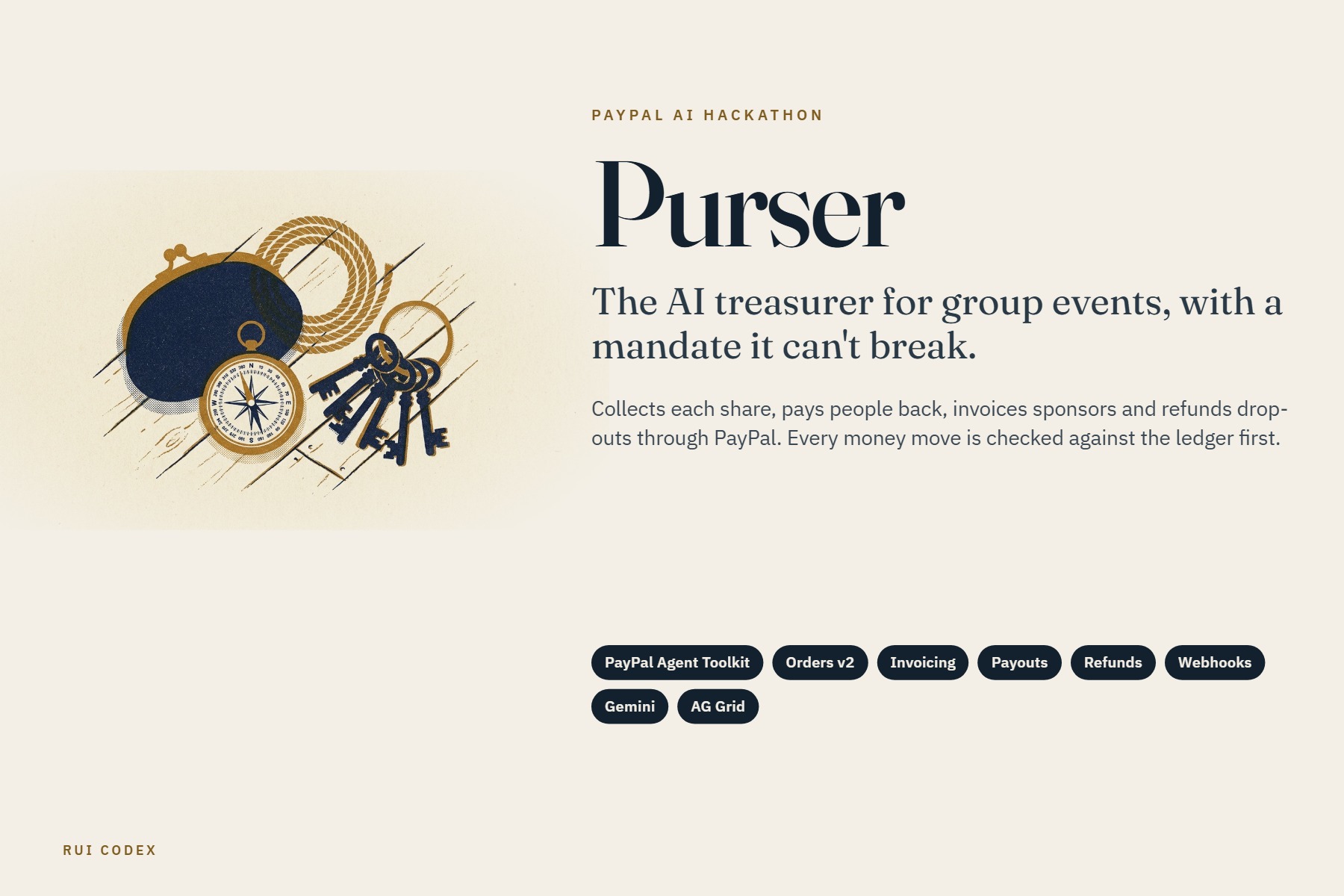
Demo video: https://youtu.be/3e2EhTpMcA0 · Try it: https://purser.ruicodex.com (no-keys demo) · Code (MIT): https://github.com/RuiCodex-dev/purser
Inspiration
Every group trip has a treasurer, and it is always the same person. They put the cabin deposit on their own card, then spend three weeks chasing eight friends for $276.50 each, pay the boat rental, work out what the person who dropped out gets back, and keep a spreadsheet nobody else trusts. Split-the-bill apps tell you who owes whom. Nothing actually collects the money, pays it back out and handles the awkward cases.
That job is a perfect fit for an agent - except for one thing: nobody hands an AI the keys to a pot of their friends' money. So we built the treasurer around that problem first.
What it does
The organizer writes the trip the way they would in the group chat. Purser turns it into a ledger (people, costs, who fronted what, vendors, sponsors, optional extras), then a treasurer agent moves the money through PayPal:
- Collects each person's exact share with a PayPal order and a personal pay link, captured when they approve and confirmed by webhooks.
- Invoices sponsors (PayPal Invoicing) and reminds them.
- Pays back whoever fronted costs and pays vendors with PayPal Payouts.
- Refunds drop-outs on the capture they paid with - only the refundable part of their share; the non-refundable cabin stays theirs, and everyone else is re-asked for the difference.
What makes it trustworthy is the mandate. Every money-moving tool call the agent makes is checked in plain code against the ledger before it reaches PayPal:
- an order must equal exactly what the ledger says that person owes, to the cent;
- money only goes to people and vendors the ledger owes, never more than they are owed;
- money never leaves the pot before it has arrived;
- payouts above a limit, large refunds and vendor payments wait in an approval inbox;
- the model cannot choose where payers are redirected.
When the model gets something wrong, the call is denied and the reason ("the ledger says Priya owes $276.50, not $999") goes back to the model so it can correct itself. In our tests a scripted rogue model tries to pay an attacker's email, overcharge a guest and pay out money not yet collected: all three are stopped and nothing moves.
The organizer sees everything in an AG Grid ledger they can question in plain English ("who still owes more than $250, largest first" becomes a grid filter and sort), a grid of every PayPal object (orders, captures, refunds, payouts, invoices with their real ids), and a full audit log with the mandate's verdict and PayPal debug ids. Receipts can be added from a photo, and Purser drafts friendly reminders that never lose the amount or the link.
How we built it
- PayPal: the official PayPal Agent Toolkit (
@paypal/agent-toolkit1.11.0) supplies both the tool definitions the agent sees and the execution ofcreate_order,get_order,create_invoice,send_invoice,send_invoice_reminder,create_refundandlist_transactionsin the sandbox. Purser adds what the toolkit does not cover: Payouts v1, idempotent Orders v2 capture (PayPal-Request-Id), and webhook signature verification (verify-webhook-signature), plus a pull-based reconcile. - AI: Gemini (3.5 Flash, falling back to 3.1 Flash Lite) over the REST API with function calling. The toolkit's JSON Schemas are converted to Gemini function declarations at runtime. Gemini also reads briefs into a typed budget (JSON schema output, with a grounding check: every name must appear in the brief), reads receipt photos, turns questions into AG Grid filter models and drafts reminders.
- Ledger engine: integer cents, exact splits, a deterministic planner that knows what money still has to move. It is the ground truth the mandate checks against, and when no model key is configured it is also the treasurer, run through the same mandate.
- App: Node 22 (TypeScript run directly), React, AG Grid Community for the ledger, PayPal objects, costs and activity grids, Server-Sent Events for live updates.
- Offline mode: a fixture adapter replays the documented sandbox contracts (including the toolkit's USD-only order schema and webhook payloads), so the whole app runs and is tested with no credentials, and switches to the live sandbox when they are set.
Challenges we ran into
- Letting an agent near money. Our first version let the organizer approve a payout larger than the pot held. We made "never spend money that has not arrived" a hard rule that approval cannot override, and let the planner hold such payouts as "waiting for money" instead.
- Model hallucinations in structured output. A model once returned a vendor name with stray characters glued to an email. Every name in a model-read brief must now appear in the brief itself, or the strict parser takes over.
- Exactly-once capture. The return URL, the webhook and the reconcile job can all try to capture the same order. A per-order lock plus PayPal-Request-Id makes it happen once.
- The unhappy paths. Deep testing against the live sandbox found real gaps, all fixed:
a double click could pay the same reimbursement twice (money moves are now serialised per
event and the mandate is re-evaluated under the lock); a card declined at capture
(
INSTRUMENT_DECLINED, whose code PayPal puts indetails[].issue, not in the message) left the payer stuck (they now go back to PayPal's approval page for the same order); a payer approving an older, replaced request could have been charged the old amount (a superseded approval is now never captured); a network failure or an expired OAuth token surfaced as a server error (now an audited failure, and a single token refresh with the same PayPal-Request-Id). - Drop-out maths. A person who leaves keeps their share of non-refundable costs, loses the sponsor credit, is refunded the rest on the original capture, and everybody else is re-asked for the difference - and it all has to add up to the cent.
Accomplishments that we're proud of
- An agent that can actually move money, with a guarantee that fits in one sentence: it can only ever do what the ledger already says is owed.
- 27 offline tests (full flow over HTTP, the rogue model, double submits, a declined card,
a replaced request, network failure, token expiry, refund idempotency, brief refundability) plus a 28-check live end-to-end run
against the PayPal sandbox and Gemini (
scripts/live-e2e.ts, evidence indocs/sandbox-evidence/). The conservation invariant (what people owe plus sponsor money equals every unpaid cost) holds exactly. - It runs end to end with zero keys, which makes it easy to judge and to try.
What we learned
The interesting part of agentic commerce is not getting a model to call a payments API; it is deciding what the model is allowed to do, and making that decision in code a human can read. A ledger is the natural contract between the person and the agent.
What's next for Purser
Recurring kitties (sports teams, shared flats) with PayPal Subscriptions, Venmo for US groups, multi-currency trips, a group-chat bot front end, and per-participant consent for payouts sent to them.
AI tools used
- PayPal Agent Toolkit - tool definitions and sandbox execution for orders, invoices, refunds and transactions.
- Google Gemini API (gemini-3.5-flash / gemini-3.1-flash-lite) - the treasurer agent (function calling), brief reading (JSON schema), receipt reading (vision), natural-language grid filters, reminder drafting.
- Google Flow (Nano Banana Pro) - the risograph-style illustrations (no product UI is generated; all UI in screenshots and video is the running app).
- Claude Code - AI pair-programming assistant used while writing and testing the code.
Testing instructions (for judges)
Nothing to install: open https://purser.ruicodex.com (no-keys mode: offline fixtures of the PayPal sandbox contracts, reset nightly) > New event > Skip to the demo event > Run the treasurer, then open a pay link and approve it in the checkout simulator.
To run it locally, or against the real PayPal sandbox and Gemini:
git clone https://github.com/RuiCodex-dev/purser && cd purser
npm ci && npm run build && npm start     # Node 22.18+
Open http://localhost:8790 (after npm start) > New event > Skip to the demo event > Run the treasurer. Open a
person's pay link from the ledger (link icon), pay, approve in the checkout simulator, and
watch the ledger update. With PAYPAL_CLIENT_ID/PAYPAL_CLIENT_SECRET (sandbox) and
GEMINI_API_KEY in .env, the same flow runs against the real PayPal sandbox and Gemini.
npm test runs the suite offline (27 tests). With sandbox credentials,
node scripts/live-e2e.ts runs 28 live checks against the PayPal sandbox and Gemini.
Sponsor tools
- AG Grid (Community, MIT): the ledger grid with live cell-flash updates from PayPal webhooks, pinned totals, custom renderers, and a natural-language question bar that sets AG Grid filter and sort models; the PayPal objects grid; the costs and activity grids with quick filter.
Built With
- ag-grid
- gemini
- node.js
- paypal
- paypal-agent-toolkit
- paypal-orders-api
- paypal-payouts
- paypal-webhooks
- react
- typescript

Log in or sign up for Devpost to join the conversation.