Inspiration
We are "data rich, but action poor." Wearables tell us we slept poorly or recovered badly, but they rarely help us navigate a real workday. As a developer, knowing I'm tired doesn't remove an 8:00 AM standup from my calendar.
I built Purrslogic—named after the masters of rest, my four cats (Huh, Lulu, Feifei, and Grey)—to bridge biometric recovery data and professional obligations. The agent's job is not to pretend every meeting can disappear. It distinguishes what must happen from what can move, and recommends recovery actions that fit a busy day.
What it does
Purrslogic is a proactive Life Triage agent that negotiates your day against your biological capacity.
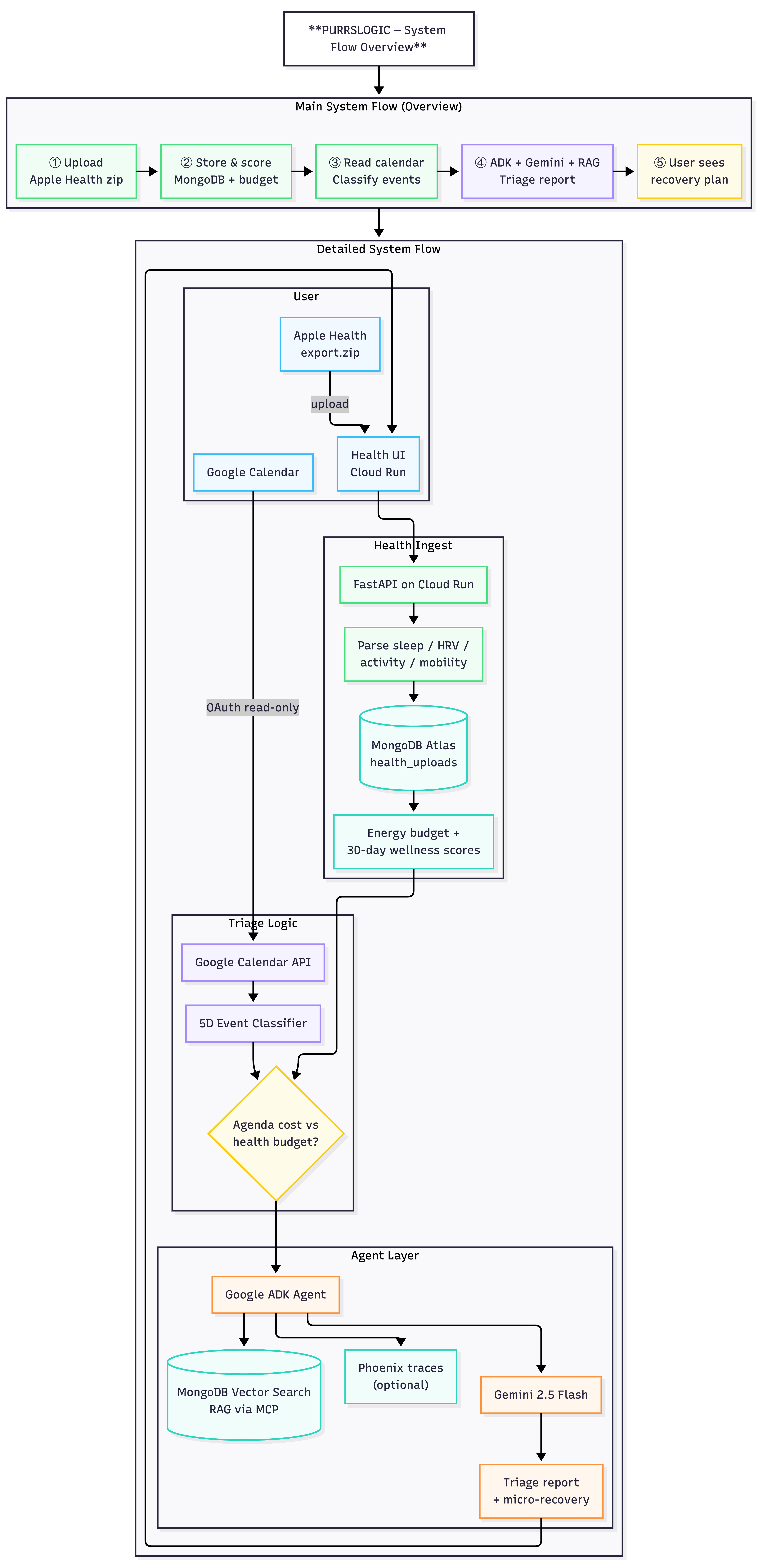
Health → Energy Budget
- Users export Apple Health from iPhone and upload
export.zipthrough a web UI. - Purrslogic parses sleep, HRV, resting heart rate, activity, and mobility data.
- It computes a daily energy budget (with fallback to a 90-day average when today's sleep is missing).
- A 30-day wellness dashboard shows sleep, vitals, activity, and mobility as simple red / yellow / green scores—no raw record dumps.
Calendar → Intelligent Triage
- Per-user Google Calendar OAuth connects each browser session to that user's schedule.
- Events are classified with a personalized 5D energy matrix (mental cost, physical cost, priority, etc.).
- Fixed events (standups, interviews) are protected; flexible blocks are flagged as candidates for change.
Agent Coaching (not just chat)
- When agenda cost exceeds recovery budget, Purrslogic triggers an ADK agent loop powered by Gemini 2.5 Flash.
- The agent pulls long-term RAG knowledge from MongoDB Atlas Vector Search (e.g., SLU hydrotherapy walk routes, breathing protocols).
- It produces a structured report: self-introspection, retrieved knowledge, and a triage recommendation.
- Safety guardrails block unsafe calendar deletes at runtime (e.g., immovable meetings).
Demo mode: judges can force overload with simulate_budget=5 to see the full agent response without waiting for a bad sleep night.
Roadmap (not in current demo): Apple Watch haptic nudges, automatic calendar rescheduling, and Fivetran → BigQuery as an optional enterprise pipeline.
How I built it
Agent orchestration
- Google ADK (
google-adk) with a rootLlmAgent, tool calling, and an in-memory session runner. - Gemini 2.5 Flash for reasoning, planning, and coaching text.
Data & memory
- Apple Health export parser (Python) → MongoDB Atlas (
health_uploads,google_calendar_tokens, user profiles). - MongoDB Atlas Vector Search for semantic RAG, queried through the official MongoDB MCP Server.
- Model Context Protocol (MCP) connects the agent to MongoDB without hard-coded retrieval logic.
Calendar & safety
- Google Calendar API (read-only OAuth per user).
- Custom classifier + recovery recommendation engine.
- Runtime guardrails before any calendar delete.
Observability
- Arize Phoenix + OpenInference instrument the Google GenAI client for trace introspection (local dev).
- On Cloud Run, traces can route to a remote collector via
PHOENIX_COLLECTOR_URL.
Deploy
- Google Cloud Run, Cloud Build, Cloud Storage (large health zip uploads), Secret Manager, Artifact Registry.
- Public demo:
https://purrslogic-ln4fq7htzq-uc.a.run.app/health
Challenges we ran into
Contextual nuance: "Tired" after poor sleep is different from tired after a long run. We grounded the agent on parsed sleep/HRV metrics and explicit calendar metadata instead of generic wellness advice.
Real-world constraints: Cloud Run limits (32 MB request body, memory during XML parse) forced a GCS upload path and streaming parser optimizations for large Apple Health exports.
Calendar complexity: Identifying movable vs. immovable events required user-specific heuristics plus hard guardrails—not just LLM judgment.
Honest agency: Calendar write tools exist but are stubbed in the demo; the agent recommends actions first, which matches how we'd ship to real users (confirm before changing someone's schedule).
Accomplishments that we're proud of
- Moved beyond "chatbot wellness" to proactive triage: upload health → compute budget → read calendar → agent decides.
- Built a live, judge-testable demo on Cloud Run with OAuth, large-file upload, and streaming progress UI.
- Integrated MongoDB MCP + Vector Search as first-class agent memory—not a side script.
- Designed for professional reality: standups stay; recovery fits before mandatory meetings.
What we learned
MCP is the integration layer. Health exports, MongoDB knowledge, and calendar context feel like one brain when tools are standardized.
Small interventions beat fantasy rescheduling. A 2-minute breathing prompt or a known calming walk route is more actionable than "cancel your afternoon."
Observability matters for agents. Phoenix traces help debug tool loops; RAG citations help judges trust the output.
What's next for Purrslogic
- Apple Watch haptic micro-recovery 10 minutes before immovable meetings.
- Real calendar write with explicit user confirmation and OAuth write scopes.
- Optional Fivetran → BigQuery pipeline for teams already on warehouse-first analytics.
- IoT sleep hygiene (lighting, temperature) and personalized recovery tied to what actually lowers your stress—more time with Huh, Lulu, Feifei, and Grey included.

Log in or sign up for Devpost to join the conversation.