Inspiration
The idea for PurpleOps was born from a frustration we constantly faced: while cybersecurity tools and AI models have advanced significantly, AI red teaming and security auditing remained disconnected, manual, and difficult to integrate into workflows. We wanted something different — a modern AI copilot built for security teams, not just researchers. Inspired by the legends of purple teams in cybersecurity — where red (attack) and blue (defense) combine — PurpleOps was designed to be the assistant that merges the offensive creativity of a red teamer with the precision of an AI defender. We envisioned a world where AI could not only simulate attacks but proactively suggest vulnerabilities, assist in CTFs, and guide forensic investigations, all from a clean, intuitive interface. PurpleOps isn't just a tool. It's your tactical AI teammate.
What it does
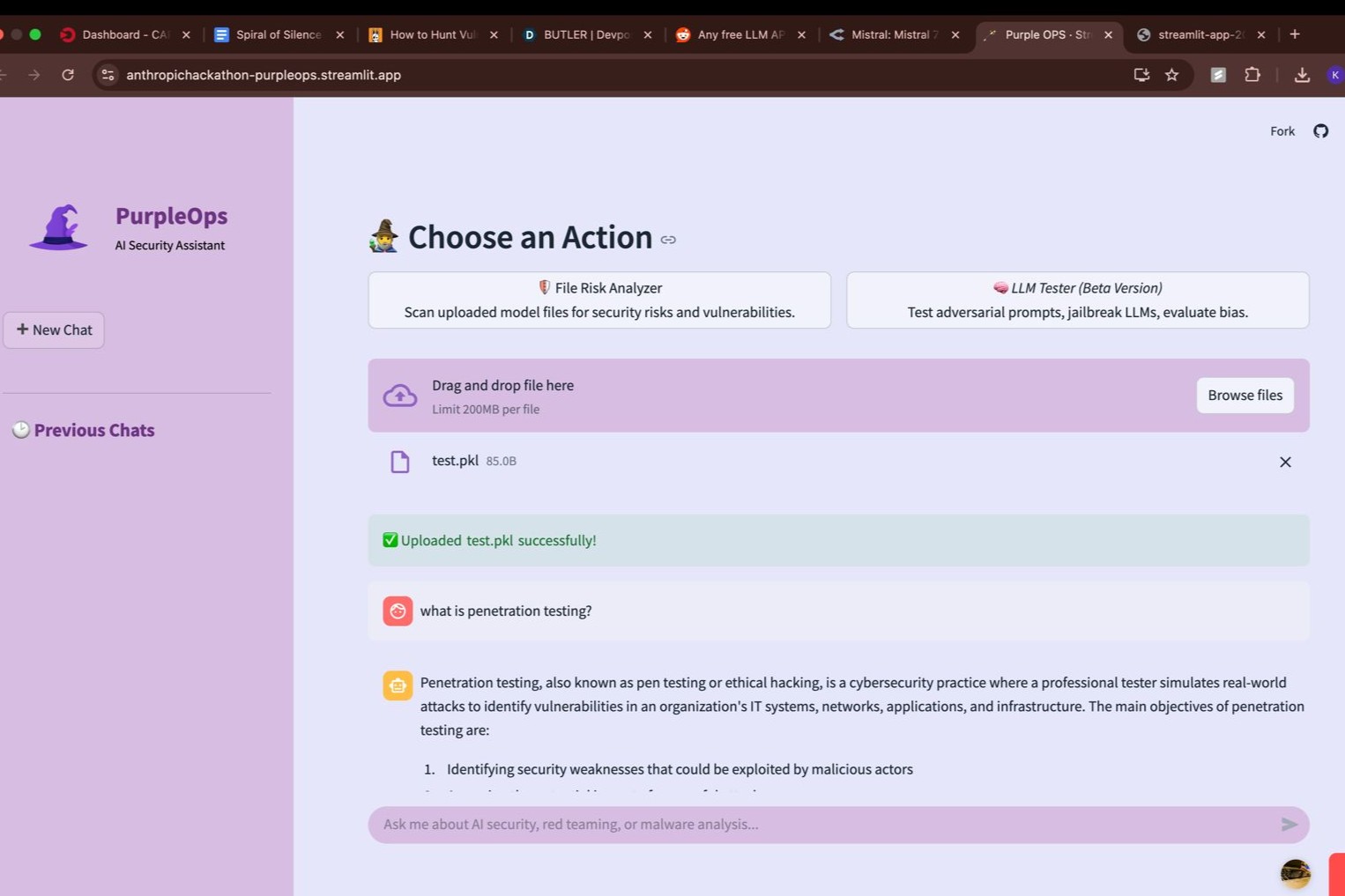
- LLM Red Teaming: Users can input natural language prompts to simulate jailbreak attacks, adversarial tests, and evaluate model robustness using dynamic red teaming techniques.
- Model Risk Analyzer: Upload AI model files (e.g., safetensors, ONNX) and let PurpleOps scan for embedded risks, security flaws, and framework vulnerabilities.
- Context-Aware Chat: A conversational AI security assistant ("PurpleOps") is integrated directly into the app, offering users guidance, risk assessments, and attack ideas in real-time.
- Seamless File Uploads: Drag and drop model files directly into the conversation to trigger automated security scans.
- Stateful Session Management: Previous chats and security sessions are stored and easily retrievable, so users can pick up right where they left off.
How we built it
- Frontend: Built using Streamlit with custom HTML/CSS tweaks, creating a fast, reactive, desktop-like experience with minimal deployment complexity.
- AI Integration: Leveraged Anthropic’s Claude 3 Opus models for red teaming, risk evaluation, and natural conversation — mastering prompt engineering and system message conditioning to control AI behavior precisely.
- File Scanning Engine: Developed a modular "Model Context Protocol (MCP)" server to handle file analysis, framework fingerprinting, and automated risk tagging.
- Session Management: Architected persistent chat sessions with Streamlit state and smart session handlers to allow multiple security analyses in parallel.
- Upload Handling: Implemented secure drag-and-drop file uploads with custom error handling to maintain a smooth experience even in high-velocity interactions.
Challenges we ran into
- Dynamic Action Triggering: Teaching Claude to understand when to automatically initiate file scans, red teaming, or simply respond conversationally required nuanced system prompts and careful state detection.
- Upload Conflicts: Managing file uploads alongside chat interactions in Streamlit without crashing the session state needed intricate flow control.
- Prompt Injection Safety: Testing jailbreak prompts without accidentally crashing or hallucinating Claude required layered input validation and fallback protections.
- Real-Time Feedback Loop: Designing a responsive "assistant" that feels collaborative (without overwhelming users) demanded multiple UI/UX iterations.
Accomplishments that we're proud of
- Created a full AI red teaming platform that's operational in a single browser tab — no heavy dependencies, no external orchestrators required.
- Merged conversational AI + file security workflows into a single seamless interface.
- Built an AI copilot (PurpleOps) that feels natural, trustworthy, and knowledgeable, yet keeps users firmly in control.
- Designed a modular architecture where new models, attack vectors, and scanning techniques can be plugged in easily.
What we learned
- Prompt Engineering is UX Design: Writing system prompts for an AI copilot is like writing the entire user experience. It's delicate, strategic work that affects everything from tone to security.
- Security Tools Need to Feel Effortless: If a security tool requires users to "think" about the interface too much, it already failed. Every upload, scan, or chat needed to be frictionless.
- Error Handling Should be Invisible: Problems like missing uploads, invalid models, or API hiccups shouldn't crash the experience. Smooth error recovery was essential for user trust.
What's next for Purple OPS
- Multi-Model Red Teaming: Extending beyond Claude to include GPT-4, Gemini, and open-weight models for comparative red team evaluations.
- Advanced Risk Scoring: Integrating OWASP LLM Top 10 and model-specific risk profiles for more granular vulnerability detection.
- Memory-Augmented Agents: Giving PurpleOpsl a memory, allowing it to learn user preferences over time and become even more strategic.
- Expanded Upload Support: Adding support for full HuggingFace safetensors metadata parsing, ONNX analysis, and even Dockerized AI apps.
- Mobile Interface: Building a companion mobile experience for quick CTF team discussions and model audits on-the-go.
- Collaborative Attack Planning: Enabling multiple users to work together on red team plans, adversarial testing campaigns, and AI system audits.


Log in or sign up for Devpost to join the conversation.