-
-
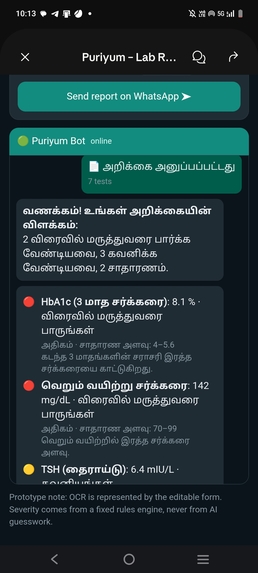
Puriyum on WhatsApp explains a lab report in plain English, with color-coded results and questions for the doctor.
-
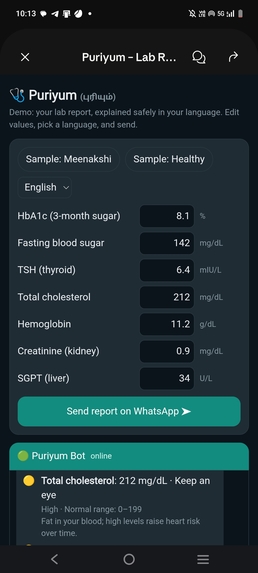
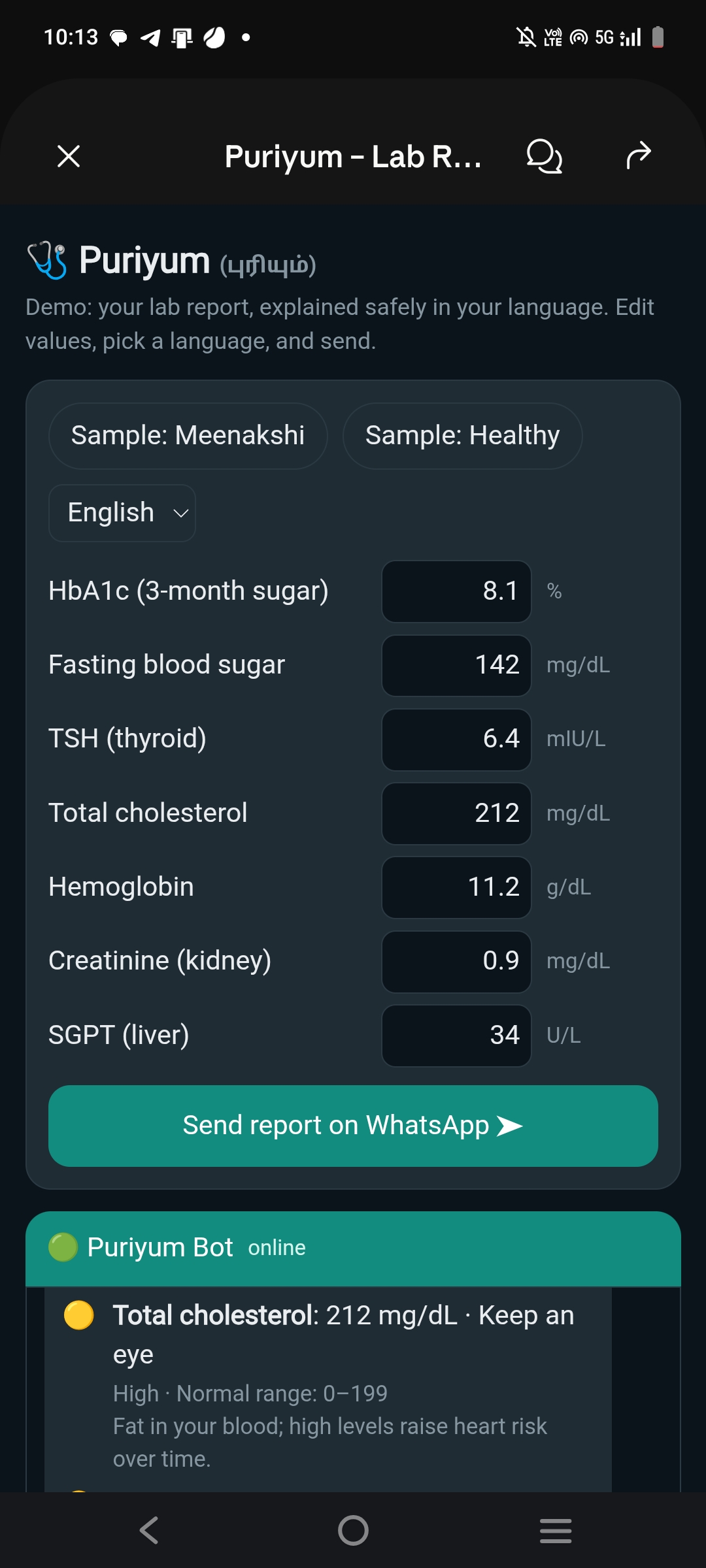
Enter or edit lab values, pick a language, and send. A fixed rules engine checks every result against standard ranges.
Inspiration
Healthcare doesn't end at the lab counter, but for many people it feels like it does. A patient gets a report full of numbers like HbA1c, TSH, SGPT and Creatinine, often in English, and the doctor's appointment is days away. In that gap, people panic over a "High" flag, ignore a value that actually needed attention, or end up on Google and WhatsApp forwards. The people most affected are the ones with the least access: elderly patients, rural families, and first-generation readers. We asked: what is not working well enough? The answer was the last mile between a lab result and a patient's understanding.
What it does
Puriyum (Tamil for "it will be understood") explains lab reports on WhatsApp, in the patient's own language.
- The user sends a photo or PDF of their report.
- Puriyum reads each test, value and unit.
- A rules engine classifies each result as Normal, Keep an eye, or See a doctor soon.
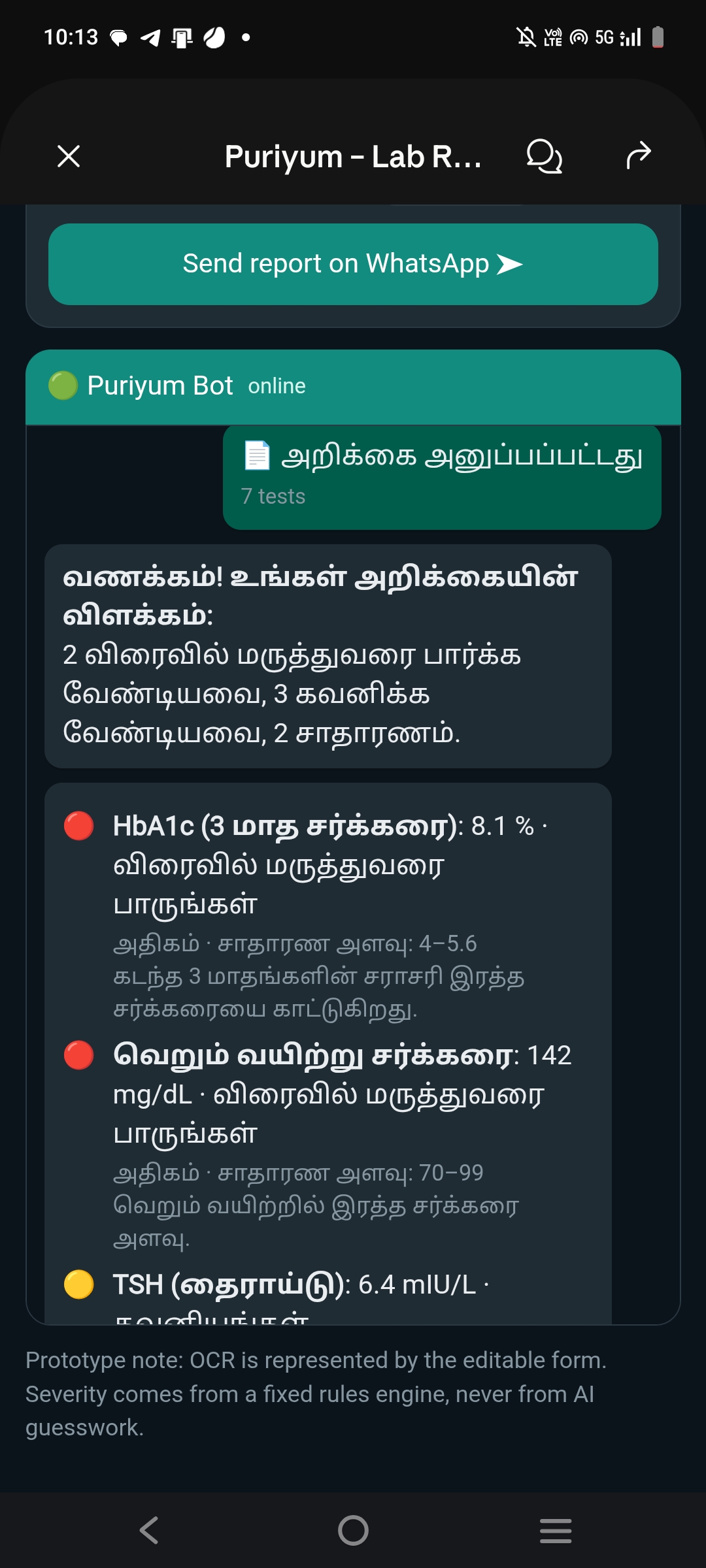
- It replies in plain language (English, Tamil or Hindi) with a short "what this means" for each abnormal value, optional voice, and questions to ask the doctor.
- Every reply carries a clear disclaimer. Puriyum never diagnoses and never suggests medicines.
How we built it
Since this is a non-code innovation challenge, our focus was the idea, its safety design and its feasibility. We also built a working interactive prototype to prove the concept:
- A WhatsApp-style chat interface where you enter or edit report values and send them.
- A deterministic rules engine with reference ranges and critical thresholds for 7 common tests (HbA1c, fasting sugar, TSH, cholesterol, hemoglobin, creatinine, SGPT).
- Multilingual explanation templates in English, Tamil and Hindi, plus text-to-speech playback.
Planned architecture: WhatsApp Business API → OCR and table parsing → rules-based severity engine → AI explanation layer with strict prompts and output validation → escalation to a partner clinic or teleconsult for critical values.
Business model: diagnostic labs pay a small per-report fee to offer Puriyum as a value-added service, while patients use the basic explanation free. Premium features (trend tracking, family profiles) and clinic referrals add revenue.
Challenges we ran into
- Safety vs. usefulness: an explainer that is too cautious says nothing, while one that is too bold risks harm. We solved it by splitting responsibilities: fixed rules decide severity, and AI only explains.
- Language quality: medical terms in Tamil and Hindi must be simple and accurate, not literal translations.
- Trust and privacy: health data is sensitive, so the design uses consent, minimal storage, deletion after processing, and masking of personal details.
- Staying in scope: we deliberately avoided diagnosis and treatment advice, and focused on understanding and preparing for the doctor visit.
Accomplishments that we're proud of
- A clear, complete story from the patient's problem to a workable solution.
- A safety-by-architecture design where the urgent/not-urgent decision is never left to an AI guess.
- A working multilingual demo that shows the full experience in under a minute.
- A realistic business model that doesn't make patients pay.
What we learned
- A good innovation starts with a specific person and a specific moment of confusion, not a technology.
- In healthcare, trust and clarity matter as much as accuracy.
- Meeting users where they already are (WhatsApp, their own language, voice) removes more barriers than building a new app.
What's next for Puriyum
- 0-3 months: pilot with 2-3 local diagnostic labs and about 200 patients, with doctors reviewing sample outputs.
- 3-9 months: add more tests and languages, a voice-first mode, and trend tracking across reports.
- 9-18 months: teleconsult integration, health-record integration, and expansion across states.
Success metrics: how well patients understand their reports before vs. after, how many abnormal reports lead to a doctor visit, user satisfaction, and agreement between Puriyum's severity flags and doctor review.

Log in or sign up for Devpost to join the conversation.