


PureFlow: Building Smarter Water Protection for Cities
Inspiration
PureFlow was inspired by Jackson’s ongoing water crisis and one simple question:
Why can cities detect risks everywhere except in the water people rely on every day?
In Jackson, Mississippi, aging infrastructure, boil-water notices, and system failures revealed a major gap in public safety. Cities monitor traffic systems, cybersecurity threats, and power grids in real time — yet water systems often rely on periodic manual testing.
Water is one of the most essential public resources. Without continuous monitoring, small chemical imbalances can grow into citywide emergencies before anyone detects them. That realization inspired PureFlow.
What It Does
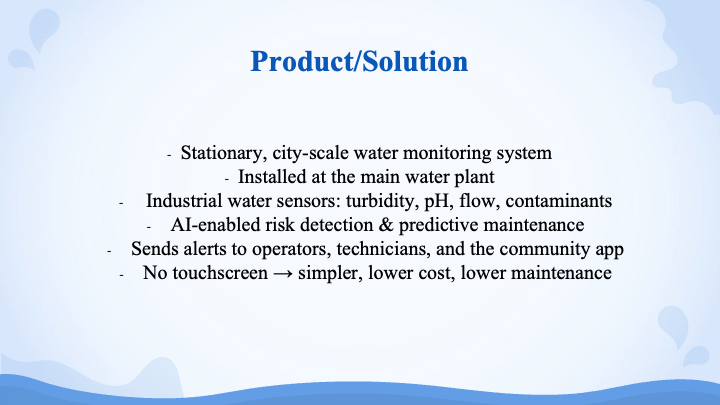
PureFlow is a city-scale, AI-powered water risk monitoring system designed to detect contamination early and prevent crises before they impact the public.
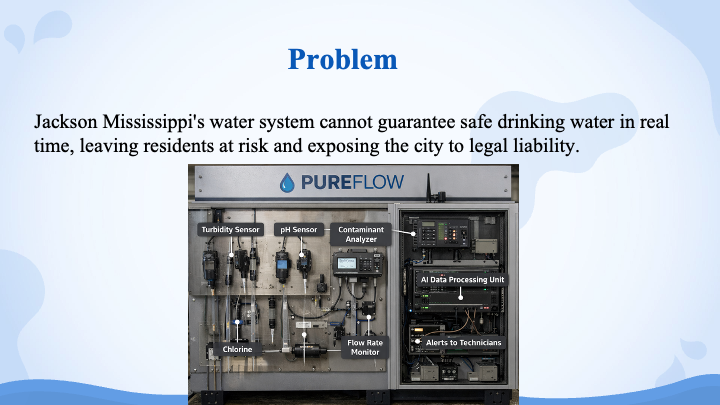
It continuously monitors indicators such as:
- pH
- Turbidity
- Chlorine levels
- Heavy metals
Using weighted sensor inputs, PureFlow calculates a dynamic risk index:
$$ R = \sum_{i=1}^{n} w_i \cdot x_i $$
Where:
- \( x_i \) = sensor measurement
- \( w_i \) = risk weighting factor
- \( R \) = overall contamination risk score
If \( R \) exceeds a defined safety threshold, the system:
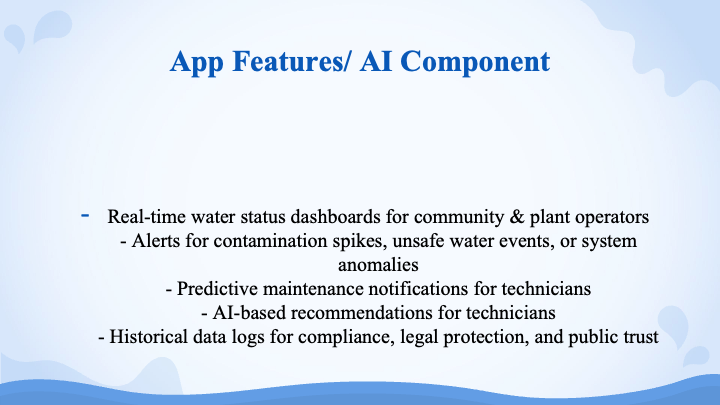
- Alerts officials immediately
- Pinpoints likely contamination zones
- Provides technicians with actionable diagnostics
The goal is simple: move from reactive response to proactive prevention.
How We Built It
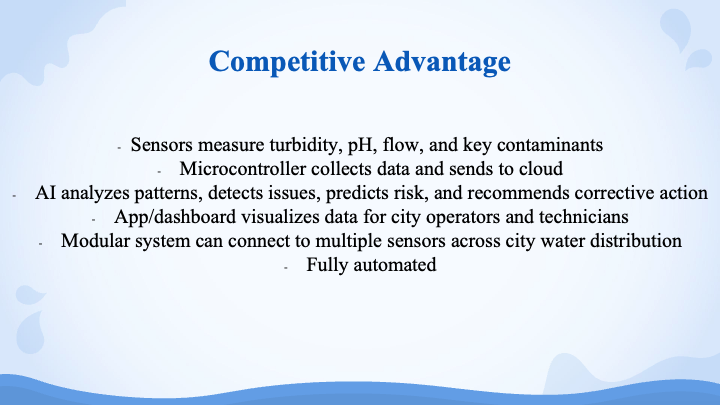
We built PureFlow using three core components:
1. Industrial-Grade Sensors
Strategically placed at treatment plants and distribution nodes to collect continuous data.
2. Cloud-Based Analytics
Sensor data streams to a centralized platform for storage, processing, and analysis.
3. AI Risk Modeling
Machine learning models compare real-time readings against historical baselines to detect anomalies and emerging risks.
Originally, we designed a smart filtration device. However, we realized that replacing infrastructure at scale was unrealistic. We reframed PureFlow as a risk-management overlay — a system that integrates with existing infrastructure instead of replacing it.
That shift made the project scalable, affordable, and city-ready.
Challenges We Faced
One of our biggest challenges was rethinking the scope of the project. Cities face:
- Budget constraints
- Regulatory requirements
- Infrastructure compatibility issues
- Workforce training limitations
We learned that innovation is not about building the most complex solution — it’s about building the most adoptable one.
Another challenge was trust. Public safety decisions require transparency, so we focused on explainable AI outputs instead of black-box predictions.
Accomplishments We’re Proud Of
- Transforming a conceptual device into a feasible, deployable monitoring system
- Designing a scalable model that improves accountability and response times
- Creating a solution that enhances safety without requiring costly infrastructure replacement
PureFlow strengthens decision-making without disrupting operations.
What We Learned
We learned that solving real problems means:
- Listening to constraints
- Simplifying the solution
- Designing technology that cities can realistically adopt and sustain
We also recognized that the cost of crisis grows exponentially the longer detection is delayed:
$$ C \propto e^{t} $$
Where:
- \( C \) = cost of crisis
- \( t \) = time before detection
Early detection changes everything.
What’s Next for PureFlow
Next steps include:
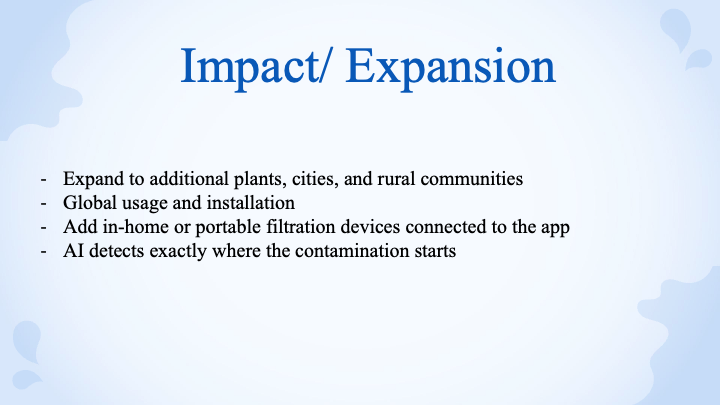
- Pilot deployment in Jackson
- Expanding monitoring nodes across high-risk areas
- Scaling the system to other cities facing water infrastructure challenges
PureFlow began with a question.
Now, it is becoming a solution.
Built With
- vibecode

Log in or sign up for Devpost to join the conversation.