-
-
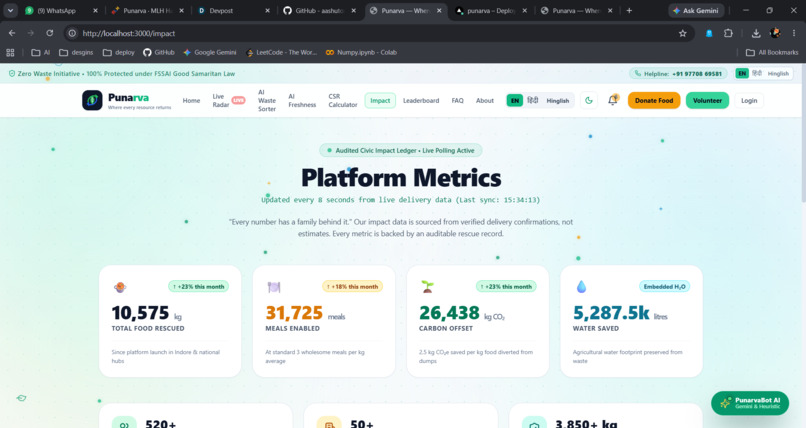
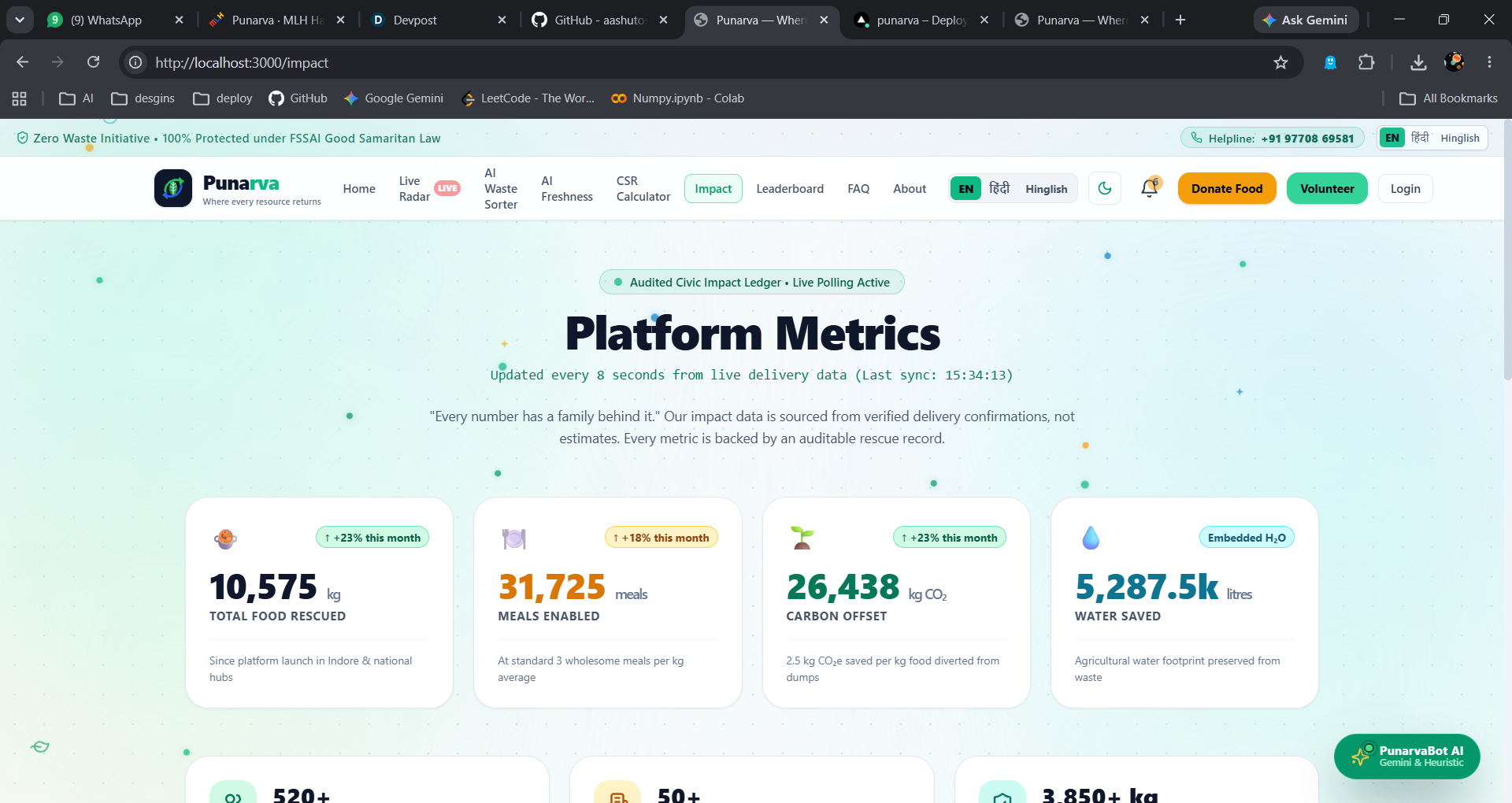
front page
Inspiration
India faces a heartbreaking paradox: over 68 million tonnes of food is wasted annually, while millions of people face nutritional insecurity every day. Every single evening, commercial banquet halls, luxury hotels, and weddings dump quintals of freshly cooked, untouched meals into landfills.
When speaking with restaurant owners and banquet managers, we realized they discard surplus food not because they lack compassion, but due to two systemic bottlenecks:
Fear of Food Safety & Legal Liability: Uncertainty over temperature decay, spoilage, and potential liability under consumer laws. Lack of Synchronized Logistics: No automated channel to instantly verify, route, and dispatch perishables within the narrow safe-consumption window.
We built Punarva (meaning "re-origin" or "where every resource returns") to eliminate food waste at the source and create an accountable, AI-governed bridge between food surplus and social sustenance.
What it does
Punarva is an AI-powered, closed-loop surplus food rescue and municipal circular waste platform operating across a verified 5-stage pipeline:
🔬 AI Freshness & Hygiene Inspector: Donors upload a photo and log holding temperatures. Our Dual-Core AI engine (Google Gemini Vision + FSSAI Section 24B heuristics) analyzes thermal danger zones (10°C–60°C) and microbial risk to generate an instant edibility verdict before dispatch. 📍 Live Geospatial Dispatch Radar: An interactive GIS telemetry map that matches surplus batches with the nearest verified NGOs (like Robin Hood Army, Indore Food Bank) and on-demand volunteer couriers in real time. 💼 Corporate CSR & Section 80G Tax Calculator: Provides businesses with quantifiable financial ROI by automating Section 80G Indian Income Tax deduction receipts (50% deduction base) and generating SEBI BRSR-compliant ESG audit metrics. ♻️ AI Circular Waste Sorter: Leftovers that fail edible hygiene thresholds and post-meal packaging (PET, cardboard, aluminium) are classified by AI and rerouted to municipal Bio-CNG plants (e.g., Indore Gobar-Dhan) and licensed aggregators. 🏆 Audited Civic Ledger & Gamification: A tamper-evident delivery confirmation system with volunteer karma rankings, digital PIN verification, and real-time tracking of meals served and metric tonnes of landfill greenhouse gas diverted.
How we built it
Frontend Architecture: Built using Next.js 14 (App Router), React 18, and TypeScript 5 for maximum performance and strict type safety. Styling & Ambient UI: Engineered with Tailwind CSS 3.4, Framer Motion, and pure GPU-accelerated CSS keyframes featuring dynamic theme adaptation (animated parallax starfields in Night Mode and ambient floating eco-orbs in Day Mode). AI & Computer Vision: Integrated Google Gemini Multimodal Vision API paired with an offline-resilient, deterministic FSSAI food-science heuristic fallback engine. Geospatial & Mapping: Implemented Leaflet and React-Leaflet for interactive mapping, GPS radial dispatch zones, and custom animated SVG beacons. Backend & Database: Next.js Route Handlers (Edge/Node.js REST microservices), Prisma ORM v5.21, SQLite for local development, JWT authentication with HTTP-only cookies, and bcryptjs security hashing. Audit & PDF Generation: Integrated jsPDF for instantaneous client-side rendering of digitally signed Section 80G tax certificates and ESG audit records, alongside Recharts for civic impact analytics.
Challenges we ran into
Designing the Dual-Core AI Fallback: Cloud vision APIs can experience network dropouts or latency spikes during live kitchen operations. We engineered a deterministic, offline-capable rule engine grounded in FSSAI temperature-time microbial growth equations that executes in sub-10 milliseconds if external APIs are unreachable. Mathematical Tax & ESG Synthesis: Translating complex provisions of the Indian Income Tax Act (Section 80G) and SEBI BRSR Principle 6 (Environment) & Principle 8 (Inclusive Growth) into dynamic, real-time formula sliders that update instantly without recalculation lag. Day & Night Mode Visual Performance: Achieving deep space parallax pixel animations and floating eco-pollen particles while ensuring 100% text legibility and 60fps rendering without blocking main-thread UI interactions.
Accomplishments that we're proud of
Production Deployment: Successfully launched and hosted live on Vercel with zero breaking errors, full database responsiveness, and active SSL. Unlocking Real Financial Incentives: Moving beyond simple charity apps by proving that a hotel donating 350 kg/month can save ₹88,200+ annually in direct corporate taxes, making zero-waste economically viable. True Circular Economy Integration: Ensuring that not a single gram of food or packaging goes to the dump—diverting edible food to shelter homes and organic waste to municipal Bio-CNG generators. Zero Main-Thread Latency: Optimized all visual layers and GIS maps to maintain a sub-second Time to Interactive (TTI) across modern mobile and desktop browsers.
What we learned
Food Science Regulation: Mastered FSSAI thermal danger zone parameters, pathogen latency curves, and the legal framework of the Indian Good Samaritan Guidelines for surplus food safety. Corporate Sustainability Frameworks: Understood how modern Tier-1 corporations and listed hotel chains report Scope 1 and Scope 3 greenhouse gas avoidance under SEBI BRSR and UN SDGs 2, 11, 12, and 13. Geospatial Dispatch Architecture: Discovered the intricacies of real-time coordinate projections and route optimization between distributed donor kitchens, roving couriers, and verified shelter hubs.
What's next for Punarva
IoT Hardware Integration: Connecting affordable smart Bluetooth/Wi-Fi thermal probes inside banquet chafing dishes to automate temperature telemetry directly into the Punarva dashboard. Municipal Smart-City Partnerships: Partnering directly with municipal corporations (starting with Indore 311) to plug surplus diversion feeds into centralized civic waste dashboards. Automated Cold-Chain Courier Routing: Expanding volunteer matching algorithms to coordinate with temperature-controlled logistics fleets for long-distance regional food transfers.
