Inspiration
A disaster can destroy much more than a home. When floods, fires, or landslides destroy identity documents, survivors can suddenly lose access to the very records they need to rebuild their lives.
We were inspired by a frustrating catch-22: digital recovery systems often depend on OTPs and existing identity documents, while getting a replacement SIM or document can itself require proof of identity. For someone who has lost their documents and phone access, the recovery process can become a deadlock.
But physical documents are not the only traces of identity. Bank notifications, examination messages, insurance alerts, government SMS messages, and other digital fragments may still exist on a device or in local archives.
We asked: What if those fragments could be organized into useful evidence for recovery?
That idea became Punarrachna — meaning “reconstruction” — a digital forensic bridge for rebuilding identity after disaster.
What it does
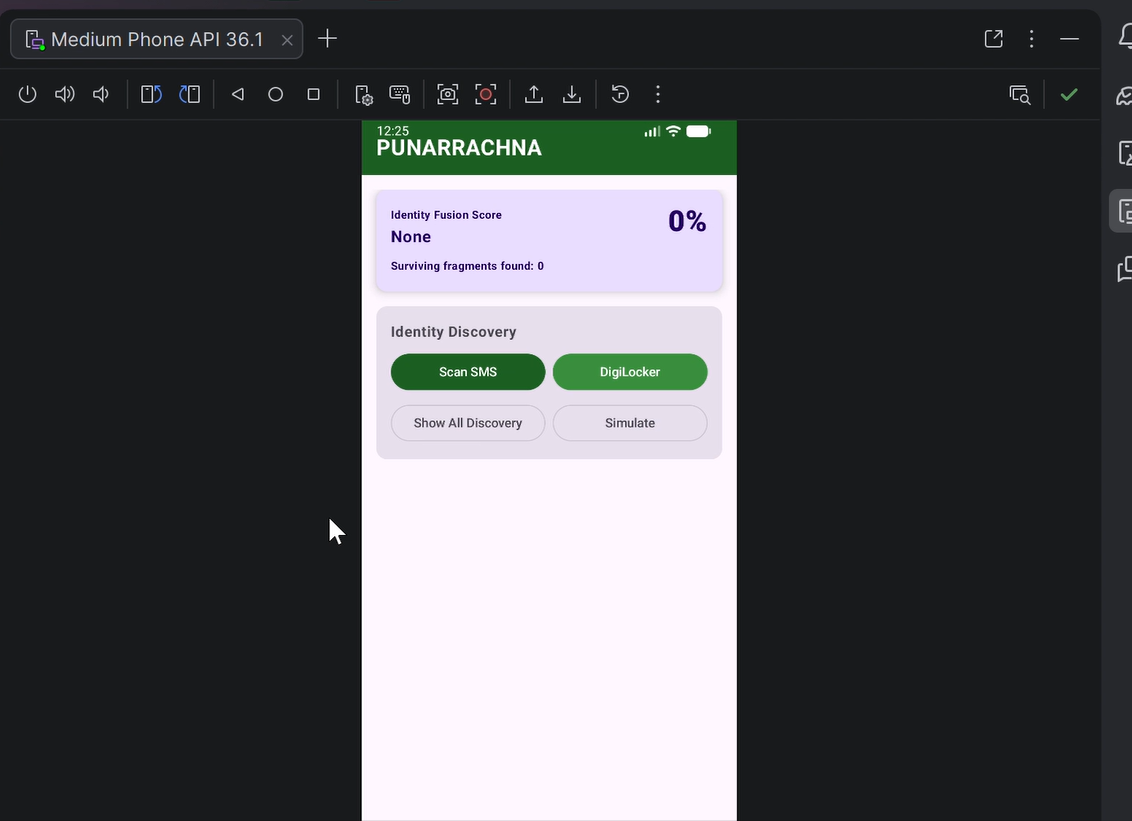
Punarrachna helps disaster survivors turn surviving digital fragments into an organized identity-recovery package.
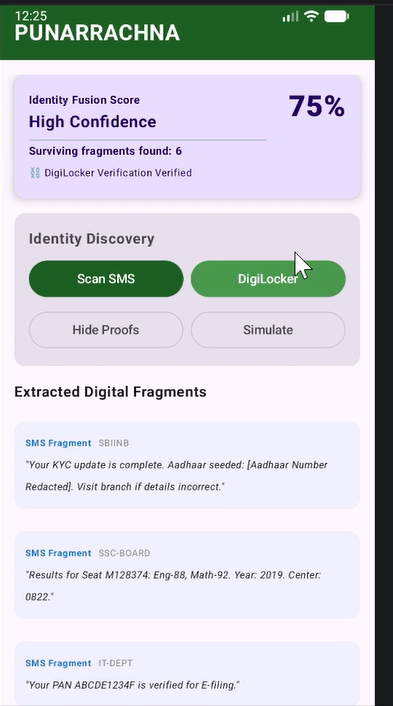
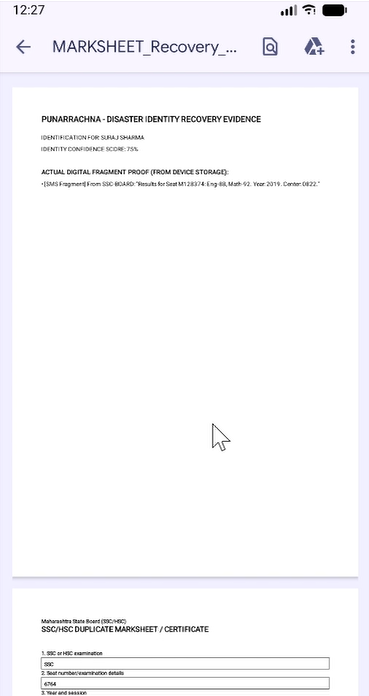
The app can scan available SMS archives and identify institutional messages containing useful information such as document numbers, examination details, insurance references, and other identity-related records.
It then:
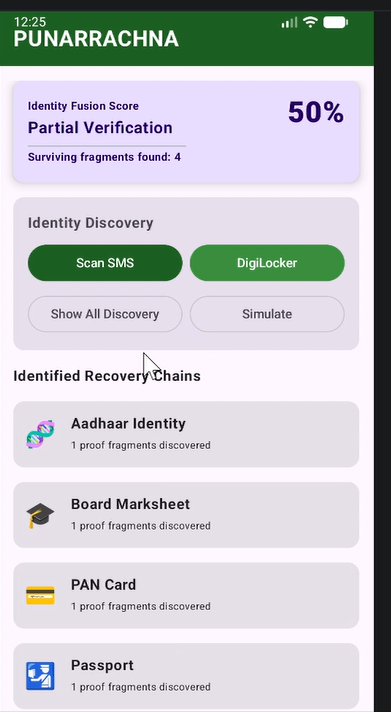
- Discovers digital fragments from available device archives.
- Extracts institutional information using forensic heuristics.
- Cross-references fragments to identify consistent identity information.
- Builds an Identity Evidence Matrix showing how different fragments support the same identity record.
- Displays the original SMS evidence so the survivor or an authorized officer can inspect the source.
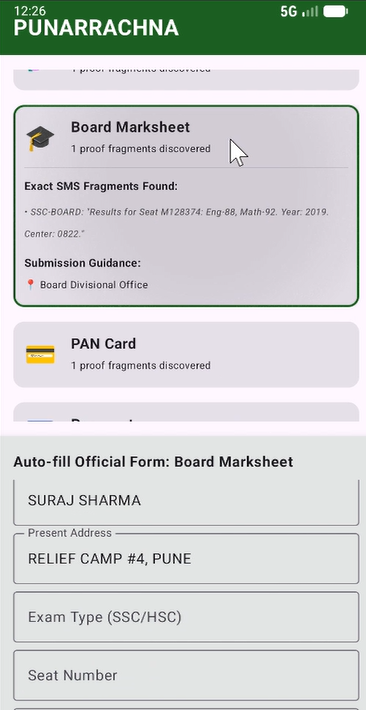
- Pre-fills recovery forms using the extracted information.
- Generates a structured recovery packet containing the available evidence and required declarations.
Punarrachna does not claim to legally verify someone's identity. Instead, it organizes surviving evidence so that the appropriate authority can review and verify it.
The app also includes a Simulation Mode, allowing judges to experience the complete recovery workflow using realistic disaster-survivor data without exposing real personal information.
How we built it
Punarrachna was designed as an offline-first Android application because disaster environments may have limited connectivity and identity information is extremely sensitive.
Technology
- Kotlin — application development
- Jetpack Compose — modern Android UI
- Android Canvas API — recreating official document layouts
- Android PDFDocument — generating recovery PDFs
- Regex-based forensic extraction engine — identifying institutional SMS patterns
- Android MediaStore / scoped storage — accessing locally available device data
- Offline-first architecture — keeping sensitive information on-device
Instead of sending personal information to a cloud server, Punarrachna performs its extraction, evidence fusion, and document generation locally on the device.
Our core pipeline is:
Digital fragments → Extraction → Evidence matching → Identity Evidence Matrix → Recovery forms → Recovery packet
Challenges we ran into
The biggest challenge was designing the system so that it could extract useful information without treating every piece of digital data as automatically trustworthy.
An SMS containing a name or number is not, by itself, legal proof of identity. We therefore had to think carefully about how to present extracted information as supporting evidence rather than an automatic identity verification system.
Another challenge was dealing with inconsistent formats. Institutional SMS messages can have different sender IDs, structures, abbreviations, and wording. We developed forensic heuristics that look for recognizable institutional patterns and relevant fields.
We also had to balance functionality with privacy. Because the application deals with highly sensitive personal information, we designed it around a zero-cloud approach, keeping processing on the device wherever possible.
Finally, recreating complex official forms in a mobile application while maintaining readable layouts and generating usable PDFs required considerable UI and document-generation work.
Accomplishments that we're proud of
We are proud that Punarrachna goes beyond simply storing information or displaying a list of recovered messages.
It creates a complete recovery workflow:
Find → Extract → Cross-reference → Explain → Generate
We built a working prototype capable of discovering institutional fragments, extracting relevant information, connecting evidence across records, displaying the original source messages, and generating structured recovery documents.
We are particularly proud of the Identity Evidence Matrix, which makes the relationship between separate digital fragments visible instead of hiding the reasoning behind a single AI-generated answer.
We also built the system to work offline-first, which makes the architecture suitable for situations where connectivity may be unreliable and privacy is critical.
Most importantly, Punarrachna changes the question from:
“Do you still have your documents?”
to:
“What evidence of those documents survived?”
What we learned
We learned that solving a real-world problem is not just about building a technically impressive system. It is also about understanding the limitations of the information being processed.
We learned to distinguish between evidence, inference, and verification. An extracted document number may be useful evidence, but the final authority to verify it still belongs to the relevant institution.
Technically, we learned more about Android's storage model, offline-first architecture, document generation, structured data extraction, and designing interfaces for sensitive workflows.
Most importantly, we learned that good technology can sometimes be about connecting information that already exists, rather than creating entirely new information.
What's next for Punarrachna
The current prototype focuses primarily on locally available digital fragments. Our next step would be expanding the types of evidence that can be securely processed, including emails, downloaded documents, photographs of damaged records, and exported digital records.
We also want to develop a more sophisticated evidence graph that can show relationships between people, documents, institutions, dates, and identifiers while preserving the source of every extracted claim.
Future versions could provide authority-specific recovery checklists, multilingual interfaces, accessibility features, and stronger local verification mechanisms.
The long-term goal is simple:
When a disaster destroys someone's paperwork, Punarrachna should help ensure that their identity does not disappear with it.
Built With
- android-studio
- api
- architecture
- extractionmultiple
- forensic
- generators
- jetpack
- kotlin
- mode
- official-form
- simulation
- sms

Log in or sign up for Devpost to join the conversation.