-
-
Flow
-
Architecture
Inspiration
Half of people with long-term conditions do not take their medicines as prescribed, and by 2030 there will be 1.4 billion people over 60, more of them living alone every year. The failure we kept seeing in our own families was not the missed tablet itself. It was that nobody found out. One notification to one phone on silent is not a safety net. We wanted an app for the family around the older adult, not only for the person holding the phone, where every alert is decided on a server, delivered on every channel, and chased until a human takes responsibility.
What it does
Pulsy links an older adult (the member) with the people who look after them (caregivers and an ordered list of emergency contacts).
For the member: alarms that ring with a photo of the exact tablet strip, three times, through Do Not Disturb; a daily check-in; a press-and-hold SOS; fall and crash detection with a 30-second "Are you okay?" countdown; vitals from Apple Health, a Wear OS watch, or a continuous glucose monitor; a health wallet for lab reports, doctor notes, insurance and prescriptions, each explained in plain language; and doctor talking points generated before every appointment. All of it in English, Spanish, Hindi and Telugu.
For the caregiver: a live picture of the day, 7-day adherence, refill warnings, vital limits per person, live location with "Update now", safe zones around home, a video check-in the member can accept or decline, and home IP cameras.
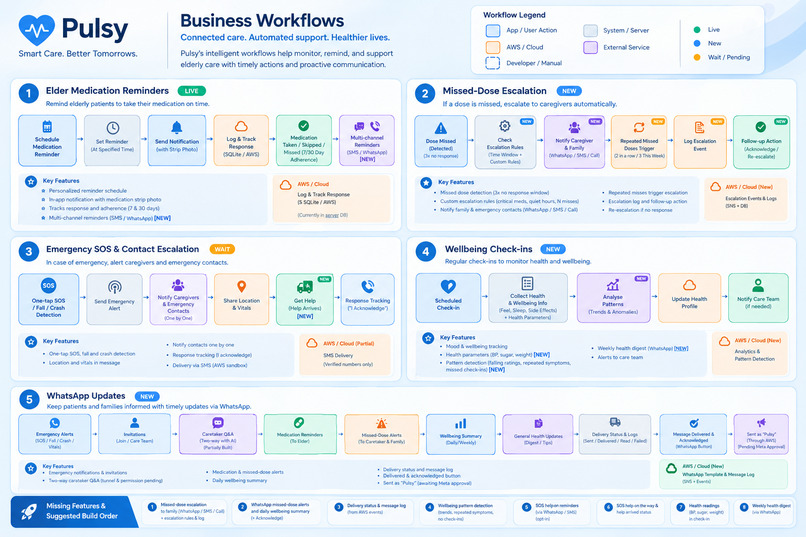
The agentic core: when a dose is missed, vitals leave their limits, a fall, crash or SOS happens, or the member leaves the safe zone, an Amazon Bedrock agent reads the event, location, latest vitals, medical ID and contact list, decides who to reach first (family and neighbors before a distant doctor), and drafts the WhatsApp, SMS, email and voice script. The backend then reaches contact 1 on every channel at once (WhatsApp and SMS through AWS End User Messaging, email through Amazon SES, an Amazon Polly voice call that asks "say I acknowledge or press 1", and a loud in-app ringtone), waits 90 seconds, and moves to contact 2, then 3, until someone acknowledges. Any acknowledgement stops the escalation for everyone and is logged.
How we built it
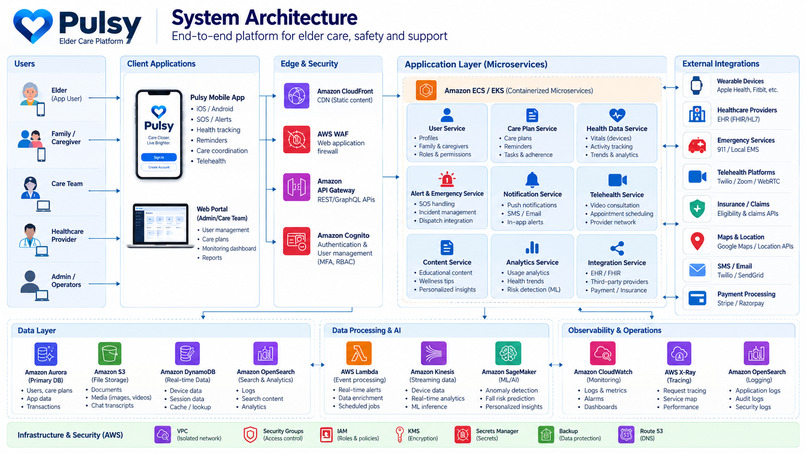
Mobile: Expo / React Native for iOS and Android, Apple HealthKit on iPhone, a Kotlin Wear OS companion app for heart rate and background fall detection, MapLibre over Amazon Location tiles, Amazon Chime SDK for video.
Backend: FastAPI in Docker with a background worker that owns the dose timeline, the escalation state machine, geofence evaluation and CGM ingestion. PostgreSQL or SQLite, JWT auth, Amazon S3 for photos and voice.
AWS: Amazon Bedrock (Nova, Converse API) as the escalation agent and for reading strips, prescriptions and reports; AWS End User Messaging for SMS and End User Messaging Social for WhatsApp; Amazon SES for email; Amazon Polly for the neural voice message; Amazon Location Service for maps, tracker and geofences; Amazon Chime SDK for the check-in call. A least-privilege IAM user, secrets only in environment variables, nothing hard-coded.
Challenges we ran into
Making escalation survive a dead phone meant moving every decision to the server and treating the app as a display. Getting the agent to be useful rather than chatty took a tight schema: it returns an ordered contact list and three drafted messages, nothing else. Voice acknowledgement over a phone call needed an IVR path next to the in-app one. Transparency around cameras was a hard line: any video on the member's phone is announced full screen, carries a persistent banner, and can be ended with one tap. Sandboxes were their own challenge: SMS origination numbers and WhatsApp template approval both have lead times, so the code degrades cleanly and reports exactly which channel is not configured.
Accomplishments that we're proud of
An escalation that reaches people until one of them takes responsibility, not a notification that hopes to be seen. Six different triggers feeding one agent and one outreach path. A caregiver experience that is impossible to miss: ringtone, vibration, full-screen Silence / Call / Acknowledge. Fall and crash detection on both phone and watch. A health wallet that turns a photographed lab report into three sentences a family can understand. Shipping both iOS and Android with the same backend, and keeping the whole thing honest about what the member's phone is doing.
What we learned
The hard part of elder care is not detection, it is closing the loop. Multi-channel only matters if the system keeps going when the first channel is ignored. Older adults need one action per screen and large type far more than features. Caregivers need rules, not more alerts: quiet hours, critical medicines, repeated misses. And an agent is most valuable when it is given a narrow decision and a strict output.
What's next for Pulsy: Medicines on Time, Help When It Matters
Production WhatsApp through End User Messaging Social with approved templates and two-way caregiver Q&A. Caregiver-configurable escalation rules: critical medicines, quiet hours, repeated-miss thresholds. Wellbeing check-ins (mood, sleep, side effects, blood pressure, weight) with pattern detection and a weekly family digest. Push notifications via APNs and FCM. Pilots with senior-living operators and home-health agencies, and a free tier so any family can use it.
Built With
- amazon-bedrock
- amazon-chime-sdk
- amazon-location-service
- amazon-polly
- amazon-ses
- amazon-web-services
- android
- aws-end-user-messaging
- docker
- expo.io
- fastapi
- healthkit
- ios
- kotlin
- maplibre
- postgresql
- python
- react-native
- sms
- sqlite
- twilio
- typescript
- wear-os

Log in or sign up for Devpost to join the conversation.