-
-
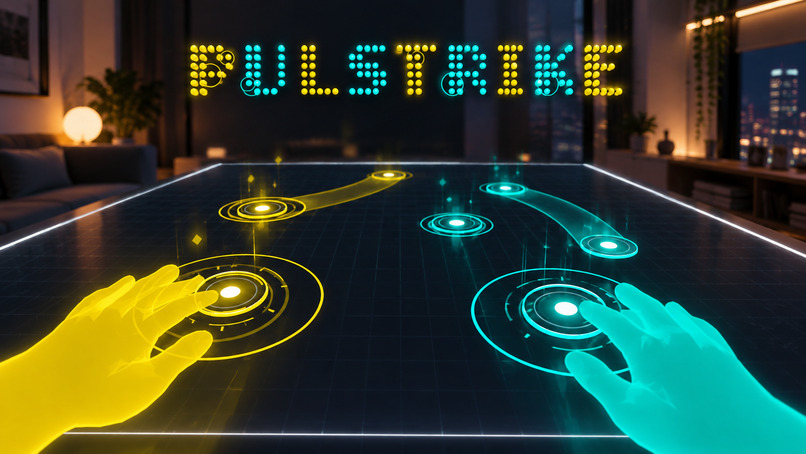
PULSTRIKE
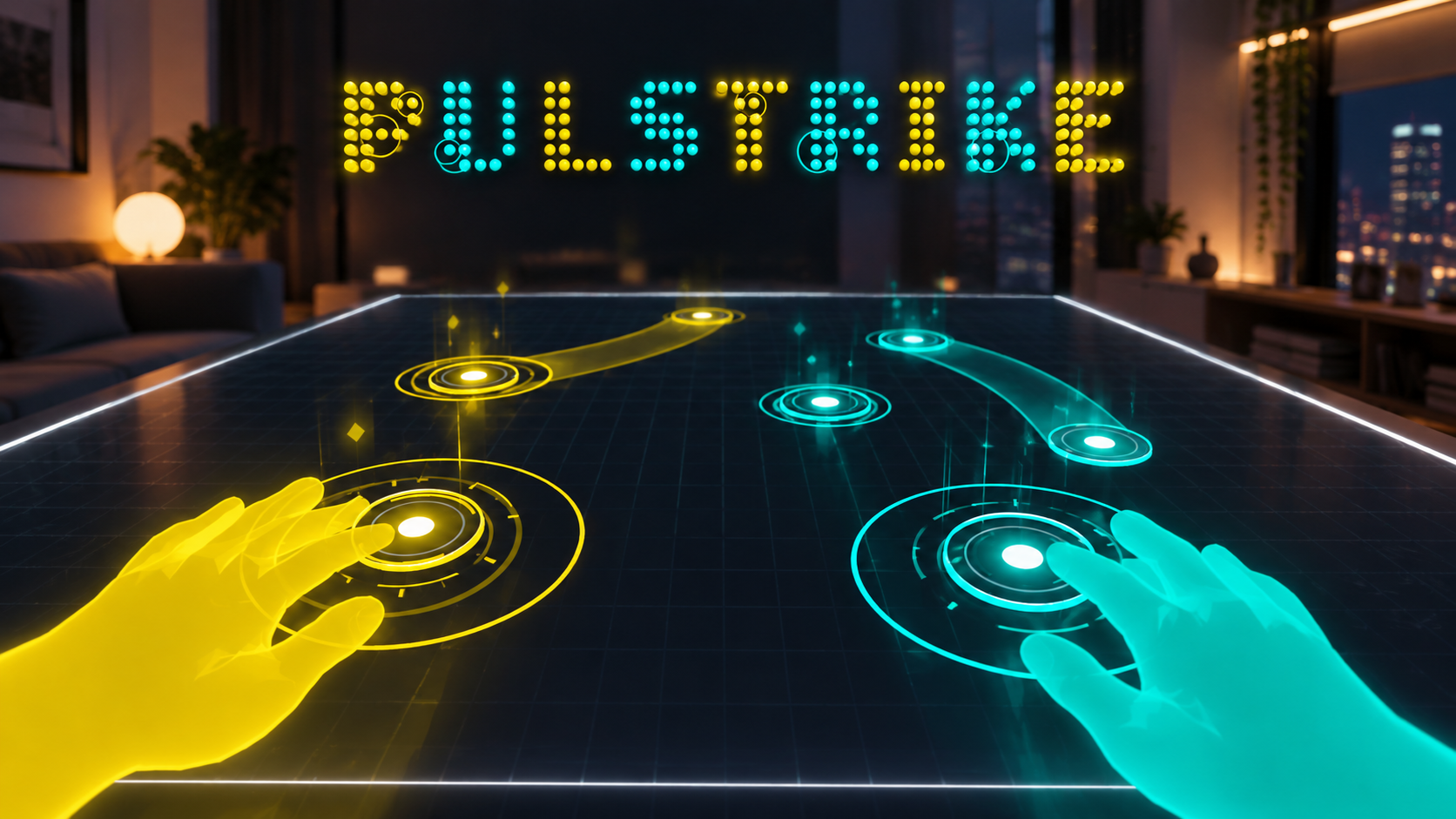
Inspiration
I've loved Japanese arcade rhythm games for years, where you hit glowing panels and drums with your bare hands. But they're expensive: every song costs a credit, and you need an arcade nearby.
Meta Quest tracks every finger with no controllers, and it has some of the most mature hand tracking of any headset you can buy. It can already do what those cabinets do: see your hands strike a surface on the beat. That made now the right time to build it.
PULSTRIKE: any surface is your grooving playground. Notes appear on a holographic play area fitted to a real table, so every hit you make with your fingers or fists lands on something you can feel.
What it does
- Hit the beat. Each note is a circle with a ring that closes in and meets its edge exactly on the beat. Tap the circle as the ring closes: within 60 ms is a Perfect, within 120 ms a Good. Hits fill your life gauge and misses drain it, so keep hitting to keep the song playing. If the gauge runs out, the song ends. Unbroken hits build a combo that multiplies your score, and at 100 combo you enter Overload: a bigger multiplier, notes that turn into beating stars and lasers tracing the table.
- Notes for each hand. Yellow notes are for the left hand, teal for the right, and white for either. There are taps, curved sliders you follow with a fingertip, two-hand chords and Thump Rush drum pads that you pound with a closed fist.
- Ten original songs, each at several difficulty levels. Each song has its own "experience": a hand duel, a blackout section, single pounds and more.
- A full game loop, all by hand: a tutorial, song select with previews, a scroll-wheel difficulty picker, pressable 3D keys, ranks from D to SS, progression that unlocks harder songs, leaderboards and achievements.
How I built it
- Workflow: I worked solo with AI coding assistants (Claude Code and Codex). I designed features from my phone, then compiled, built and tested on the headsets at my PC. Every build writes a session log on the headset (each tap, its timing error, finger, hand and why it was judged that way), and those logs drove almost every tuning decision.
- Engine: Unity 6 with OpenXR, the Meta XR Core SDK and the Interaction SDK, Android builds for Quest 2 and Quest 3. Hands only, no controllers anywhere.
- Music: all ten songs are my own, made with Suno on my Pro plan.
- My own tools. I wrote a Python auto-mapper that drafts charts from a song's audio and stems, a chart checker, and a browser chart editor for cleaning up charts by hand against the waveform. The menu keys and air-mode grips are models made in Blender.
Challenges I ran into
- First-time players. At the playtest, testers calibrated two or three times, did not know what to do and sometimes had no desk. That led to a mid-air mode, a calibration that cannot loop, room-scan desk detection, a "clear your table" step, short pop-ups in place of long panel text, and a guided tutorial.
- The fist. Thump Rush started as a feasibility test that only logged whether a closed fist could be tracked reliably on both headsets before any gameplay was built on it.
- Performance and the store rules. Holographic glows, Overload stars and lasers all had to hold 72 fps on a Quest 2, along with Meta's technical requirements: pausing on the system menu, recentering, entitlement checks and never leaving the player stuck.
- Shooting under the sun. Creating a gameplay video outdoors for me to showcase the Mixed Reality feature is a bit challenging because when the hands are being lit by the sun, the tracking becomes wonky.
Accomplishments that I'm proud of
- Hitting a real desk in VR feels right. The virtual play area sits on the real table to within about a centimetre, so your fingers touch wood exactly where the note is.
- Bare-hand timing that holds up. Tracked fingertips are judged against a ±60 ms Perfect window, and 140 BPM at one note per beat plays at 86–98% hits. After tuning, missed taps the game never registered fell to about 2%.
- A complete game, solo, in about six weeks. From the first commit on 7 October to a build on Meta's Competition release channel: ten original songs, a tutorial, progression, mixed reality and more than 500 commits.
- Fists as notes. Thump Rush turns a closed-fist pound on the desk into a note, something controllers can't do.
- 72 fps on a Quest 2 through whole songs and the menus, holographic effects included.
- Built around real players. Playtesters' struggles became the mid-air mode, the room-scan desk finder and the guided tutorial, so a new player can find their way from launch to a first song.
What I learned
- Touch you can feel changes a VR game. Hitting a real surface makes the timing feel honest.
- Writing new players' problems into the game (pop-ups, a tutorial, a mode for players with no desk) mattered as much as any feature.
- Testing in a headset vs playing it from unity editor is a night and day difference
What's next for PULSTRIKE
Near term: more songs and charts, Insane difficulty across the song list, sharing a results card, and a tilted play area for players who would rather not look down.
Next, an online mapper: upload a song you own and PULSTRIKE generates a map for it, using the same auto-mapper that drafted the charts in the game. Then share it with a short code your friends type in to play your map and chase your score.
The long-term dream: PULSTRIKE shipping with Meta's VR glasses, as the game that shows what they can do. Lightweight glasses that track your hands change everything. You sit at any table, put them on and play, the way you'd drop a coin into a cabinet. PULSTRIKE is already built for that: hands-only, seated, mixed reality, played on a real surface. It's the game you'd hand someone with new glasses, so they find out in one song that their hands are the controller.


