-
-
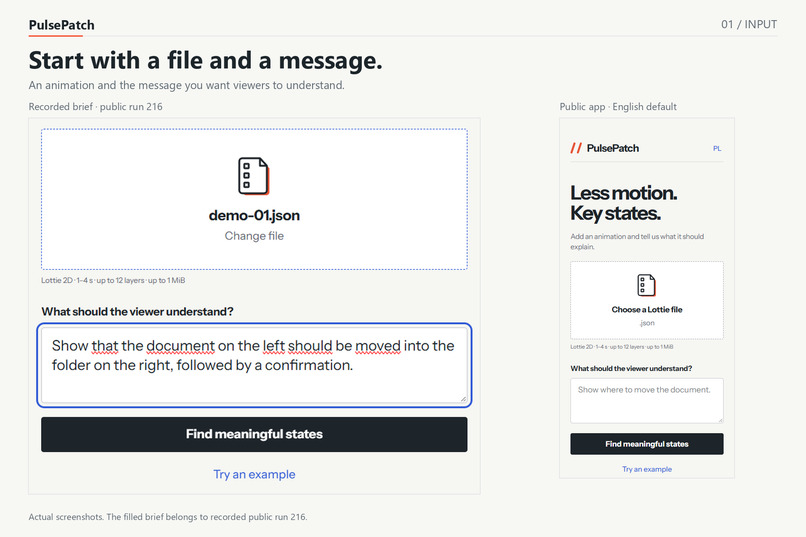
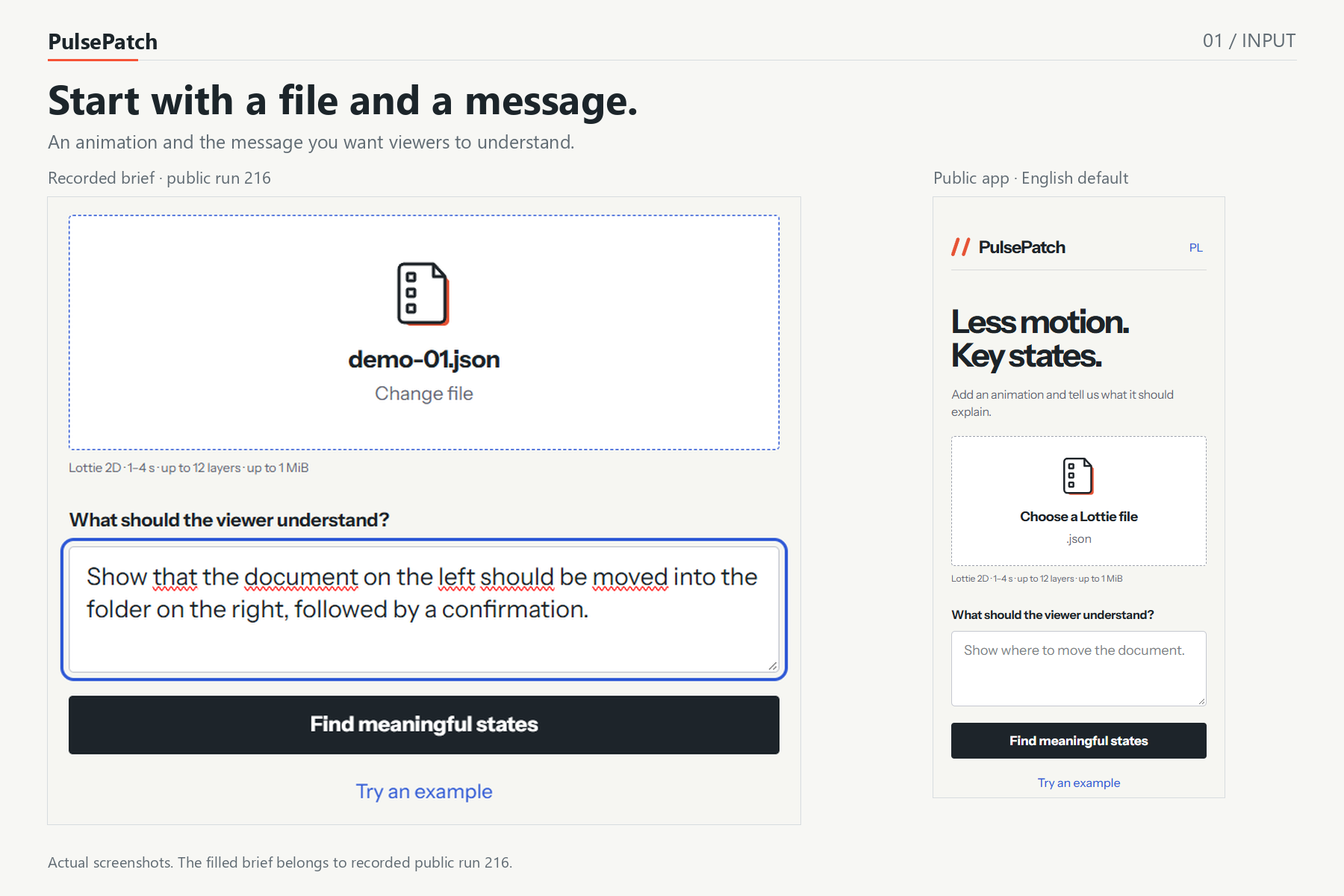
Start with a Lottie and brief. Recorded input216 and English-default mobile217; release218 adds an optional Guide.
-
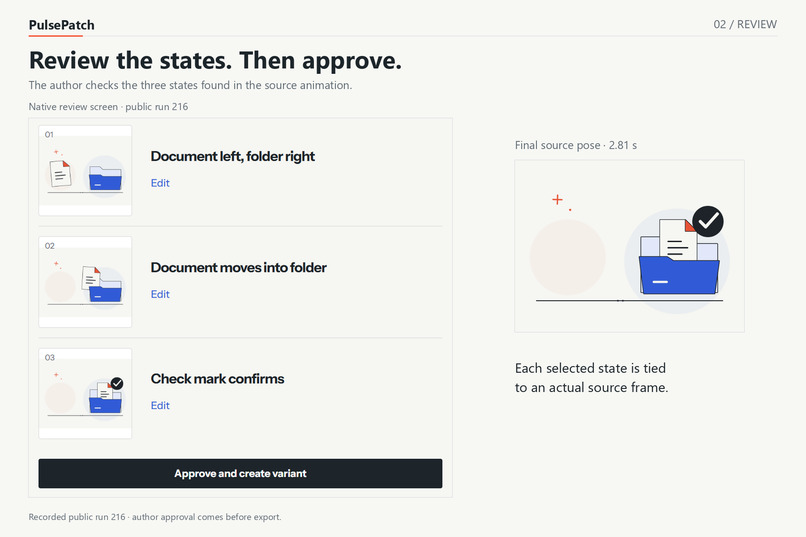
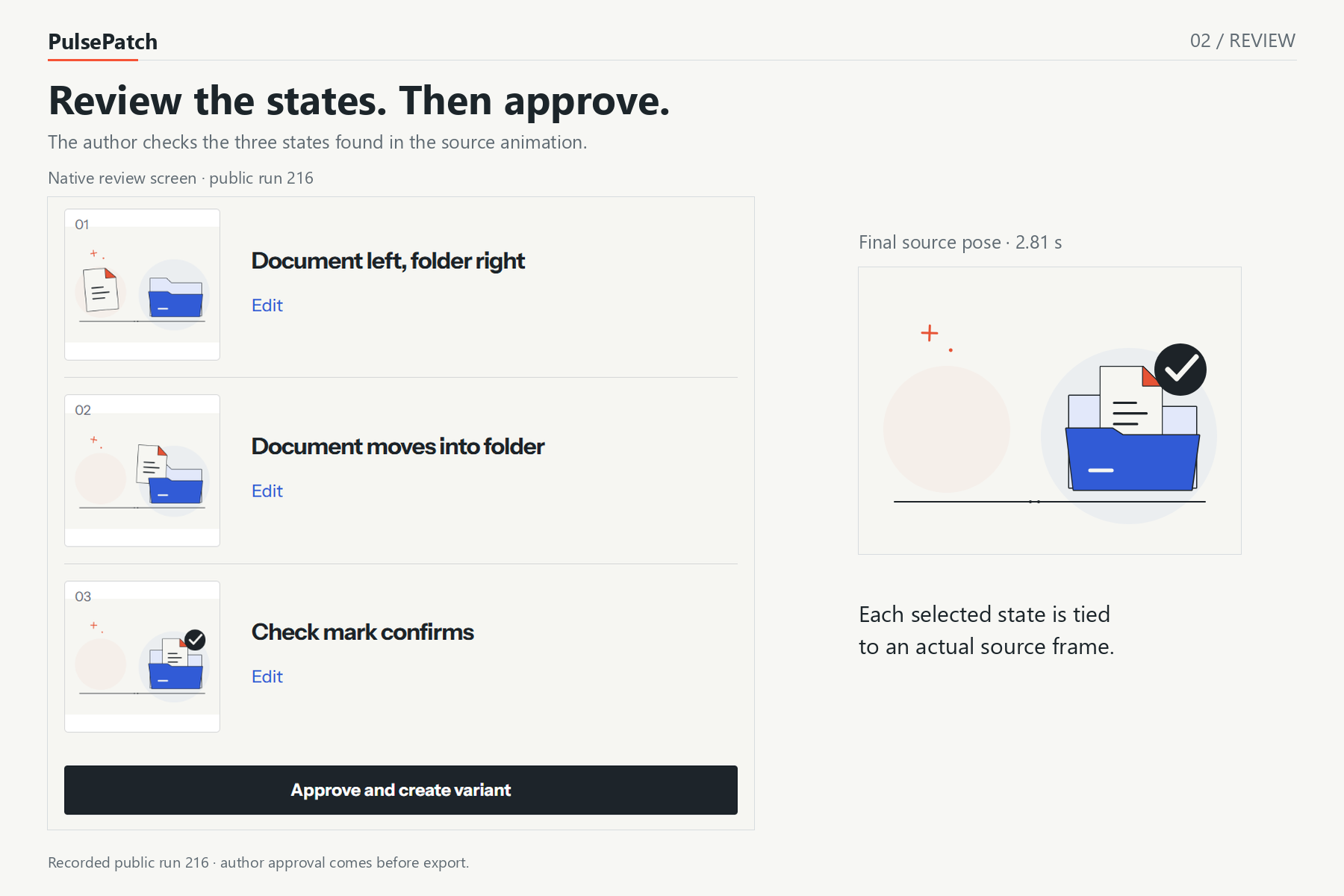
Inspect three actual source states, then approve the sequence. Recorded public run216.
-
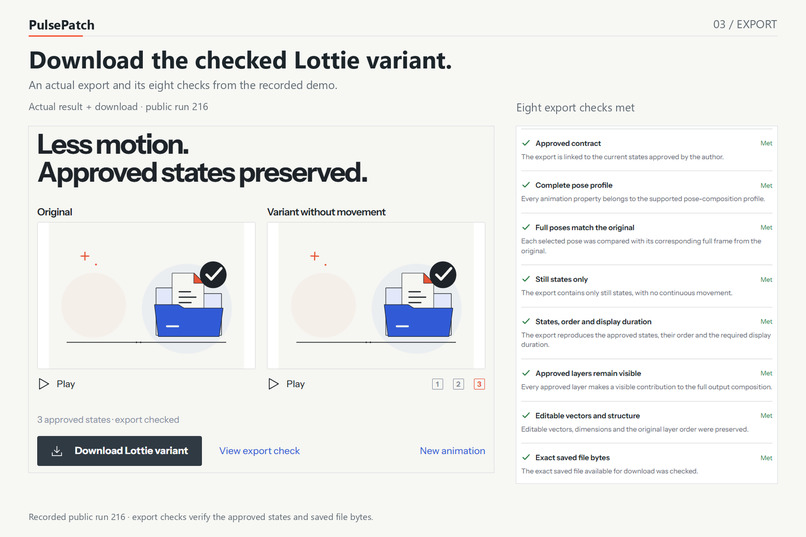
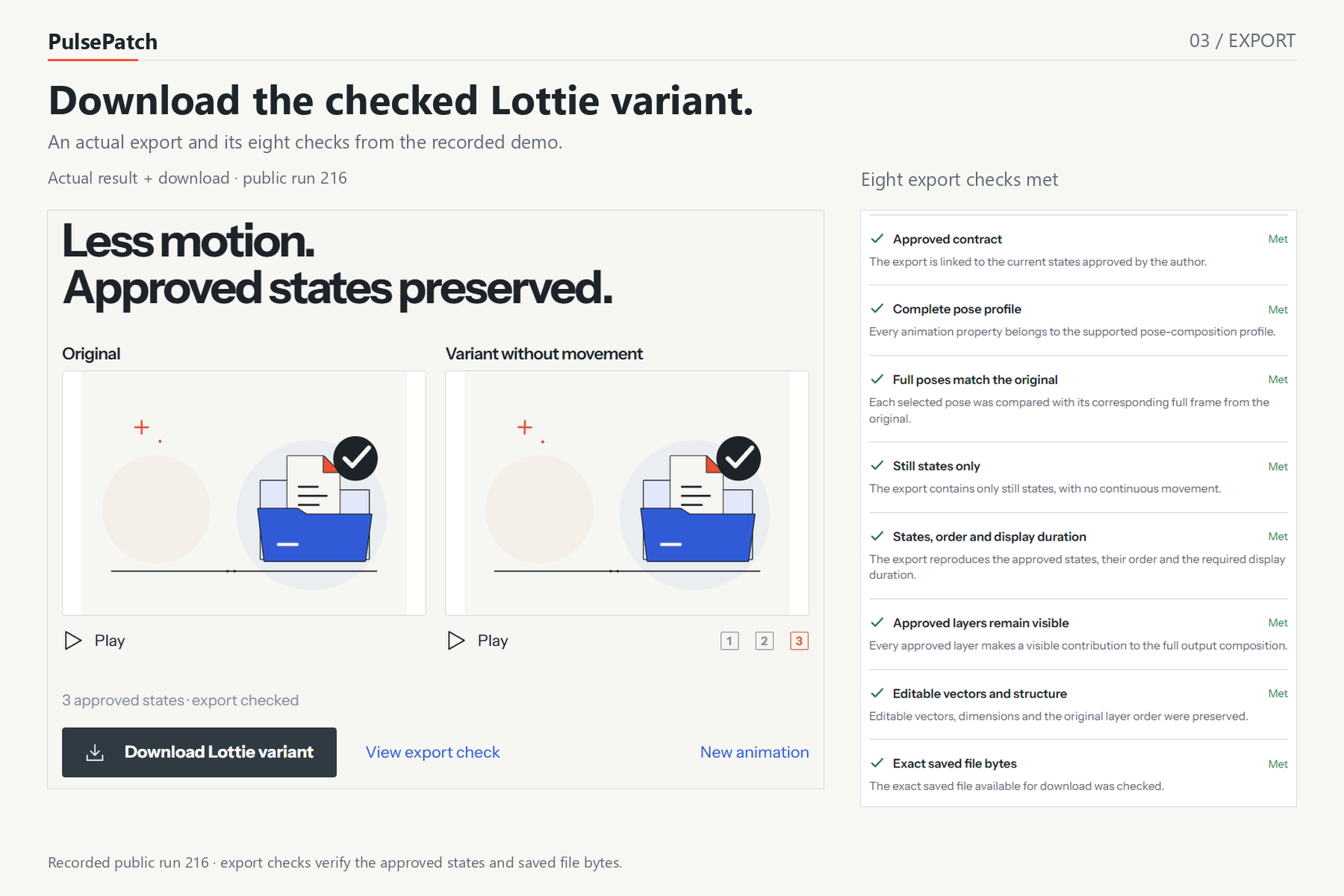
Download the editable Lottie variant. Eight checks passed on the actual saved export. Recorded public run216.
Inspiration
A document moves into a folder, then a confirmation appears. A designer preparing a version with less motion needs to decide whether to keep the steps or only the result. A last-frame screenshot preserves one image; it does not deliver an editable vector sequence. Manual editing remains a valid alternative; any reduction in author effort still needs testing.
Our film gives that intention a human setting: a fictional designer prepares an instruction for someone's first day on campus. The student's request for less motion is part of the dramatization. It is not a customer quotation or a user-study result.
What it does
PulsePatch turns a short, supported 2D vector Lottie and an author's brief into one to three proposed states. The author sees actual rendered frames and their order, can make corrections, and approves the exact current version.
After approval, deterministic code creates an editable static pose or a finite hold-only sequence. The original stays separate. A successful package includes the Lottie JSON, approved-state record, report and integration note. Eight checks examine the exact saved export before it is accepted.
The current client opens in English and supports Polish. An optional guide explains the real author steps without starting analysis or approving a result. Input and storage disclosures appear before the task begins. The input boundary is deliberately narrow: standalone 2D vector shapes, 1–4 seconds, up to 12 layers, 512 × 512 pixels and 1 MiB.
When embedding an export, configure the host player with loop: false and autoplay: false. The app preview does not loop; the downloaded Lottie cannot enforce a host player's settings. The ZIP and its integration note are available in Export check.
How we built it
The React/TypeScript interface connects to an asynchronous Python service on AWS. Chromium and lottie-web render real composition and layer images. OpenCV 5 measures sampled changes and visible layer contribution. Claude receives the brief, selected actual images and bounded context through the external Anthropic API.
Visual feedback can change the next model decision. In the recorded run, the model called a confirmation at 2.48 seconds stable. OpenCV classified it as transitional; that feedback reached a later request, and the next proposal selected the stable 2.81240625-second state. The model then reviewed the proposal. An AI operator inspected and explicitly approved the three-state sequence; the exporter passed all eight checks on the saved file.
The model proposes; it does not approve its own result or write the final animation. Manual revisions render fresh frames and require fresh approval. Bounded decisions, persistent accounting and retained uncertain-charge holds constrain paid operations.
Architecture and bounded agent workflow show the runtime components and decision loop.
Documentation clarification: the 32 sampled-time limit in the report/profile applies only to initial candidate discovery (up to 12 candidates). Selected-state measurements, local stability windows, model observations and export checks require additional renders.
What we tested and learned
The retained engine 216 development run completed with three settled model calls costing USD 0.130228. Release 218 improves first-use guidance, diagnostic readability and bounded structured export evidence. Its current runtime identity is separate from compatibility API 210. Provider decisions, prompts, accounting and physical checks retain their prior limits. The film keeps the earlier recording; it is not a new 218 model run.
In the separate closed study 215, adaptive achieved 6/6 complete factual outcomes: four approved exports and two appropriate author questions. Strong one-pass plus candidate CV achieved 4/6. The registered material-advantage criterion failed: it required six semantic executions in both arms, while one-pass had five. Technical failure and an unsupported premise in a delivered question remained in the results. The 18 study calls cost USD 0.575554.
The sources, operation and assessment were AI-based, with limited concealment. These are small synthetic results, not a human study or proof of an advantage over manual authoring. Export checks do not measure human understanding, comfort, accessibility compliance or time saved. Full outcomes, failures, costs and provenance accompany the technical report.
What is next
We want to test whether authors find this complete workflow useful against their existing editing process, including whole-task time and the choices they revise. Those benefits and a business model remain hypotheses.
Created by Damian Karolewski with AI coding assistants. The film's campus and designer scenes are dramatized, with synthetic narration; its product footage and exported file come from the actual recorded run. Original work retains its stated rights, and dependencies retain their own notices.

Log in or sign up for Devpost to join the conversation.