Inspiration
Every quarter, the same conversation happens in finance review meetings: "Where did all the money go?" By the time the spreadsheet shows the answer, the bleeding has been happening for weeks. We were tired of waiting for month-end PDFs to discover that the engineering team spent 38% of its time in meetings, that nobody opened the $1,200/month design tool we renewed, or that a critical PR sat unreviewed for 5 business days while the deadline slipped. The waste is not hidden. It's just scattered across ten different tools that never talk to each other. PulseOps was born from one question: what if you could see your company's operational waste the same way you see your CPU usage, live, with numbers, and ranked by what's hurting you most?
What it does
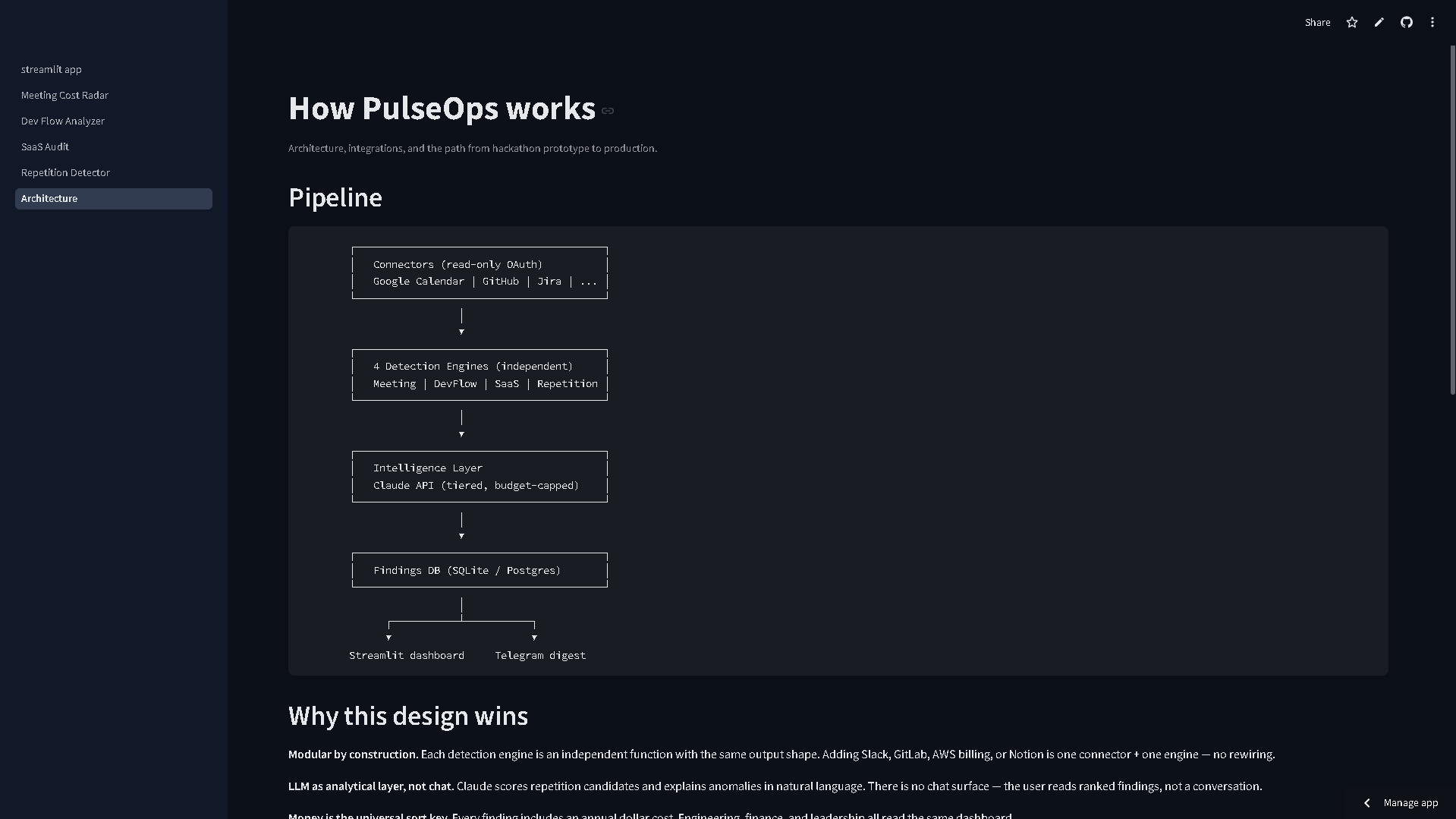
PulseOps is a real-time operational intelligence platform that connects (read-only) to the tools your company already uses and continuously calculates the dollar cost of detected inefficiencies. It runs four detection engines in parallel.
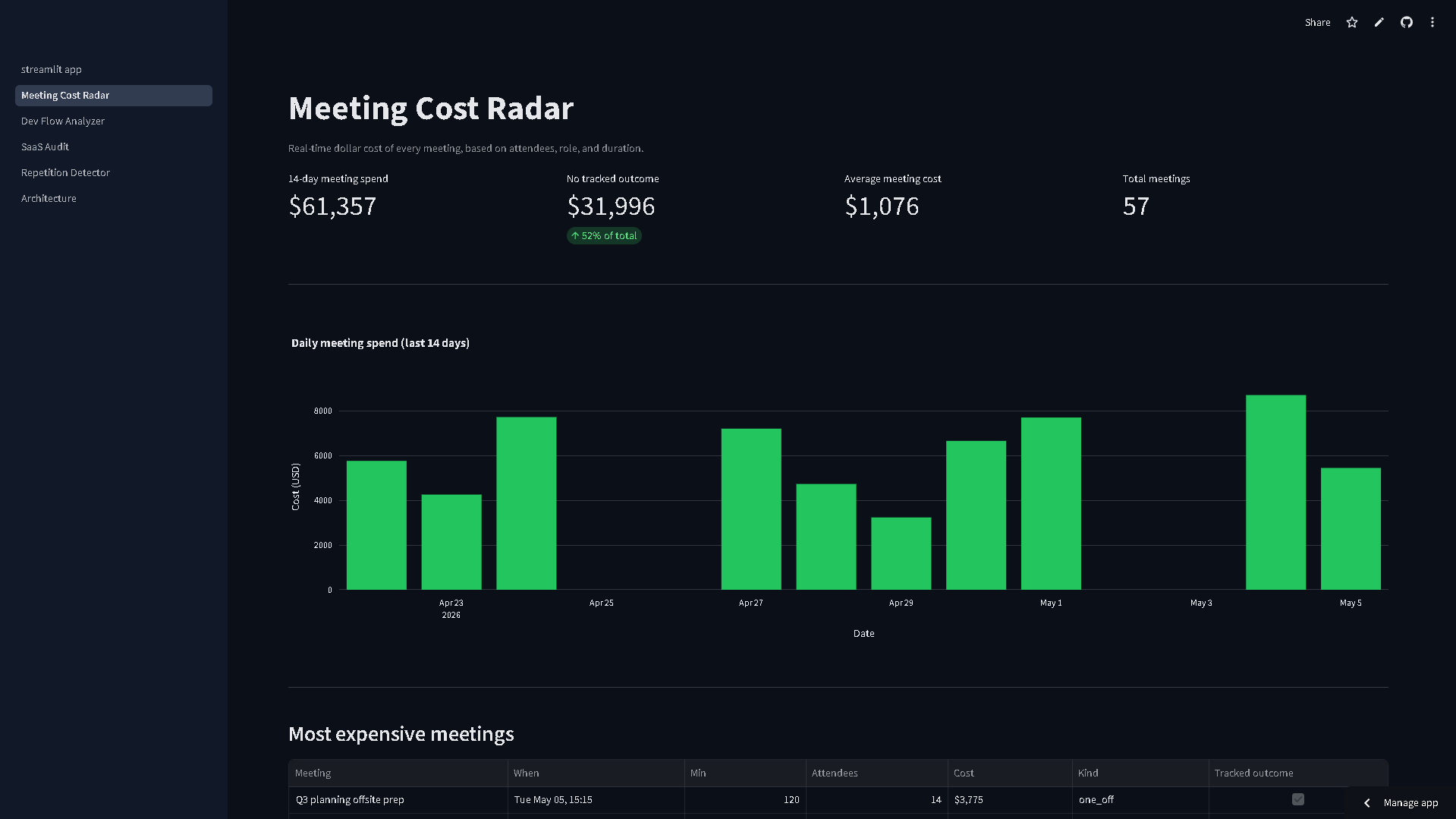
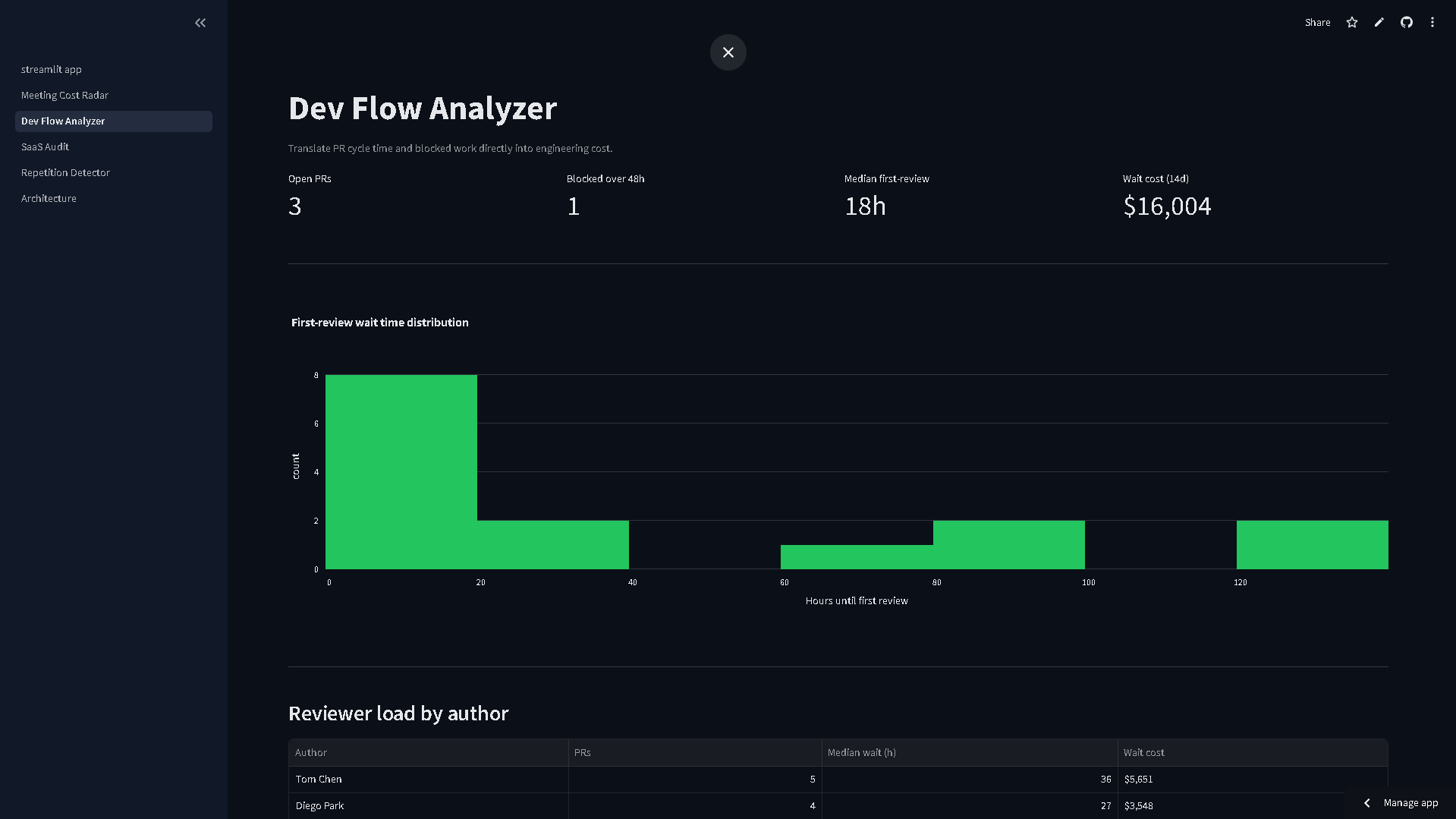
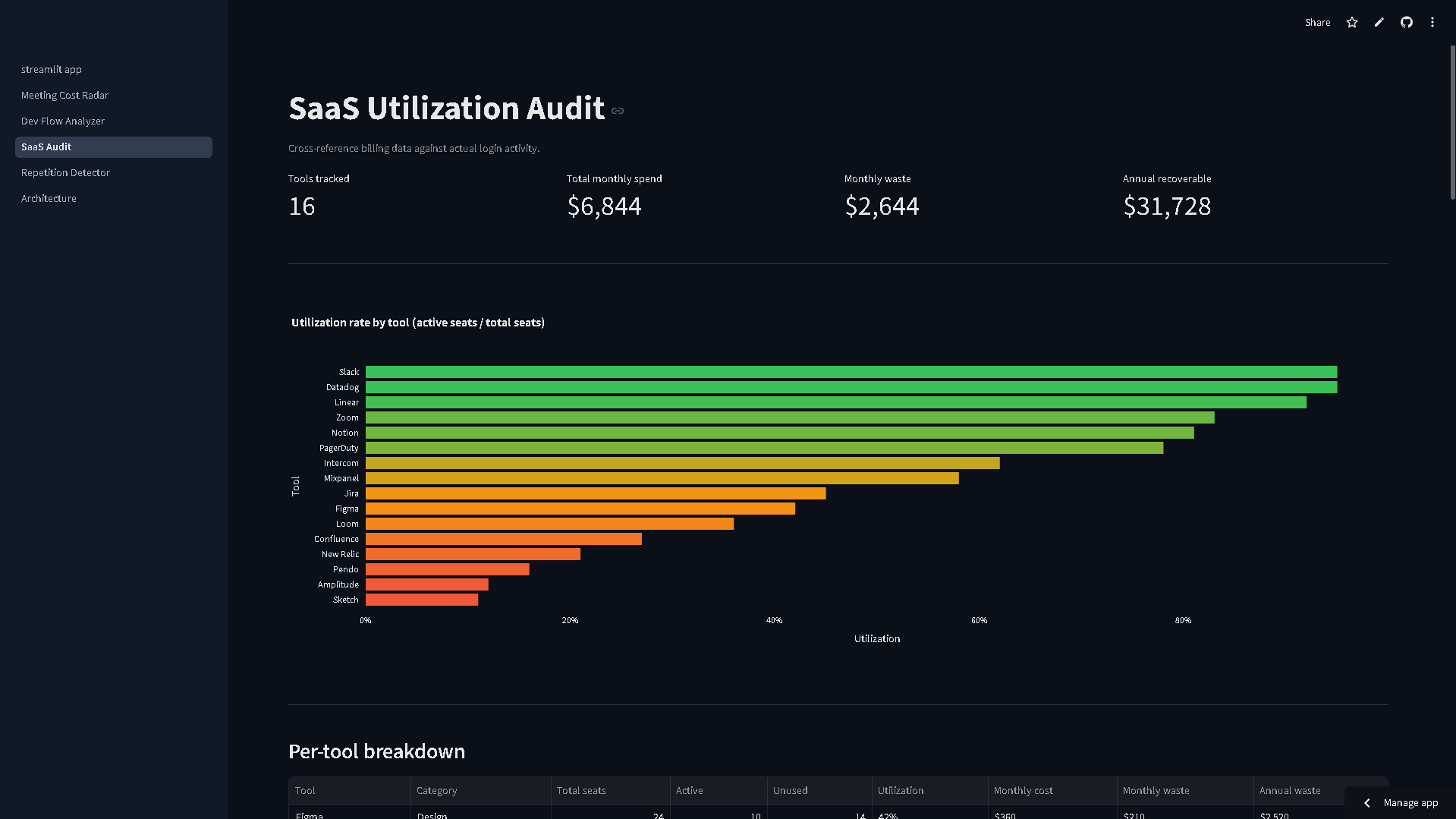
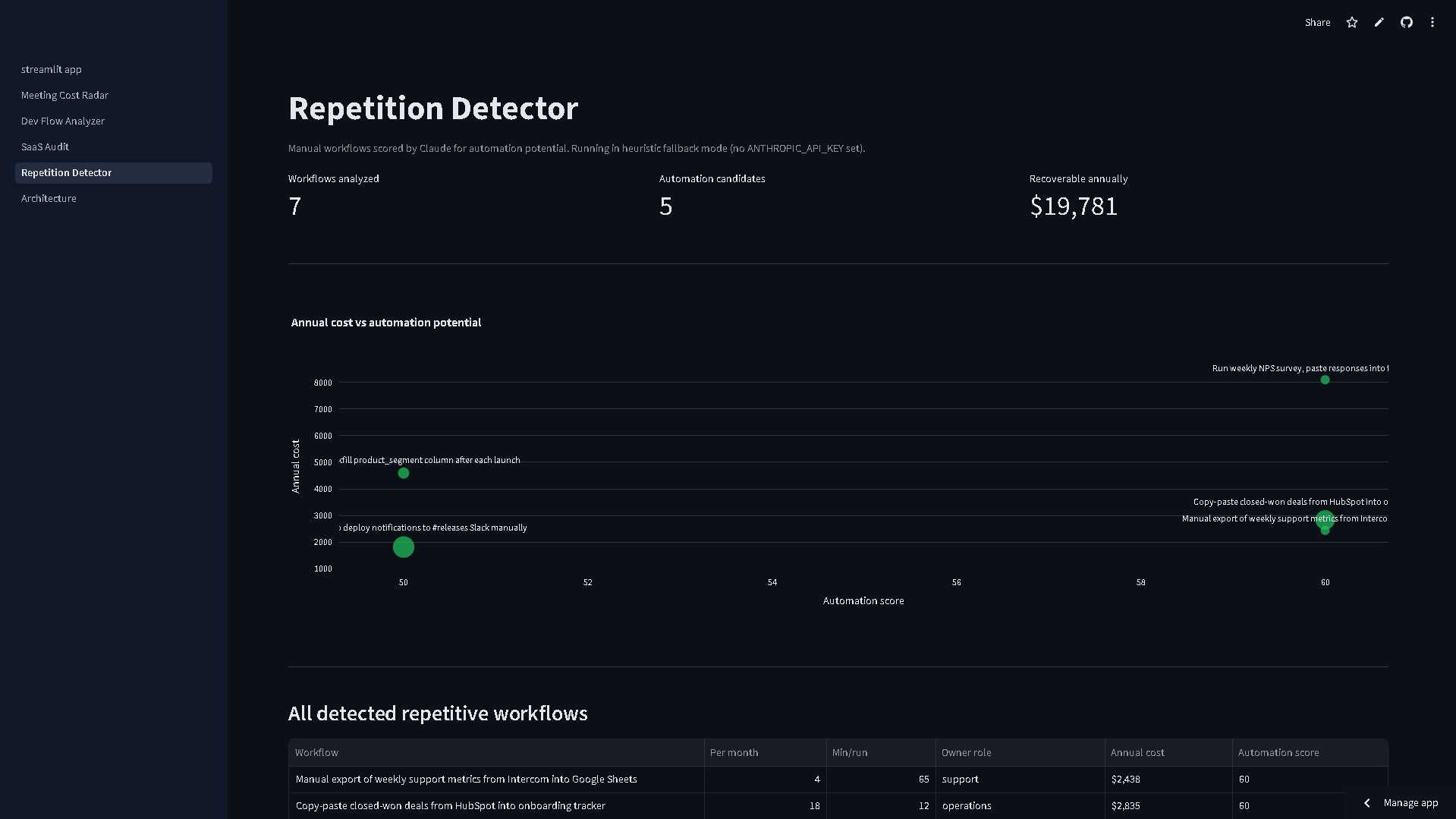
The Meeting Cost Radar scans your calendar and computes the real-time cost of every meeting based on attendee count, role-based salary bands, and duration, flagging meetings with no resulting decisions or action items. The Dev Flow Analyzer pulls data from GitHub and Jira or Linear to detect blocked PRs, abandoned tickets, and excessive context switching, translating wait time directly into engineering cost. The SaaS Utilization Audit cross-references billing data against actual login activity to surface unused licenses and redundant tools. The Repetition Detector uses Claude to analyze ticket and PR histories for repeated manual workflows that are candidates for automation.
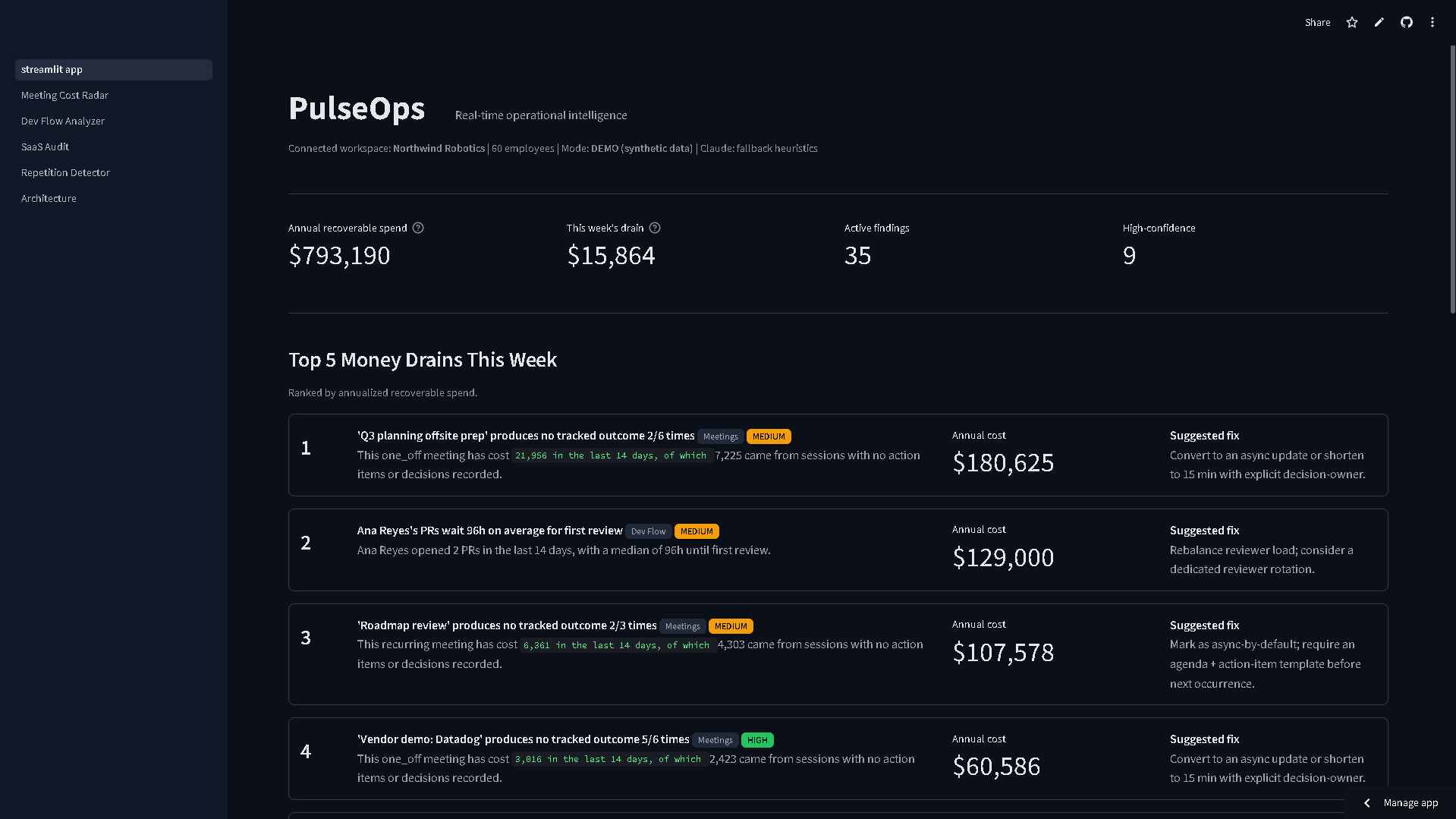
The output is a live dashboard showing the Top 5 Money Drains This Week, each with an exact dollar estimate, root cause, and a one-click suggested fix. A weekly digest is delivered via Telegram or email, ranked by recoverable spend.
How we built it
The application is built in Python 3.11, with Streamlit serving the live dashboard and orchestrating scheduled scans. The intelligence engine is powered by Anthropic's Claude API, which handles pattern detection, anomaly classification, and natural-language explanations of detected inefficiencies. Data ingestion is handled through the Google Calendar API, GitHub REST API, and Jira Cloud API, all behind a pluggable connector architecture so new sources drop in cleanly.
For storage we use SQLite in the demo for zero-config startup, with a PostgreSQL-compatible schema ready for production. The frontend is built in Streamlit, chosen for speed of iteration without sacrificing the visual polish judges see in a demo. Deployment is fully Dockerized with a single docker-compose up startup, and scheduled scans run through a cron daemon. Weekly digests are delivered through the Telegram Bot API with markdown formatting and rate-limit-aware chunking.
The architecture is module-based. Each detection engine is independent, has its own LLM token budget, and can be enabled or disabled per organization without touching the others.
Challenges we ran into
The first challenge was calculating cost without payroll access. Companies are not going to hand you their HR system on day one. We solved this with configurable salary bands per role, defaulting to public market data (Levels.fyi, BLS) so the tool delivers useful numbers from minute one and grows more accurate as it learns.
The second challenge was normalizing data across heterogeneous APIs. GitHub thinks in PRs, Jira thinks in issues, and Calendar thinks in events, but a "blocking dependency" might span all three. We built an internal "work unit" abstraction that maps cross-tool signals into a single timeline per person and per project.
The third challenge was avoiding LLM cost blowup. Naive prompting against Claude for every event would cost more than what the tool saves. We implemented a tiered approach: cheap heuristic filters first, LLM scoring only on the top candidates, with a daily token budget enforced at the orchestrator level.
The fourth challenge was defining "inefficiency" responsibly. A long PR review might be careful engineering, not waste. A 10-person meeting might be a critical incident response. We built calibration thresholds and a feedback loop so teams can mark false positives, and the model adjusts.
Accomplishments that we're proud of
We shipped a working end-to-end pipeline from raw API data to dollar-quantified insights, built and deployed inside the hackathon window. In our demo, after under 5 minutes of connecting a sample workspace, the tool surfaced over $50,000 in annual savings opportunities without any pre-training or company-specific configuration. We are also proud of the modular architecture we landed on: adding a new data source like Slack, Linear, or GitLab requires implementing one interface and registering one config block. Finally, our LLM cost model delivers full analysis on a free-tier Anthropic budget for small teams, which means the tool pays for itself many times over from day one.
What we learned
The most valuable insights are not inside any single tool. They live in the gaps between tools. A meeting on Tuesday that blocks a PR review on Wednesday that delays a deploy on Thursday is invisible to Calendar, GitHub, and Jira individually. Connecting them is where the leverage is. We also learned that money is the most universal language for prioritization: the moment we attached a dollar figure to each inefficiency, the conversation around fixing them changed entirely.
What's next for PulseOps
We plan to expand the connector library to include Slack, Linear, GitLab, AWS billing, Notion, and Figma seat data. We are also building a predictive mode that, instead of reporting waste that already happened, forecasts next week's drain based on current trajectories (for example, "this sprint is on track to cost 35% more than the last"). Team-level scorecards are next on the roadmap, giving teams an opt-in benchmark to see how their flow compares to the company average. Beyond reporting, we want PulseOps to act: auto-fix suggestions will generate the actual calendar invite, license cancellation request, or GitHub reminder, not just the recommendation. Finally, we are working toward a SOC2-ready deployment with a self-hosted option for full data isolation in enterprise environments.
Built With
- anthropic
- claude
- claude-api
- cron
- docker
- docker-compose
- github-api
- google-calendar-api
- jira-api
- oauth2
- postgresql
- python
- rest-api
- sqlite
- streamlit
- telegram-bot-api


Log in or sign up for Devpost to join the conversation.