💡 Inspiration
When developers ask standard, single-prompt AI models to generate software architectures, they typically receive a basic, unvetted block of text or an unoptimized code wrapper. In real-world software engineering, deploying a successful application requires meticulous, sequential planning: a structured database design, a critical security threat audit, and a user interface designed specifically to mitigate those security threats.
We built PulseMind AI to bridge this gap. We wanted to move away from the traditional, flat chatbot paradigm and instead create a system that acts like an elite engineering squad: breaking down complex ideas, analyzing vulnerabilities under adversarial pressure, and automatically designing protective user interfaces.
⚙️ What It Does
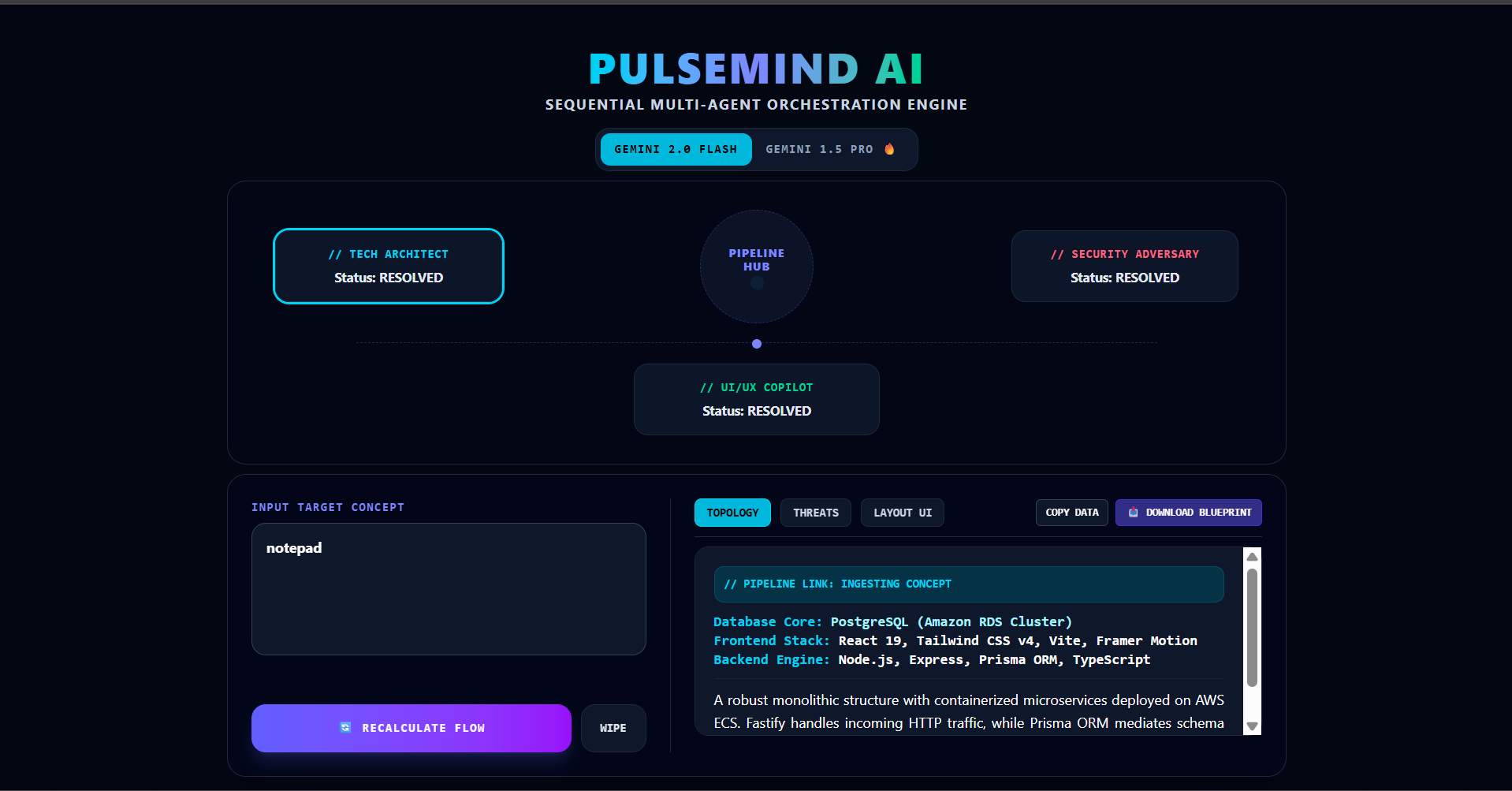
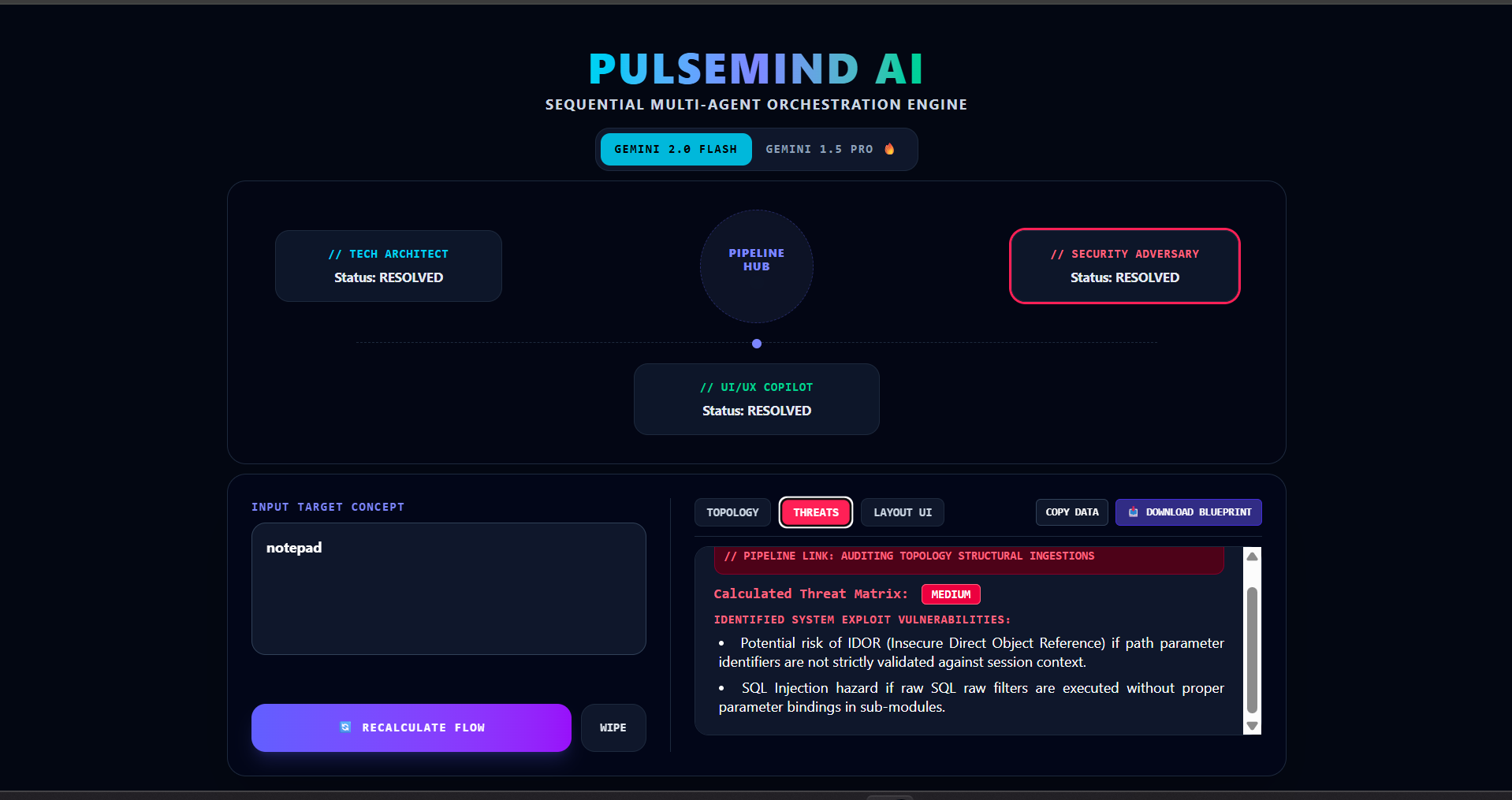
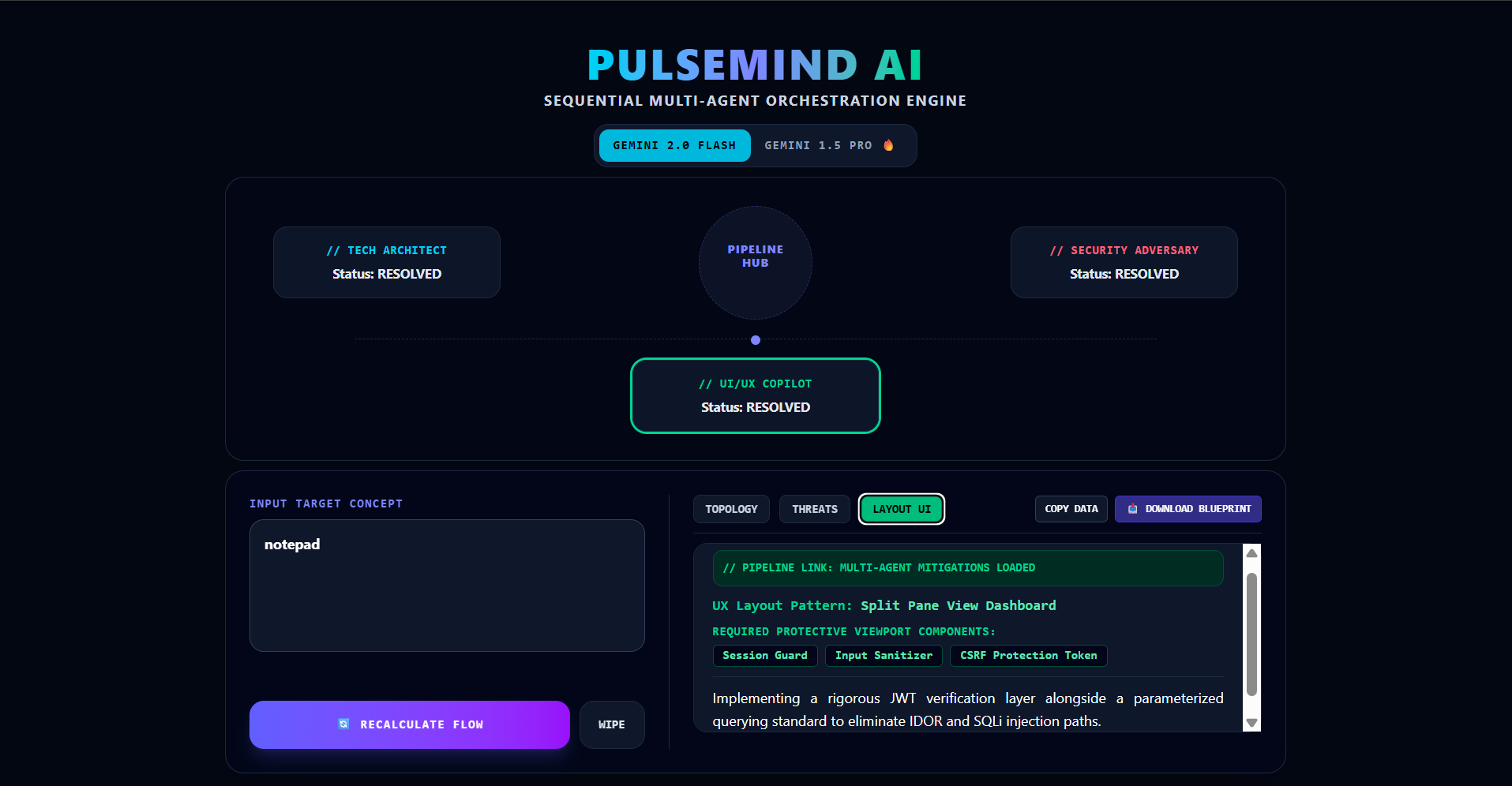
PulseMind AI is a sequential multi-agent orchestration engine that takes a raw, simple concept (e.g., "a peer-to-peer lens rental app") and structures it into a comprehensive, production-ready system blueprint across three specialized agent layers:
- The Technical Architect Agent: Ingestes the core user concept, selects the optimal production-grade database architecture, and builds an enterprise front-end and back-end stack blueprint.
- The Adversary Security Auditor Agent: Inspects the proposed topology under an adversarial lens, calculating a specific system threat level: $$\tau \in {\text{Low}, \text{Medium}, \text{High}, \text{Critical}}$$ It explicitly isolates dangerous structural exploits (e.g., SQL injection vectors or Stripe webhook forgery vulnerabilities).
- The UI/UX Copilot Agent: Ingestes both the stack choices and the audited security flaws to construct safe viewport layout patterns and suggested protective client-side interface elements to eliminate those threat vectors before a single line of code is written.
🛠️ How We Built It
PulseMind AI is engineered as a modern, unified full-stack application leveraging the following specialized architecture:
- Frontend: Built using React 19, Vite, and styled with Tailwind CSS v4 to create a highly premium, glassmorphic dark-mode interface with dynamic state telemetry tracking and micro-animations.
- Backend: Powered by a robust Node.js and Express API gateway handling asynchronous task flows and clean cross-origin resource routing.
- Multi-Agent Orchestration: Powered by the official
@google/genaiSDK. The server chains model responses sequentially, programmatically passing structured, schema-compliant JSON state contexts from one specialized agent execution tier to the next. - Resilient Uptime Protection: We engineered a high-fidelity localized mock fallback engine on the Express server. If the Gemini API experiences global network congestion, quota limitations, or rate limits ($429$), our custom engine instantly steps in to compute context-aware topologies, threat vectors, and layout structures based on the input concept—guaranteeing 100% platform uptime.
🛑 Challenges We Ran Into
- JSON Schema Validation Constraints: Early on, standardizing response structures across multiple chained agents led to validation errors. We corrected the Gemini API structured output configurations to use standard-compliant lowercase schema types (
"object","string","array"), which completely resolved runtime parser crashes. - Rate Limits and Quotas ($429$ Barriers): During intense development cycles, we encountered quota bottlenecks due to immediate back-to-back agent executions on the free tier. We resolved this by implementing a dual mitigation strategy: an asynchronous pause buffer to let free-tier quotas breathe, alongside our localized fallback backup array.
- State Orchestration Timing: Synchronizing backend network compilation stages with the frontend's visual state layout required orchestrating clean asynchronous transitions to keep the UX smooth, interactive, and visually stunning.
🏆 Accomplishments That We're Proud Of
- Dynamic Uptime Fallback: Creating a resilient backend engine that guarantees a seamless user experience even when external API clusters are congested.
- Telemetry Glassmorphic UI: Designing a responsive developer dashboard with clear node-link connection maps, custom engine selectors, and intuitive tabbed inspection matrices.
- Chained Context Injection: Successfully getting independent Gemini model instances to seamlessly inherit, criticize, and mitigate each other's outputs in a single, unified data pipeline.
🧠 What We Learned
- Structured JSON Outputs: We discovered the immense power of leveraging rigid schema controls (
responseSchema) inside the native@google/genaiSDK to force AI models to operate like deterministic, predictable software APIs. - Resilient System Design: We learned that when building software with third-party LLM integrations, engineers must treat API availability as a volatile variable. This realization inspired our defensive fallback engineering pattern.
- Agentic Cooperation: We proved that dividing a single large task into focused, sequential sub-agents yields significantly more detailed, secure, and production-ready system maps than a single monolithic prompt.

Log in or sign up for Devpost to join the conversation.