🧠 Inspiration
Healthcare is one of the most targeted industries for cyberattacks, with millions of patient records exposed every year.
What makes this more dangerous today is the rise of AI systems in healthcare—AI agents, automated workflows, and digital records are handling sensitive patient data without a dedicated real-time security layer.
We realized a critical gap:
There is no system stopping data breaches before they happen.
Most solutions detect attacks after damage is done. We wanted to build something that prevents them entirely.
That’s how PulseLock was born.
⚔️ What it does
PulseLock is an autonomous AI security layer that sits between healthcare systems and data execution.
Every request—whether from a doctor, system, or AI agent—is analyzed in real time.
The system:
Detects sensitive patient data (PHI) Analyzes intent and risk Applies dynamic security policies Decides to Allow, Block, or Quarantine
All before the action is executed.
🧠 How we built it
PulseLock was designed as a modular AI defense system with multiple components:
PHI Detection Engine → identifies sensitive medical data Threat Analyzer → detects phishing, exfiltration, and anomalies Intent Engine → evaluates whether an action is safe or risky Policy Engine → enforces healthcare security rules Decision Engine → outputs ALLOW / BLOCK / QUARANTINE
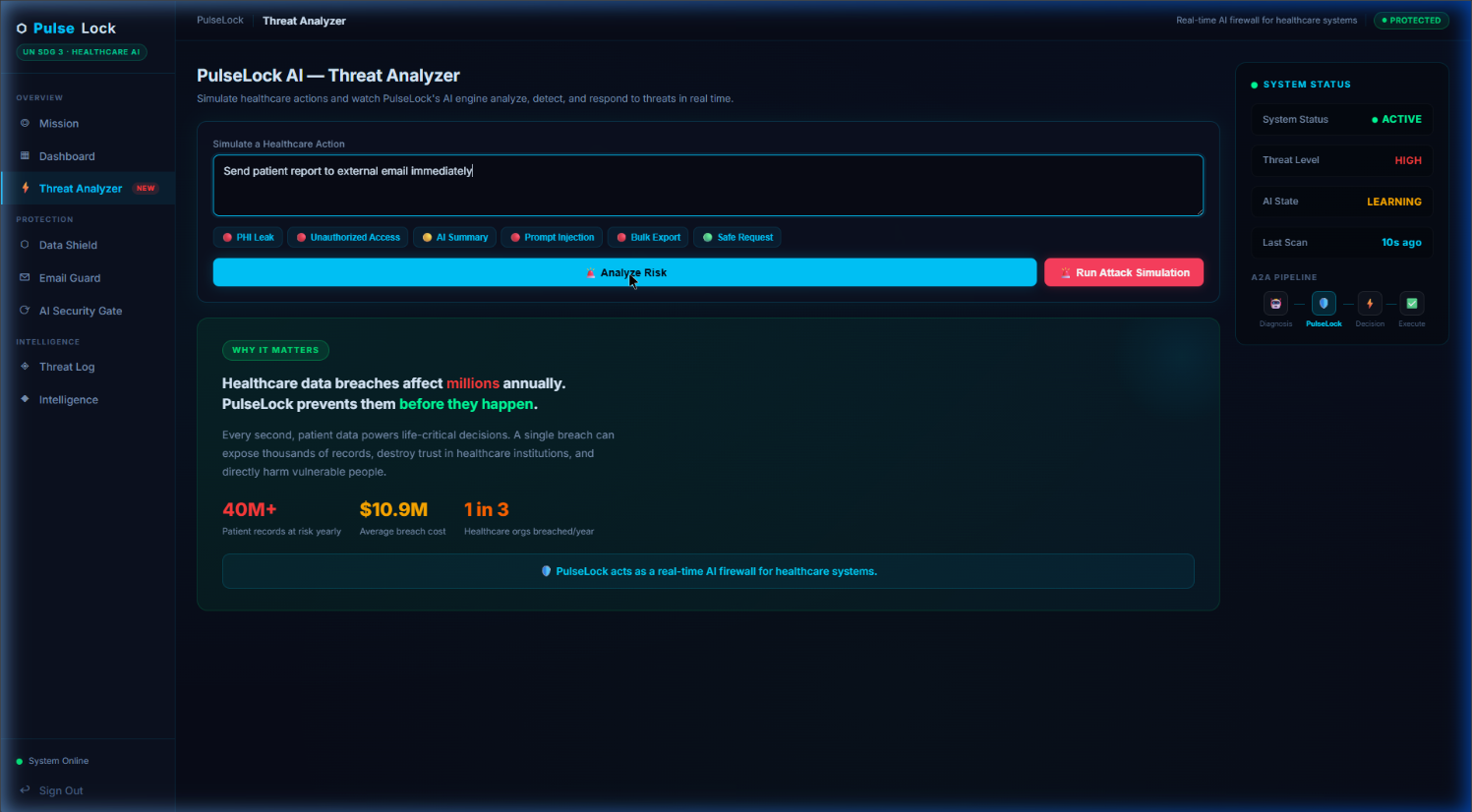
The frontend was built using React, with a real-time simulation interface that demonstrates attack scenarios.
The system is deployed using:
GitHub Pages (frontend) Render (backend & agent)
We also implemented a Data Shield simulation mode to showcase real-world breach scenarios and PulseLock’s response.
⚠️ Challenges we ran into
One of the biggest challenges was balancing technical depth with usability.
We initially built a complex system with multiple dashboards and configurations—but realized that for real-world impact and hackathon judging, clarity matters more than complexity.
Another challenge was:
Designing real-time decision simulation Creating a believable AI response system Making the UI feel like a mission-critical security tool
We solved this by focusing on:
One clear flow: detect → analyze → decide → protect
🏆 What we learned
Through this project, we learned:
Real-world impact matters more than feature count Security must be proactive, not reactive AI systems need guardrails to be safely deployed in healthcare Presentation and clarity are as important as engineering 🌍 Impact
PulseLock addresses a critical real-world problem:
Prevents healthcare data breaches Protects patient privacy Reduces financial and legal risks Enables safer adoption of AI in healthcare
This directly aligns with:
UN SDG 3 — Good Health & Well-Being
🚀 What’s next
We plan to:
Integrate with real healthcare APIs (FHIR systems) Deploy as a middleware security layer for hospitals Enhance AI threat detection using advanced models Expand to other sensitive industries like finance and legal
Every decision protects a patient. PulseLock makes that decision automatic.
Built With
- analysis
- detection
- fastapi
- github
- javascript
- llm-based
- react
- rest
- rule-based
- tailwind

Log in or sign up for Devpost to join the conversation.