Inspiration
Every day, we talk to people — friends, colleagues, family — but too often, the words don't match the real intent behind them. A casual comment feels like criticism, a neutral tone hides frustration, and suddenly, anxiety creeps in. We second-guess, overthink, and pull back from connections that matter.
As someone who has felt this invisible barrier in conversations, I wondered: what if we could sense someone's true intention the way we feel a heartbeat?
The quantified self movement has made the invisible visible — steps, sleep, mood — but the unspoken iraada (intent) behind words remains hidden. Humans already have 22–33+ senses, including subtle social and cognitive signals we’re not consciously aware of.
PulseIntent explores a new possibility: enabling an "Intent Sense" that helps people perceive the intentions behind conversations.
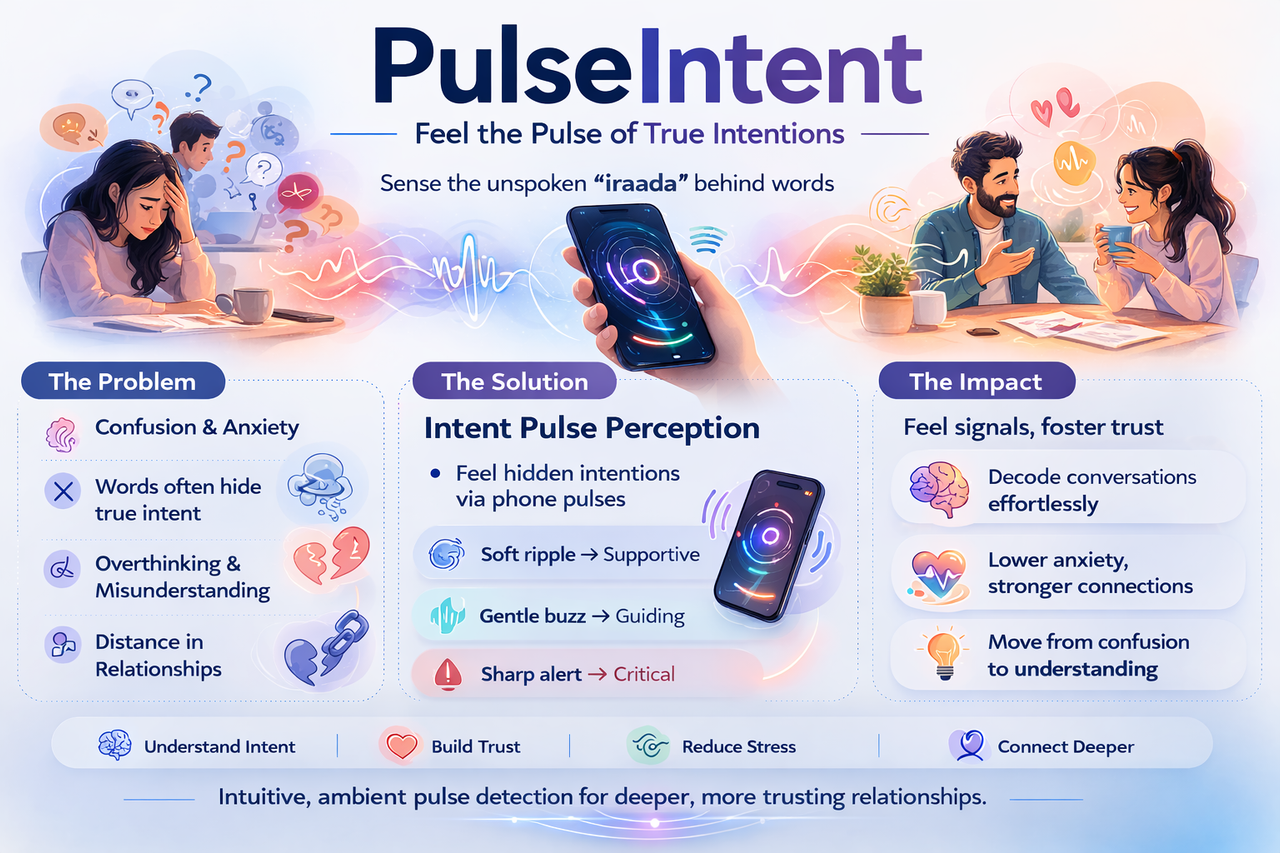
What it does
PulseIntent is a speculative wellness tool that gives users a new heightened sense: Intent Sense Perception.
It tracks and interprets subtle interaction signals in real-time conversations — helping reveal the underlying intent behind what someone says or does.
Users feel these signals through subtle phone vibrations:
- a gentle ripple → supportive intent
- a soft buzz → guiding intent
- a sharper alert → critical intent
This allows people to sense intentions without constantly looking at a screen.
The result: users move from confusion and anxiety to proactive understanding, fostering deeper and more trusting relationships.
How we built it
I built PulseIntent in Figma over the weekend, focusing on a seamless, pocket-friendly experience:
- Started with deep problem framing: who struggles most with intent misreads, and why it hurts mental/social wellness.
- Used Figma Make to prompt and generate interactive prototypes — radial "Pulse Map" dashboard, vibration pattern simulations, consent flows, and 3 use-case modals.
- Created a Figma Slides presentation (10 slides) with embedded playable prototypes to show the full experience: ambient detection, interface, safeguards, and thoughtful tradeoffs.
- Iterated heavily on UX decisions: ambient-only (phone mic + context, optional clip for extra cues), on-demand activation, no constant wearables to keep it effortless and real-world usable.
Challenges we ran into
Making a completely new sense feel believable and useful was tough — early versions risked feeling like "just another emotion tracker." I solved this by focusing on the intent layer (iraade beyond surface emotions) and keeping detection ambient/non-visual (no forced screen staring).
Information overload was another risk — extra perception can overwhelm. I addressed it with intentional constraints: contextual prioritization (top contacts only), fade-out mechanics, and gentle nudges instead of constant alerts.
Balancing speculation with human-centered design took iteration: I kept asking, "Does this actually reduce anxiety in real conversations, or just add noise?"
Accomplishments that we're proud of
- Defined a novel interaction concept: Intent Sense Perception, enabling people to sense conversational intentions.
- Designed effortless UX: pocket-friendly ambient detection, vibration feedback, and optional clip — thoughtful tradeoffs to avoid fatigue and make it accessible.
- Embedded interactive prototypes in slides so judges can feel the pulse patterns themselves.
- Crafted a cohesive story that ties inspiration → problem → solution → safeguards, showing clear understanding of the challenge.
What we learned
I learned that speculative design shines when it's deeply rooted in real human pain — misunderstandings are universal, yet almost no tools address the "intent layer."
I also discovered the power of constraints: limiting to ambient phone detection made the idea more human-centered and believable than adding complex wearables. Finally, storytelling is everything — a clear, emotional narrative turns a concept into something judges remember and believe in.
What's next for PulseIntent
In the future, PulseIntent could integrate emerging non-invasive sensors (advanced mics, bio-field clips) for even sharper accuracy. I'd love to add mutual opt-in modes for friends/family and guided empathy practice features. Ultimately, it could become a quiet companion for everyday social wellness — helping people build trust, reduce isolation, and connect more deeply in an ambiguous world.
"Thank you for considering PulseIntent — a small step toward making the unspoken feel a little more understood."
Built With
- figma
- figma-make
- figma-slides


Log in or sign up for Devpost to join the conversation.