-
-
QNX PulseGuard
Inspiration
In autonomous driving and automotive safety architectures (such as brake-by-wire and steer-by-wire), meeting deterministic execution deadlines is a fundamental safety requirement. Generic profiling tools often introduce significant overhead or treat the operating system as a black box. We built QNX PulseGuard to leverage the unique microkernel architecture of BlackBerry QNX Neutrino RTOS 8.0, giving developers microsecond-level timing visibility without compromising real-time determinism.
What it does
QNX PulseGuard consists of two integrated components:
- Target-Native Telemetry & IPC Agent: Cross-compiled with QNX SDP 8.0 qcc, this lightweight daemon uses ClockCycles() and SYSPAGE_ENTRY(qtime) for zero-syscall timestamping, measures synchronous microkernel IPC performance (MsgSend/MsgReceive/MsgReply), and broadcasts binary UDP telemetry frames at 10 Hz.
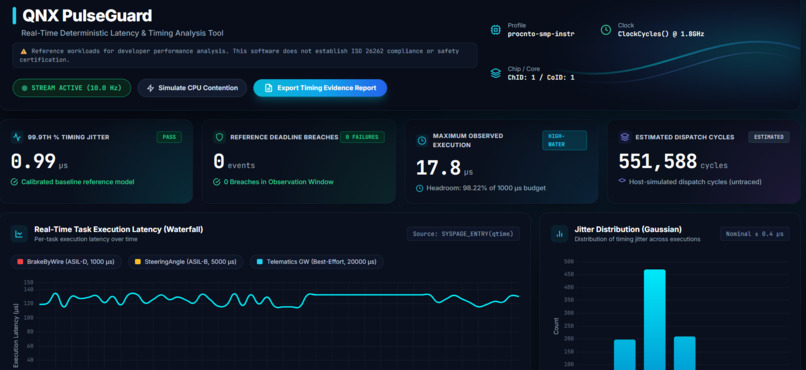
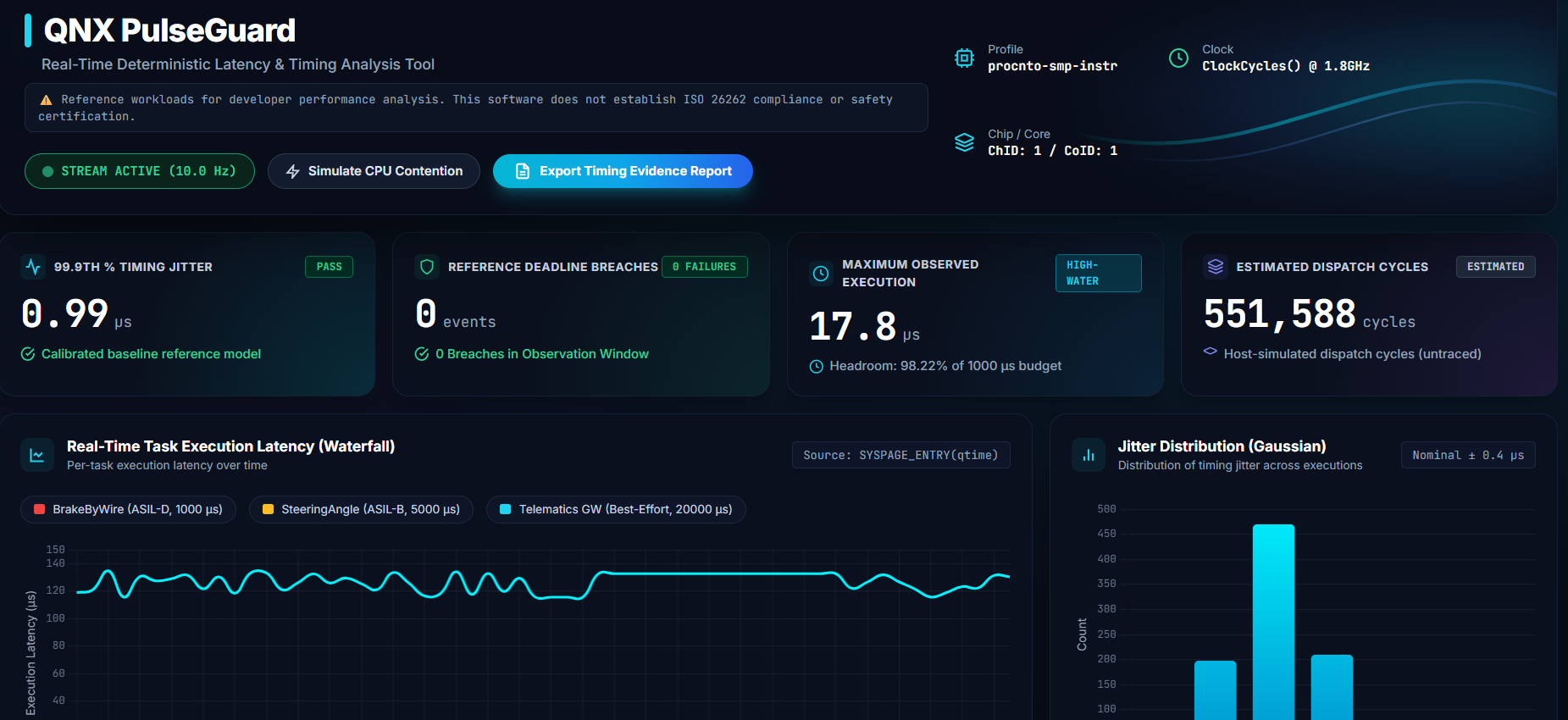
- Host-Side Verification Dashboard: Built in Python, this server ingests live telemetry, validates packet framing and sender subnets, displays dynamic waterfall latency charts and Gaussian jitter histograms, and provides one-click export of structured Timing Evidence Reports in JSON and CSV.
How we built it
- Target C Code: Developed against QNX Neutrino 8.0 headers using POSIX threads, SCHED_FIFO real-time scheduling priorities (63 for BrakeByWire, 50 for SteeringAngle, 15 for Telematics), and microkernel channel communication.
- Cross-Compilation: Built using qcc (GCC 12.2.0 gcc_ntox86_64) from the official QNX SDP 8.0 toolchain.
- Target Virtualization: Packaged and deployed onto an x86_64 QNX 8.0 target using mkqnximage targeting Oracle VM VirtualBox 7.2 with host-only networking.
- Host Dashboard: Built with a lightweight zero-dependency Python backend serving interactive WebSockets/REST APIs and a responsive dark-mode front-end.
Challenges we ran into
- Ensuring strict wire-format compatibility between 64-bit C structs compiled under qcc and Python's struct unpacker, which required #pragma pack(push, 1) to eliminate architecture-specific padding mismatches.
- Resolving network communication between the headless VirtualBox QNX guest and the Windows host adapter using VirtualBox host-only networking and DHCP leasing.
- Correctly binding QNX 8.0 system page calibration macros (struct qtime_entry *qtime = SYSPAGE_ENTRY(qtime)).
Accomplishments that we're proud of
- Verified Execution on Live QNX 8.0: Successfully cross-compiled and executed the native binaries on a real QNX Neutrino RTOS 8.0.0 target (192.168.56.102).
- Microkernel IPC Performance: Measured empirical round-trip synchronous message passing latencies on QNX 8.0 VirtualBox of 1.49 µs minimum and sustained throughput exceeding 189,000 round-trips/second.
- Live Telemetry Pipeline: Streaming continuous real-time frames from the QNX target to the host dashboard, achieving zero deadline breaches under nominal operations.
- Comprehensive Quality: 16 automated tests covering API schemas, security constraints, and statistical math.
What we learned
Deep insights into the QNX SDP 8.0 microkernel architecture, particularly the efficiency of synchronous message passing, high-resolution cycle counter calibration via system pages, and VM image creation workflows with mkqnximage.
What's next for QNX PulseGuard
- Adding trace-event instrumentation (TraceEvent()) integration to capture kernel context switch timelines alongside user-space telemetry.
- Expanding hardware target validation to ARMv8 / ARM64 automotive platforms (e.g., NXP S32G, Qualcomm Snapdragon Ride).
- Adding automated regression thresholds for continuous integration pipelines in ISO 26262 development environments.
