-
-
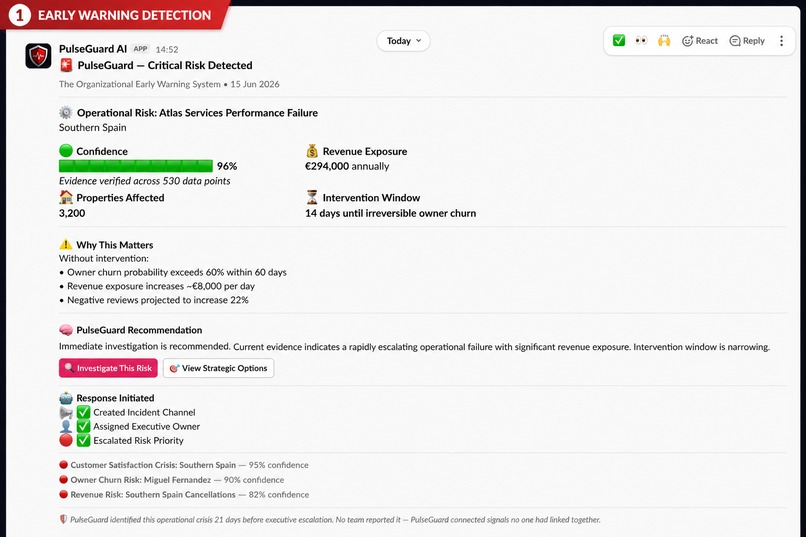
Detect critical business risks before teams report them. PulseGuard identifies crises 21 days before escalation.
-
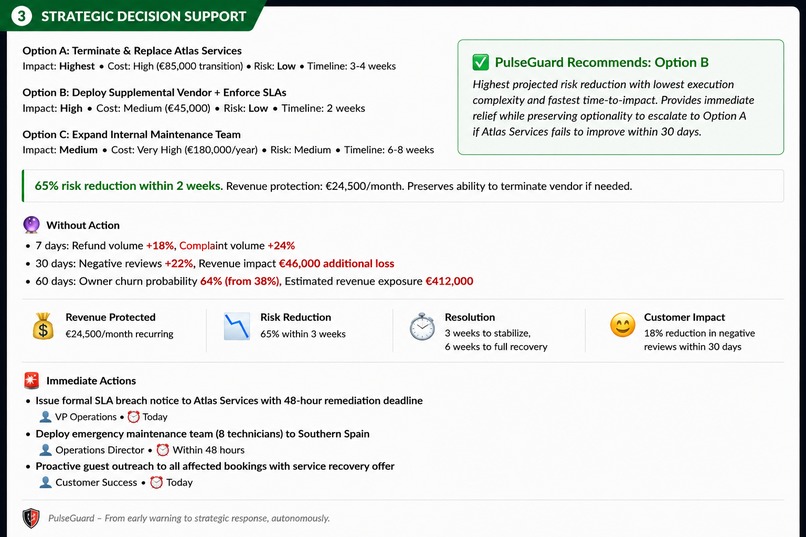
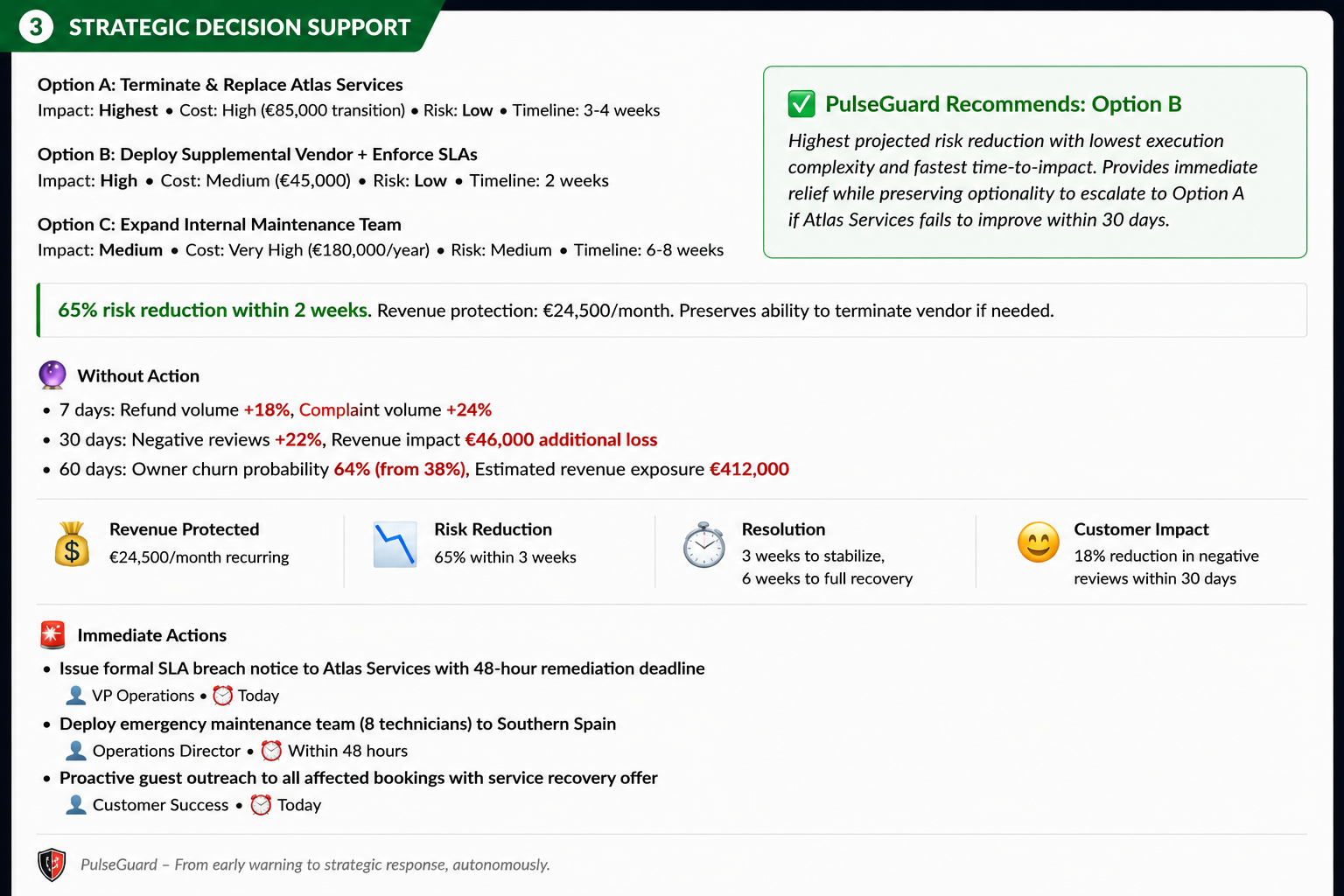
Compare response options, forecast outcomes, and receive actionable recommendations with projected business impact.
-
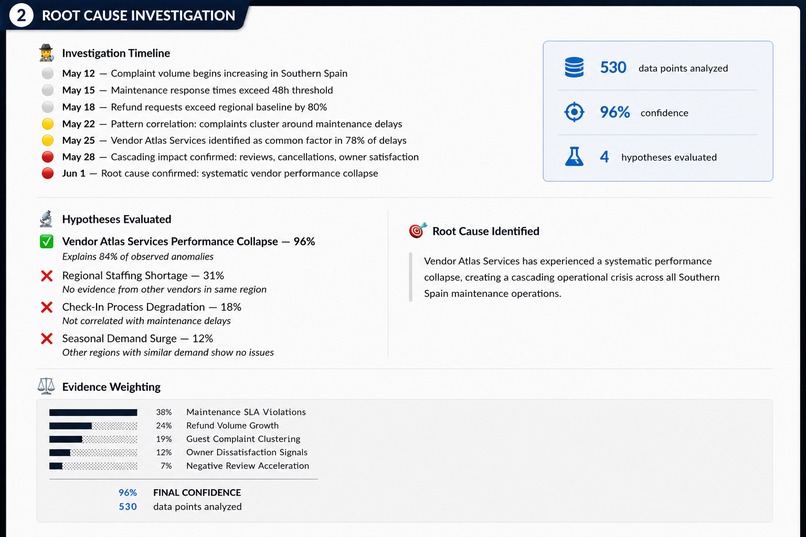
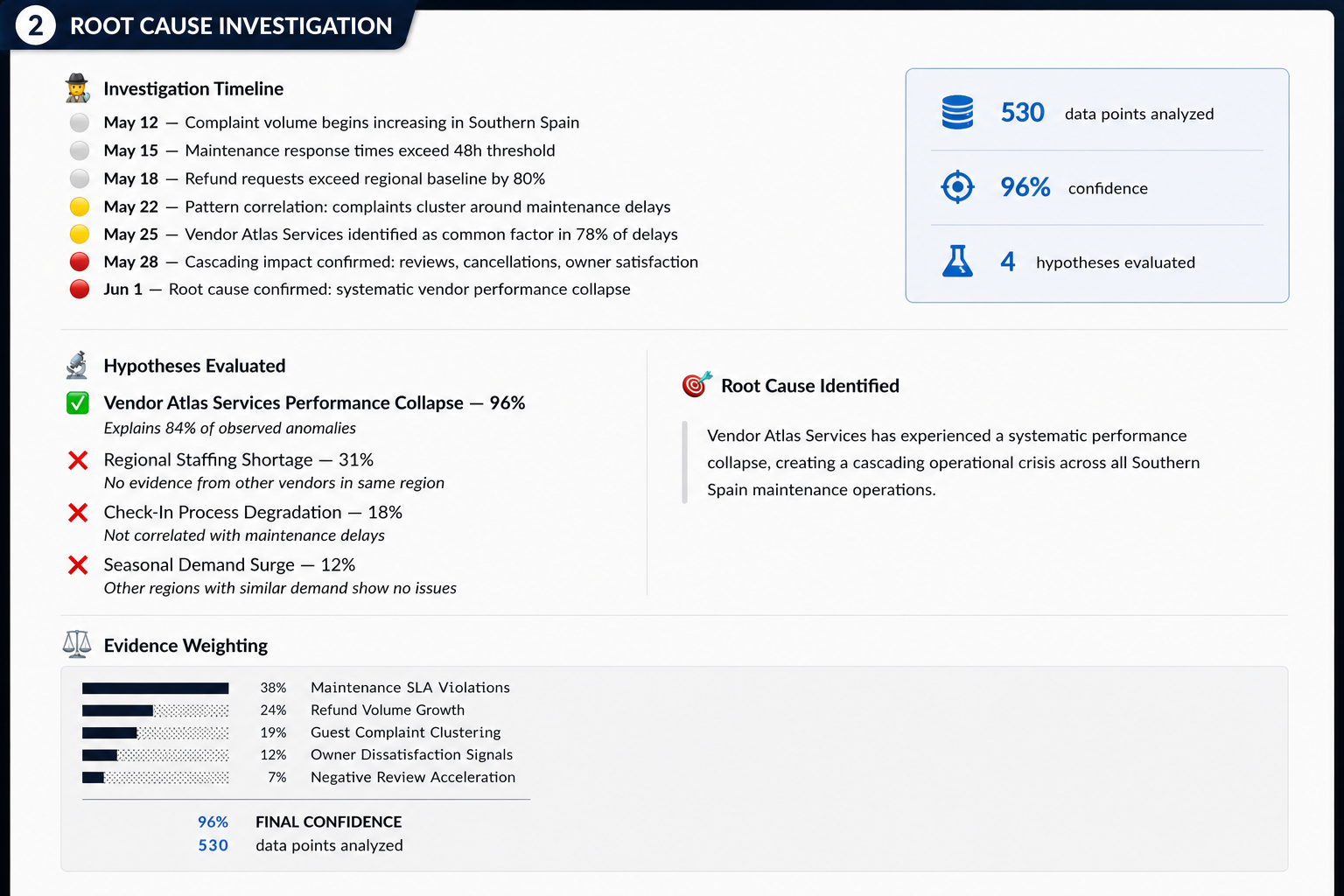
Transparent AI reasoning: timelines, hypotheses, evidence weighting, and root cause analysis across 530 data points.
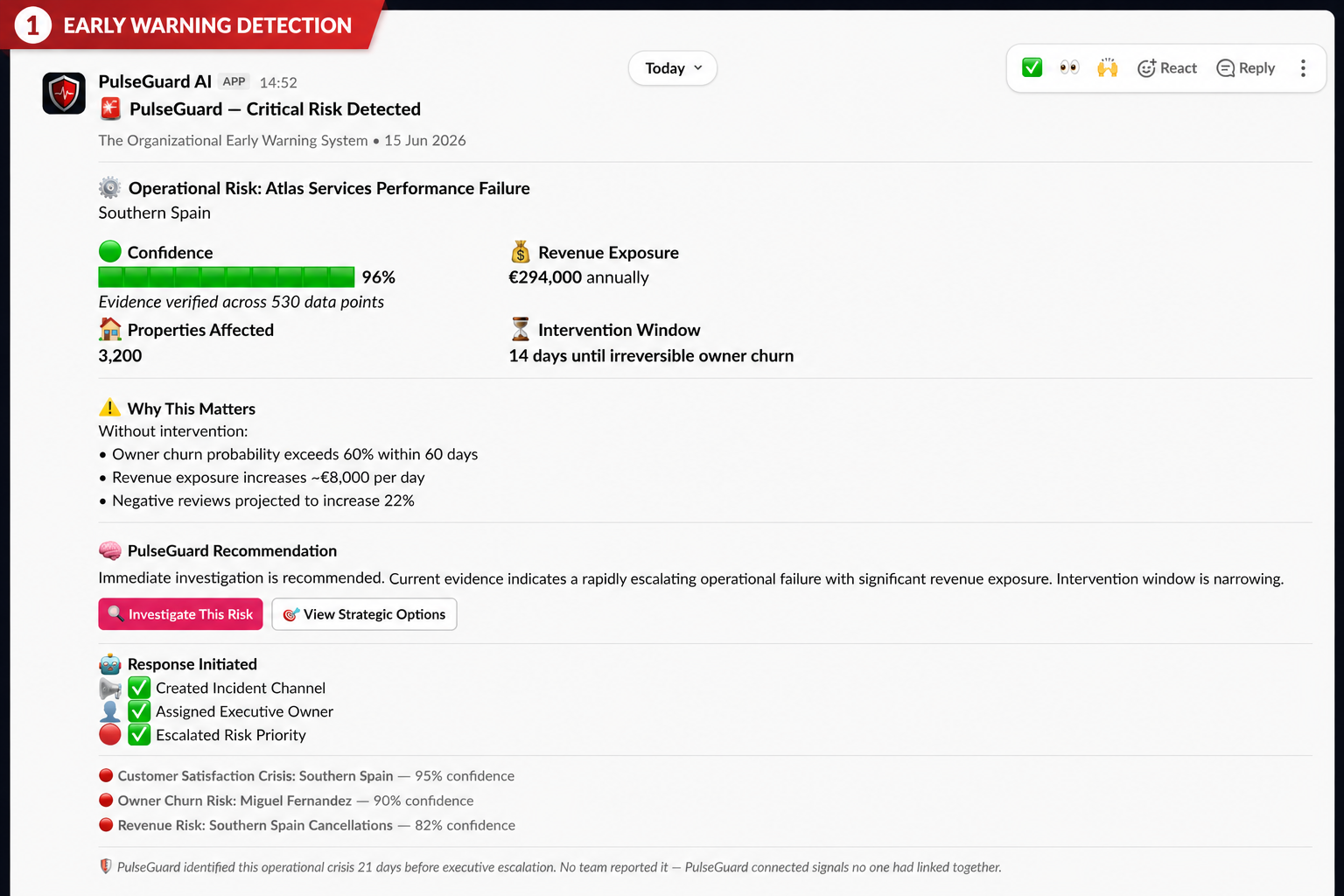
PulseGuard AI
Inspiration
Most companies don't fail because of a single catastrophic event.
They fail because thousands of small warning signals go unnoticed.
Support tickets increase slightly. Customer reviews begin to decline. Vendors miss deadlines. Refunds slowly rise. Ownership teams become frustrated. Individually, none of these signals seem critical. Together, they often indicate an emerging crisis.
While exploring AI agents, we noticed that most solutions are reactive. They wait for users to ask questions, search documents, or request information.
We asked a different question:
What if an AI agent could discover business problems before anyone knew they existed?
That idea became PulseGuard.
PulseGuard is a proactive AI agent for Slack that continuously analyzes operational signals, detects emerging risks, investigates root causes, predicts business impact, and coordinates responses before issues escalate.
What it does
PulseGuard transforms Slack into a proactive AI workspace that continuously discovers operational risks instead of waiting for users to ask questions.
When a significant issue is detected, PulseGuard:
- Detects anomalies across operational signals
- Investigates competing hypotheses
- Identifies likely root causes
- Calculates business impact
- Forecasts future consequences
- Recommends strategic actions
- Coordinates response workflows
The result is an experience that feels less like a chatbot and more like an AI-powered executive investigation team.
In our demonstration scenario, PulseGuard discovers that a failing maintenance vendor is causing customer dissatisfaction, refund growth, owner churn risk, and revenue exposure across an entire region—before any executive escalation occurs.
How we built it
PulseGuard was designed as a Slack-native AI agent.
The platform consists of four core components:
Risk Detection Engine – analyzes operational signals using trend analysis, threshold monitoring, spike detection, correlation analysis, and risk scoring.
Investigation Engine – evaluates competing hypotheses, tracks confidence progression, gathers supporting evidence, and identifies likely root causes.
Executive Intelligence Layer – transforms findings into executive briefings, impact forecasts, strategic recommendations, and decision support.
MCP Integration – PulseGuard exposes its investigation and risk-analysis capabilities through the Model Context Protocol (MCP), allowing any MCP-compatible AI client to discover risks, perform investigations, retrieve forecasts, and generate recommendations.
Slack Agent Experience – delivers everything directly inside Slack through executive summaries, investigations, strategic options, and response coordination.
The result is a system that proactively discovers operational risks rather than waiting for users to ask questions.
Challenges we ran into
The biggest challenge was avoiding the creation of "just another AI chatbot."
Most AI agents answer questions.
We wanted PulseGuard to proactively discover problems.
Building a believable investigation experience required transparent reasoning, confidence progression, evidence weighting, hypothesis evaluation, and business impact calculations.
Another challenge was balancing complexity and clarity.
Risk analysis can quickly become overwhelming. We spent significant time simplifying the experience so that executives could understand a complex situation within seconds.
Accomplishments that we're proud of
We're particularly proud that PulseGuard feels like an actual investigator.
Rather than generating conclusions immediately, it:
- Builds confidence over time
- Evaluates alternative explanations
- Shows evidence weighting
- Explains financial impact
- Provides strategic recommendations
We're also proud that the entire experience lives inside Slack and feels like a natural part of a team's workflow.
The final product feels less like a dashboard and more like an AI-powered organizational early warning system.
Unlike traditional chatbots, PulseGuard continuously reasons about operational data and proactively initiates investigations, demonstrating a different interaction model for AI agents inside Slack.
What we learned
This project reinforced an important lesson:
The most valuable AI systems may not be the ones that answer questions.
They may be the ones that identify problems nobody thought to ask about.
We also learned that explainability matters. Users trust AI significantly more when they can see how conclusions were reached rather than simply receiving answers.
Finally, we learned that great AI products are not only about intelligence—they are about decision-making, trust, and action.
What's next for PulseGuard
proactive AI agent for operational intelligence
Our hackathon version uses a simulated business environment to demonstrate the concept.
The next step is connecting PulseGuard to real operational systems such as customer support platforms, incident management tools, CRM systems, and business intelligence platforms.
Future versions could:
- Monitor live business operations
- Detect risks across multiple departments
- Learn organization-specific risk patterns
- Trigger automated workflows
- Coordinate cross-functional response teams
Our vision is to create an AI-powered Organizational Early Warning System that helps companies discover operational crises before humans recognize them.
Detect. Investigate. Predict. Act.
Built With
- ai-agents
- apis
- business-intelligence
- javascript
- mcp
- next.js
- node.js
- openai-api
- openai-api-(gpt-4o-mini)
- predictive-analytics
- rest
- rest-apis
- risk-detection-engine
- slack-agent-builder
- slack-block-kit
- slack-bolt-sdk
- slack-platform
- statistical-analysis
- vercel

Log in or sign up for Devpost to join the conversation.