-
-
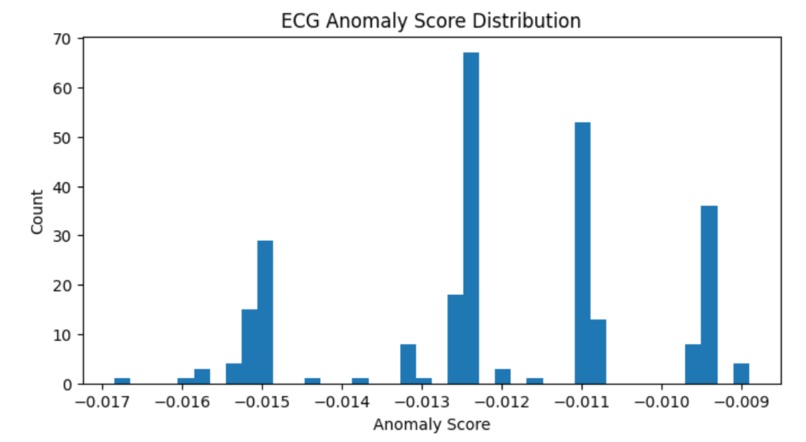
ECG Anomaly Score Distribution
-
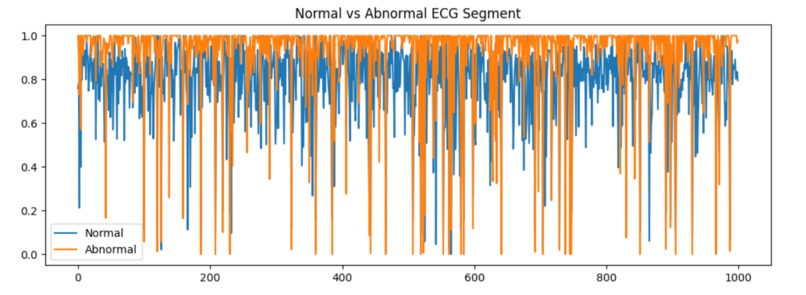
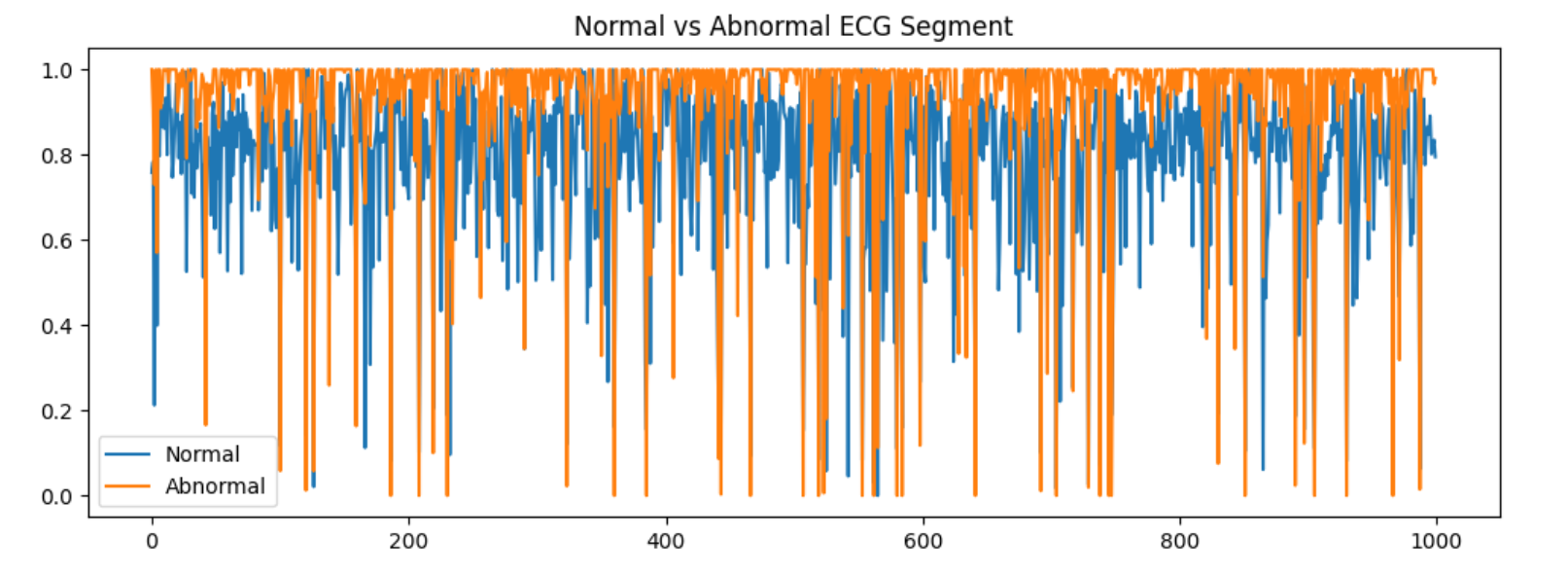
ECG Time-Series Visualization
-
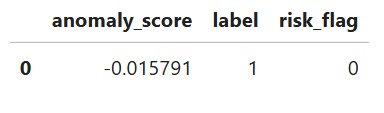
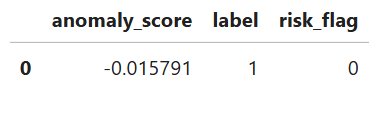
Feature-Based Risk Scoring Output
🫀 PulseGuard AI — ECG Anomaly Detection for Early Cardiac Risk 💡 Inspiration
Cardiovascular diseases often progress silently, with early warning signs hidden in subtle ECG variations that are difficult to detect through manual inspection. In real-world clinical settings, abnormal ECG samples are rare, making traditional supervised learning approaches impractical. This inspired us to explore unsupervised anomaly detection as a way to identify early cardiac risk signals without relying on large labeled datasets.
✅ What it does
PulseGuard AI analyzes ECG time-series data to detect anomalous heart rhythm patterns. Instead of attempting medical diagnosis, it learns what normal ECG signals look like and assigns risk scores to incoming ECG segments, flagging statistically abnormal patterns as potential early warnings for cardiac issues.
🛠️ How we built it
We processed ECG time-series data and extracted meaningful statistical and rhythm-based features from each signal segment. Due to extreme class imbalance, we used an unsupervised Isolation Forest model trained only on normal ECG patterns. The model outputs anomaly scores, which are converted into risk flags using percentile-based thresholds to simulate a real-world clinical alerting system.
⚠️ Challenges we ran into
Severe data imbalance, with very few abnormal ECG samples
Ensuring feature consistency between training and evaluation stages
Avoiding misleading metrics like accuracy in a healthcare context
Framing results responsibly as risk indicators, not diagnoses
These challenges required careful model design and evaluation choices.
🏆 Accomplishments that we're proud of
Successfully built a working ECG anomaly detection pipeline
Handled real-world healthcare constraints like data scarcity
Designed a clinically realistic risk-scoring approach
Produced interpretable visualizations of ECG anomaly distributions
📚 What we learned
Why unsupervised learning is powerful for medical data with limited labels
The importance of feature engineering over raw signal modeling
How to evaluate models beyond accuracy using ranking and thresholds
Best practices for responsible AI in healthcare applications
🚀 What's next for PulseGuard AI
Expanding the dataset with more abnormal ECG samples
Adding advanced time-domain and frequency-domain ECG features
Integrating real-time ECG monitoring and alert dashboards
Collaborating with clinicians for validation and feedback

Log in or sign up for Devpost to join the conversation.