-
-
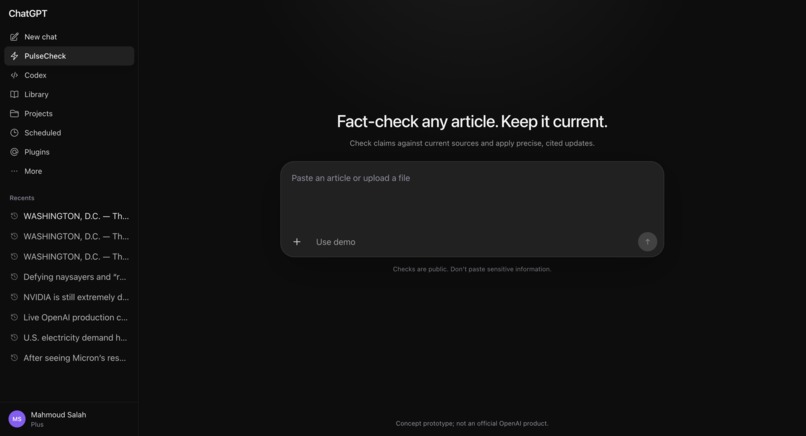
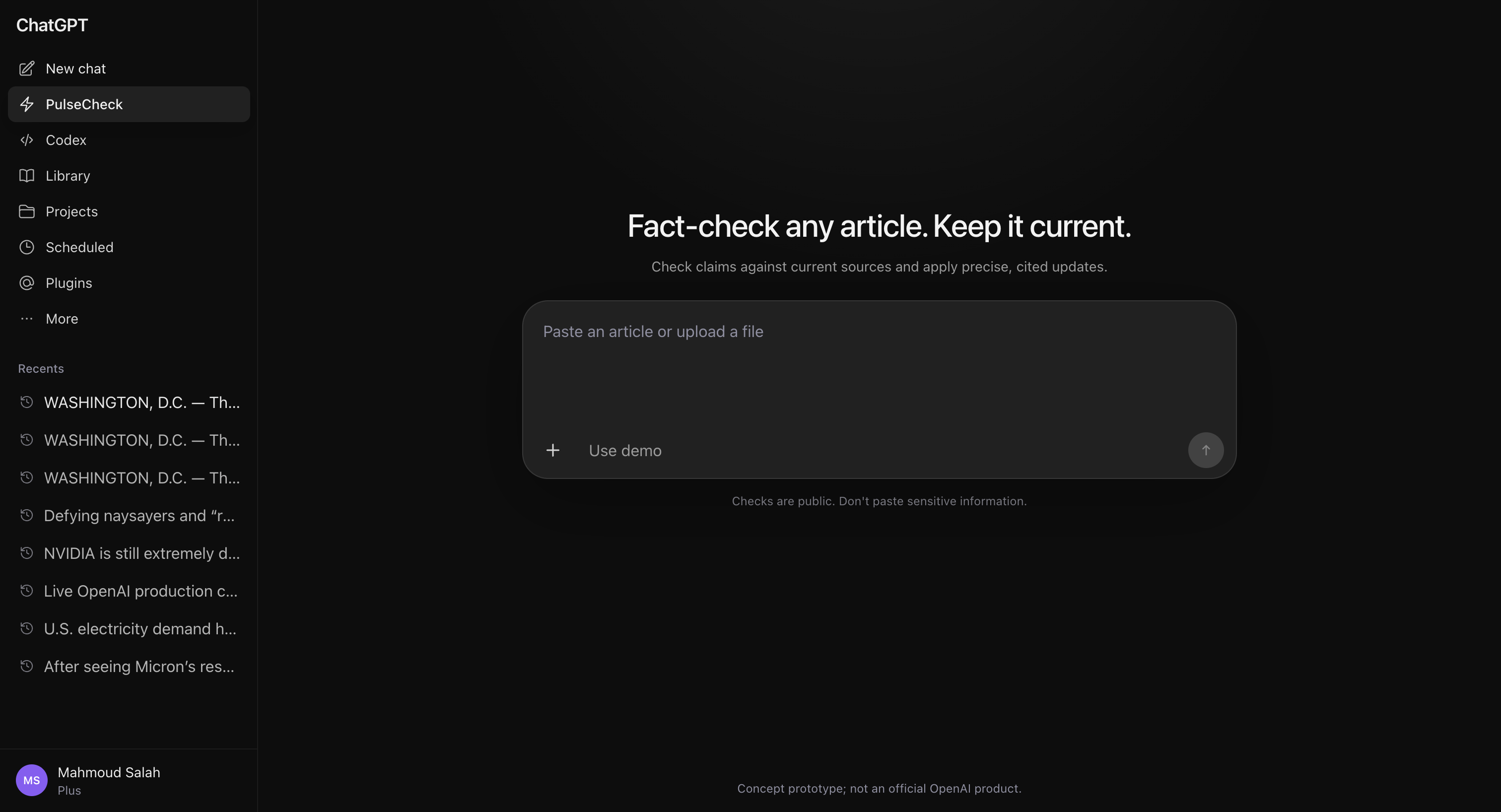
first page - paste an article - how we imagined this would look like as an OpenAI feature
-
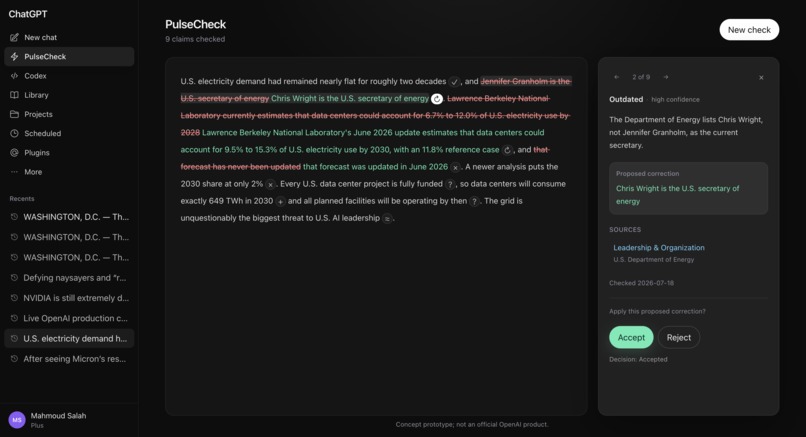
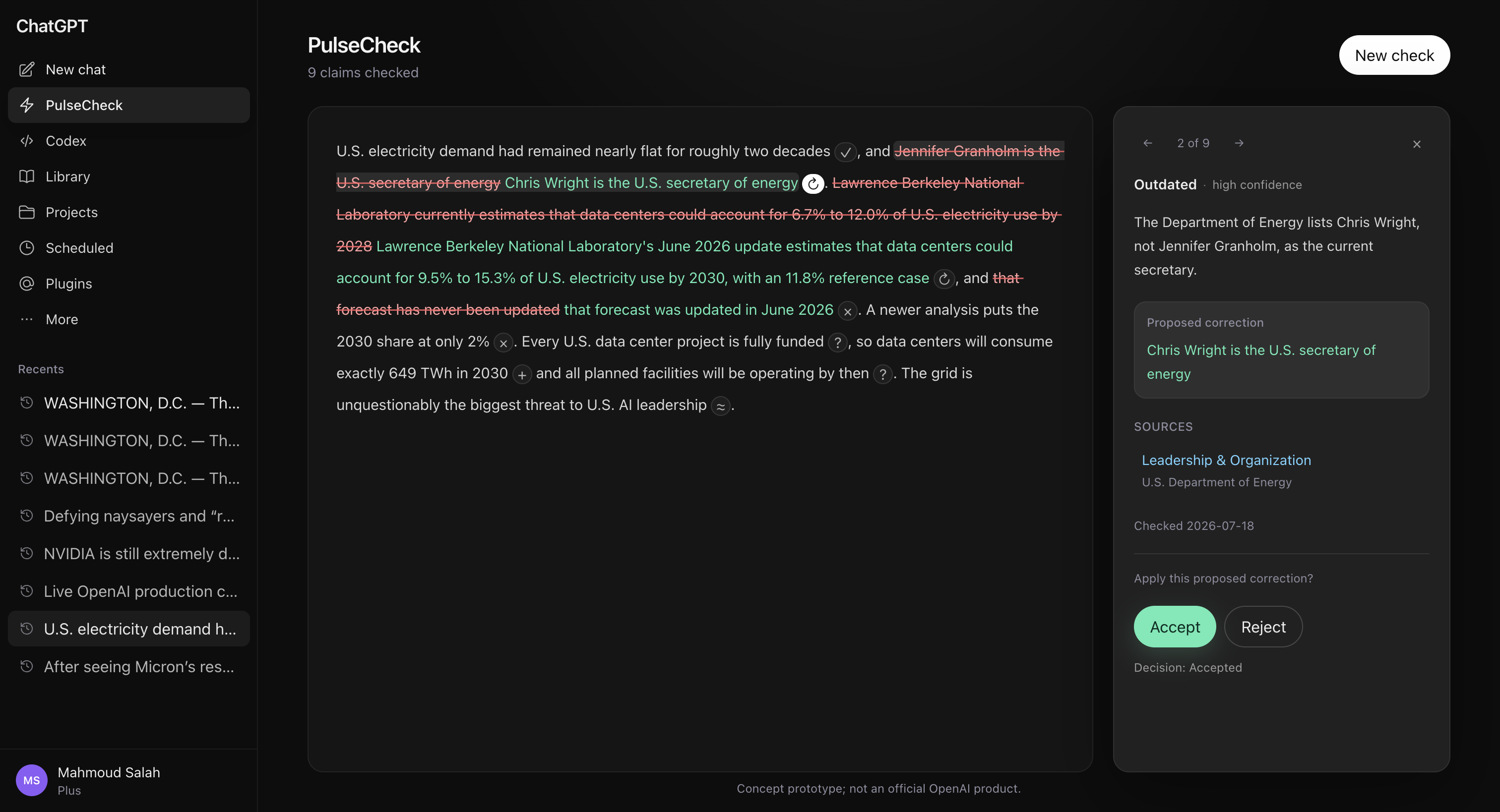
second page - fact checked / updated article
Inspiration
I can’t be the only person tired of opening X, Reddit, or an article and wondering: is any of this actually true? You check one sentence. Then another. Then another. Now do that for the whole article. You can already paste an article into an LLM and ask, “Is this accurate?” But then it gives you another article to read. Now you have the original, the AI response, five sources, and somehow even more tabs than when you started. We built PulseCheck because we wanted the research inside the article itself: show me exactly what is wrong, what changed, and what I can fix without losing the original context.
What it does
PulseCheck is Grammarly for factual accuracy. Paste in an article and it checks claims against current sources, then marks findings directly beside the relevant text. You can inspect the evidence and accept or reject small, source-backed corrections in place. No separate AI rewrite. You keep reading the same article just with the questionable parts surfaced.
How we built it
We started 3 days before the deadline, I had an idea/problem me and my teammate had, asked Codex to come up with a PRD, we're both software engineers so we had some back and forth with it to consolidate requirements, choose a tech stack, and divide tasks between us. We then got into building! We used GPT-5.6 with web search to research claims and return structured findings, then built the review experience with Next.js, TypeScript, Supabase, and PostgreSQL.
Challenges we ran into
The hard part was getting a non-deterministic AI system to produce results we could actually trust in the UI. We kept testing the same articles, reviewing bad outputs, tightening the prompts and validation, and adding guardrails so unsupported or ambiguous edits get dropped instead of confidently shown to the user. We also built most of this in just a few days, so coordinating fast-moving AI-assisted development without letting the codebase drift was a challenge of its own.
Accomplishments that we're proud of
We are proud that we went from an idea to a deployed product people can actually use in a few days. We also built it together with a real engineering workflow: pull requests, CI, tests, validation, and a live deployment not just a demo that barely works on localhost.
What we learned
Vibe coding is incredibly powerful, but you still need guardrails. It is very easy to let AI keep generating code until the product “looks done.” We learned that reviewing the code, keeping tests green, using pull requests, and staying deliberate about architecture matters even more when AI lets you move this fast.
What's next for PulseCheck
The bigger idea is to make factual maintenance continuous. I read a lot about stocks, energy, and technology, and the internet is increasingly full of mass-generated content from people and accounts I do not know or trust. We want PulseCheck to eventually work across URLs, documents, and team workflows and alert you when something you published no longer holds up.
Built With
- api
- codex
- css
- gpt-5.6
- next.js
- openai
- postgresql
- react
- responses
- search
- supabase
- tailwind
- typescript
- vercel
- vitest
- web
- zod

Log in or sign up for Devpost to join the conversation.